Lifted's 2020 Seed deck is a masterclass in narrative-driven fundraising for the healthcare sector. By leading with the personal motivations of the founders—Rachael (ex-McKinsey) and Sam—the deck establishes immediate credibility and empathy. It identifies a highly fragmented market with 10,000 agencies and no single player holding more than 2% market share. While the deck heavily redacts specific financial figures, the visual growth trajectory and the milestone of over 6,000 care hours delivered provide a sense of momentum. The presentation focuses on professionalizing the 'devalued workforc…
Key takeaways
- The founders use personal family stories on Slide 2 to establish a 'founder-market fit' rooted in lived experience.
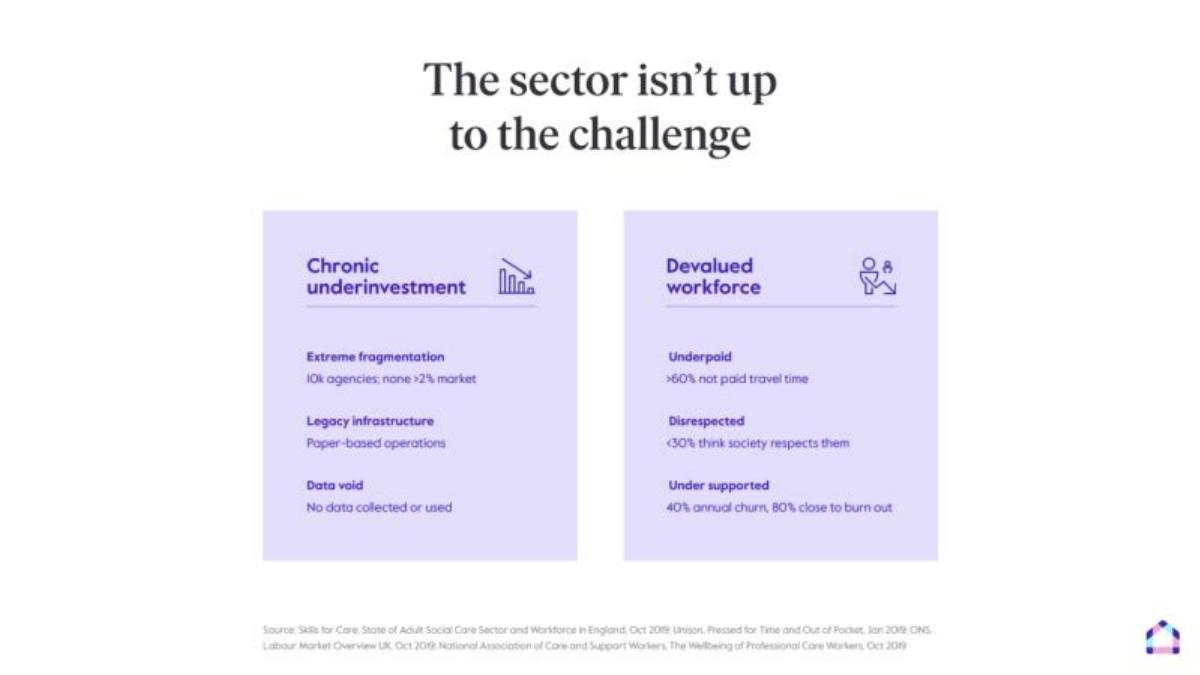
- Market fragmentation is highlighted as a key opportunity, noting that none of the 10,000 existing agencies hold more than 2% of the market (Slide 3).
- The deck identifies a 'data void' in current home care, positioning Lifted's structured data collection as a competitive moat (Slide 3).
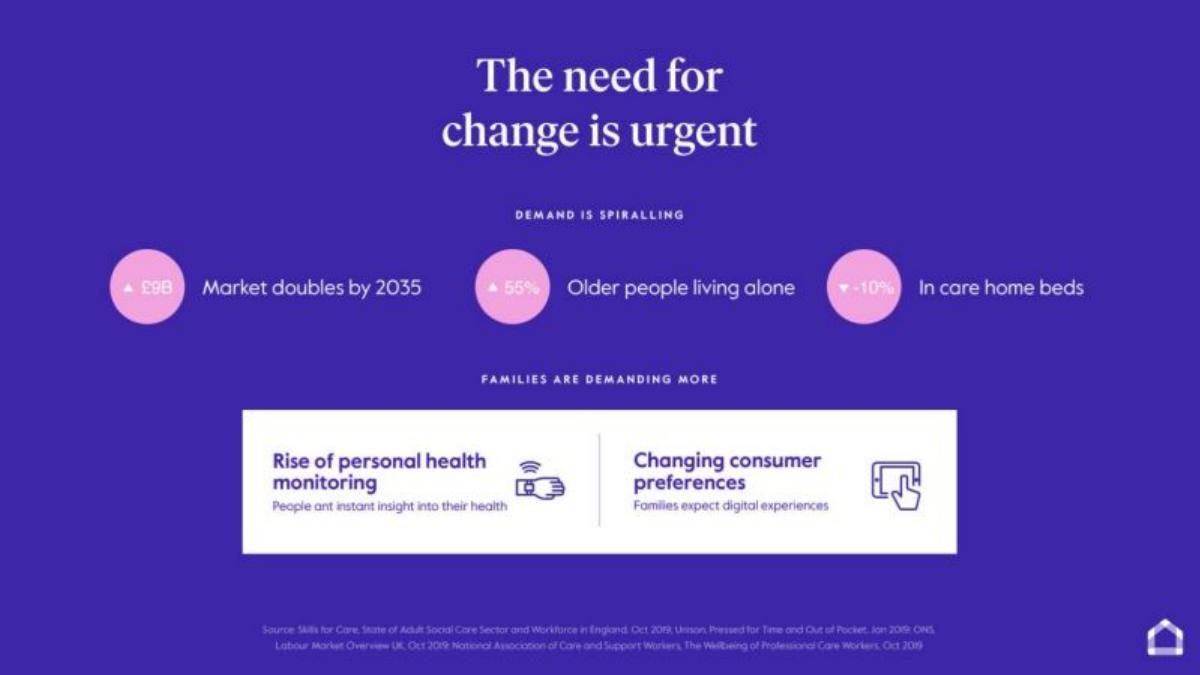
- Macro trends such as a 55% increase in older people living alone and a 10% decrease in care home beds create a sense of urgency (Slide 4).
- The business model is transparently displayed with three pricing tiers: Hourly care from £19, Overnight from £100, and Live-in from £950 (Slide 10).
- Lifted emphasizes workforce retention by paying the London Living Wage, addressing the industry's 40% annual churn rate (Slide 3, Slide 9).
- The product slide showcases a three-sided ecosystem: a Client App, a Carer App, and an Admin Console (Slide 12).
- The deck omits a traditional 'Team' slide featuring the broader staff or advisors, focusing solely on the two co-founders on Slide 2.
The Narrative Arc: From Personal Pain to Market Solution
Lifted’s pitch deck is a textbook example of how to build a narrative around a 'broken' industry. In the healthcare and eldercare space, investors are often wary of the high operational overhead and regulatory hurdles. Lifted counters this by focusing on the human element first, then layering on the technological efficiency. The deck is visually clean, using a palette of deep purples and soft pinks that feel both professional and compassionate.
Slides 1-2: The Hook and the Founders
Slide 1 is a simple title slide featuring the tagline 'The future of care at home.' It uses high-quality photography of an elderly woman, setting an aspirational tone rather than a clinical one. This is a subtle but important branding choice; it focuses on the outcome (joy and health) rather than the process (medical assistance).
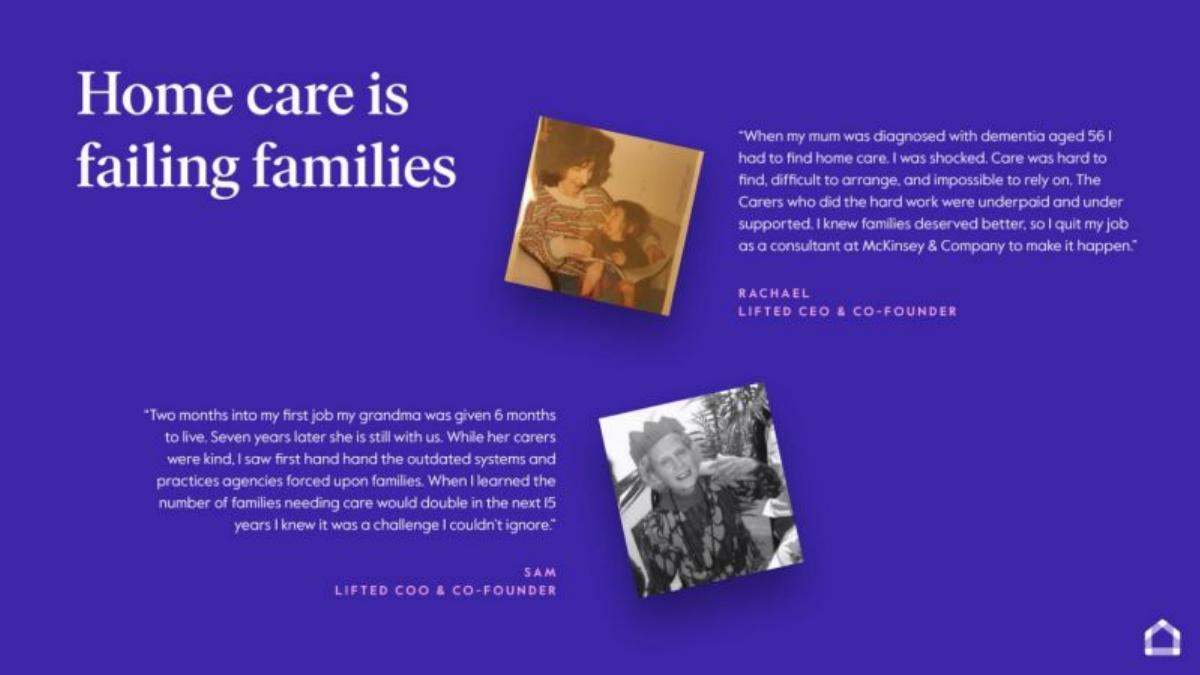
Slide 2 introduces the co-founders, Rachael and Sam, through the lens of their personal experiences. Rachael, a former McKinsey consultant, shares the story of her mother’s dementia diagnosis at age 56. Sam discusses his grandmother’s terminal diagnosis. By leading with these stories, the founders establish 'Founder-Market Fit.' They aren't just looking for a profitable niche; they are solving a problem they have lived. This slide also establishes their professional pedigree (McKinsey) without needing a separate, more corporate-feeling team slide later on.
Slides 3-4: Defining the Sector's Failure
Slide 3 , titled 'The sector isn’t up to the challenge,' breaks the problem into two categories: Chronic Underinvestment and a Devalued Workforce. The statistics here are damning: 10,000 agencies with none holding more than 2% of the market, and a reliance on 'paper-based operations.' On the workforce side, they note that 40% of carers churn annually and 80% are close to burnout. This slide identifies the 'Data Void'—the fact that no data is currently being collected or used in home care.
Slide 4 creates urgency. It cites a market that will double by 2035, a 55% increase in older people living alone, and a 10% decrease in care home beds. This 'Demand is Spiralling' section tells investors that the problem is getting worse, and the current infrastructure cannot handle the load. It also notes changing consumer preferences, stating that families now 'expect digital experiences.'
Slides 5-7: The Vision and Strategy
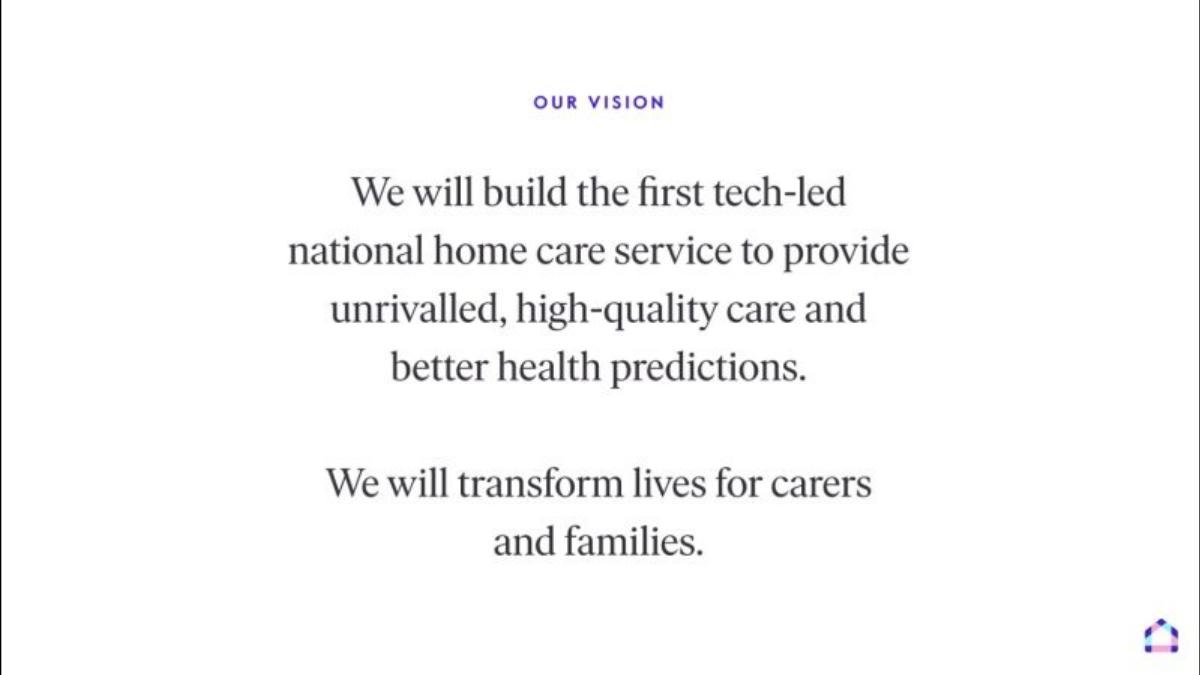
Slide 5 is a 'Vision' slide that asks the audience to 'Imagine a world where...' This is a classic rhetorical device to pivot from the bleak reality of the previous slides to the solution. Slide 6 formalizes this vision: 'We will build the first tech-led national home care service to provide unrivalled, high-quality care and better health predictions.'
Slide 7 introduces a health-over-time graph. It shows three stages of care: Prolonged Independence, Everyday Assistance (noted as 'Our focus today'), and Constant Care. This slide is important for showing the 'Land and Expand' strategy. By starting with everyday assistance, they can eventually move upstream into preventative care (prolonging independence) and downstream into more intensive medical care.
Slides 8-10: The Product and Business Model
Slide 8 explains 'How we’re transforming care today' through three pillars: a Revolutionary Platform, a Skilled Workforce, and Structured Data. This is where the 'tech' in 'tech-led' is defined. They mention 'geo-location check-ins' for carers and 'real-time events' for families. Slide 9 goes deeper into the workforce, explicitly stating they pay the 'London Living Wage.' This is a strategic business choice to solve the churn problem mentioned on Slide 3.
Slide 10 is the 'Value Proposition' slide, which doubles as a pricing sheet. It lists three clear tiers: Hourly care (£19/hr), Overnight care (£100/night), and Live-in care (£950/week). Providing these numbers is a bold move in a pitch deck, as it allows investors to immediately calculate potential margins and Average Contract Value (ACV).
Slides 11-13: Traction and Product UI
Slide 11 shows a bar chart of Monthly Recurring Revenue (MRR) from April to October. While the actual currency figures are redacted ('£x'), the growth trend is clearly upward and accelerating. They also claim over 6,000 'Care hours delivered.' Slide 12 provides a look at the actual software: the Client App, the Carer App, and the Admin Console. The UI looks modern and intuitive, reinforcing the 'digital experience' promise made on Slide 4.
Slide 13 concludes with social proof. It features a testimonial from a customer named Sylvia and mentions a 5-star Trustpilot rating with 10 reviews. While 10 reviews is a small sample size, the 'Excellent' rating serves as an early validation of their service-quality claims.
What Lifted Does Well
Lifted excels at problem-solution alignment . Every pain point mentioned in the first half of the deck (fragmentation, paper-based systems, devalued workforce, data void) is directly addressed in the second half (national service, digital platform, London Living Wage, structured data). This creates a very cohesive and logical argument for why the company needs to exist.
The transparency regarding pricing is also a strength. Many startups hide their pricing in early decks, but by putting it front and center, Lifted shows they have a firm grasp on their unit economics and the competitive landscape of the London care market.
What is Missing from the Lifted Deck
The most notable omission is a comprehensive Team slide . While the founders are introduced on Slide 2, there is no mention of the engineering team, clinical advisors, or any existing board members. For a 'tech-led' company, investors usually want to see who is actually building the 'Revolutionary Platform.'
There is also a lack of competitive analysis . While they mention the market is fragmented, they don't name specific competitors or explain why a legacy agency couldn't simply adopt similar software. A 'Magic Quadrant' or a feature-comparison table would have helped solidify their competitive moat.
Finally, the 'Ask' is missing . There is no slide indicating how much they are raising, what the milestones for the next 18 months are, or how the $2M (which we know they raised from catalogue facts) would be allocated between hiring, marketing, and R&D.
Founder's Playbook: What to Copy
The Personal 'Why': Use Slide 2 as a template for establishing founder-market fit. Don't just list your resume; explain the emotional catalyst for the business. · Macro-Micro Problem Mapping: Follow the structure of Slides 3 and 4. Start with the industry's systemic failures (Macro), then move to how those failures affect the end-user (Micro). · The Three-Sided Product View: If your business involves a service provider, a customer, and an administrator, use the layout of Slide 12. It clearly shows how the technology serves all stakeholders in the ecosystem. · Pricing as Strategy: If your pricing is a competitive advantage (e.g., you are more expensive because you pay workers better), put it in the deck. It filters for investors who understand and value your business model.
Frequently asked questions
- What is Lifted's core value proposition?
- Lifted positions itself as a 'tech-led national home care service.' Its value proposition rests on three pillars: a digital platform for real-time management, a skilled and fairly compensated workforce (paying the London Living Wage), and the use of structured data to provide predictive health insights. Unlike traditional agencies, Lifted uses technology to keep families informed while improving the working conditions for carers.
- How does Lifted address the labor shortage in home care?
- The deck identifies that 80% of the current workforce is close to burnout and 40% churn annually. Lifted addresses this by 'professionalizing' the role. According to Slide 9, they handpick and train their carers, provide them with digital tools to maximize care time, and pay the London Living Wage. This strategy is designed to attract and retain higher-quality talent than fragmented, legacy competitors.
- What market gap is this startup filling?
- The deck points to an 'extreme fragmentation' in the UK market, where 10,000 agencies exist but none have more than a 2% share. Furthermore, these agencies rely on 'paper-based operations' and a 'data void.' Lifted fills this gap by introducing a scalable, tech-enabled model that can provide consistent quality across a national footprint while collecting data that legacy providers ignore.
- Is there a clear exit strategy or 'Ask' in the deck?
- No. The 13-slide deck provided does not include a specific 'Ask' slide detailing the amount of capital being raised, the valuation, or the intended use of funds. It also lacks an exit slide or long-term financial projections. This suggests the deck was likely used as a teaser or part of a larger presentation where the 'Ask' was handled in person or in a separate document.
- What is the significance of the 'Structured Data' mentioned on Slide 9?
- Lifted views data as the 'backbone for predictive analytics.' By collecting observational data daily (such as mood, sleep, pain, and appetite, as seen on Slide 12), they aim to move from reactive care to proactive health predictions. This transforms the business from a simple service provider into a health-tech company with potentially higher margins and stickier customer relationships.