Limis is an early-stage software startup aiming to solve the massive financial burden of unplanned manufacturing shutdowns, which cost US manufacturers an estimated $50 billion annually. The company's core value proposition is the replacement of archaic paper logsheets with a digital platform that provides real-time feedback to plant operators and decision-makers. Priced at $40 per person per month, the solution seeks to reduce downtime by at least 10%. While the deck demonstrates strong initial traction through pilot agreements with companies like K2 Pure Solutions and recognition in startup…
Key takeaways
- Unplanned manufacturing shutdowns cost US companies $50 billion per year and reduce profits by 11% (Slide 2).
- The software is priced at $40 per person per month, which the company claims is 1% of a typical firm's annual downtime costs (Slide 3).
- The product workflow involves scanning QR codes at data sources to enter information into a digital dashboard (Slide 4).
- The Total Addressable Market (TAM) is cited as $54 billion, representing 6% of global lost production value (Slide 5).
- Go-to-market strategy relies on the founder's previous professional connections at K2 Pure Solutions, Dow, and Ecolab (Slide 6).
- Traction includes an agreement to test the product with K2 and semi-finalist status in the Dempsey Startup Competition (Slide 7).
- The company assumes the initial product can reduce unplanned downtime by up to 20% (Slide 8).
- The funding ask is $300,000 to expand sales capability and assistance in finding a developer (Slide 9).
Executive Summary
Limis is a specialized software solution designed for the industrial manufacturing sector. The deck, dated July 7th, 2022, and presented by Evan Wasik, outlines a transition from manual, paper-based data logging to a digital-first approach. By providing real-time visibility into plant operations, Limis aims to mitigate the high costs associated with unplanned downtime. The deck is structured as a standard 10-slide pitch, focusing heavily on the problem-solution fit and early validation through the founder's professional network.
Slide 1: Title Slide
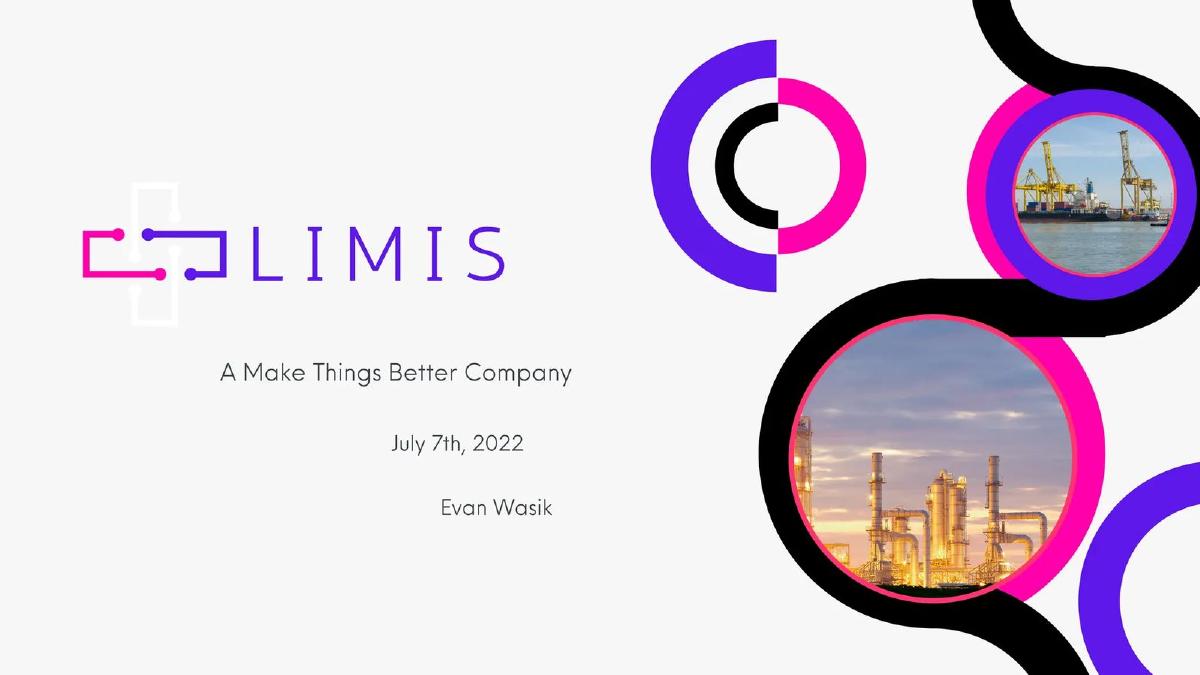
The title slide introduces the company name, Limis, and the tagline 'A Make Things Better Company.' It features industrial imagery—a shipping port and a chemical plant—establishing the sector focus immediately. The presenter is identified as Evan Wasik, and the date is July 7th, 2022. The branding uses a purple and pink color palette with geometric circular motifs.
Slide 2: The Problem
This slide defines the pain point: 'Unplanned Manufacturing Shutdowns.' It provides four key data points to establish urgency:
Cost to US Manufacturers: $50 Billion per year. · Profit Impact: Reduces profits by 11%. · Safety: Often accompanied by threats to life and health for employees and communities. · Avoidability: Stated as 'Frequently avoidable.'
The use of a high-contrast image of firefighters adds a sense of crisis to the industrial problem.
Slide 3: Value Proposition
Limis positions its software as the 'last line of defense' against downtime. The core function is replacing 'archaic paper logsheets' to increase visibility for operators and decision-makers. Crucially, this slide introduces the pricing: $40 per person per month. It frames this cost as a high-ROI investment, claiming it represents only 1% of downtime costs while aiming to reduce that downtime by 10% or more.
Slide 4: Product Workflow
This slide uses a flow diagram to explain the user experience. It starts with a 'Data Source' (a physical gauge), moves to 'Data Entry' via a QR code scan on a tablet, and results in two outputs: a 'Custom Dashboard' for real-time visualization and an 'Export to CSV' option for data portability. This visualizes the transition from physical reality to digital data.
Slide 5: Market Size
The market slide uses the standard TAM/SAM/SOM framework, though the definitions are tied to 'lost production value' rather than direct software spend:
TAM: $54B (6% of global lost production value). · SAM: $3B (6% of US lost production value). · SOM: $500M (25% of first 5 customers' lost production value).
The use of a flame icon is consistent with the 'firefighting' theme established earlier.
Slide 6: Go To Market
The strategy is straightforward: 'Start with companies you've worked for.' It displays logos for K2 Pure Solutions, Dow, and Ecolab. This suggests a founder-led sales approach leveraging existing industry relationships and credibility to bypass the long sales cycles typical of industrial enterprise software.
Slide 7: Traction
Limis demonstrates early momentum through four bullet points:
Independent meetings at Ecolab regarding the specific problem. · Agreement to test the product with K2 in the 'coming months.' · Semi-finalist status in the Northwest Entrepreneurship and Dempsey Startup Competitions. · A developing partnership with SWYFT ERP.
The slide includes a photo of a tire track in snow, a literal interpretation of 'traction.'
Slide 8: Assumptions
In a rare move for a pitch deck, Limis includes an 'Assumptions' slide. It lists what must be true for the business to succeed: the product must reduce downtime by 20% (expanding to 50% later), custom integrations must be scalable, tailored solutions must create switching costs, and the company must find the right talent. This slide functions as a transparent risk assessment.
Slide 9: The Ask(s)
The company is seeking two things: help finding a developer and $300,000 to 'add to our sales capability.' The monetary ask is relatively low for the industrial space, suggesting a seed or pre-seed stage aimed at proving the pilot programs mentioned in the traction slide.
Slide 10: Contact Information
The final slide provides a physical address in Kirkland, WA, a telephone number, and an email address (ewasik@limislog.com). It maintains the visual theme of the deck with a clipboard graphic.
What Limis Does Well
The deck is exceptionally clear about the financial impact of the problem. By citing the $50 billion cost to manufacturers and the 11% profit reduction on slide 2, the founders establish a 'must-have' rather than a 'nice-to-have' product. The pricing slide (Slide 3) is also a highlight; by anchoring the $40/month cost against the massive cost of downtime, they make the software appear inexpensive and the decision to purchase seem like a mathematical certainty.
Furthermore, the 'Assumptions' slide (Slide 8) demonstrates a level of founder maturity. Instead of hiding the risks of scalability and integration, they acknowledge them upfront. This builds trust with sophisticated investors who know that industrial software often struggles with 'pilot purgatory' and difficult on-site integrations.
What is Missing from the Deck
The most glaring omission is a dedicated Team Slide. While Evan Wasik is named on the title slide, there is no information regarding his background, technical expertise, or the rest of the founding team. In early-stage investing, the 'who' is often as important as the 'what.' The ask for help finding a developer on slide 9 suggests a lack of technical co-founder, which is a significant red flag for a software startup.
Additionally, there is no Competitor Slide. The industrial IoT and 'connected worker' space is crowded with players like Parsable, Dozuki, and Tulip. Failing to acknowledge the competitive landscape makes the founders look under-researched. Finally, the deck lacks a roadmap or financial projections beyond the initial $300,000 ask. Investors need to see how this small initial investment leads to the $500M SOM mentioned on slide 5.
Founder Takeaways
Leverage your network: The most compelling part of this deck is slide 6. If you have worked at major industry players like Dow or Ecolab, highlight that. It proves you understand the 'insider' problems and have the Rolodex to get the first meetings. For many B2B startups, the founder's network is the only viable initial go-to-market strategy.
Anchor your price: Don't just state your price; explain why it's a bargain. Limis does this perfectly by showing that their fee is a tiny fraction (1%) of the problem's cost. This framing shifts the conversation from 'how much does this cost?' to 'how much money are we losing by not having this?'
Be transparent about risks: Including an 'Assumptions' slide is a bold move that can pay off. It shows you are thinking like an operator, not just a promoter. It allows you to control the narrative around your weaknesses rather than letting an investor discover them during due diligence.
Frequently asked questions
- What specific problem is Limis trying to solve?
- Limis targets unplanned manufacturing shutdowns. According to slide 2, these events cost US manufacturers $50 billion annually and slash profits by 11%. The deck argues that these shutdowns are frequently avoidable and often pose threats to the health and safety of employees and surrounding communities. The root cause identified is the reliance on 'archaic paper logsheets' which lack visibility.
- How does the Limis software actually work?
- Based on slide 4, the process begins at the physical 'Data Source' (like a pressure gauge), where an operator scans a QR code. This leads to 'Data Entry' on a tablet. The information is then processed into a 'Custom Dashboard' for real-time monitoring or can be 'Exported to CSV' for further analysis. This replaces manual paper recording with a digital audit trail.
- What is the business model and pricing strategy?
- Limis utilizes a per-user subscription model. Slide 3 states the cost is $40 per person per month. The founders justify this price point by comparing it to the cost of the problem, claiming the subscription represents only 1% of a company's annual downtime costs while promising to reduce that downtime by 10% or more.
- What kind of traction has the company achieved so far?
- Slide 7 lists several milestones: independent meetings at Ecolab, a signed agreement to test the product with K2 Pure Solutions, and a developing partnership with SWYFT ERP. Additionally, the project was a semi-finalist in the Northwest Entrepreneurship competition and the Dempsey Startup Competition, indicating some level of external validation.
- What are the primary risks identified in the deck?
- The deck explicitly lists its 'Assumptions' on slide 8, which serve as the primary risks. These include the ability to actually achieve a 20% reduction in downtime, the ability to streamline custom integrations for scalability, the hope that tailoring solutions will create high switching costs, and the critical need to 'find the right talent.'