The Limitless pitch deck is a masterclass in category creation, specifically defining 'GigCX' as the intersection of crowdsourced expertise and AI automation. By highlighting a founding team with over 70 years of collective experience in customer service, the deck establishes immediate credibility. The narrative focuses on the failure of traditional BPO models—citing 50%+ annual attrition and slow response times—and positions Limitless as the agile, cost-effective successor. With a proven revenue split shifting toward the US (from 47% in 2019 to 68% in 2020) and a clear two-step AI training l…
Key takeaways
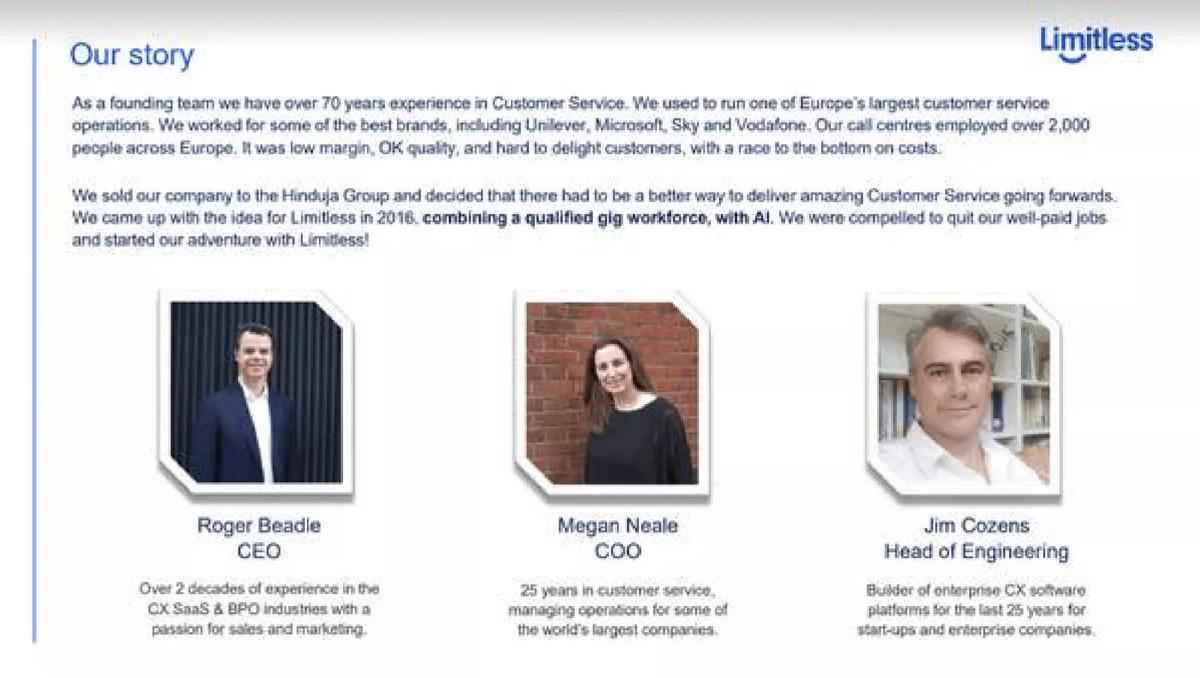
- The founding team leverages over 70 years of industry experience, having previously run one of Europe's largest customer service operations (Slide 2).
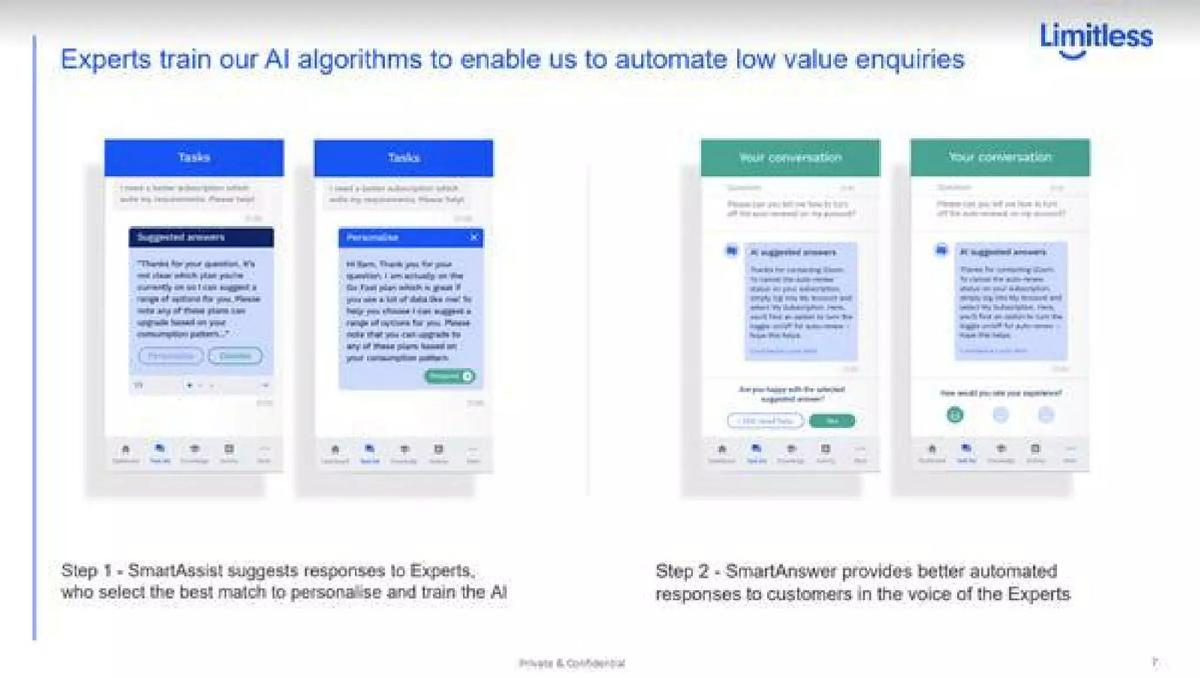
- The platform utilizes a two-step AI loop where experts personalize suggested answers to train the 'SmartAnswer' automation system (Slide 7).
- Limitless demonstrates significant geographic expansion, growing from 22 countries to 31 in early 2020 (Slide 8).
- Revenue concentration shifted heavily toward the US market, increasing from 47% in 2019 to 68% in 2020 (Slide 8).
- The deck identifies a massive $1 trillion total market for customer service calls, with $20 billion specifically addressable by gig workforces (Slide 11).
- A demographic shift is highlighted, predicting that Millennials and Gen Z will make up 75% of the workforce by 2025 (Slide 10).
- The business model combines a SaaS subscription fee with a 'per resolved ticket' pricing approach to align costs with client success (Slide 14).
- The deck lacks a specific financial 'Ask' slide or a detailed breakdown of how the Series B funds will be allocated (Omission).
The Limitless Series B Deck: A Category Creation Masterclass
Limitless entered the Series B stage with a clear mission: to redefine customer experience (CX) through a model they coined 'GigCX.' The deck, used to secure a $20.5 million round, focuses heavily on the transition from traditional, high-friction call centers to a fluid, AI-augmented gig workforce. By the time this deck was circulated in early 2021, the company had already proven its ability to scale globally and capture significant market share in the US. The following teardown examines the 13 slides that defined their pitch.
Introduction and Founder Pedigree
Slide 1: Title Slide The deck opens with a clean, minimalist design, introducing 'The GigCX platform.' It immediately establishes the value proposition: 'Expert powered automation.' The subtitle emphasizes that they work with the world's largest brands to deliver AI-powered, crowdsourced customer service. This sets a high-enterprise tone from the outset.
Slide 2: Our Story This is one of the strongest slides in the deck. The founders don't just list their names; they lead with '70 years experience in Customer Service.' They explicitly mention running one of Europe's largest customer service operations with over 2,000 employees before selling to the Hinduja Group. This 'insider' perspective gives them the authority to critique the industry. They describe the old model as 'low margin, OK quality, and hard to delight customers.' This creates a 'founder-market fit' narrative that is hard to ignore. The team includes Roger Beadle (CEO), Megan Neale (COO), and Jim Cozens (Head of Engineering).
The Problem: A Broken Industry
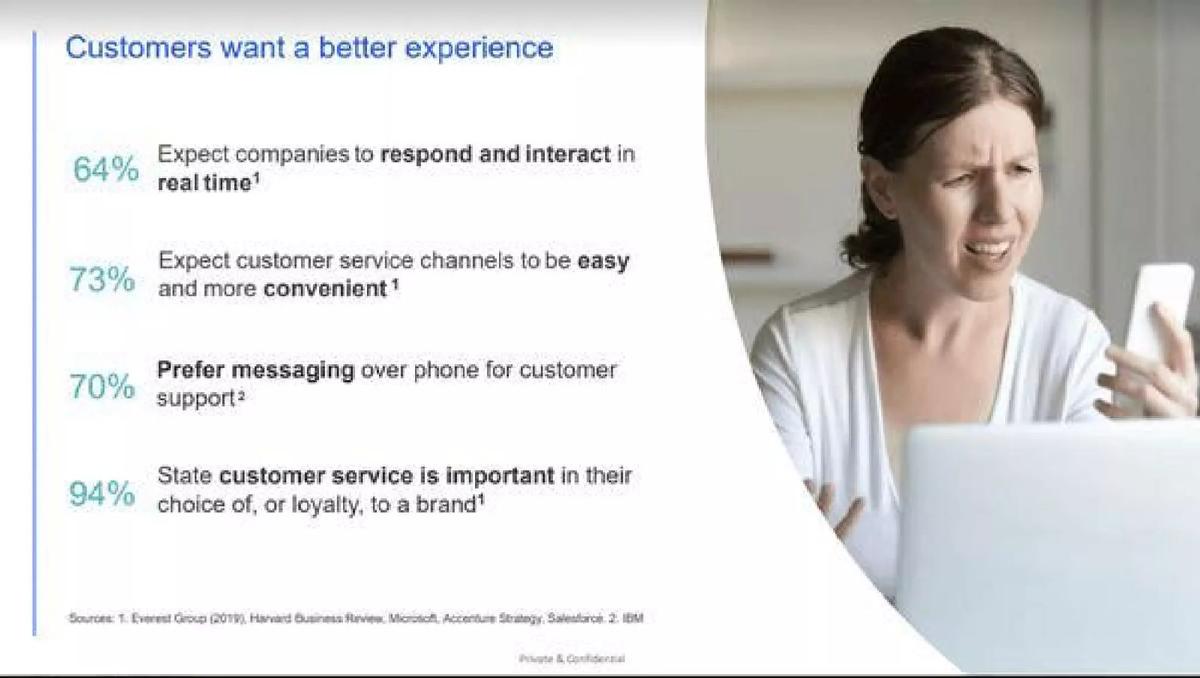
Slide 3: Customers want a better experience Limitless uses third-party data from Everest Group, IBM, and Harvard Business Review to validate the problem. Key stats include: 64% of customers expect real-time interaction, and 94% state customer service is vital to brand loyalty. The visual of a frustrated customer reinforces the emotional stakes of the problem.
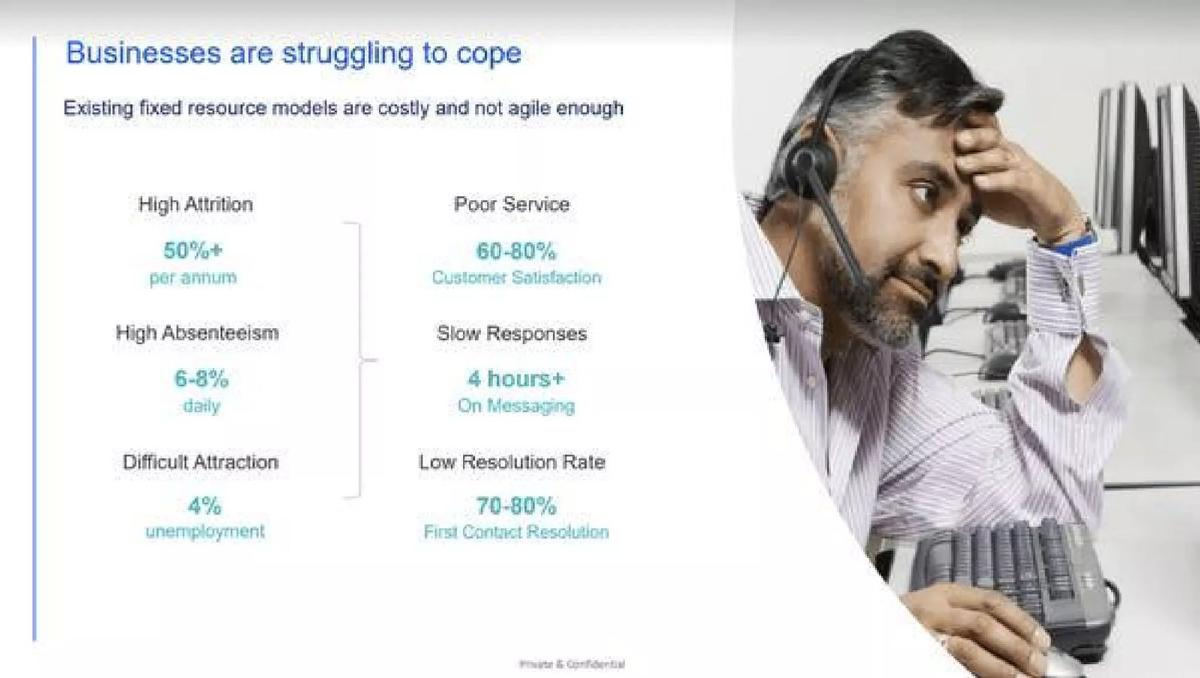
Slide 4: Businesses are struggling to cope While Slide 3 focuses on the consumer, Slide 4 focuses on the operational nightmare for businesses. It lists 'High Attrition' at 50%+ per annum and 'Slow Responses' of 4 hours+ on messaging. By quantifying the failure of 'fixed resource models,' Limitless positions itself as the only logical alternative for an agile enterprise.
The Solution: SmartCrowd and AI Loops
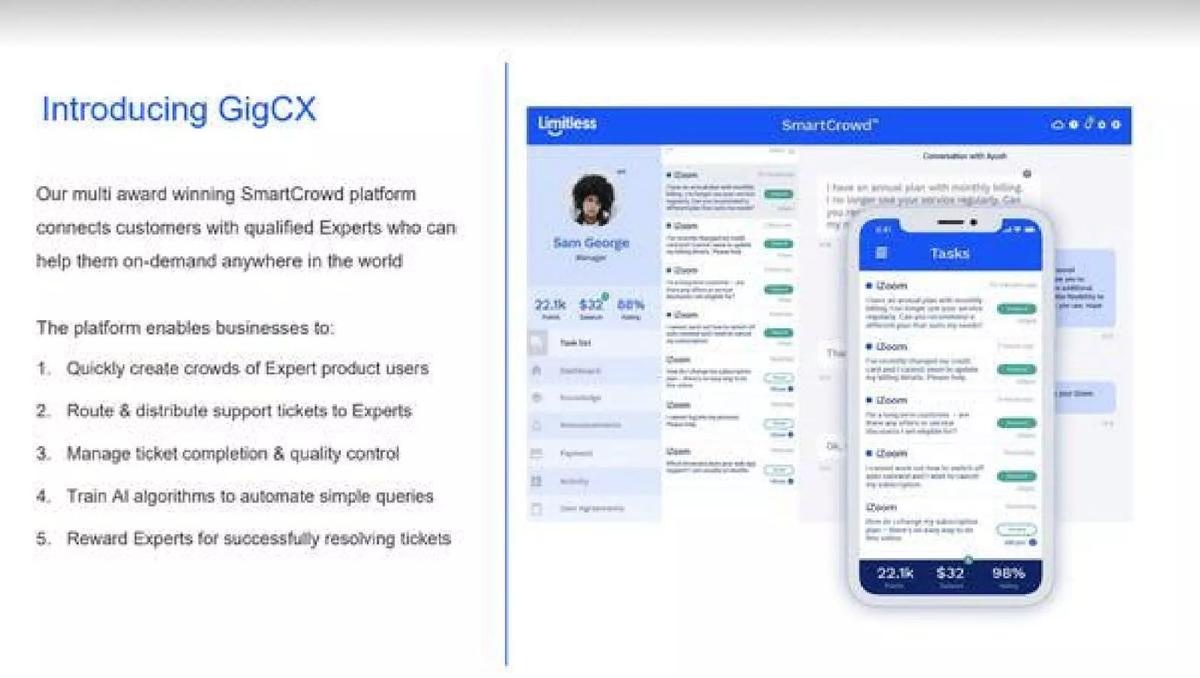
Slide 5: Introducing GigCX This slide introduces the 'SmartCrowd' platform. It lists five core capabilities, including routing support tickets to experts, managing quality control, and rewarding experts for resolutions. The inclusion of a mobile interface mockup suggests a user-friendly experience for the gig workers, which is critical for maintaining a high-quality crowd.
Slide 6: Experts train our AI algorithms This slide explains the 'flywheel' effect. It shows how expert responses are used to train AI to automate 'low value enquiries.' This is a crucial Series B point: the business isn't just a labor marketplace; it is a data-generation engine that becomes more profitable as the AI takes over more of the volume.
Slide 7: Product Workflow A visual breakdown of 'SmartAssist' (Step 1) and 'SmartAnswer' (Step 2). It shows the transition from a human selecting a suggested response to the AI providing a fully automated response in the 'voice of the experts.' This slide effectively demystifies their 'AI' claims by showing the actual human-in-the-loop process.
Traction and Market Dynamics
Slide 8: Global Coverage and Revenue Split Traction is shown through geographic reach. The platform was live in 22 countries with 9 more planned for H1-2020. The most compelling data point here is the 'Regional revenue split.' In 2019, the US accounted for 47% of revenue; by 2020, that figure jumped to 68%. For a UK-founded company, showing dominant US growth is a major signal for Series B investors.
Slide 9: Generational Shift Limitless argues that the 'why now' is driven by a shift in the labor pool. They cite that Millennials and Gen Z will make up 75% of the workforce by 2025. A second chart shows the US gig workforce projected to surpass the permanent workforce by 2027. This frames Limitless not just as a tool, but as an inevitability of the modern economy.
Slide 10: Addressable Market Size The deck uses a 'Total Market' of $1 trillion (265 billion calls). They narrow this down to a $105 billion outsourced market, and finally a $20 billion 'Addressable by Gig' market. By citing Everest Group's prediction that 20% of the market will be gig-serviced by 2021, they provide a credible path to a multi-billion dollar valuation.
Competition and Strategy
Slide 11: Enterprise Customer Support Market Today A standard 2x2 matrix places Limitless in the top-right quadrant (High Engagement Quality, Low Cost). They position themselves against 'In-house Call Centres' (High Cost) and 'Offshore Outsourced' (Low Quality). It is a classic positioning tactic that highlights their unique combination of GigCX and AI.
Slide 12: Sales and Product Strategy The roadmap is divided into four phases from 2019 to 2023. It moves from direct sales in target markets (US/Europe) to channel partners (BPOs) and finally to an 'Autonomous Product for Mass market.' This shows a clear evolution from a service-heavy start to a technology-heavy scale-up.
Slide 13: Business Model The final content slide explains the 'Recurring monthly revenues.' It is a two-pronged approach: a Subscription Model for platform access and a 'Per Resolved Ticket' model for volume. This aligns the company's incentives with the client's success—they only get paid more if they actually solve problems.
What Works in This Deck
The 'Insider' Narrative: The founders' deep background in the very industry they are disrupting is their greatest asset. By admitting the flaws of their previous 2,000-person call center operations, they build immediate trust with investors who know the BPO space is notoriously difficult to scale.
The US Growth Story: For a European startup, the 2019-2020 revenue shift toward the US (Slide 8) is the 'smoking gun' of product-market fit. It proves the model travels well and is capturing the most lucrative market in the world.
Clear AI Utility: Many decks use 'AI' as a buzzword. Limitless explicitly shows how the AI is trained (Slide 6 and 7). The 'Human-in-the-loop' explanation makes the technology feel real and defensible rather than magical.
What is Missing
The Ask: The deck ends abruptly with contact details. There is no slide stating how much they are raising (though we know from catalogue facts it was $20.5M) or how they intend to spend the capital. In a Series B deck, investors expect to see a 'Use of Funds' breakdown.
Unit Economics: While the pricing model is explained, the deck omits Gross Margins, Customer Acquisition Cost (CAC), and Lifetime Value (LTV). For a Series B, these metrics are usually mandatory to prove the business can scale profitably.
Case Studies: The listing mentions major clients like Microsoft, Unilever, and Sage, but the deck doesn't include a dedicated slide showing a specific success story or ROI metric for these brands. Actual 'before and after' data from a Tier-1 client would have strengthened the pitch.
What a Founder Should Copy
The 'Generational Shift' Slide: Slide 9 is an excellent example of how to use macro trends to create urgency. If you can show that the world is moving in your direction regardless of your company's existence, you make the investment feel like a bet on an inevitable future.
Quantified Problem Statements: Don't just say 'call centers are bad.' Say '50%+ attrition' and '4 hours+ response times.' Specificity on Slide 4 makes the problem feel urgent and solvable.
The Two-Pronged Revenue Model: Combining a SaaS subscription with a usage-based 'per resolution' fee is a great way to capture both stability and upside. Founders in the marketplace or automation space should look at Slide 13 as a blueprint for aligning with enterprise procurement needs.
Frequently asked questions
- What is GigCX and how does Limitless define it?
- GigCX, as defined on Slide 1 and 6, is an 'expert-powered automation' platform. It connects brands with a qualified gig workforce—often actual product users—to resolve customer service tickets on-demand. Unlike traditional call centers, it uses these human interactions to train AI algorithms, eventually automating low-value, repetitive queries while maintaining a high quality of service through human oversight.
- How does the AI training process work in this deck?
- Slide 7 details a two-step process. First, 'SmartAssist' suggests responses to human experts. The experts then select and personalize the best match, which trains the AI. Second, 'SmartAnswer' uses this training to provide fully automated responses to customers in the specific 'voice' of the experts, allowing the system to handle increasing volumes without increasing human headcount.
- What market trends are driving the adoption of Limitless?
- Slide 10 points to a 'generational shift' in the labor pool. It notes that the US contingent (gig) workforce is projected to overtake the permanent workforce by 2027. Additionally, Slide 3 highlights that 64% of customers expect real-time responses and 70% prefer messaging over phone calls, creating a need for the asynchronous, scalable model Limitless provides.
- What are the primary pain points of the traditional BPO model mentioned?
- Slide 4 identifies several critical failures in existing fixed-resource models: high attrition (50%+ per annum), high absenteeism (6-8% daily), and poor service levels (60-80% customer satisfaction). These inefficiencies lead to slow response times—often over 4 hours on messaging channels—which Limitless aims to solve through its on-demand crowd model.
- How does Limitless generate revenue?
- According to Slide 14, the company uses a hybrid revenue model. Clients pay an annual subscription fee to access the SmartCrowd platform. On top of that, they pay 'Per Resolved Ticket,' where clients either agree to a minimum monthly revenue commitment or purchase credits in advance. This ensures recurring revenue while scaling with the client's volume.