Flick’s 11-slide Seed deck is a masterclass in founder-market fit. Rather than leading with market size or revenue, the company leads with the pedigree of its founders: Ray Wang, a founding engineer on Instagram’s AI team, and Zoey Zhang, an award-winning filmmaker. The deck relies on visual evidence, showcasing films that have won over 20 festival awards and highlighting a public launch that occurred just one week prior to the presentation. By positioning themselves as the 'Figma + Cursor for AI Filmmaking,' Flick creates a clear mental model for investors. The absence of traditional slides—…
Key takeaways
- The deck leads with a high-authority hook on Slide 1, identifying the founder as the co-creator of Instagram Stories.
- Founder pedigree is the primary value driver, with Slide 2 detailing Ray Wang’s growth of Instagram Stories from 0 to 400M DAU.
- Product validation is established through external accolades, citing 20+ film festival awards on Slide 3.
- The company uses a clear 'X for Y' analogy on Slide 1 and Slide 11, comparing themselves to Figma and Cursor.
- Speed of execution is emphasized on Slide 10, noting the company was founded only three months prior to the deck.
- Social proof is used as a proxy for traction, with Slides 8 and 9 dedicated to user testimonials and user-generated content.
- The deck completely omits a formal 'Ask' slide, financial forecasts, and a competitive landscape analysis.
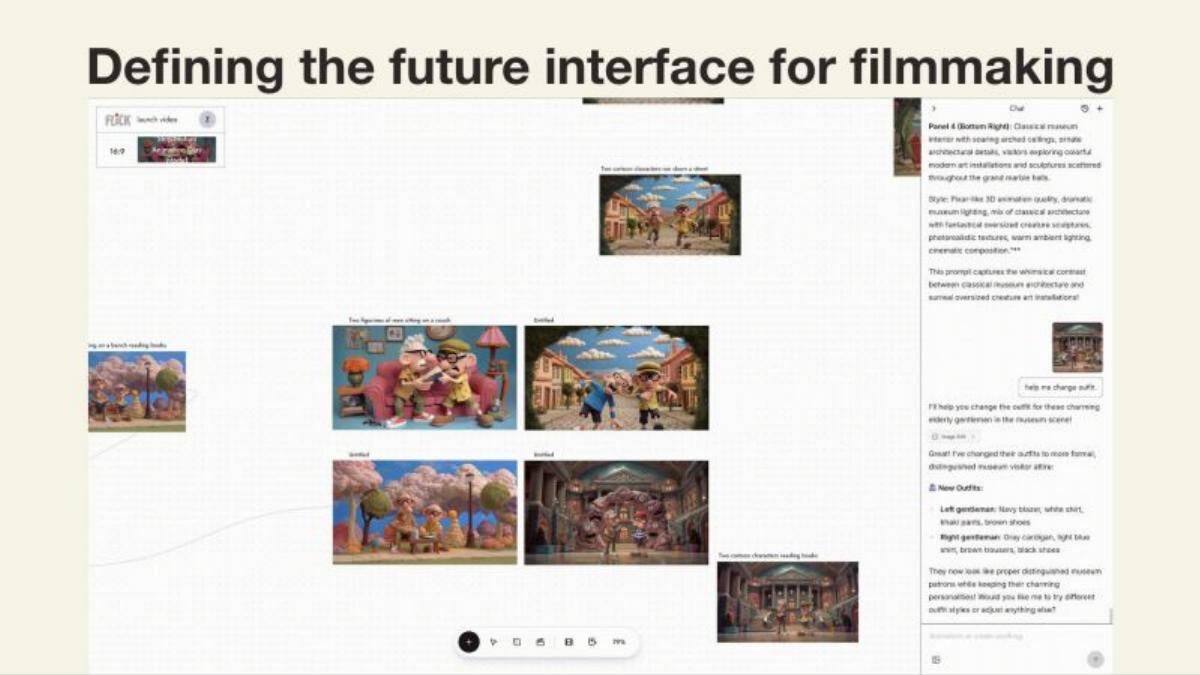
- The interface vision is presented as a 'canvas' style on Slide 5, moving away from traditional linear video editing.
The Power of Pedigree: A Review of the Flick Seed Deck
Flick’s 11-slide pitch deck is a concise, high-signal document that prioritizes founder credibility and product output over traditional business metrics. In the world of early-stage AI startups, where technical moats are often thin, Flick bets everything on the 'who' and the 'what.' The 'who' is a team with experience scaling products to hundreds of millions of users, and the 'what' is a tool that has already produced award-winning content. This teardown examines how Flick used this lean presentation to secure $6M from some of the most prestigious venture capital firms in the world.
Slides 1-3: The Authority Hook
Slide 1: Title Slide The deck opens with a bold claim: 'Figma + Cursor, for AI Filmmaking.' By referencing Figma (design) and Cursor (AI coding), Flick immediately establishes a mental model for investors. They aren't just building a video generator; they are building a professional-grade creative environment. The sub-headline, 'By the co-creator of IG Stories,' is a massive authority signal that likely secured the first meeting with every VC on their list.
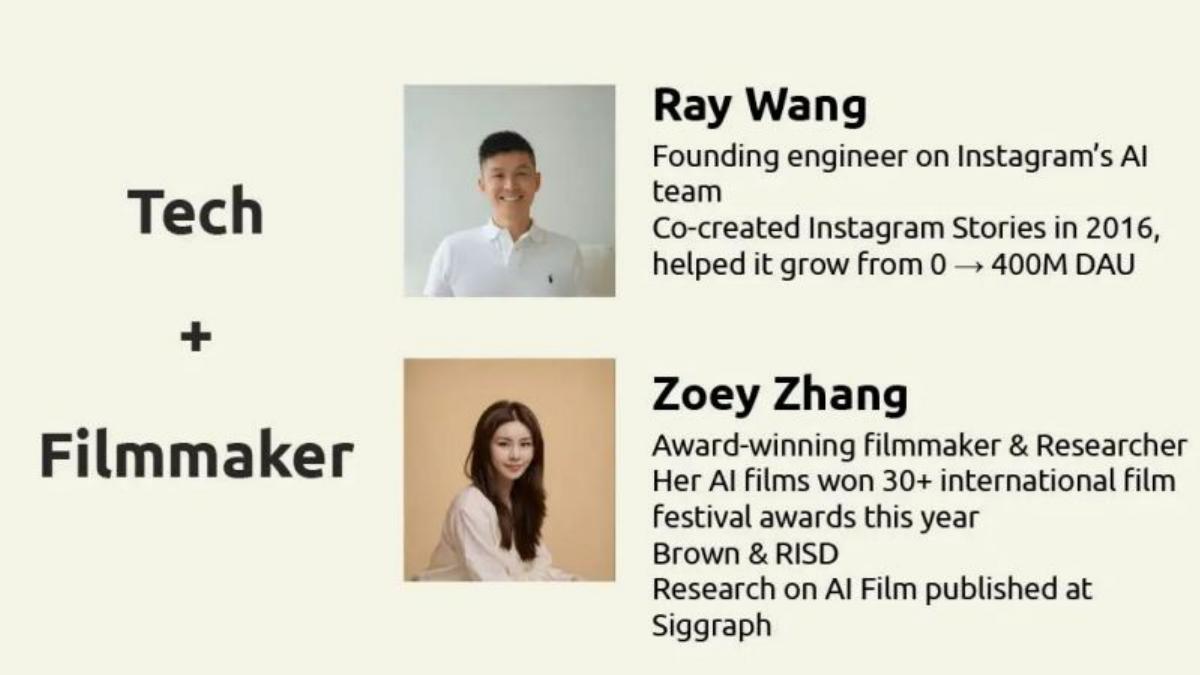
Slide 2: The Team The 'Tech + Filmmaker' slide is the heart of the deck. Ray Wang’s credentials—Founding engineer on Instagram’s AI team and co-creator of Instagram Stories—provide the 'Tech' half of the equation. The metric '0 to 400M DAU' (Daily Active Users) on Slide 2 proves he can scale a product. Zoey Zhang provides the 'Filmmaker' half, with 30+ international film festival awards and research published at Siggraph. This balance addresses a common investor fear: that AI tools are built by engineers who don't understand the creative process.
Slide 3: External Validation Slide 3 doubles down on Zoey’s credentials, showing posters for three films: 'A Letter in Early Fall,' 'Sacred Dance,' and 'Dating.' The headline claims these films won awards from '20+ film festivals.' This is a clever way to prove the product works before showing a single line of code. If the tool can produce award-winning art, the quality bar is already met.
Slides 4-5: The Product and Vision
Slide 4: Video Demo Slide 4 is a placeholder for a video demo with the text 'All content made with FLICK.ART.' In a live pitch, this is where the 'magic' happens. For an AI company, the output is the ultimate proof of the underlying technology.
Slide 5: The Interface The headline 'Defining the future interface for filmmaking' accompanies a screenshot of the Flick workspace. Unlike traditional video editors (like Premiere) or simple AI chat boxes, Flick appears to be a spatial canvas. The screenshot shows multiple panels, character consistency (two elderly men), and a chat interface on the right that handles complex instructions like 'help me change outfit.' This slide visualizes the 'Figma' part of their opening analogy—it’s a collaborative, visual workspace.
Slides 6-9: Momentum and Social Proof
Slide 6: The Launch A simple, high-impact slide: 'We public launched 1 week ago.' This creates a sense of urgency. It tells investors that they are seeing the company at the exact moment it is entering the market.
Slide 7: User Feedback Titled 'Wows from users,' this slide is a collage of Discord and Twitter (X) screenshots. One user calls it 'one of the coolest AI startups of recent,' while another notes the 'visual styles and film scenes are awesome.' These quotes are used to demonstrate immediate product-market resonance.
Slide 8: User Feedback (Continued) This slide focuses on more detailed testimonials. A comment from 'Stephen Walter' mentions using the tool 'every day' and being 'extremely impressed with the first 10 minutes.' Crucially, a comment from 'mimeecat' mentions a 'plan' and 'subscription,' which is the only hint of a business model in the entire deck.
Slide 9: User-Generated Content Slide 9 shows 'AI films made by our users.' This is vital because it proves that the quality shown on Slide 3 wasn't just a result of the founders' personal skills, but is repeatable by the general public. The slide features various art styles, from 3D animation to hand-drawn aesthetics, showcasing the tool’s versatility.
Slides 10-11: The Speed and The Analogy
Slide 10: Execution Speed 'Flick was founded just 3 months ago.' This slide is intended to shock the investor. If the team could build a functional, award-winning, public-facing tool in 90 days, their velocity is exceptional. High velocity is one of the most sought-after traits in Seed-stage startups.
Slide 11: The Mental Model The final slide reinforces the opening analogy. It maps 'Design' to Figma, 'AI Coding' to Cursor, and 'AI Filmmaking' to Flick. It is a clean, confident closing that leaves the investor with a clear understanding of where Flick intends to sit in the modern tech stack.
What Works in This Deck
Extreme Brevity: At only 11 slides, the deck doesn't overstay its welcome. It focuses on the most impressive facts and stops there. · Founder-Market Fit: The 'Tech + Filmmaker' narrative is perfectly tailored to the product. It’s hard to imagine a more qualified duo for this specific niche. · Show, Don't Tell: Instead of explaining how the AI works, they show the films it produces and the awards those films won. · Strategic Analogies: Comparing themselves to Figma and Cursor helps investors understand the potential scale and the 'pro-tool' nature of the product without needing a 5-year roadmap.
What is Missing
The Ask: There is no slide detailing how much money they are raising or what they will use the funds for. While common in 'hot' rounds, it is a notable omission for a standard pitch. · Business Model: Beyond a few user comments about 'plans,' there is no breakdown of pricing tiers, unit economics, or revenue targets. · Competition: The AI video space is incredibly crowded (Sora, Runway, Pika, Luma). Flick chooses to ignore these competitors entirely in the deck, likely relying on their unique interface and founder pedigree to differentiate themselves during the Q&A. · Market Size: There is no mention of the multi-billion dollar film or creator economy markets. The founders assume the investors already know the market is huge.
What Other Founders Should Copy
The Authority Hook: If you have a 'claim to fame' (like co-creating a major feature at a Big Tech company), put it on Slide 1. Don't bury it on the team slide at the end. · Visual Social Proof: If your product is visual, your deck should be a gallery. Flick’s use of film posters and user-generated clips is much more persuasive than a list of features. · The 'X for Y' Comparison: Use analogies to established, successful companies to help investors categorize your startup quickly. It reduces the cognitive load required to understand your vision. · Velocity as a Metric: If you have moved fast, highlight it. Stating that the company is only three months old (Slide 10) turns a lack of history into a proof of execution speed.
Frequently asked questions
- How much did Flick raise with this deck?
- According to the catalogue facts, Flick raised $6M in a Seed round. The deck itself does not state the amount raised or the terms of the deal, which is common in high-profile Silicon Valley seed rounds where the 'ask' is often communicated verbally or in a separate term sheet.
- Who are the investors in Flick?
- The catalogue listing identifies a high-pedigree investor group including True Ventures, GV (Google Ventures), Lightspeed Venture Partners, and Y Combinator. This level of institutional interest is likely tied to the founders' previous successes at Instagram and in the film industry.
- What is Flick's business model?
- While the deck does not include a business model slide, the catalogue facts describe it as a B2C SaaS model. Slide 8 shows a user comment mentioning a 'plan' and 'subscription,' confirming the intent to monetize via a recurring software-as-a-service structure.
- Is there a market size (TAM) slide in the deck?
- No. The deck omits traditional market sizing (TAM/SAM/SOM) slides. Instead, it relies on the 'Defining the future interface' narrative on Slide 5 and the comparison to massive platforms like Figma and Instagram to imply a significant market opportunity.
- How does Flick differentiate itself from other AI video tools?
- Flick differentiates through its interface and founder expertise. Slide 5 shows a non-linear, canvas-based interface rather than a simple prompt box. Slide 2 emphasizes the 'Tech + Filmmaker' duo, suggesting their tool is built by artists for artists, rather than just being a technical wrapper.