FlightClaim’s deck serves as a high-level overview of an insurtech platform designed to automate flight disruption claims. Originally founded in 2016 as a service to help passengers obtain compensation, the company pivoted in 2022 to a B2B SaaS model branded as 'Peace of Mind' (POM). The deck identifies a significant market inefficiency: 90% of eligible passengers do not file claims, leaving $12.8 billion on the table annually. The solution automates the claim process through a virtual assistant, integrating with travel agencies and insurance companies. While the deck excels at defining the p…
Key takeaways
- The company identifies a $12.8 billion annual market of unclaimed flight compensation on slide 4.
- FlightClaim shifted from a service model to a B2B SaaS model called 'Peace of Mind' in 2022, per slide 3.
- Approximately 90% of passengers fail to claim compensation due to complexity or lack of awareness, according to slide 4.
- The platform claims a 70% conversion rate when the service is offered to passengers at the point of sale on slide 7.
- The business model includes four distinct revenue streams: per-transaction fees, SaaS subscriptions, embedded insurance, and data monetization on slide 7.
- The roadmap targets entry into the United States market by 2025, as shown on slide 3.
- The deck completely omits a team slide, providing no information on the founders or their technical expertise.
- There is no stated financial 'ask' or valuation, leaving the purpose of the fundraise undefined within the slides.
Executive Summary: The B2B Pivot of Flight Compensation
FlightClaim’s deck is a lean, 7-slide presentation that focuses heavily on the transition from a manual service to an automated SaaS platform. The narrative is built around a massive, untapped market of $12.8 billion in unclaimed airline compensation. By positioning themselves as a B2B layer rather than a consumer-facing app, FlightClaim attempts to solve the distribution problem that plagues many legal-tech and insurtech startups. However, the deck functions more as a product overview than a comprehensive investment memorandum, as it lacks critical data regarding the team and the specific capital requirements.
Slide 1: Title and Value Proposition
The cover slide introduces the brand "Flight Claim" and its primary product, "PEACE OF MIND (POM)." The tagline, "Seamlessly manages passenger flight claims in the event of flight disruption," is clear and functional. The imagery of a relaxed traveler reinforces the brand name "Peace of Mind." A small badge in the corner indicates this deck was associated with the "Pitch Deck Lift Off" program, likely for the Insurtech Innovation Award mentioned in the source listing.
Slide 2: The Vision Statement
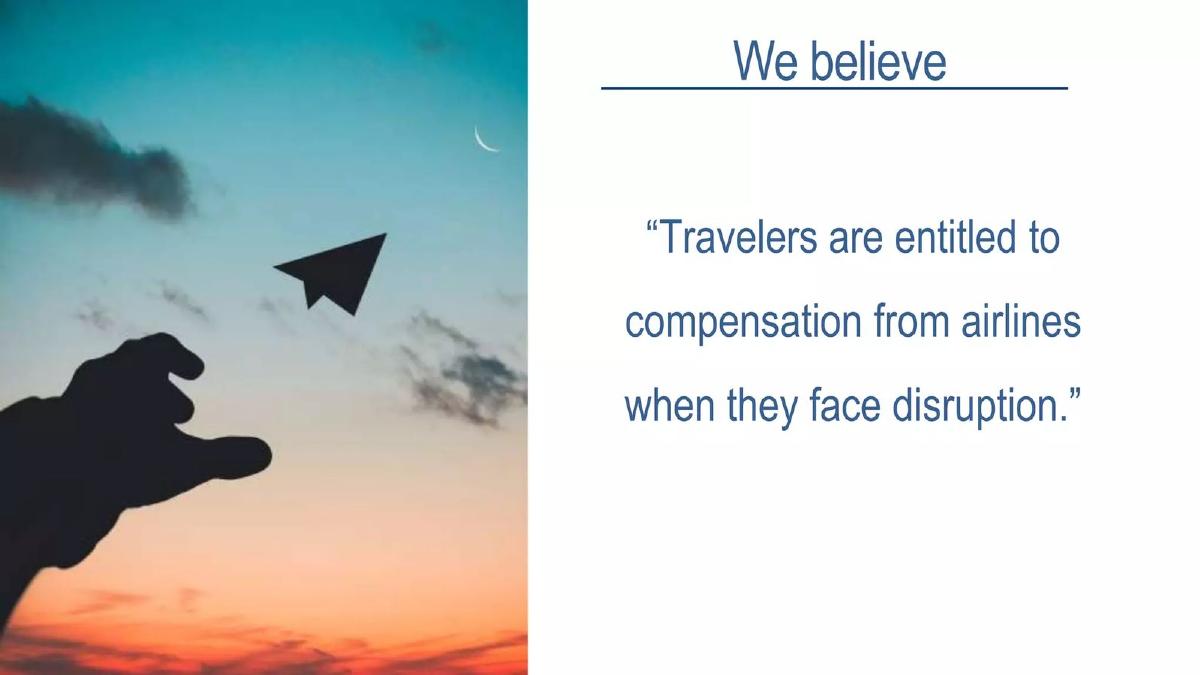
Slide 2 is a simple "We believe" statement: "Travelers are entitled to compensation from airlines when they face disruption." This serves to establish the moral and legal foundation of the business. It frames the company not just as a software provider, but as an advocate for consumer rights, which is a common narrative in the flight compensation space.
Slide 3: Timeline of Accomplishments
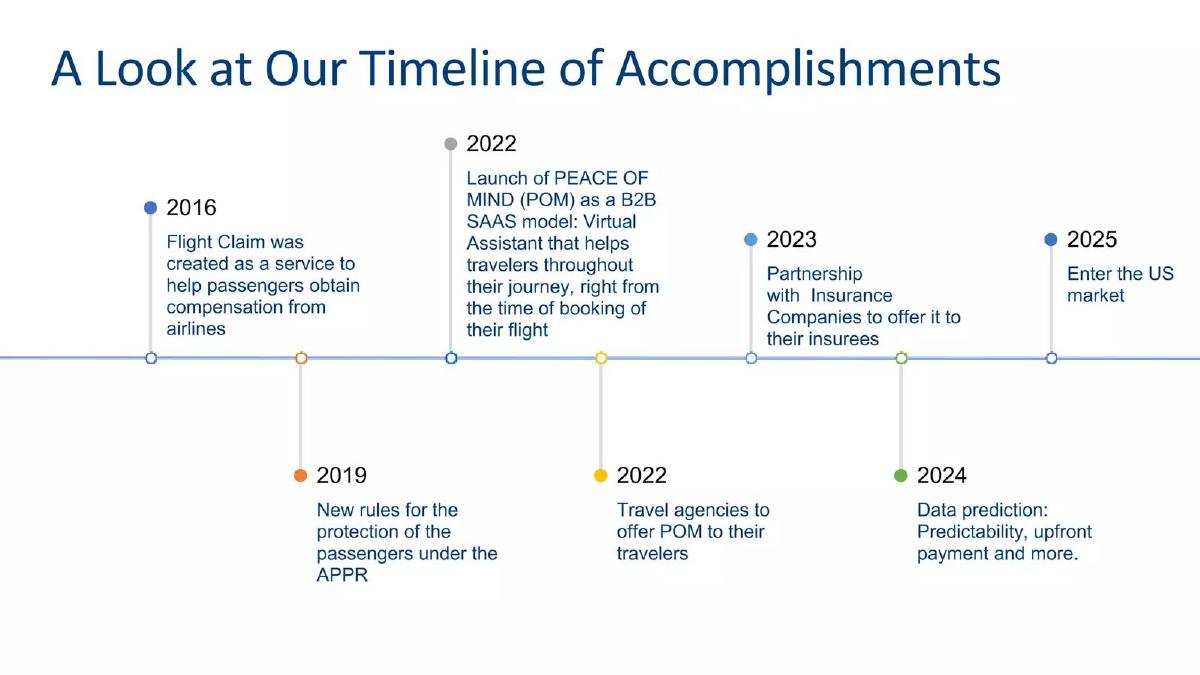
This slide provides a historical context for the business. Flight Claim was created in 2016 as a service-based model. A significant regulatory milestone is noted in 2019 with new rules under the APPR (Air Passenger Protection Regulations). The most critical business shift occurred in 2022 with the launch of PEACE OF MIND as a B2B SaaS model . The roadmap extends to 2025, with a planned entry into the US market. This slide is effective because it shows the company has survived multiple years and regulatory shifts before scaling their technology.
Slide 4: The Problem and Market Opportunity
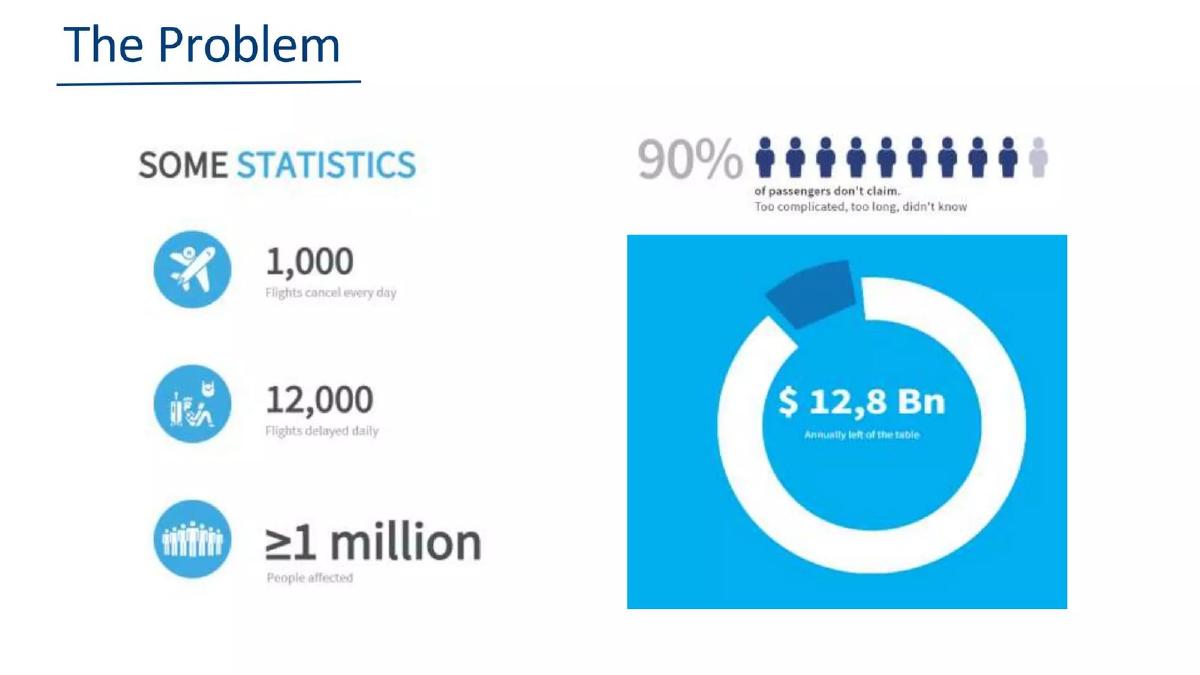
This is the "money slide" of the deck. It quantifies the pain point with three daily statistics: 1,000 flights cancelled, 12,000 flights delayed, and over 1 million people affected . The core inefficiency is highlighted by the fact that 90% of passengers don't claim because it is "too complicated, too long, [or they] didn't know." This results in $12.8 billion left on the table annually . Using a large, bold figure for the market size helps anchor the investor's interest in the scale of the opportunity.
Slide 5: The Peace of Mind Platform
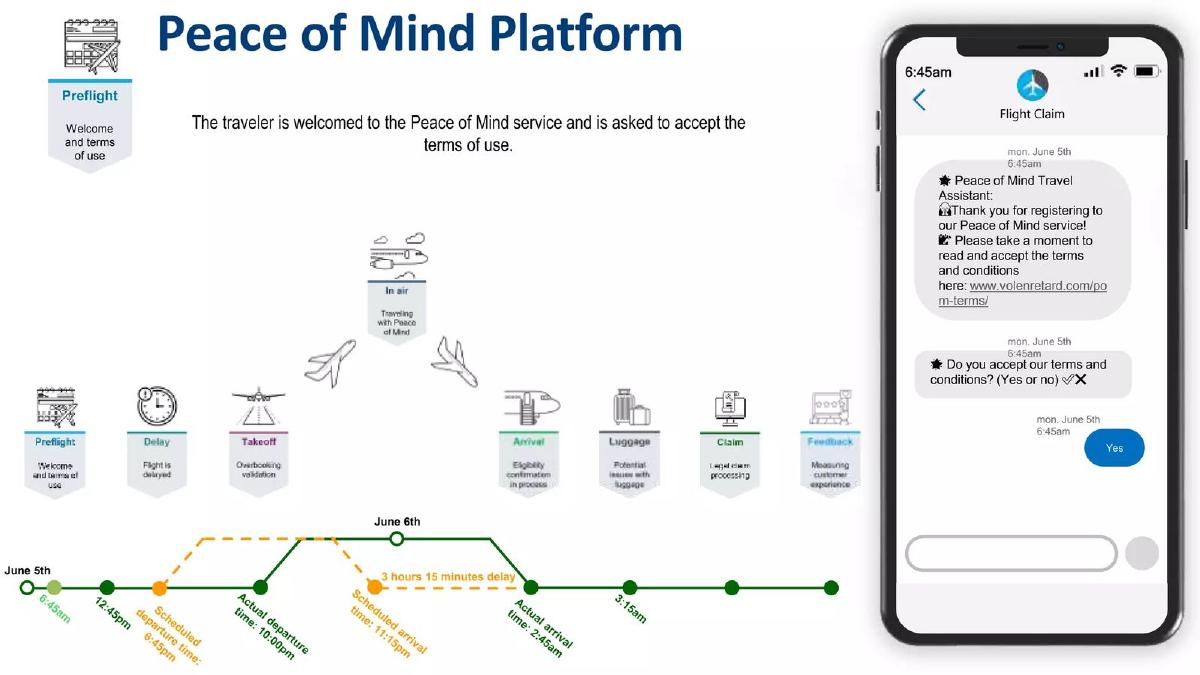
Slide 5 attempts to visualize the user journey. It shows a timeline from "Preflight" to "Feedback," including milestones like "Delay," "Takeoff," "Arrival," and "Claim." A mobile mockup on the right shows a SMS/chat-based interface where the "Peace of Mind Travel Assistant" interacts with the user. The example shows a flight with a 3 hours 15 minutes delay , which triggers the eligibility process. This slide demonstrates that the product is designed to be low-friction, operating via automated messaging rather than requiring the user to navigate a complex portal.
Slide 6: Compensation for Travelers
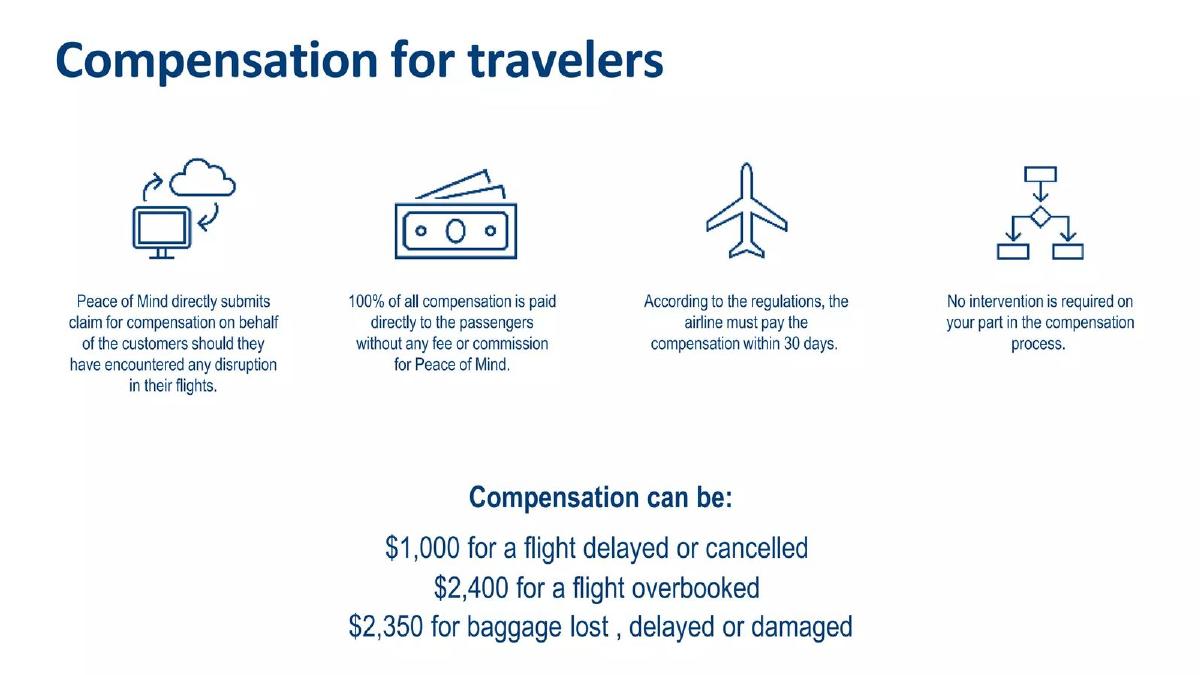
This slide breaks down the financial benefits for the end-user. It claims that 100% of all compensation is paid directly to the passengers without any fee or commission for Peace of Mind . This is a significant departure from traditional "no win, no fee" legal services that typically take a 25-35% cut. Instead, the slide notes that airlines must pay within 30 days and no intervention is required from the traveler. The slide lists specific compensation amounts: $1,000 for delays/cancellations, $2,400 for overbooking, and $2,350 for baggage issues . This transparency helps explain why the 70% conversion rate mentioned later is achievable.
Slide 7: Business Model and Distribution
The final slide explains how the company makes money if they aren't taking a cut of the claims. The revenue comes from the B2B side: SaaS subscriptions (monthly/yearly), one-time fees, and per-transaction fees . The distribution wheel shows the passenger at the center, surrounded by Aggregators, OTAs, Travel Agencies, GDS, Insurance brokers, and Travel insurance companies . A key metric is highlighted in the bottom left: 70% of passengers purchase the service when it is offered to them . This high attachment rate is the strongest evidence of product-market fit in the deck.
What Works Well
Clear Market Gap: The $12.8 billion figure on slide 4 is a compelling reason for the business to exist. · B2B Strategy: By integrating with OTAs and insurance companies (slide 7), FlightClaim avoids the high Customer Acquisition Cost (CAC) associated with direct-to-consumer legal services. · User Friction: The chat-based interface shown on slide 5 suggests a product that is easy for non-technical travelers to use. · Historical Context: Showing the evolution from a 2016 service to a 2022 SaaS platform demonstrates founder persistence and adaptability.
What Is Missing
Team Slide: There is no mention of who is building this. In early-stage insurtech, the founders' background in insurance, law, or travel technology is vital. · The Ask: The deck does not state how much money is being raised, the valuation, or the specific use of funds. · Unit Economics: While the revenue streams are listed, there is no data on the average revenue per user (ARPU) or the cost to support the SaaS model. · Competitive Landscape: The flight compensation space is crowded (e.g., AirHelp, Skycop). The deck does not explain how FlightClaim’s B2B SaaS approach specifically beats these established consumer-facing incumbents. · Financial Projections: There are no charts showing historical revenue growth or future projections, which are standard for a pitch deck.
Founder Takeaways
Quantify the 'Leftover' Value: If your startup addresses a regulatory or legal right, quantify how much money goes unclaimed every year. It is a more powerful metric than a generic TAM/SAM/SOM slide. · Show the Pivot: If you started as a service and moved to software, use a timeline (like slide 3) to show that your software is built on years of manual expertise. · Distribution is Product: For B2B2C companies, the slide showing how you plug into the existing ecosystem (slide 7) is just as important as the product UI slide. · Don't Forget the Team: Even for an award submission, omitting the team slide is a mistake. Investors invest in people first, especially when the business model involves complex regulatory navigation.
Frequently asked questions
- What is the core product offered by FlightClaim?
- The core product is 'Peace of Mind' (POM), a B2B SaaS virtual assistant. It manages the end-to-end process of flight disruption claims, from monitoring delays to submitting claims on behalf of passengers. According to slide 6, it handles claims for delays, cancellations, overbooking, and lost baggage without requiring intervention from the traveler.
- How does FlightClaim generate revenue?
- FlightClaim utilizes a multi-pronged revenue strategy detailed on slide 7. This includes per-transaction fees through B2B partners, monthly SaaS subscriptions via group benefits and credit card partners, embedding the service into existing travel insurance products, and data monetization.
- What market problem is the company solving?
- The company addresses the 'unclaimed compensation' gap. Slide 4 notes that 1,000 flights are cancelled and 12,000 are delayed daily, affecting over 1 million people. However, 90% of these people do not claim the money they are owed because the process is too long or complicated.
- What are the projected compensation amounts for travelers?
- Slide 6 lists specific compensation targets: $1,000 for delayed or cancelled flights, $2,400 for overbooked flights, and $2,350 for lost, delayed, or damaged baggage. The slide notes that 100% of this compensation is paid to the passenger without a fee from the POM service itself.
- What is the company's expansion strategy?
- According to the timeline on slide 3, the company focused on travel agency partnerships in 2022 and insurance company partnerships in 2023. Their future goals include launching data prediction services in 2024 and entering the US market in 2025.