Nfinite, a French SaaS platform for 3D product visualization, raised a $100M Series B in 2022 led by Insight Partners. The deck is remarkably brief at only 8 slides, relying on high-level market trends and a clear 'Before vs. After' narrative regarding product photography. By positioning traditional photography as an 'outdated' and 'perishable expense,' Nfinite frames its CGI-based platform as an essential infrastructure for the 'Metaverse' and modern e-commerce. While the deck lacks specific internal financial metrics or a team slide, it leans heavily on third-party validation from Gartner,…
Key takeaways
- The deck highlights a massive market opportunity, noting global retail e-commerce sales have grown 10x in 10 years to reach $6 trillion by 2023 (Slide 3).
- Nfinite positions 3D visuals as 'table stakes' for e-commerce, citing Google's launch of 3D search results and Meta's rebranding as proof of a virtual shift (Slide 4).
- The problem statement quantifies the inefficiency of traditional photography, citing costs from $20 to $5,000 per visual and lead times of several months (Slide 5).
- The platform workflow is simplified into a four-step cycle: Create, Display, Track, and Improve, emphasizing a '1 click' leverage of CGI (Slide 6).
- Consumer behavior data supports the product, with 83% of buyers stating product images are the most influential factor in purchasing decisions (Slide 7).
- The deck uses a 'bridge to the Metaverse' narrative to align with 2022's primary tech investment trend, backed by a CMO testimonial from Delamaison (Slide 8).
- Despite raising $100M, the deck omits standard Series B requirements like a detailed team slide, specific revenue growth (ARR), or a clear use of funds (Slide 1-8).
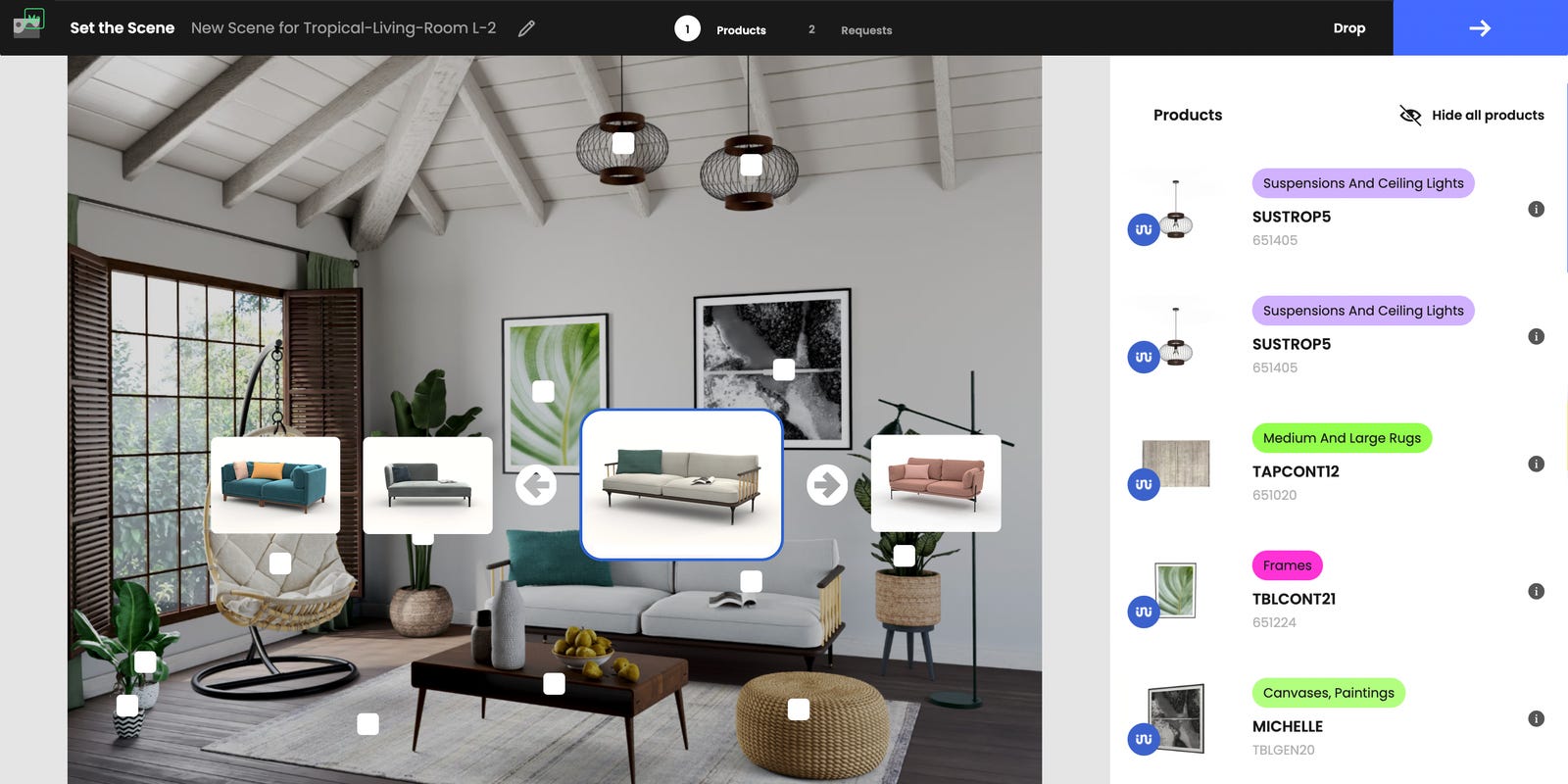
- Visual evidence is prioritized, opening with a full-page product interface demonstration rather than a traditional title slide (Slide 1).
The 8-Slide Strategy for a $100M Round
Nfinite's Series B deck is a study in narrative efficiency. In an era where pitch decks often bloat to 25+ slides, Nfinite secured $100M in 2022 using a lean, visually-driven presentation. As reported by Business Insider, this European-based startup operates at the intersection of e-commerce and graphic design, providing a SaaS platform for 3D product visualization. The deck doesn't get bogged down in technical architecture; instead, it focuses on the inevitable transition from physical photography to digital asset management.
Slide 1: The Product in Action
Nfinite breaks the standard 'Title Slide' rule by leading with a full-bleed screenshot of their platform interface. The slide shows a 'Set the Scene' tool for a 'Tropical-Living-Room.' It demonstrates the core functionality: selecting 3D models (like the 'SUSTROP5' ceiling light or 'TAPCONT12' rug) and placing them into a digital environment. This immediately answers the 'what is it?' question before a single word of the pitch is spoken.
Slide 2: The Hook
The formal title slide is minimalist, featuring the company logo and the tagline: 'The future of visuals for e-commerce.' The underlined 'future' emphasizes the shift the company is betting on.
Slide 3: Market Context and Scale
This slide establishes the 'Why Now.' It notes that retail e-commerce is 'one of the largest & fastest growing markets in the world.' A bar chart shows global retail e-commerce sales growing 10x in 10 years, reaching a projected $6 trillion by 2023. Crucially, it links this growth to visual assets, citing that 90% of Etsy users say photo quality influences purchasing decisions. It also lists logos of major players like Walmart, Wayfair, and Amazon to show that every major retailer is building a strategy around product visuals.
Slide 4: The Virtual Shift
Nfinite doubles down on the macro trend here. By highlighting that Google has 'launched 3D results in search' and Facebook rebranded to Meta, they frame 3D visuals as 'table stakes for the future of e-commerce.' This slide is designed to create FOMO (Fear Of Missing Out) for investors—suggesting that the world has already turned virtual and 2D photography is a relic of the past.
Slide 5: The Problem Statement
This is the most effective slide in the deck. It categorizes the pain points of 'Classic photography' into three buckets: Expensive ($20 to $5,000 per visual), Time-consuming (weeks to months to market), and Single use . The phrase 'perishable expense' is used to describe traditional photos, contrasting them with the reusable nature of Nfinite's digital assets. It frames the current retail workflow as a 'dramatic loss of value.'
Slide 6: The Solution Workflow
The 'end to end e-merchandising platform' is explained through a circular workflow: 1. You create, 2. You display, 3. You track, 4. You improve. It starts with 'We digitize your catalog,' where products are modeled in 3D. The slide uses a simple juice box example to show how a single 3D asset can be repurposed for web displays, social media (Instagram, Facebook, Snapchat), and performance tracking. The promise is 'computer generated imagery in 1 click.'
Slide 7: External Data Validation
Instead of showing their own growth metrics, Nfinite uses four data points from reputable sources to validate their existence:
61% of U.S. retailers find visual production time-consuming (Smartly.io). · 50% of sales in Home & Living will be online within 20 years (Forbes). · 64% of consumers believe experience is more important than cost (Gartner). · 83% of buyers say images are the most influential purchasing factor (The Digital Shopper).
Slide 8: The Visionary Close
The deck concludes with a quote from L. de la Morandière, CMO of Delamaison, stating that Nfinite 'is the bridge to the Metaverse.' This was a strategic choice in 2022 to align the company with the highest-growth narrative in tech at the time. It elevates the company from a 'CGI tool' to a 'Metaverse gateway.'
What Works in the Nfinite Deck
The 'Perishable' Narrative: By labeling traditional photography as 'perishable,' Nfinite creates a powerful mental model. Investors understand that 'perishable' is bad for margins, while 'SaaS-based digital assets' are scalable and reusable. This framing justifies a high valuation for what might otherwise look like a creative agency tool.
Macro-Trend Alignment: The deck perfectly captures the 2022 zeitgeist. By citing Google's 3D search and Meta's rebrand, Nfinite makes their success seem like a mathematical certainty of the internet's evolution. They aren't just selling a product; they are selling a ticket to the next version of the web.
Simplicity: The 8-slide format ensures that the core message—'3D is the new standard, and we are the platform'—is never lost in the weeds of technical specs or complex pricing models.
What is Missing from the Nfinite Deck
The Team: There is no team slide. For a $100M Series B, investors usually want to see a deep bench of talent, particularly in computer vision and enterprise sales. Its omission suggests this deck was used for investors who were already intimately familiar with the founders.
Internal Metrics: There is a total absence of ARR, NRR (Net Retention Rate), customer count, or growth percentages. While the market data is strong, the deck doesn't actually prove that Nfinite is winning that market—only that the market is worth winning.
Unit Economics: The deck mentions that traditional photography costs $20-$5,000, but it never explicitly states how much Nfinite saves the customer or what their own margins look like. A Series B deck usually requires a deeper dive into the 'machine' of the business.
Founder's Guide: What to Copy
The 'Before vs. After' Problem Slide: Slide 5 is a masterclass in identifying a legacy process and ruthlessly deconstructing its flaws. Founders should copy the way Nfinite uses specific dollar amounts ($20 to $5,000) and timeframes (weeks to months) to make a vague problem feel concrete and expensive.
Visual-First Opening: Don't wait until Slide 10 to show your product. Nfinite's Slide 1 immediately grounds the investor in the user experience. If your product is visual, lead with the visuals.
Third-Party Validation: If your own metrics are under NDA or you are in a quiet period, use Slide 7's approach. Curate a 'Proof in the Data' slide that uses Gartner or Forbes data to confirm that the problem you are solving is a top priority for your target customers.
Frequently asked questions
- How did Nfinite raise $100M with only 8 slides?
- At the Series B stage, the deck is often a conversation starter rather than the entire due diligence package. Nfinite focused on a 'big picture' narrative, highlighting a $6 trillion market and the fundamental shift from physical to digital assets. The brevity suggests strong existing investor relationships or a highly compelling data room that sat behind these high-level slides.
- What is the core value proposition presented in the deck?
- The core value prop is the replacement of 'perishable' traditional photography with reusable 3D assets. Slide 5 explicitly attacks the 'Single use' nature of photos, which are 'impossible to modify without reshooting.' Nfinite offers a SaaS alternative that allows retailers to create, track, and improve visuals at a fraction of the time and cost.
- Does the deck mention specific competitors?
- No. The deck avoids a competitive matrix entirely. Instead, it lists partners and platforms like Google, Walmart, Wayfair, and Amazon on Slide 3 to show that the entire industry is moving toward 3D, implying that Nfinite is the infrastructure enabling this shift rather than just another tool.
- What metrics does Nfinite use to prove market fit?
- Nfinite relies on external validation rather than internal KPIs. They cite that 90% of Etsy users are influenced by photo quality and 64% of consumers value experience over cost (Slide 3 and 7). By using Gartner and Forbes data, they validate the problem space even without sharing their own churn or LTV numbers.
- Why is the 'Metaverse' mentioned on the final slide?
- In 2022, the Metaverse was the dominant investment thesis for many VCs. By ending with a quote calling Nfinite the 'bridge to the Metaverse,' the company aligned its 3D catalog technology with a broader, high-valuation trend, making a tactical SaaS tool feel like a strategic platform play.