Nexad's 10-slide pitch deck focuses on the displacement of traditional search engines by AI chatbots and the resulting need for a new advertising infrastructure. The company positions itself as the first AI-native ads system, moving away from legacy display units toward contextually aware, generative recommendations. The deck highlights significant early traction, claiming a reach of over 30 million users within three months of launch in early 2025. By combining a strong technical team with backgrounds at TikTok, Martian, and Uber Ads, Nexad successfully argued that the 'Google era' of search…
Key takeaways
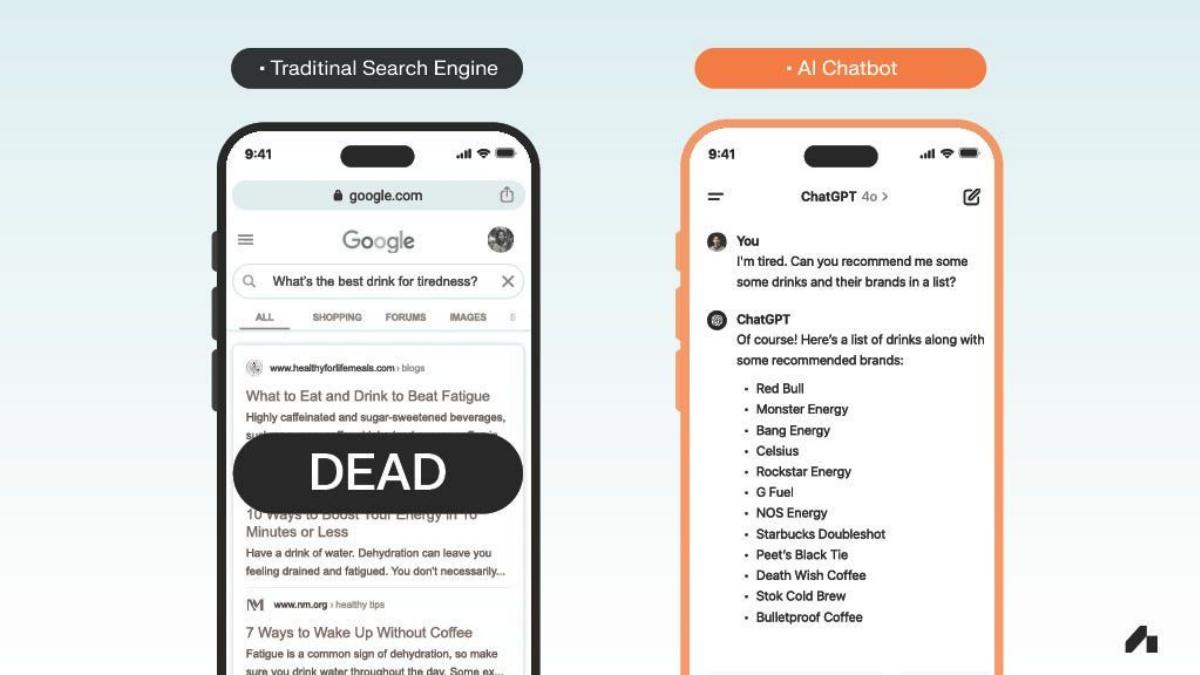
- Nexad explicitly labels traditional search engines like Google as 'dead' in the context of modern brand discovery (Slide 3).
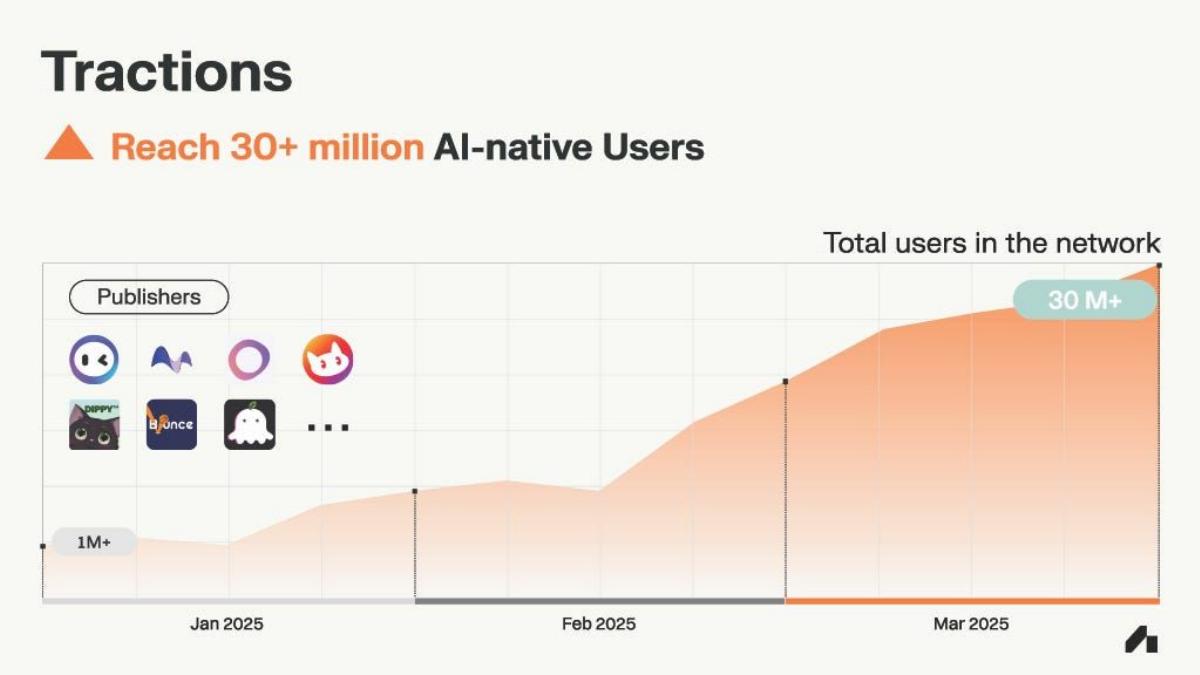
- The company claims to have scaled from 1 million to over 30 million AI-native users between January and March 2025 (Slide 5).
- The product functions as a 'Generative Ad Engine' that adapts ad copy in real-time based on user conversation context (Slide 7).
- Nexad utilizes a data flywheel where engagement data from 'Useful Ads' feeds back into the engine for continuous refinement (Slide 8).
- The founding team possesses deep domain expertise, including ML engineering at Martian and monetization experience at TikTok (Slide 9).
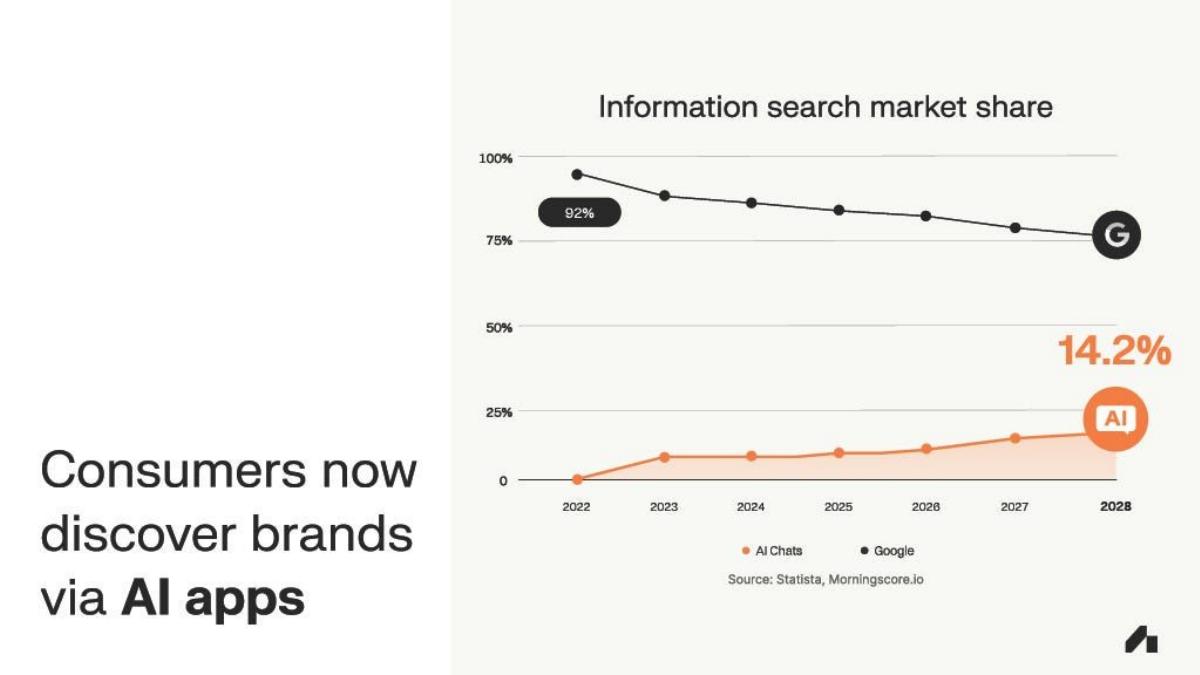
- The deck identifies a projected 14.2% market share for AI chats in information search by 2028, citing Statista (Slide 2).
- Advisors include former directors from Unity Ads and Uber Ads, providing high-level industry validation (Slide 9).
- The deck lacks a specific financial 'Ask' slide or detailed breakdown of how the $6M seed round will be deployed.
Introduction: The Shift to AI-Native Monetization
Nexad’s pitch deck is a masterclass in narrative-driven fundraising. In an era where 'AI' is often used as a buzzword, Nexad anchors its value proposition in a tangible shift in consumer behavior: the transition from search engines to chatbots. Reported by Business Insider as a $6M Seed round raised in 2024, the company positions itself not just as an ad network, but as the fundamental infrastructure for the next generation of digital marketing.
Slide 1: The Vision Statement
The title slide is minimalist, featuring the Nexad logo and the tagline: "Native Ads System for the AI Era." Notably, the bottom of the slide includes logos for a16z, Prosus, and Point72 Ventures , labeled as "Backed by Visionaries." This immediately establishes social proof, signaling to potential investors that top-tier firms have already vetted the technology and the team.
Slide 2: The Market Opportunity
Slide 2 uses a line graph to illustrate "Information search market share." It shows Google’s dominance declining from 92% in 2022 toward a downward trend, while "AI Chats" are projected to reach 14.2% by 2028. By citing sources like Statista and Morningscore.io, Nexad moves the conversation from theory to data-backed market reality. The slide effectively sets the stage: the incumbent is losing ground, and a new category is emerging.
Slide 3: The 'Dead' Incumbent
This slide is the most aggressive in the deck. It shows a side-by-side comparison of a traditional Google search result and a ChatGPT response for the query "What's the best drink for tiredness?" A large "DEAD" stamp is placed over the Google interface. The contrast is clear: Google provides a list of links that require further clicking, while the AI Chatbot provides a direct, conversational list of brands like Red Bull, Monster, and Celsius. This slide identifies the exact 'real estate' Nexad intends to monetize.
Slide 4: Defining the Solution
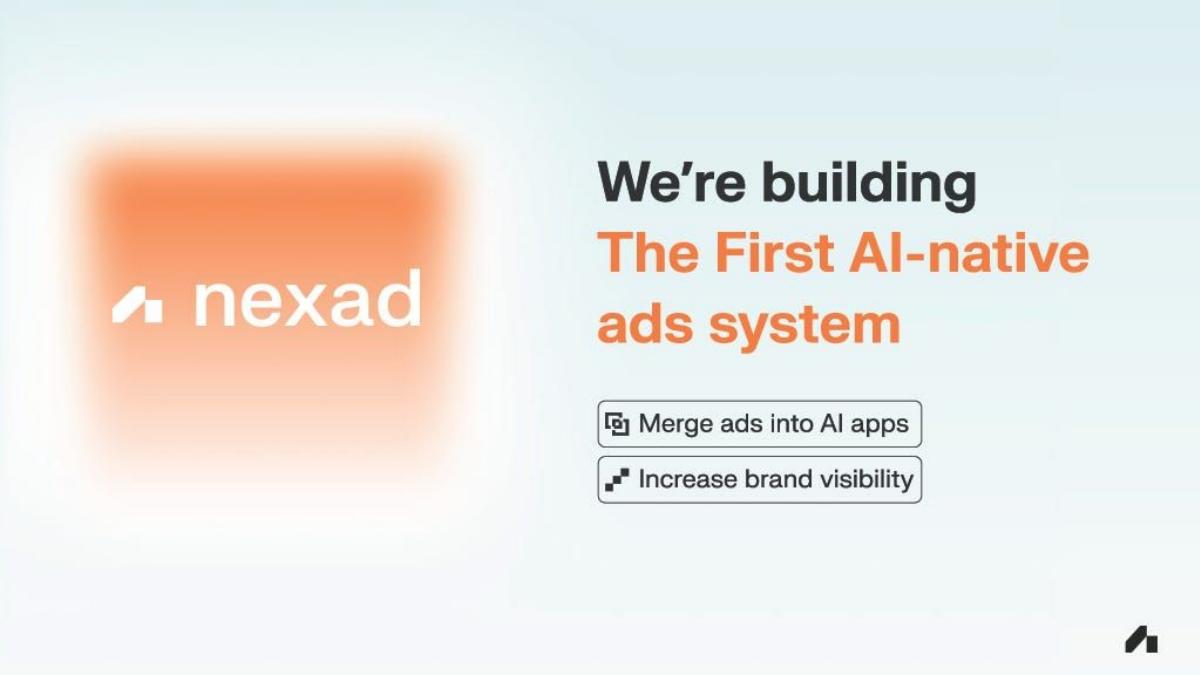
Nexad explicitly states their mission: "We’re building The First AI-native ads system." The slide highlights two primary functions: "Merge ads into AI apps" and "Increase brand visibility." This is the 'What' slide, clarifying that Nexad is the bridge between brands and the conversational interfaces shown on the previous slide.
Slide 5: Explosive Traction
Titled "Tractions," Slide 5 displays a growth chart showing the "Total users in the network." The chart begins at 1M+ in January 2025 and climbs steeply to 30 M+ by March 2025. Several publisher logos are displayed, including Dippy and Bounce, suggesting that Nexad has already integrated with a variety of third-party AI applications to achieve this scale. This rapid growth is the primary evidence of product-market fit presented in the deck.
Slide 6: Product in Action
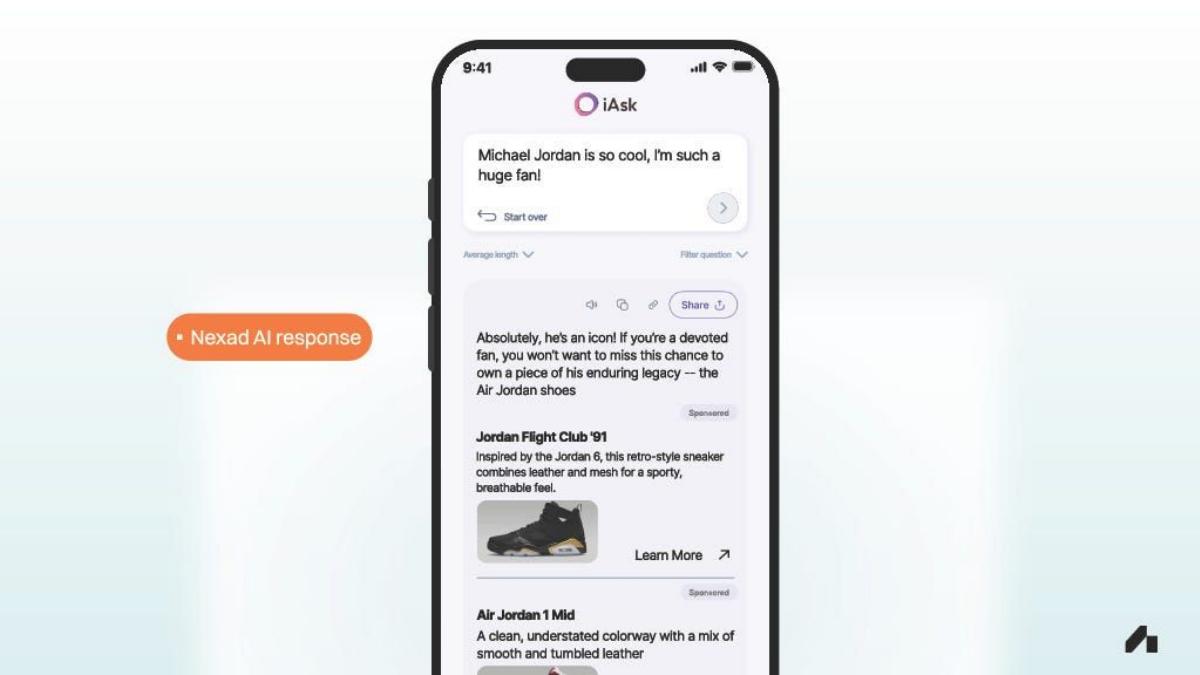
This slide provides a concrete example of the user experience. In a search on an AI engine called iAsk , a user says, "Michael Jordan is so cool, I'm such a huge fan!" The "Nexad AI response" then recommends Jordan Brand sneakers, complete with product descriptions and a "Learn More" link. This demonstrates how the ad is woven into the conversation naturally, rather than appearing as a disruptive banner.
Slide 7: The Generative Ad Engine
Slide 7 goes deeper into the technology. It labels the backend as a "Generative Ad Engine" characterized by two features: "Contextual awareness" and "Real-time adaptation." This suggests that the ads are not just static placements but are dynamically generated or selected to match the tone and specific intent of the user's current conversation.
Slide 8: The Data Flywheel
To demonstrate defensibility, Nexad introduces their "Data Flywheel." The cycle starts with a User Query , moves to the Nexad Engine , serves a Useful Ad , collects Engagement Data , and results in Continuous Refinement . This is a classic venture capital trope used to show that the product gets better (and harder to compete with) as it scales.
Slide 9: The Team
The team slide is high-pedigree. Jason Hu (CEO) is noted as a former ML engineer at Martian and a monetization specialist at TikTok. Harry Zhou (COO) is credited with growing an AI video generator to 1 million users and has a background in M&A at Skadden. The inclusion of advisors from Unity Ads and Uber Ads , along with founding members from Comcast and AGI labs, rounds out a team that possesses both technical depth and commercial experience in advertising.
Slide 10: The Closing
The final slide reiterates the core message: "Reinventing Ads for the AI Era." It provides the company website (www.nex.ad) and a contact email for the CEO. It is a standard, clean closing that maintains the deck’s professional aesthetic.
What Nexad Does Well
The deck excels at problem identification . By visually contrasting the 'clunky' nature of traditional search with the 'seamless' nature of AI chat, they make the need for a new ad system feel inevitable. The traction slide (Slide 5) is also a major strength; showing a 30x growth in user reach over just three months is a compelling reason for a Seed investor to move quickly. Finally, the team slide (Slide 9) perfectly balances machine learning expertise with 'big adtech' experience, which is crucial for a company trying to build a new marketplace.
What is Missing from the Deck
Despite its strengths, the deck leaves several critical questions unanswered. There is no 'Ask' slide , which is standard for a pitch deck; it does not specify how much capital is being sought or what the valuation expectations are. There is also a lack of unit economics —while they show 'reach,' they do not show revenue, CPMs (cost per thousand impressions), or CTRs (click-through rates). Furthermore, the competitive landscape is ignored. While they position themselves as the 'first,' they do not address how they will compete with internal monetization efforts from giants like OpenAI or Perplexity.
Founder Takeaways: Lessons from Nexad
Visual Contrast is Powerful: Use 'Before and After' or 'Old vs. New' visuals (like Slide 3) to make your market thesis immediately obvious. · Social Proof Early: If you have notable backers or advisors, put them on the first or second slide to build immediate credibility. · Focus on the Flywheel: Investors love systems that improve with scale. Explicitly drawing out your data flywheel (Slide 8) helps communicate long-term value. · Pedigree Matters in Adtech: In a crowded market, highlighting specific experience at major platforms (TikTok, Unity, Uber) proves you understand the 'plumbing' of the industry you are trying to disrupt.
Frequently asked questions
- What is the core problem Nexad is solving?
- Nexad addresses the 'death' of traditional search-based brand discovery. As consumers move from Google to AI chatbots like ChatGPT, traditional display and search ads become obsolete. Nexad provides the infrastructure to insert relevant, native recommendations directly into these AI-driven conversations without disrupting the user experience.
- How does Nexad's technology differ from traditional ad servers?
- Unlike static ad servers, Nexad uses a 'Generative Ad Engine.' As shown on Slide 7, this system offers real-time adaptation and contextual awareness. It doesn't just serve a pre-made banner; it generates or selects recommendations that fit the specific flow of a natural language conversation.
- What kind of traction has the company achieved?
- According to Slide 5, Nexad saw explosive growth in early 2025. They reported reaching 1 million users in January 2025 and surged to over 30 million users by March 2025. This rapid scaling across their publisher network was likely a key factor in securing their $6M seed round.
- Who are the key people behind Nexad?
- The team is led by CEO Jason Hu, a former ML engineer at Martian and TikTok monetization specialist, and COO Harry Zhou, who has experience in AI video generation and legal/M&A at Skadden. They are supported by advisors from major ad platforms like Unity and Uber.
- What is missing from the Nexad pitch deck?
- The deck is notably missing a slide detailing the 'Ask' (how much they are raising and on what terms) and a 'Use of Funds' breakdown. It also lacks a detailed competitor matrix and specific unit economics or revenue figures, focusing instead on user reach and technical architecture.