Next Play’s 2016 pitch deck is a concise 10-slide presentation that leans heavily on early validation and founder-market fit. Instead of spending time on complex AI architecture, the deck focuses on the 'what' and the 'who.' It establishes a massive $356 billion market on slide 1, immediately validates the product with high-tier enterprise logos on slide 3, and showcases a team with direct experience from LinkedIn on slide 5. The deck is notable for its brevity, omitting traditional sections like competition and detailed financial projections in favor of a 'traction-first' narrative. With $10…
Key takeaways
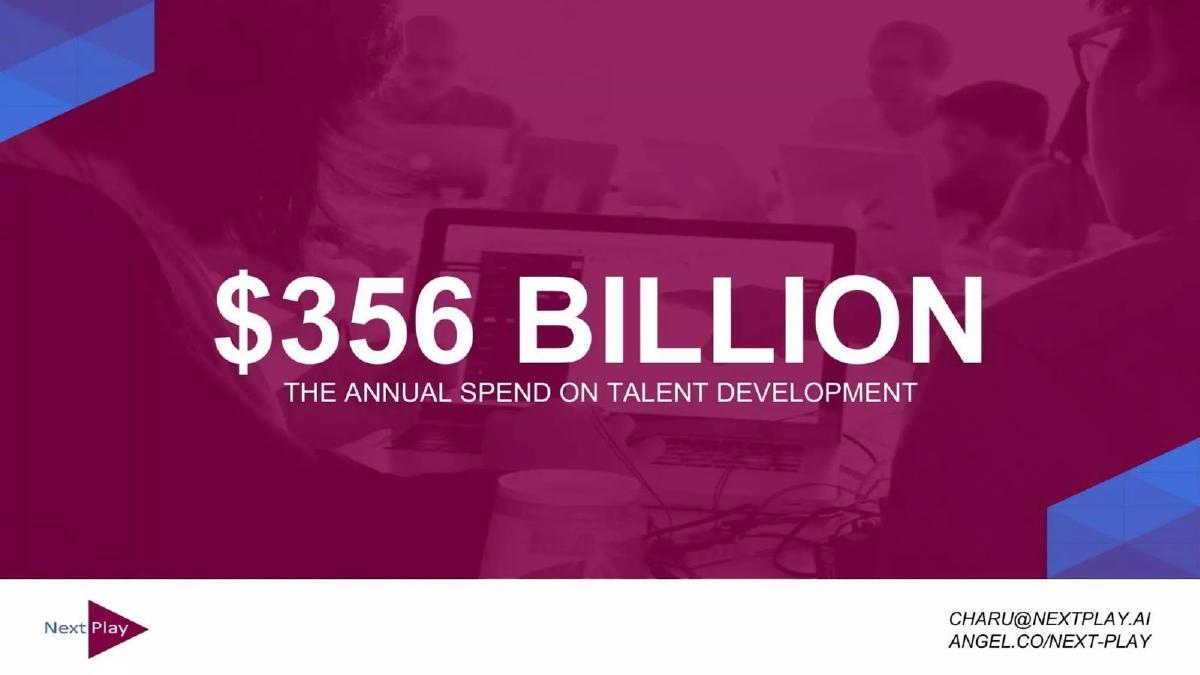
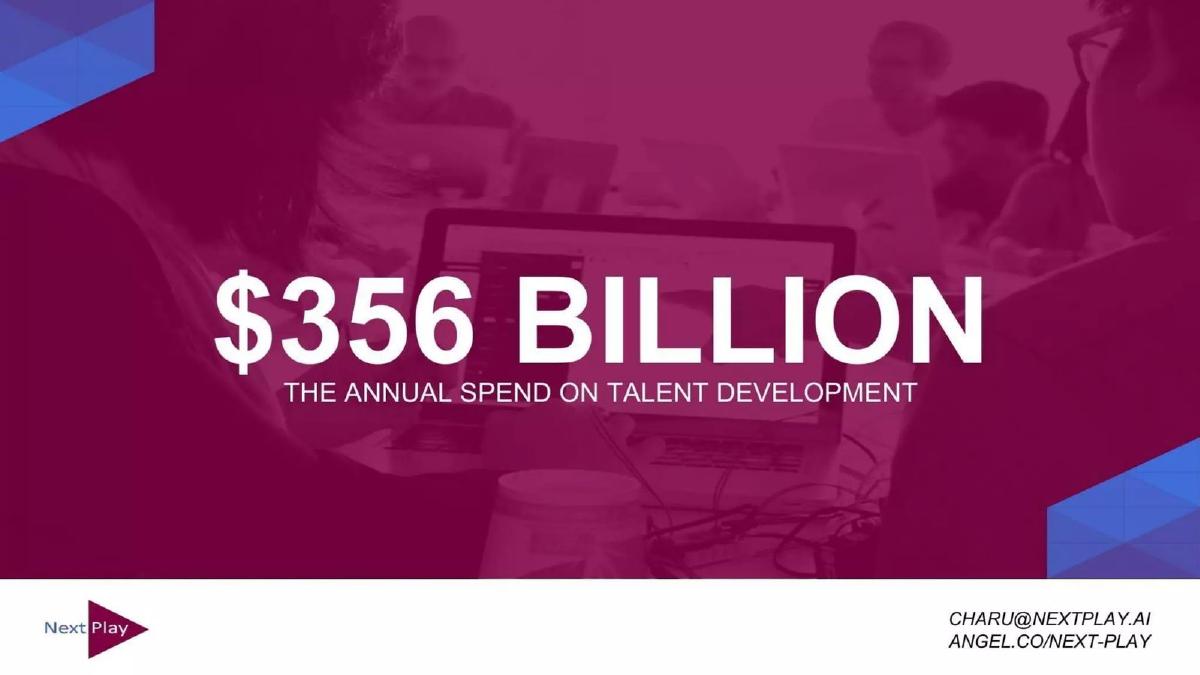
- The deck opens with a massive $356 billion figure representing the annual spend on talent development to establish market scale immediately (Slide 1).
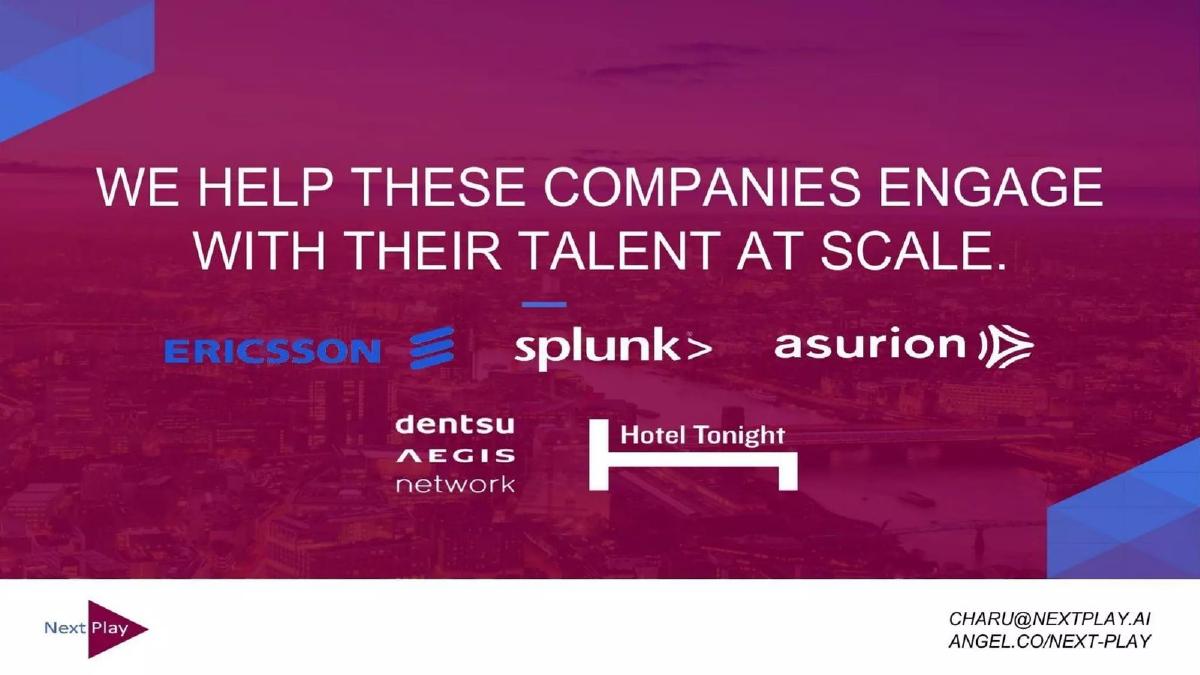
- Social proof is prioritized early, listing major enterprise clients like Ericsson, Splunk, and Asurion by the third slide (Slide 3).
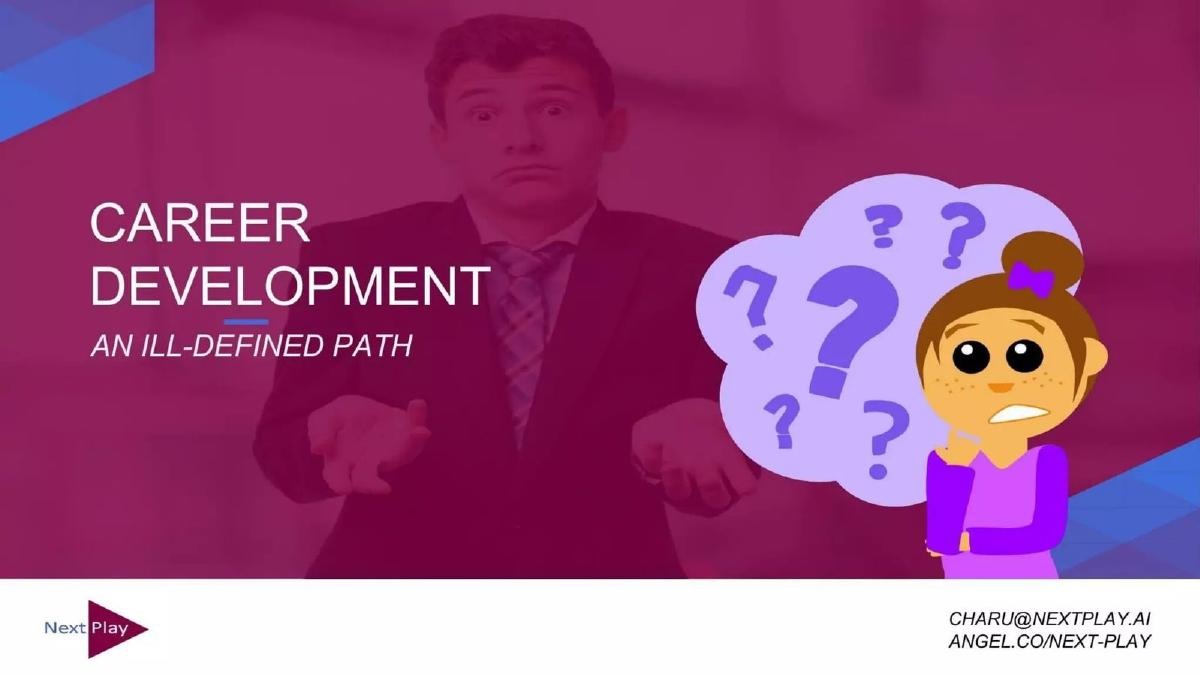
- The problem is framed simply as 'Career Development: An Ill-Defined Path,' using relatable imagery rather than dense text (Slide 4).
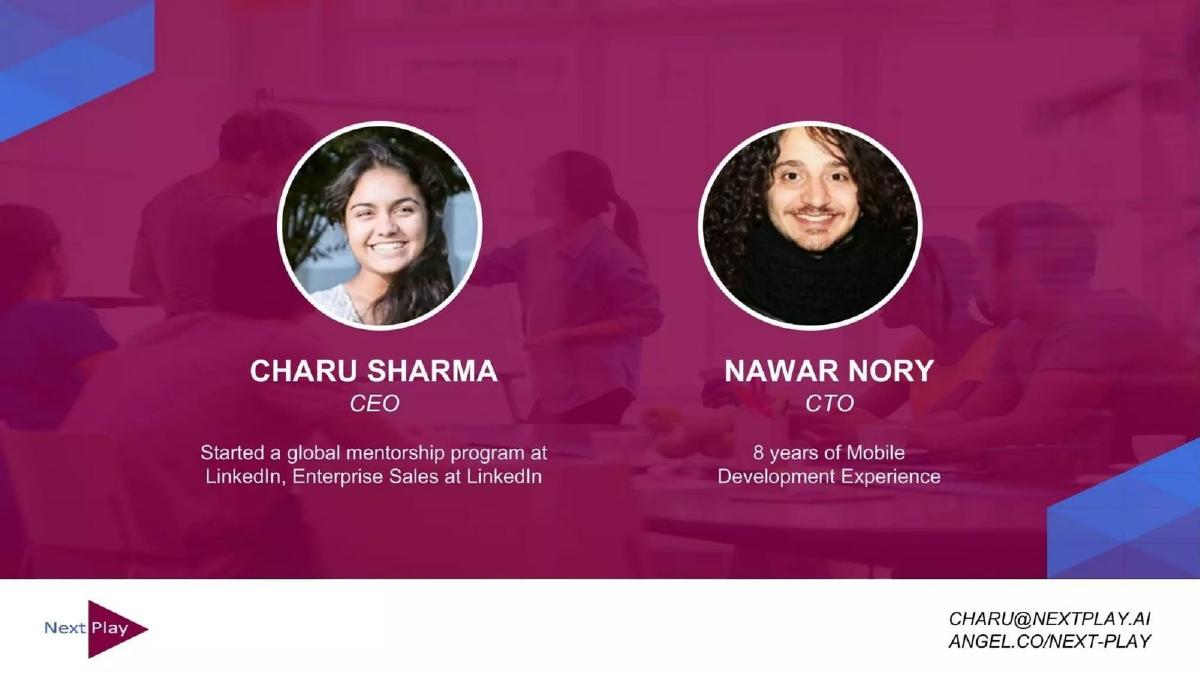
- Founder-market fit is highlighted through CEO Charu Sharma's background starting a global mentorship program at LinkedIn (Slide 5).
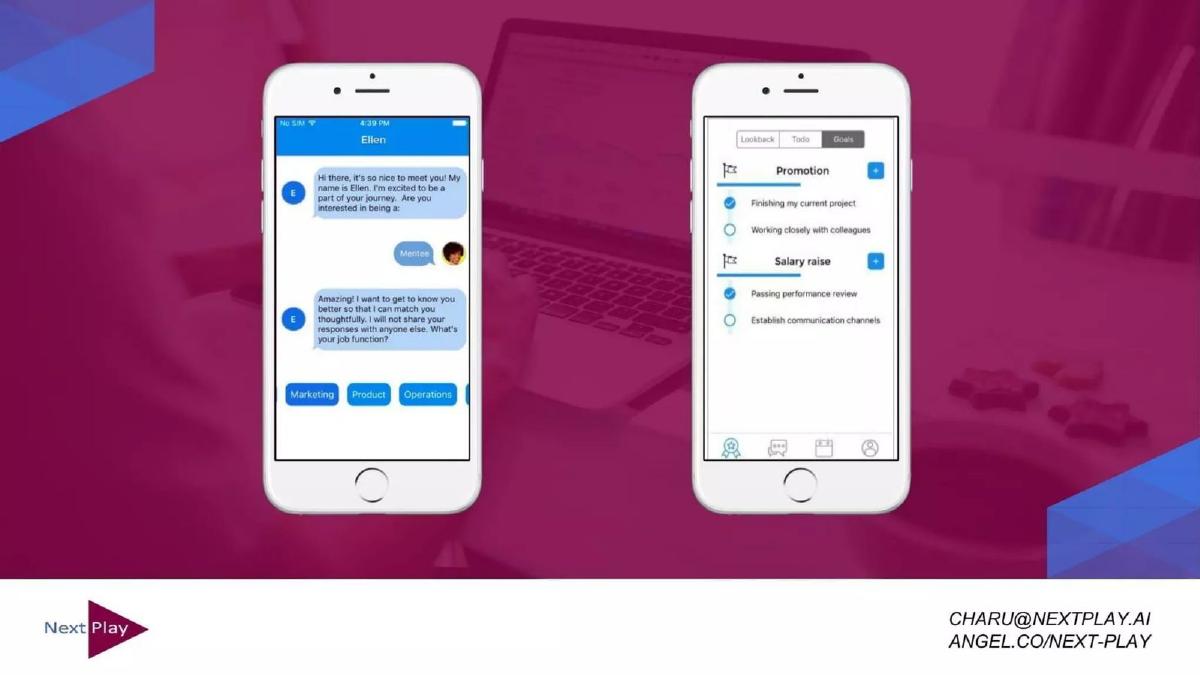
- The product is personified through 'Ellen,' a chatbot interface that handles mentorship matching and goal setting (Slide 6).
- Impact metrics are presented as simple percentages, including a 90% figure associated with Splunk and Asurion (Slide 8).
- Financial traction is explicitly stated as $100k in revenue and a $1M sales pipeline within nine months (Slide 9).
- The deck completely omits a competition slide, a business model slide, and a specific funding 'ask' amount (Slides 1-10).
The Traction-First Approach to HR Tech
Next Play’s 2016 pitch deck is a study in brevity and momentum. In just ten slides, the company attempts to move from a massive macroeconomic problem to a specific, validated solution. The deck is designed for a quick read, relying on large typography and high-impact logos rather than dense paragraphs. This teardown examines how Next Play uses its early enterprise wins to overshadow the lack of traditional financial modeling in the deck.
Slides 1-3: Market Size and Immediate Validation
Slide 1 opens with a bold statement: $356 Billion . This is identified as the annual spend on talent development. By starting with the total addressable market (TAM) in such a stark, numerical way, Next Play establishes the stakes before even mentioning their name. It is a classic 'big market' opening designed to grab an investor's attention by highlighting the inefficiency of a massive spending category.
Slide 2 introduces the company name and its core mission: "We engage & retain talent at scale." The use of the word 'scale' is intentional here, signaling that this is a technology play rather than a consulting service. The logo, a stylized play button, reinforces the brand name 'Next Play,' suggesting career progression.
Slide 3 is perhaps the most important slide in the deck. It lists five major logos: Ericsson, Splunk, Asurion, Dentsu Aegis Network, and Hotel Tonight . Placing this social proof on the third slide is a power move. It tells the investor that despite being a young startup (2016), the product is already being used by multi-billion dollar enterprises. This immediately mitigates the perceived risk of the technology not being 'enterprise-ready.'
Slides 4-5: The Problem and The Pedigree
Slide 4 defines the problem: "Career Development: An Ill-Defined Path." The slide uses a simple cartoon of a confused employee surrounded by question marks. While the imagery is a bit informal, the message is clear: employees leave companies because they don't know how to grow within them. This sets the stage for a solution that provides clarity.
Slide 5 introduces the founders, Charu Sharma (CEO) and Nawar Nory (CTO) . The text for Sharma is highly specific: "Started a global mentorship program at LinkedIn, Enterprise Sales at LinkedIn." This is a textbook example of founder-market fit. She isn't just a founder; she is someone who has already built exactly what the company is selling, and she did it at the world's largest professional network. Nory’s "8 years of Mobile Development Experience" provides the necessary technical balance to Sharma's sales and domain expertise.
Slides 6-8: Product Personification and Impact
Slide 6 provides a product demo via two smartphone mockups. The interface shows a chatbot named Ellen . The left screen shows Ellen initiating a conversation with a new mentee, asking for their job function (Marketing, Product, Operations). The right screen shows a 'Goals' tab with checkboxes for 'Promotion' and 'Salary raise.' This slide effectively communicates that the product is a mobile-first, conversational AI that tracks tangible career outcomes.
Slide 7 is a curious choice, featuring a full-page photo of Ellen DeGeneres. Given the chatbot's name is Ellen, this is likely a mnemonic device or a placeholder for a joke used during a live pitch to make the AI feel 'friendly' and 'approachable.' While it adds personality, it doesn't provide new data.
Slide 8 returns to hard data, showing the results "After 6 months with Ellen." It lists three key metrics: 2x (associated with Ericsson), 25% (associated with Hotel Tonight and Dentsu), and 90% (associated with Splunk and Asurion). While the slide doesn't explicitly define what these percentages represent (e.g., 25% increase in retention? 90% engagement?), the proximity to the logos and the '6 months' timeframe implies significant positive impact on the HR metrics mentioned in Slide 2.
Slides 9-10: The Growth Engine
Slide 9 delivers the 'knockout' metrics. Under the heading "In only 9 months," the company claims "$100k Revenue," "200% QoQ Growth," and a "$1M Sales Pipeline." For a seed-stage startup in 2016, $100k in revenue from enterprise clients in under a year is a very strong signal. The $1M pipeline suggests that the sales process is repeatable and that there is significant market pull.
Slide 10 is a simple closing slide that repeats the mission: "Engage and retain talent at scale." It includes the CEO's email and the company's AngelList URL. Notably, there is no 'Ask' slide. There is no mention of how much money they are raising, the valuation, or what the funds will be used for. This suggests the deck was either used as a 'teaser' to secure meetings or that the 'ask' was delivered verbally to maintain flexibility in negotiations.
What Works in the Next Play Deck
Logo Density: For an early-stage company, having five recognizable enterprise logos by slide 3 is exceptional. It proves the founders can sell into complex organizations. · Founder-Market Fit: The CEO’s background at LinkedIn is the strongest possible validation for a mentorship-focused startup. It removes the 'why you?' question entirely. · Simplicity: The deck avoids 'AI buzzword soup.' Instead of explaining natural language processing, it shows a chatbot asking a simple question. It focuses on the outcome (retention) rather than the process. · Clear Traction: Slide 9 provides the three numbers every investor wants to see: current revenue, growth rate, and future potential (pipeline).
What is Missing from the Next Play Deck
The 'Ask': As noted, the deck does not state how much capital is being sought. This is a significant omission for a fundraising document, as it leaves the investor guessing about the round's structure. · Competitive Landscape: The HR tech space is notoriously crowded. The deck doesn't explain how Next Play differs from legacy LMS (Learning Management Systems) or other emerging mentorship platforms. · Business Model: There is no mention of pricing. Is it per-seat, per-mentor, or a flat enterprise license? Without this, the $1M pipeline is hard to evaluate. · Go-To-Market (GTM) Strategy: While they have five clients, the deck doesn't explain how they got them or how they plan to get the next fifty. Is it a top-down sales motion or a bottom-up employee adoption model?
What a Founder Should Copy
The 'Social Proof Early' Strategy: If you have big-name customers, don't wait until the end of the deck to show them. Put them upfront to build immediate authority. · Metric Bubbles: The use of large circles with simple percentages (Slide 8 and 9) is an effective way to communicate growth without cluttering the slide with spreadsheets. · Specific Experience: When listing team members, don't just list titles. List the specific achievement that makes them qualified for this specific company, just as Sharma did with her LinkedIn mentorship program. · Personification: Giving your technology a name (Ellen) and a clear interface makes it much easier for non-technical investors to visualize how the product actually works in the hands of a user.
Frequently asked questions
- What is the primary value proposition of Next Play according to the deck?
- Next Play positions itself as a tool to 'engage and retain talent at scale' (Slide 2). It achieves this through an AI-driven chatbot named Ellen that facilitates internal mentorship matching and career goal setting. The deck emphasizes that this helps companies manage the $356 billion spent annually on talent development more effectively by providing employees with a defined career path.
- How does the deck demonstrate product-market fit?
- The deck demonstrates product-market fit through a combination of high-profile logos and growth metrics. By Slide 3, the company lists Ericsson, Splunk, Asurion, Dentsu Aegis Network, and Hotel Tonight as users. Slide 9 further validates this by showing $100k in revenue and 200% quarter-over-quarter growth, suggesting that large enterprises are willing to pay for the solution.
- What are the most significant omissions in this pitch deck?
- This deck is missing several standard components: a detailed business model (pricing), a competitive landscape analysis, a go-to-market strategy, and a specific funding ask. It also lacks a slide on unit economics or long-term financial projections. While this brevity works for a high-momentum seed round, more conservative investors would likely require these details in a follow-up data room.
- How is the team's expertise leveraged in the presentation?
- The team slide (Slide 5) focuses on specific, relevant experience rather than general resumes. CEO Charu Sharma is highlighted for starting a global mentorship program at LinkedIn, which directly mirrors Next Play's core product. CTO Nawar Nory is credited with eight years of mobile development experience, providing the technical credibility needed for a chatbot-based platform.
- What role does 'Ellen' play in the pitch?
- Ellen is the personification of the Next Play AI. By giving the chatbot a name and a face (Slides 6 and 7), the founders make a complex AI matching algorithm feel accessible and user-friendly. The deck uses Ellen to bridge the gap between the 'ill-defined path' of career development and the concrete results (2x engagement, 25% retention) shown on Slide 8.