Next Island is a virtual world and MMORPG built on Mindark’s Entropia Platform, which features a 'true currency' economy. The deck highlights a soft-launched product with 100,000 active players and a partnership with a platform that has seen over $60,000,000 in development costs. The core value proposition revolves around a diverse range of player activities—from hunting to real estate—that generate revenue for both the platform and its partners. Notably, the deck attempts to bridge the gap between gaming and investment by offering shares in virtual assets like 'Ancient Greece,' which they cl…
Key takeaways
- The platform reports having 100,000 active players currently on the platform (Slide 5).
- Next Island operates on the Entropia Platform, which has been in existence for over 15 years and represents $60,000,000 in development (Slide 7).
- The business model relies on every player activity generating revenue for the company and its partners (Slide 5).
- The deck pitches a specific virtual asset, 'Ancient Greece,' valued at $750,000 with a stated 5% ROI (Slide 8).
- The environment includes diverse biomes such as jungle, desert, mountain, and Mediterranean regions (Slide 3).
- The game supports a wide array of virtual professions, including Social Entrepreneur, Beautician, and Spaceship Captain (Slide 5).
- The technology stack is transitioning to new graphical engines, specifically mentioning a 'Sizzle Reel' featuring Unreal Engine branding (Slide 6).
- The deck omits a traditional 'Ask' slide, failing to specify the amount of capital being raised or the intended use of funds.
Next Island: The Intersection of MMORPGs and Real-Money Economies
The Next Island pitch deck represents a specific niche in the gaming industry: the 'Real Cash Economy' (RCE) MMORPG. Unlike traditional games where currency is a closed loop, Next Island builds on the Entropia Universe, where virtual assets have a fixed exchange rate with the US Dollar. The deck focuses heavily on the breadth of the world and the maturity of its underlying technology partner, Mindark.
Slide 1: Title and Vision
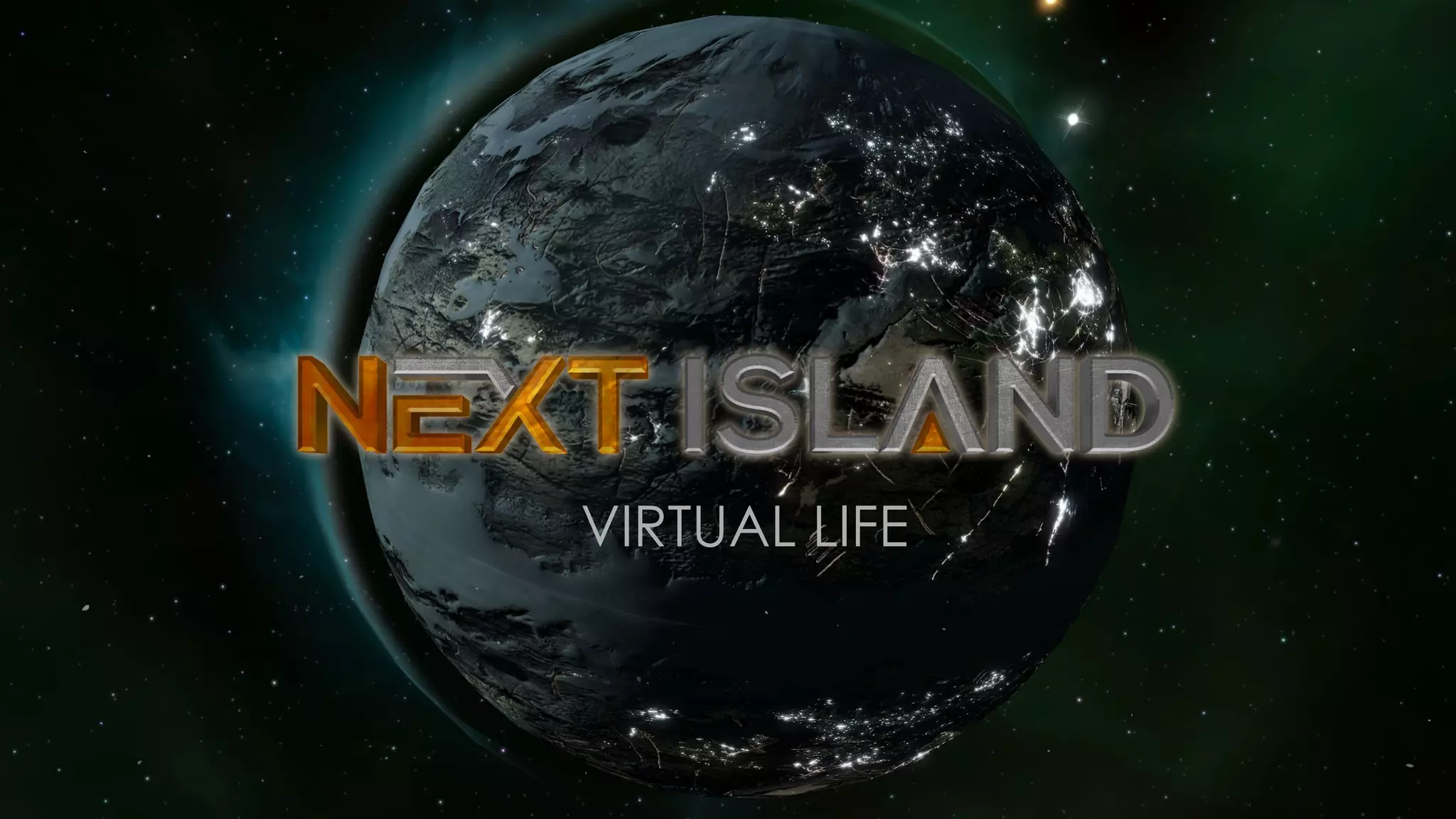
The opening slide features the Next Island logo over a dark, illuminated planet. The tagline 'VIRTUAL LIFE' establishes the scope of the project. It positions the company not just as a game, but as a persistent digital existence. The aesthetic is sci-fi and space-oriented, which aligns with the 'Primary Planet' description found later in the deck.
Slide 2: Customizable Avatars
Slide 2 focuses on the user onboarding experience. It shows a screenshot of an avatar customization interface. The text 'Customize your own personal avatar upon account creation' is a standard feature for the genre, but its inclusion early in the deck emphasizes the 'Virtual Life' aspect—personal identity is the hook for player retention in RCE games.
Slide 3: Massive Environment
This slide details the scale of the game world. It lists a 'Primary Planet with surrounding space' and specific biomes: 'Detailed jungle, desert, mountain and mediterranean regions.' The mention of 'dozens of creatures, materials and structures' points toward a resource-heavy economy. The final bullet point, 'Connect to alternate realities,' hints at the interoperability inherent in the Entropia Universe, where players can travel between different planets (developed by different companies) using the same avatar and currency.
Slide 4: Endless Adventure and Entertainment
Slide 4 is a placeholder for a video, stating 'Next Island is continually evolving and growing new content for our customers.' The visual shows a Greco-Roman statue overlooking a lush landscape, introducing the 'Ancient Greece' theme that becomes a central financial point later in the presentation. This slide serves to demonstrate that the world is not static.
Slide 5: Existing Assets and Traction
This is the most data-dense slide in the deck. It lists the following key metrics and facts:
100,000 active players on the platform. · 211 million gamers in the US and 2.2 billion worldwide (market context). · Revenue Model: 'Every activity generates revenue for us and our partners.' · Professions: A list ranging from 'Hunting' and 'Mining' to 'Social Entrepreneur' and 'Beautician.'
The inclusion of 'Social Entrepreneur' and 'Real Estate Mogul' as professions reinforces the idea that this is an economic simulation as much as a game.
Slide 6: Technology Evolution
Slide 6 addresses the technical longevity of the product. It states that Next Island on the Entropia platform has 'continually adapted to new gaming engines.' It explicitly mentions a 'transition of graphical growth in the near future,' accompanied by an Unreal Engine 'Sizzle Reel' thumbnail. This is a crucial point for investors who might be wary of the aging graphics often associated with long-running MMOs.
Slide 7: Collaborators and Infrastructure
This slide highlights the partnership with Mindark PE AB . Key figures cited include:
Mindark has existed for over 15 years . · The platform represents over $60,000,000 in development costs. · It is described as the 'largest true currency virtual environment in existence.'
By anchoring their pitch to Mindark, Next Island attempts to de-risk the investment by showing they aren't building the core engine from scratch, but rather building content on a proven, high-value infrastructure.
Slide 8: Virtual World Investment
Slide 8 introduces a specific investment vehicle within the game. It mentions a virtual asset called 'Ancient Greece' valued at $750,000 . The deck claims this asset is 'currently operating at 5% ROI' and offers a 'minimum $1 buy-in.' This slide blurs the line between a pitch for company equity and a pitch for virtual land speculation. It provides a direct call to action to 'Create your account HERE' to purchase shares.
Slide 9: Call to Action
The final slide provides links to Twitch streams and game downloads. It is a standard 'Want to know more?' closing. It lacks a traditional contact list for the executive team, instead pointing toward general community and gameplay links.
What Next Island Does Well
The deck excels at conveying the breadth of the virtual economy . By listing diverse professions like 'Beautician' and 'Spaceship Captain,' the founders show they understand the multi-faceted nature of a functional virtual society. The partnership with Mindark is their strongest selling point; citing $60 million in platform development gives the project a sense of scale and stability that a standalone indie MMO would lack.
Furthermore, the traction figure of 100,000 active players is a significant milestone. In the world of niche RCE games, a dedicated user base of that size is often enough to sustain a profitable ecosystem, provided the ARPU (Average Revenue Per User) is high, which is typical for 'true currency' games.
What is Missing from the Deck
The most glaring omission is a traditional fundraising structure . There is no slide detailing how much money the company is looking to raise, what the valuation is, or what the specific milestones are for the next 18-24 months. The deck feels more like a 'Player-Investor' brochure than a 'Venture Capital' pitch.
Additionally, there is no Team Slide . In early-stage or growth-stage investing, the pedigree of the founders—their experience in game design, economics, or software engineering—is paramount. Without knowing who is steering the ship, it is difficult for an institutional investor to assess execution risk.
Finally, the deck lacks Unit Economics . While it mentions that 'every activity generates revenue,' it doesn't provide the cost of user acquisition (CAC) versus the lifetime value (LTV) of a player. In a crowded gaming market, understanding the efficiency of the marketing spend is critical.
Founder's Guide: What to Copy
Founders building in the 'Metaverse' or Web3 gaming space should look at Slide 7. Leveraging the R&D of a platform partner is a great way to show capital efficiency. If you are building on top of Unreal, Unity, or a specific blockchain, quantify the value of that underlying infrastructure to show that your 'Ask' is going toward content and growth, not reinventing the wheel.
The specific asset valuation on Slide 8 is also an interesting tactic. While perhaps too 'retail-focused' for a VC deck, showing that your virtual assets have a measurable ROI and a secondary market value is a powerful way to prove that your virtual economy has real-world utility.
Final Analysis
The Next Island deck is a product-heavy presentation that leans on the credibility of its partner, Mindark. It successfully argues that the game is a living, breathing economy with significant history and a large player base. However, to attract serious institutional capital, the founders would need to add a clear financial 'Ask,' a detailed roadmap, and a breakdown of the leadership team. As it stands, the deck is a strong sales tool for the game's ecosystem but an incomplete narrative for a corporate equity raise.
Frequently asked questions
- What is the primary revenue model for Next Island?
- According to slide 5, every activity within the virtual world generates revenue for Next Island and its partners. This is supported by the Entropia Platform's 'true currency' system, where virtual items and activities have real-world monetary value. The deck also mentions profit-sharing through virtual asset investments, such as the 'Ancient Greece' territory.
- How does Next Island leverage third-party technology?
- Next Island is not a standalone engine; it utilizes Mindark’s Entropia Platform. Slide 7 notes that this platform has over $60,000,000 in development history. Additionally, slide 6 indicates a transition to modern graphical growth, showing the Unreal Engine logo, suggesting they are upgrading their visual stack to remain competitive.
- What is the scale of the current user base?
- Slide 5 claims the platform has 100,000 active players. It contextualizes this within a broader market of 211 million gamers in the US and 2.2 billion gamers worldwide. However, the deck does not define 'active' (e.g., DAU vs. MAU) or provide a growth trend over time.
- What kind of investment opportunities does the deck highlight?
- Uniquely for a pitch deck, slide 8 invites investors (or players) to buy into virtual assets. It lists 'Ancient Greece' as a $750,000 asset with a minimum $1 buy-in and a 5% ROI. This suggests a fractional ownership model for virtual land or revenue-generating game zones.
- Is there a clear exit strategy or funding goal mentioned?
- No. The provided slides do not include a financial roadmap, a specific funding 'ask,' or a target valuation. The deck functions more as a product overview and a call to participate in their virtual economy rather than a traditional venture capital solicitation for equity in the parent company.