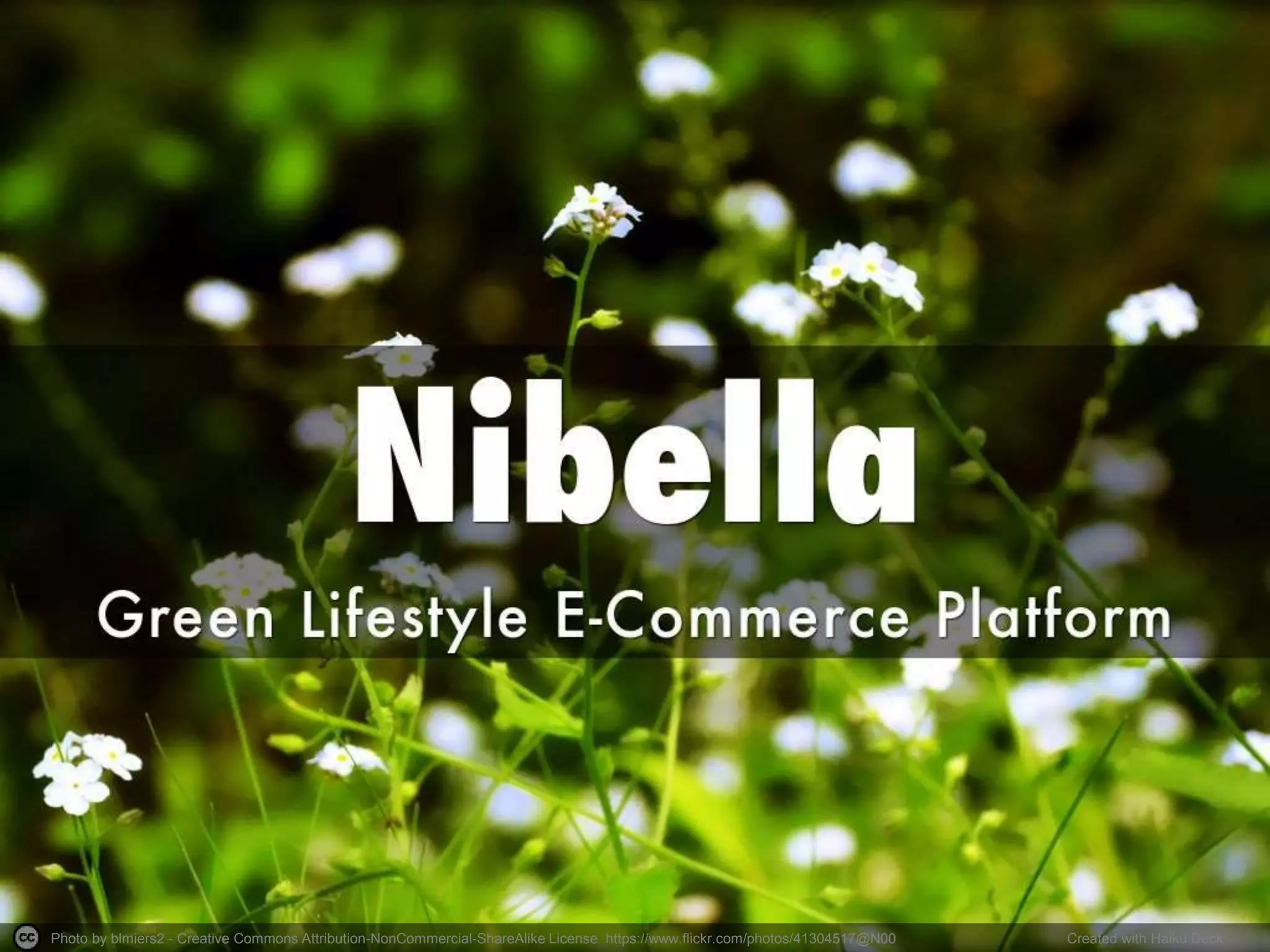
Nibella’s pitch deck is a product of its time, utilizing the Haiku Deck template to present a high-level vision for a green lifestyle e-commerce marketplace. The deck relies heavily on broad market statistics from 2013, such as the $593 billion U.S. B2C e-commerce market, to justify its existence. While it identifies a clear pain point—the lack of a centralized platform for thousands of new green brands—it lacks the granular detail required for a modern seed round. There are no financial projections, no specific product features, and no competitive analysis. The $100,000 ask is remarkably low…
Key takeaways
- The company defines itself as a one-stop shop online marketplace for green lifestyle enthusiasts on slide 2.
- Market validation is based on 2013 data showing $593 billion in U.S. B2C e-commerce sales on slide 3.
- The deck claims 54% of shoppers are 'leaning green,' providing a broad target demographic on slide 4.
- A core problem identified is the 'lack of platform' for the 10,000s of new green brands to reach consumers on slide 6.
- The solution aims to increase overall B2C e-commerce through a centralized green shopping hub on slide 7.
- The founders are seeking a $100k investment to redesign the platform and expand the marketing team on slide 8.
- The team consists of two co-founders, Bellina and Frank, though their full names and specific past companies are omitted on slide 9.
- The deck lacks any mention of business model, unit economics, or current traction metrics.
The Vision: A Green One-Stop Shop
Nibella’s pitch deck is a minimalist presentation that follows a classic problem-solution narrative. It positions itself as the missing link in the green economy, attempting to aggregate a fragmented market of eco-friendly brands into a single, community-driven marketplace. However, the deck is light on the 'how' and 'how much,' focusing instead on the 'why.'
Slide 1: Title Slide
The deck opens with a high-resolution image of white flowers, reinforcing the 'Green Lifestyle' branding. The subtitle, "Green Lifestyle E-Commerce Platform," immediately identifies the sector and the business model. It is a clean, albeit generic, start that sets the aesthetic tone for the rest of the presentation.
Slide 2: Nibella Is...
This slide serves as the executive summary. It lists four bullet points: interaction between consumers and brands, a one-stop shop marketplace, a community of enthusiasts, and a catalyst for green business growth. By using the word "interaction," the founders hint at a social or community element that goes beyond a standard retail site, though they do not explain the mechanics of this interaction here.
Slide 3: Market Size (Macro)
The deck cites "$593 billion in B2C E-Commerce Sales in U.S. Alone in 2013." While this number is large, it is a 'Total Addressable Market' (TAM) figure that is too broad. It represents the entire e-commerce industry, not the specific 'green' niche Nibella occupies. Using 2013 data dates the deck significantly and suggests it was produced in late 2013 or early 2014.
Slide 4: The Target Consumer
Slide 4 narrows the focus, stating that "54% of Shoppers are 'Leaning Green'." This is a Serviceable Addressable Market (SAM) indicator. It suggests a massive appetite for eco-friendly products, but the term 'leaning green' is vague and lacks a cited source, making it difficult to weigh the actual intent to purchase versus general sentiment.
Slide 5: The Brand Explosion
The deck notes there are "10,000s of New Green LifeStyle Brands." This slide establishes the supply side of the marketplace. It suggests a fragmented market where small brands are struggling to find a voice, which leads directly into the problem statement on the next slide.
Slide 6: The Problem
The problem is succinctly stated as a "Lack of Platform To Help Them Grow & Reach More Consumers." This is a classic marketplace pitch: the supply (brands) and demand (consumers) exist, but the infrastructure to connect them is missing. It identifies the pain point for the brands rather than the consumers.
Slide 7: Our Solution
The solution slide reiterates the marketplace concept. It claims that through the platform, there will be an "Overall increase in B2C e-commerce." This is a bold claim, suggesting that Nibella won't just capture existing market share but will actually grow the category by making these products more accessible.
Slide 8: The Ask
Nibella is seeking a "Target Investment $100K." This is a very small seed or pre-seed ask. The funds are designated for a "Redesign [of the] e-commerce platform into an interactive B2C E-Commerce Community" and to "Expand Marketing & Sales Team." The low dollar amount suggests the founders are looking for 'friends and family' level funding or a very early angel check to reach a specific technical milestone.
Slide 9: The Team
The co-founders are introduced as Bellina and Frank . Bellina is credited with an "Economics & Marketing Background," and Frank with a "Business & B2C Background." The lack of surnames, specific titles, or past company logos is a significant weakness. In early-stage investing, the team is often more important than the idea, and this slide provides very little to vet.
Slide 10: Contact Information
The deck concludes with an email address ( info@econibella.com ) and a social handle ( @econibella ). The use of the 'econibella' domain suggests the company may have been branded as EcoNibella or that the primary domain was already taken.
What Nibella Does Well
The deck is highly readable. By using the Haiku Deck format, the founders were forced to limit text, which prevents the 'wall of words' common in amateur decks. The flow is logical: it identifies a massive market, a specific growing niche, a supply-side problem, and a platform-based solution. The visual consistency—using nature-themed photography—aligns well with the brand's 'green' mission.
What is Missing from the Deck
The omissions in this deck are substantial and would likely prevent a professional VC from moving to a second meeting. Specifically:
Business Model: There is no explanation of how Nibella makes money. Do they take a 15% commission? Is there a monthly fee for brands? · Traction: There are no metrics regarding current users, GMV (Gross Merchandise Volume), or brand partnerships. Even if the platform is in pre-launch, there should be a list of 'signed' brands or a waitlist of consumers. · Product Deep Dive: The deck mentions an 'interactive community' but doesn't show what that looks like. Are there forums? User reviews? Social sharing features? · Competition: The deck acts as if Nibella is the only player in the space. Acknowledging competitors and explaining a unique value proposition (UVP) is essential. · Financial Projections: A $100k ask usually requires a basic roadmap of how that money sustains the company until the next milestone or profitability.
Founder Takeaways: What to Copy and What to Avoid
Copy the simplicity: The one-idea-per-slide rule is effective here. You never have to guess what a slide is about. The use of large, bold numbers (like the $593 billion on slide 3) creates immediate impact.
Avoid the lack of specificity: Never list your team without full names and LinkedIn-verifiable backgrounds. Investors invest in people. Furthermore, avoid using 'Total Market' figures that aren't specific to your niche. Claiming the entire U.S. e-commerce market as your playground makes the founders look like they don't understand their actual reachable market.
Bridge the gap between 'Community' and 'Commerce': Nibella mentions 'interaction' and 'community' multiple times but never defines them. If your 'secret sauce' is a community aspect, you must show—via wireframes or feature lists—how that community actually drives sales. Without that, it’s just a buzzword.
Frequently asked questions
- What is the primary business model of Nibella?
- The deck does not explicitly state a business model. While it describes itself as an 'online marketplace' and a 'platform' on slide 7, it fails to mention if it generates revenue through transaction fees, listing fees, subscriptions, or advertising. This is a significant omission for an e-commerce pitch.
- How does Nibella plan to use the $100,000 investment?
- According to slide 8, the funds are earmarked for two primary activities: redesigning the e-commerce platform into an 'interactive B2C E-Commerce Community' and expanding the marketing and sales team to reach a wider demographic. The specific allocation between these two goals is not provided.
- Who are the competitors in the green e-commerce space?
- The deck completely omits a competitive landscape slide. It does not mention existing giants like Amazon’s climate-pledge friendly section, or niche competitors like Thrive Market or Grove Collaborative, which were emerging or established around the time of this deck's 2013 data points.
- What is the current stage of the product?
- The deck implies the product already exists but requires a 'redesign' (slide 8). However, there are no screenshots of the current interface, no user growth data, and no sales figures to indicate whether the platform is live or in a beta stage.
- What are the qualifications of the founding team?
- Slide 9 lists Bellina (Economics & Marketing background) and Frank (Business & B2C background). The deck does not provide their last names, educational institutions, or specific professional achievements, making it difficult for investors to verify their expertise or 'founder-market fit'.