NEXT Life Sciences utilizes a 16-slide deck to position its product, Plan A, as the first viable long-acting, reversible male contraceptive. The pitch centers on the acquisition of Vasalgel technology, a hydrogel that offers a 10-year duration of effectiveness with on-demand reversibility. By highlighting a $55B total addressable market and a 3x increase in vasectomy demand following the overturn of Roe v. Wade, the deck builds a case for a massive, underserved consumer base. While the deck is strong on intellectual property and medical validation through its advisory board, it lacks specific…
Key takeaways
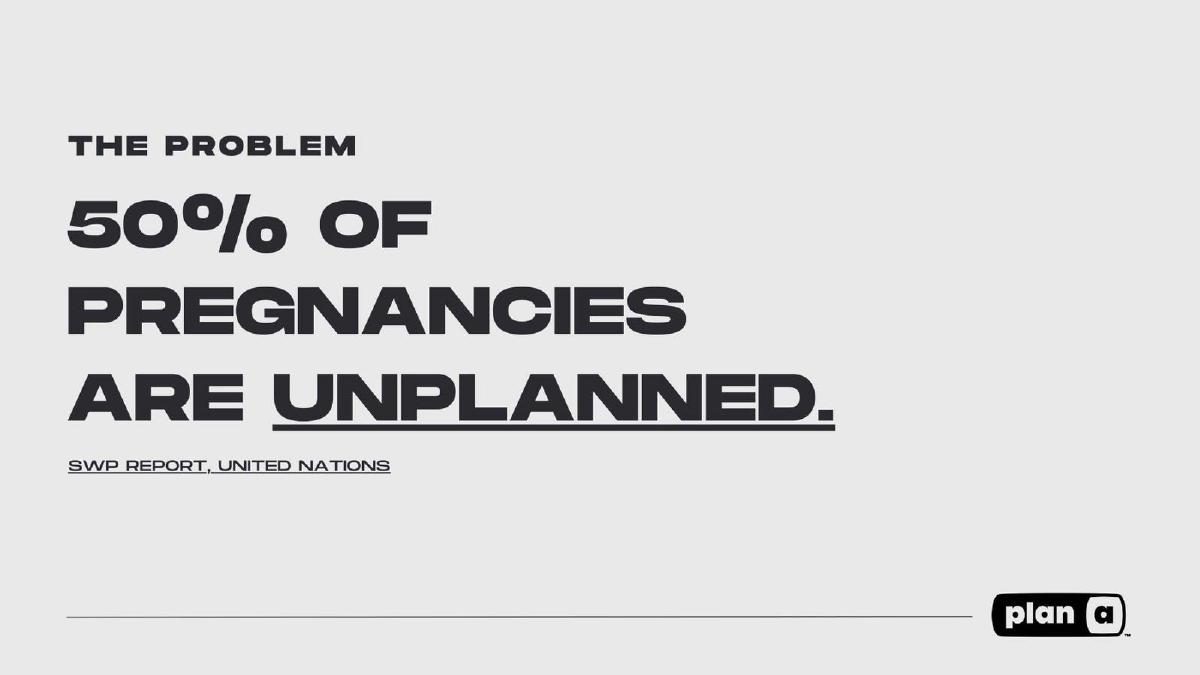
- The deck identifies a massive market gap by stating 50% of pregnancies are unplanned on slide 3.
- Plan A is positioned as a 10-year, 'thought-free' protection method that is easily reversible on slide 5.
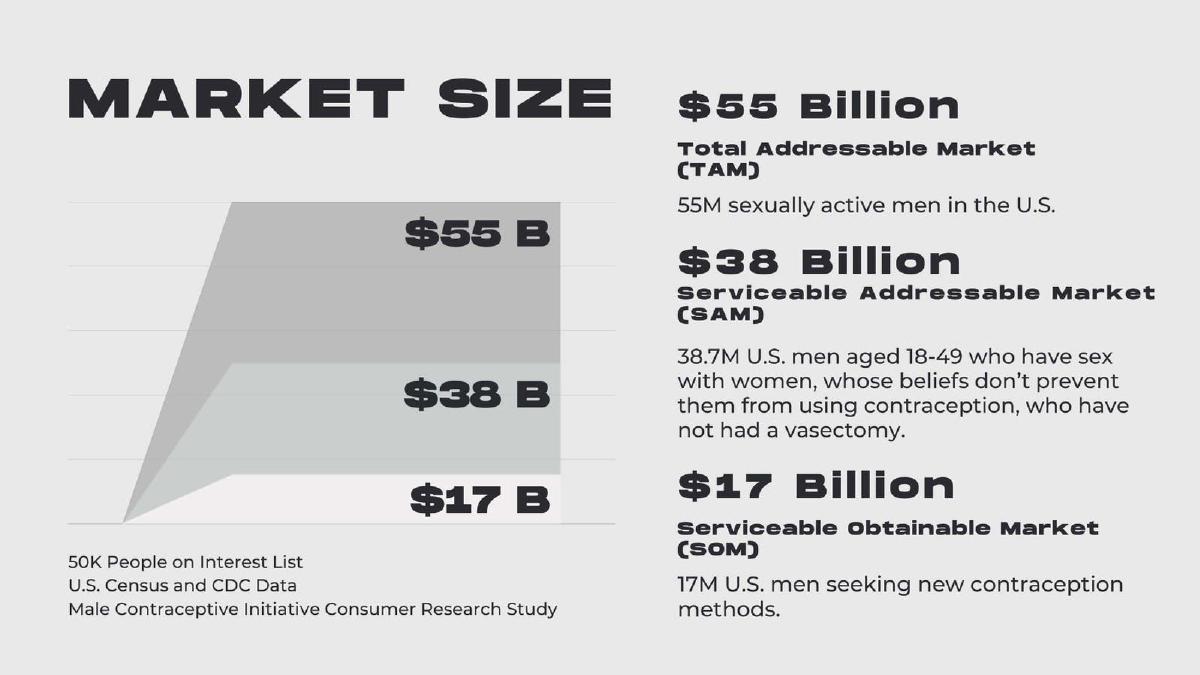
- The company claims a $55B total addressable market for male contraception on slide 8.
- External regulatory shifts are used as a tailwind, citing a 3x increase in vasectomy demand since the Roe v. Wade overturn on slide 9.
- The medical advisory board features experts who have collectively performed over 140,000 vasectomies, providing deep clinical credibility on slide 11.
- Intellectual property is a core pillar, with 10+ years of patent life and multi-layered global protection detailed on slide 13.
- The deck omits a specific 'Ask' slide detailing how the $2.5M will be spent or the milestones it will achieve.
- Unit economics and specific pricing strategies for the 10-minute procedure are not included in the slides.
Introduction and The Problem
Slide 1: Intro Slide
The deck opens with a minimalist aesthetic, focusing on the brand name NEXT Life Sciences and the product name plan a . The sub-headline clearly defines the value proposition: "Non-hormonal, long-acting, and reversible male birth control." This slide establishes the CEO as L.R. Fox and includes a standard legal disclaimer regarding forward-looking statements and FDA status. It is a functional, high-signal start that tells the investor exactly what industry and product category they are looking at.
Slide 3: The Macro Problem
Slide 3 presents a single, stark statistic: "50% of pregnancies are unplanned." Citing a United Nations SWP report, this slide establishes the social and economic urgency of the mission. By starting with the global impact rather than the technical specifications, NEXT Life Sciences frames their product as a solution to a systemic public health issue.
Slide 4: Inadequacy of Current Options
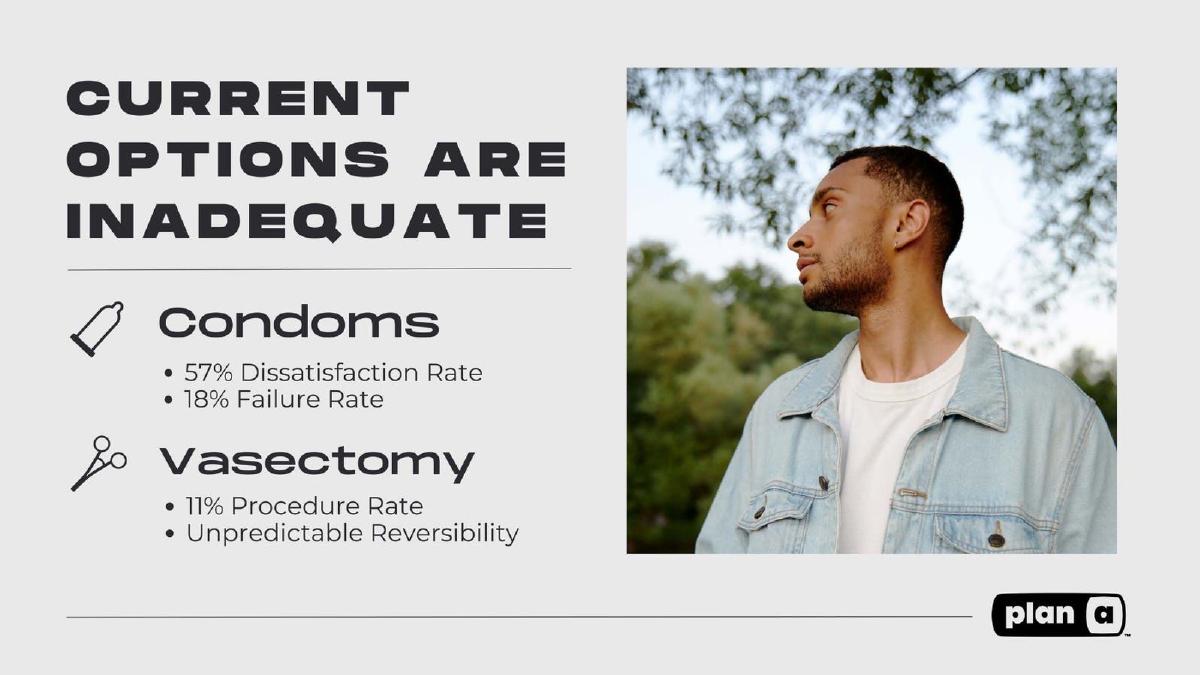
This slide (text-only in the provided list) argues that current male birth control options are inadequate. This sets the stage for the competitive comparison later in the deck. It implies that the binary choice between highly temporary methods (condoms) and permanent ones (vasectomies) leaves a massive gap in the market.
The Solution: Plan A
Slide 5: The Value Proposition
The solution slide introduces Plan A with three primary pillars: a 10-minute pain-free procedure, 10 years of "thought-free" protection, and easy reversibility. It explicitly mentions the use of patented Vasalgel technology . This is a critical point for investors, as Vasalgel has a pre-existing reputation in the medical community, suggesting the company is not starting from zero but rather commercializing a known asset.
Slide 6: How Plan A Works
This slide (text-only) provides the technical mechanism. For a medical device, explaining the "how" is vital. It describes the hydrogel's role in blocking the vas deferens, emphasizing the non-hormonal nature of the product, which avoids the systemic side effects typically associated with female hormonal birth control.
Slide 7: Competitive Landscape
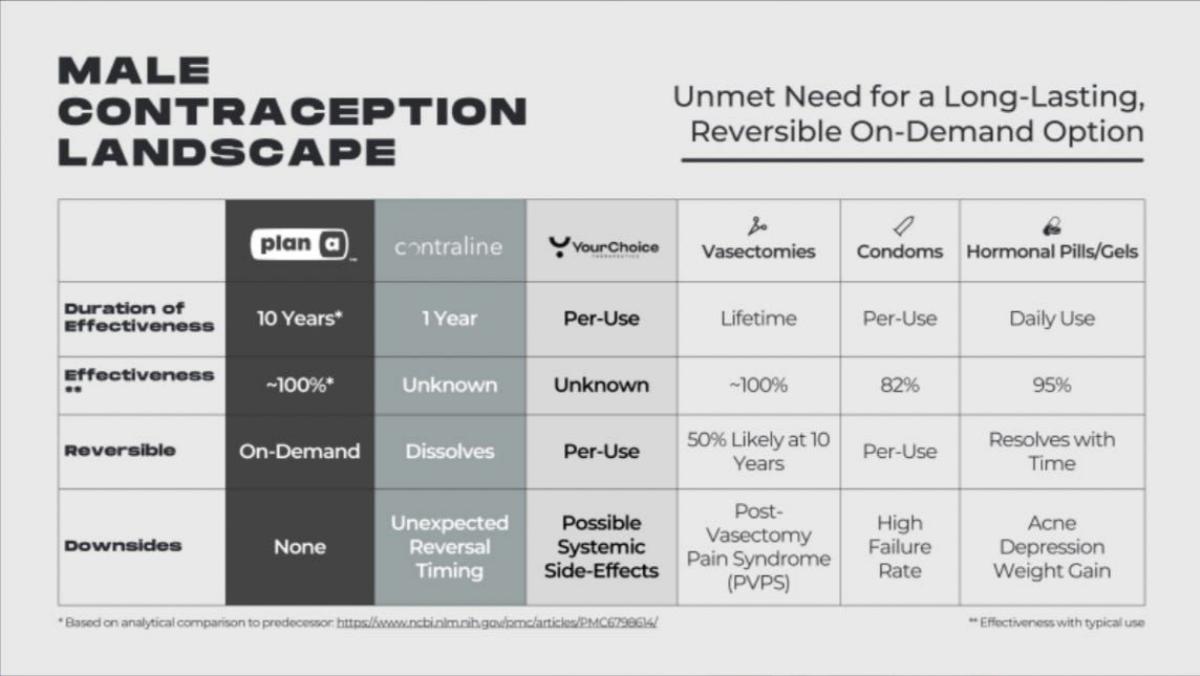
Slide 7 is a classic comparison matrix. It pits Plan A against Contraline, YourChoice, Vasectomies, Condoms, and Hormonal Pills/Gels . Plan A is the only option listed with a 10-year duration, ~100% effectiveness, and on-demand reversibility. Most notably, under the "Downsides" row, the company claims "None" for Plan A, while listing "Post-Vasectomy Pain Syndrome" for vasectomies and "Acne, Depression, Weight Gain" for hormonal options. Claiming "None" for downsides is a high-risk statement in a pitch deck, as all medical procedures carry some level of risk, but it serves to highlight the perceived superiority of the hydrogel approach.
Market Opportunity and Trends
Slide 8: Market Size
The company claims a $55B Total Addressable Market (TAM) . While the slide doesn't provide the bottom-up calculation for this figure, it sets the scale of the ambition. In the context of a $2.5M seed round, a $55B TAM suggests significant room for venture-scale returns if the product captures even a fraction of the market.
Slide 9: Market Trends
This slide uses three data points to prove market pull: 85% of men want to participate in pregnancy prevention, 1/3 of vasectomy referrals go unfulfilled (suggesting a supply/demand mismatch or patient hesitation), and a 3x increase in vasectomy demand since the Roe v. Wade overturn. This last point is particularly savvy, as it ties the company's success to current geopolitical and regulatory shifts in the United States, creating a sense of "why now.”
Validation and Execution
Slide 10: Company History
Slide 10 (text-only) likely details the acquisition of the Vasalgel assets. For a biotech startup, the history of the intellectual property is often as important as the history of the founders, as it proves the technology has undergone prior scrutiny and development.
Slide 11: Medical Advisory Board
This is one of the strongest slides in the deck. It features five MDs with significant credentials. Mike Eisenberg is the Director of Male Reproductive Medicine at Stanford. Ron Weiss, Doug Stein, and Michel Labrecque are highlighted for their sheer volume of clinical experience, having performed a combined 140,000+ vasectomies . This level of clinical validation is intended to de-risk the "procedure" aspect of the product for investors.
Slide 12: Go-To-Market Plan
Slide 12 (text-only) outlines how they intend to reach the consumer. Given the product requires a procedure, the GTM likely involves a mix of direct-to-consumer marketing to build demand and partnerships with urology clinics to facilitate the actual injections.
Slide 13: International IP Protection
Slide 13 focuses on the "moat." It claims 10+ years of patent life and a multi-layered strategy covering the injection/dissolution method, hydrogel tissue bridging, manufacturing process, and composition/formulation. The presence of flags from the EU, China, Mexico, Canada, USA, Hong Kong, South Korea, Israel, and Australia indicates a global commercial intent.
Timeline and Conclusion
Slide 14: Development Timeline
This slide (text-only) provides the roadmap. In healthcare, this usually includes preclinical trials, IDE (Investigational Device Exemption) submission, and various phases of clinical trials. Investors in this round are looking to see how far $2.5M gets them—specifically, if it reaches a major clinical milestone that triggers a Series A.
Slide 15: The Gates Quote
The deck concludes with a quote from Bill Gates : "Contraceptives are one of the greatest lifesaving innovations in history." This is a classic "appeal to authority" move, aligning the company with global philanthropy and high-level tech validation, even if the Gates Foundation is not an explicit investor in this specific round.
What Works and What is Missing
What Works
Clear Value Proposition: The "10-minute, 10-year, reversible" hook is incredibly easy to understand and communicate. It passes the "elevator pitch" test perfectly.
Clinical Credibility: The Medical Advisory Board is not just a list of names; the inclusion of their total procedure counts (e.g., 50,000+ vasectomies) provides a tangible sense of expertise.
Timing: Leveraging the post-Roe v. Wade landscape (Slide 9) provides a compelling "Why Now" that moves the product from a "nice to have" to a critical healthcare tool.
What is Missing
The Ask: The deck does not explicitly state how much they are raising or what the specific milestones are for the capital. While we know from external reports that they raised $2.5M, a slide detailing the use of funds (e.g., 40% R&D, 30% Clinical Trials, 30% Ops) is standard and missing here.
Unit Economics: There is no mention of what the procedure will cost the patient or what the margins look like for the company. Is this a $500 procedure or a $5,000 one? How does it compare to the lifetime cost of condoms or the one-time cost of a vasectomy?
Regulatory Detail: While the timeline is mentioned, the specific regulatory pathway (PMA vs. 510k) for the FDA is not detailed in the provided text. For a medical device, the complexity of the regulatory path is a primary driver of risk.
Founder Takeaways
Quantify your advisors: Don't just list titles. NEXT listed the number of procedures their advisors performed, which is a much stronger signal of market knowledge. · Tie your product to current events: The 3x increase in vasectomy demand since Roe v. Wade (Slide 9) makes the market opportunity feel urgent and inevitable rather than theoretical. · Own the IP narrative: If you have acquired or licensed technology, be transparent about the patent life and the layers of protection (Slide 13). This is your primary defense against incumbents. · Simplify the mechanism: Slide 5 and 6 avoid overly dense medical jargon in favor of clear benefits: "thought-free protection" and "pain-free procedure."
Frequently asked questions
- What is the core technology behind NEXT Life Sciences?
- The company utilizes Vasalgel, a patented hydrogel technology. As described on slide 5 and 13, it is a non-hormonal, long-acting, and reversible male contraceptive. The procedure involves a 10-minute injection that provides up to 10 years of protection by physically blocking sperm, and it can be reversed on-demand by dissolving the gel.
- How does NEXT Life Sciences justify its market size?
- On slide 8, the company cites a $55B total addressable market. This is supported by trends on slide 9, which state that 85% of men want to participate in pregnancy prevention and that vasectomy demand has tripled following the overturn of Roe v. Wade. They also note that 1/3 of vasectomy referrals currently go unfulfilled.
- Who is on the team for NEXT Life Sciences?
- The deck highlights a leadership team led by CEO L.R. Fox (slide 1) and a robust Medical Advisory Board (slide 11). The board includes experts like Mike Eisenberg (Director of Male Reproductive Medicine at Stanford) and practitioners like Ron Weiss and Doug Stein, who have performed over 50,000 vasectomies each.
- What are the main competitors mentioned in the deck?
- Slide 7 compares Plan A against Contraline, YourChoice Therapeutics, vasectomies, condoms, and hormonal pills/gels. The deck claims Plan A is superior due to its 10-year duration and 'on-demand' reversibility, whereas competitors are either daily-use, per-use, or have lower effectiveness and higher side effects.
- What is missing from the NEXT Life Sciences pitch deck?
- The deck lacks a clear 'Ask' slide detailing the specific use of funds for the $2.5M seed round. It also omits financial projections, unit economics (cost per procedure vs. revenue), and a detailed breakdown of the clinical trial phases required for FDA approval, though a general development timeline is mentioned on slide 14.