Revolut’s 2014 seed deck is a masterclass in identifying a visceral consumer pain point: the high cost of global spending. Despite a weak marketing slide and a missing team page, the deck succeeded by presenting a bold vision for a 'personal money cloud' and de-risking the venture through early partnerships with MasterCard and Barclays. It effectively positioned Revolut as a holistic platform rather than a niche tool, setting the stage for its evolution into a global financial super-app.
Key takeaways
- Obsess over your problem statement: make it simple, visceral, and relatable using the language customers actually use.
- Frame competition around customer jobs to show how you solve the full cycle of pain versus point solutions.
- Use pre-launch traction like waitlists and strategic partnerships to prove demand and execution capability.
- Tie your funding ask to specific milestones that will make the next round of investment a no-brainer.
- Focus on a powerful core story to get the meeting; vision and founder-market fit often trump detailed execution plans.
The Moment: London, 2014, The Dawn of the Neobank
To understand why this deck worked, you have to transport yourself back to 2014. The global financial system was still nursing a hangover from the 2008 crisis. Public trust in big banks was at an all-time low. In the UK, high-street banks were seen as dinosaurs with extortionate fees, terrible technology, and a profound disconnect from their customers. The smartphone was king, yet mobile banking apps were often little more than clunky website wrappers.
Into this environment, a few disruptive players had emerged. Most notably, TransferWise (now Wise) had spent three years proving that a tech-first approach could dramatically lower the cost of international money transfers. They validated the core pain point: people hate hidden FX fees. But their focus was narrow—primarily P2P transfers.
This was the world Nikolay Storonsky, a former derivatives trader for Credit Suisse and Lehman Brothers, surveyed. He saw a bigger opportunity. The problem wasn't just sending money; it was the entire experience of being a global citizen. Spending abroad on a debit card meant getting hit with fees. Holding foreign currency meant opening a complex, expensive bank account. The whole system was fragmented and hostile to the user. Revolut’s seed deck was a direct pitch to fix this fragmented experience. It aimed to raise a £1.5 million seed round, led by Balderton Capital, to build the first version of a product that would bundle these solutions into a single, elegant app.
Slide-by-Slide Analysis
h3>Slide 1: Title ('personal money cloud')
The deck opens with a title that is both evocative and of its time. In 2014, everything was moving to the 'cloud'. This phrase cleverly positioned Revolut not as a bank, but as a lightweight, digital-native service. It’s an asset, not an institution. The most striking element, however, is the founder's name and personal phone number. This is a move of supreme confidence. It says, "I am the company. I am accessible. Call me if you have questions." For an early-stage investor, this directness is powerful. It cuts through formality and signals a founder who is all-in.
h3>Slide 2: The Problem
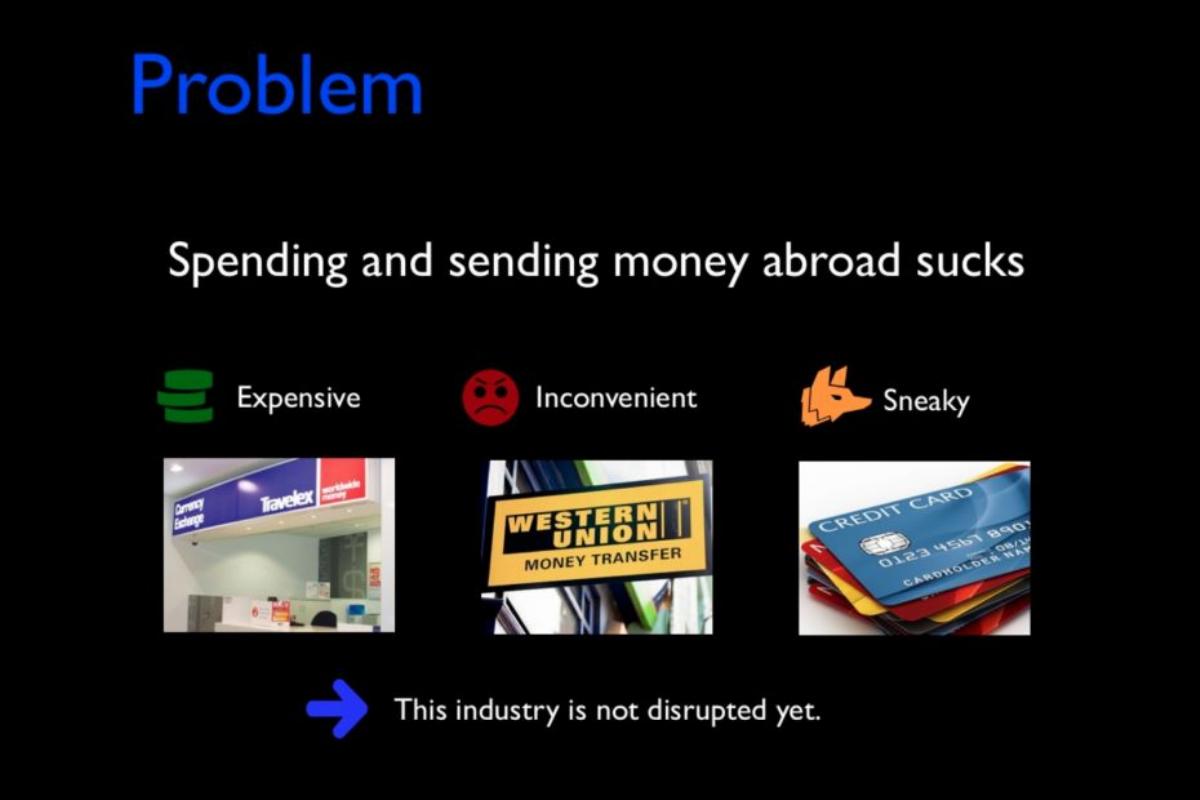
This is, without a doubt, one of the great problem slides in modern pitch deck history. Its power lies in its brutal simplicity: "Spending and sending money abroad sucks." It’s not 'inefficient' or 'sub-optimal'. It sucks. This is the language customers use. The three descriptors—Expensive, Inconvenient, Sneaky—are emotional and instantly relatable to anyone who has ever traveled. The word 'sneaky' is particularly brilliant, capturing the feeling of being ripped off by hidden fees and opaque exchange rates. The closing statement, "This industry is not disrupted yet," is a bold, direct challenge. It acknowledges competitors like Wise but simultaneously dismisses them as incomplete solutions, positioning Revolut's vision as the true, holistic disruption.
h3>Slide 3: Market Size
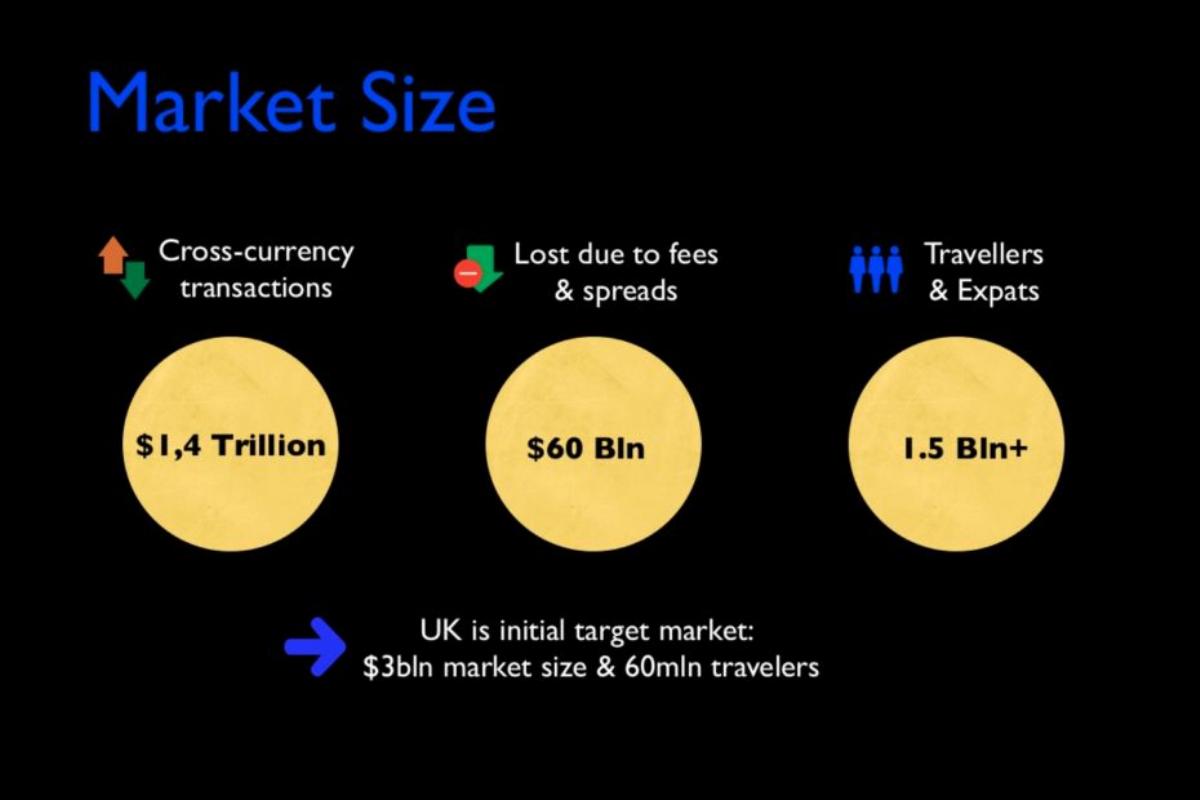
Revolut follows the classic TAM-SAM-SOM (Total Addressable Market, Serviceable Addressable Market, Serviceable Obtainable Market) structure.
TAM: $1.4 Trillion in cross-currency transactions. This is the big, sexy number that says the underlying activity is massive. · SAM: $60 Billion lost to fees. This is the crucial slide. It's not about the transaction volume; it's about the value that can be captured. This is the actual market Revolut is playing in. · SOM: A $3 Billion market in the UK with 60 million travelers. This grounds the pitch in reality. It shows investors they have a focused beachhead market and aren't boiling the ocean from day one. It makes the plan feel achievable.
This slide effectively communicates both the scale of the long-term vision and the pragmatism of the initial go-to-market.
h3>Slide 4: The Solution
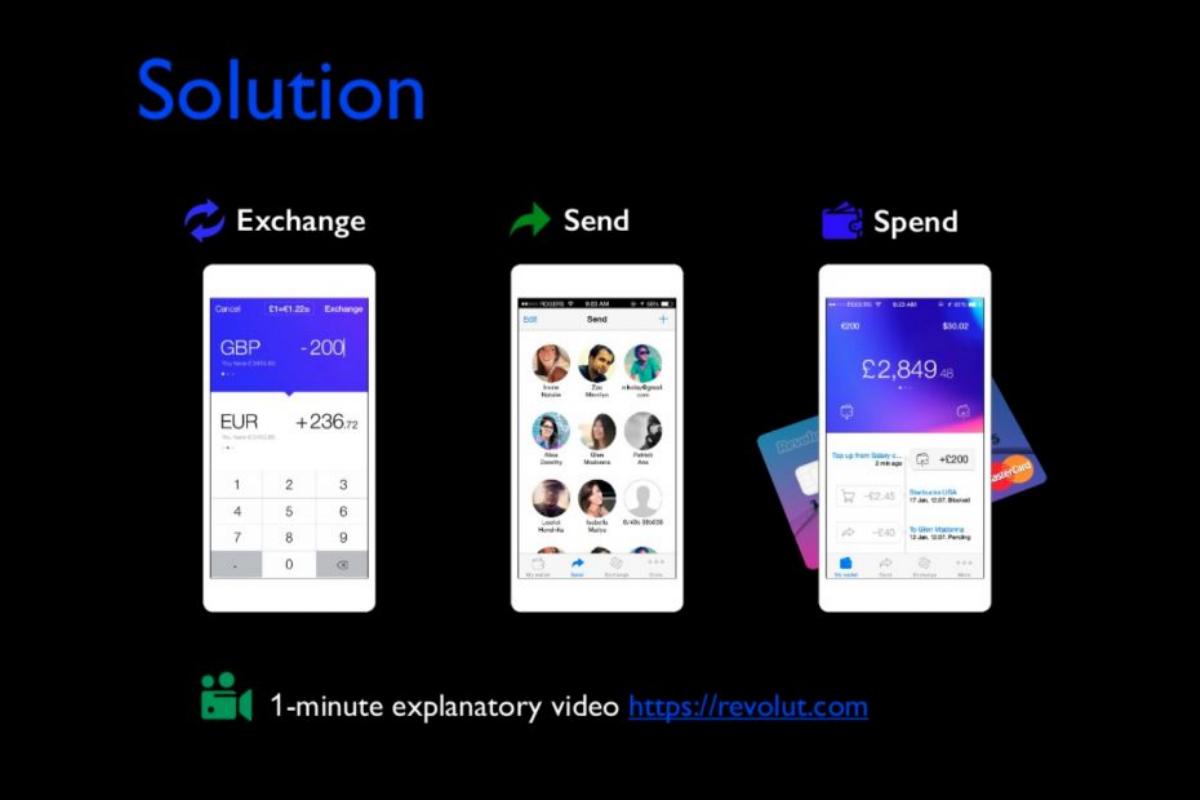
Mirroring the simple problem slide, the solution is presented with three clean icons: Exchange, Send, Spend. This maps directly to the pains of international money. You need to get currency (Exchange), move it to others (Send), and use it for purchases (Spend). By presenting these three pillars, Revolut defines its scope as far broader than the pure-play money transfer startups. The inclusion of a "1-minute explanatory video" is a smart tactic for a pre-product company. It keeps the deck clean and delegates the detailed product demo, ensuring the core narrative isn't bogged down in UI specifics. It's a way of saying, "The experience is so smooth, we need to show you in motion."
h3>Slide 5: Business Model
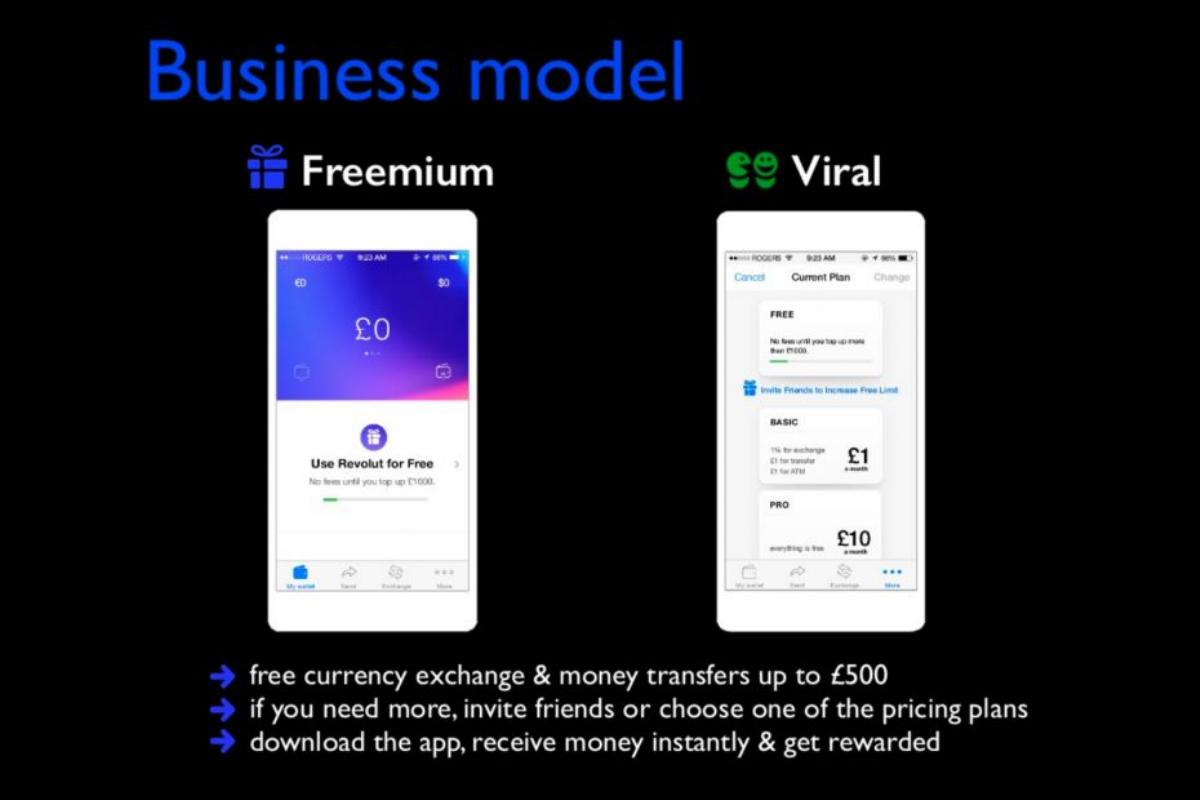
The deck presents two key concepts: "Freemium" and "Viral". This was a killer combination for consumer apps in the mid-2010s. The model is simple: use Revolut's core services for free up to a certain limit (£500). This is the Trojan Horse. It removes all friction and cost from trying the product, a brilliant strategy for acquiring users in a market where trust is low and inertia is high. The monetization and growth mechanics are baked in from the start: once you hit the limit, you can either invite friends (fueling the viral loop) or upgrade to a paid plan. This showed investors a clear, scalable path to both user growth and future revenue.
h3>Slide 6: Marketing
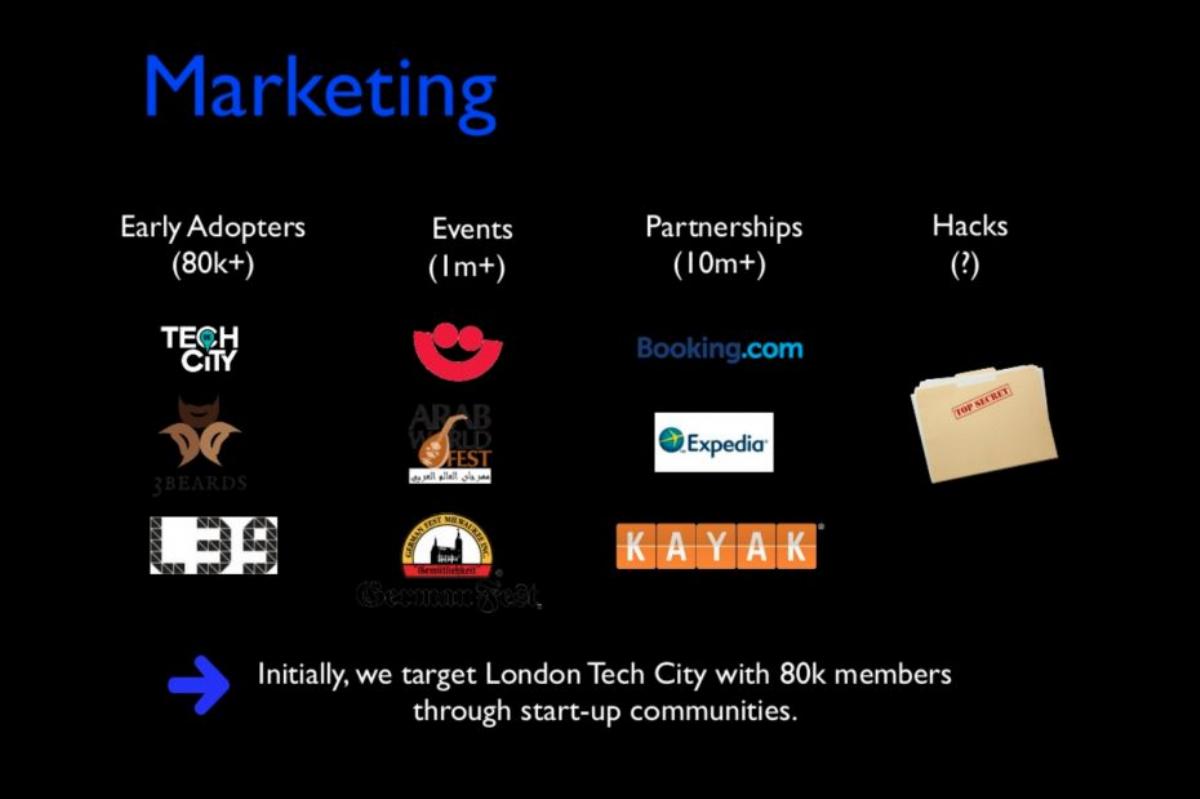
This is easily the weakest and most hand-wavy slide in the entire deck. It breaks the go-to-market into four buckets: Early Adopters, Events, Partnerships, and Hacks. The only concrete detail is the plan to target "London Tech City with 80k members." The other numbers—"1m+" from events, "10m+" from partnerships—are pure fantasy at this stage. They are unsubstantiated, top-down numbers with no strategy behind them. So why did it pass? Because the problem, solution, and business model were so compelling, and the initial target audience was so well-defined, that investors were willing to overlook the lack of a detailed marketing playbook. They bet that a product this disruptive would find its own channels.
h3>Slide 7 & 8: Competition and 'Why we are better'
This is a strong one-two punch. First, Revolut segments the competition intelligently: the "Old Players" (banks), other "Start-ups" (Wise, etc.), and by "Use cases." This use-case checklist is the most effective part. It reframes the competition from a feature-for-feature battle to a 'job-to-be-done' framework. It visually demonstrates that while competitors might solve one specific pain point (like sending money cheaply), only Revolut solves the "full cycle of customer pain." It’s a powerful narrative that positions Revolut as the integrated platform versus a collection of point solutions. The "Why we are better" slide then summarizes the core value propositions: Interbank rates, Freemium/Viral model, Usability, Own Infrastructure, and a pending Patent. This provides a neat summary of their defensibility and competitive moats.
h3>Slide 9: Traction
For a company that hadn't launched, this slide is excellent. It provides three critical points of validation:
Demand Validation: 4,000 pre-product subscribers in a month from a simple landing page. This is concrete proof that the problem resonates and people want the solution. · Execution Validation: Deals with MasterCard and Barclays. This is huge. It told investors that the team could navigate the complex world of financial partnerships and had solved the critical infrastructure problem of how to issue a card (MasterCard) and hold funds (Barclays). It dramatically de-risks the plan. · Industry Validation: Being a finalist at Finovate Europe adds third-party credibility and shows they are recognized as a serious player in the fintech community.
h3>Slide 10: The Ask & Use of Funds
The financials are almost comically sparse, showing only a projected net loss. This signals that it's a pure vision play; the goal isn't short-term profit but land-grabbing. The ask is commendably direct: "We need £1.5m to make it happen." The Use of Funds is clear, logical, and tied to the next major milestone. The capital will be used to build the initial team, fund the freemium model to acquire the first 60,000 active users, and explicitly "prepare... for a big £££ series A round." This shows forward-thinking and tells investors exactly what their money will achieve: the proof points required for a much larger future valuation.
What Worked and Why Investors Said Yes
This deck is a classic example of a seed-stage pitch where vision and founder-market fit trumped detailed execution plans. Investors weren't funding a spreadsheet; they were funding a revolution led by a credible guide.
Clarity of Problem and Vision: The deck hammered on a massive, expensive, and universally understood problem. The vision was not just to be a cheaper alternative but to be a fundamentally better, integrated financial platform for a new generation. · Founder-Market Fit (The Unwritten Slide): While criminally absent from the deck itself, Nikolay Storonsky's background as an FX trader at elite financial institutions gave him immense credibility. He understood the system he was trying to break from the inside. Investors were betting on the jockey. · An Elegant Growth Engine: The freemium-viral loop was a self-perpetuating machine on paper. It presented a believable strategy for achieving massive scale with low marginal acquisition costs, a narrative that is music to a VC's ears. · Tangible De-Risking: The pre-launch signups and, most importantly, the partnerships with MasterCard and Barclays, proved this wasn't just an idea. The team had already overcome significant execution hurdles that would stop most other founders.
What Was Weak or Missing
The Team Slide: The single biggest omission. A seed-stage investment is a bet on the founding team. The deck completely fails to introduce them. This would be a near-fatal flaw in a 2024 pitch process. · Detailed Go-To-Market: The marketing slide was a list of channels with arbitrary numbers. A modern seed deck would require at least some bottom-up analysis on target channels, estimated CAC, and a phased rollout plan. · Product Visuals: Relying on an external video link is not ideal. Including 2-3 key mockups of the app's user journey would have made the solution much more tangible within the deck itself. · Unit Economics: The deck makes no attempt to quantify the path to profitability. There is no discussion of LTV, interchange revenue, or subscription conversion rates. The assumption is simply: get users, and the money will follow. This is a much harder sell in today's capital environment.
5 Lessons For Founders Raising Today
Obsess Over Your Problem Statement. Make it simple, visceral, and relatable. "Spending and sending money abroad sucks" is perfect. Test it on people outside of the tech bubble. If they don't get it in 5 seconds, it's too complicated. · Frame Competition Around Customer Jobs. Don't just show a grid of logos. Use a checklist or a journey map to show how your product uniquely solves a customer's entire problem, while competitors only offer point solutions. · Pre-Launch Traction is About De-Risking. You don't need revenue. A waitlist proves demand. A strategic partnership proves execution capability. An industry award proves social proof. Collect these proofs before you ask for money. · Tie Your 'Ask' to a Specific, Next-Round-Enabling Milestone. Don't just ask for money to "cover burn for 18 months." Ask for money to reach 'X' users, 'Y' in revenue, or 'Z' product milestone that will make your Series A a no-brainer. · Your Deck's Job is to Get the Meeting. This deck was imperfect. It had holes. But it was simple, bold, and compelling enough to get the founders in the room. In that room, the founder's personal credibility and ability to articulate the vision closed the deal. Don't let perfection be the enemy of a powerful core story.
Revolut: Then vs. Now
The 2014 deck was a blueprint; the reality is a skyscraper. The promise was to build a "personal money cloud" to Exchange, Send, and Spend. On this, Revolut has over-delivered to an almost unimaginable degree.
Product Expansion: The initial multi-currency card has exploded into a financial "super app." Revolut now offers stock and crypto trading, business accounts, junior accounts, savings 'vaults', personal loans, travel insurance, and subscription tiers ranging from free to the high-end 'Ultra' plan. · Scale: The deck aimed to fund growth to 60,000 monthly active users. Today, Revolut has over 40 million personal customers worldwide. The initial UK beachhead has expanded across Europe, to the US, Australia, and beyond. · Financials: The deck projected a £1.2M loss. The company raised its £1.5M seed round and went on to raise billions more, reaching a $33 billion valuation in its 2021 funding round. It has achieved profitability in recent years, a massive milestone for a company long criticized for a 'growth at all costs' mindset.
Ultimately, the Revolut seed deck stands as a testament to the power of a clear vision targeting a painful, expensive problem. It correctly identified that the future of finance wasn't just about being cheaper, but about being integrated, global, and mobile-first. For all its stylistic simplicity and tactical gaps, the deck's core thesis was profoundly right.
Frequently asked questions
- Why was there no team slide in the deck?
- A major omission by today's standards. Investors likely overlooked it due to founder Nikolay Storonsky's incredibly strong background as a trader at Lehman Brothers and Credit Suisse. His domain expertise was so apparent that he likely covered it in person, and investors were betting on his unique ability to disrupt a system he knew inside-out.
- Could a marketing slide this vague raise money today?
- It would be extremely difficult. The slide was aspirational, not strategic. Today, investors expect founders to have a much more detailed, bottom-up plan for customer acquisition, including target channels, estimated CAC, and experiments to be run. The bar for GTM strategy is significantly higher.
- How crucial was the 'Freemium + Viral' model to their success?
- Absolutely fundamental. It was the wedge that broke open the market. By eliminating the cost to try the product, they dramatically lowered customer acquisition cost. The 'invite friends' feature then turned their early adopters into a free sales force, creating the explosive growth that defined their early years.
- What's the biggest lesson from this deck for a non-fintech founder?
- Nail your one-sentence problem statement. Revolut's 'Spending and sending money abroad sucks' is a masterclass. It's human, emotional, and instantly understandable. It sets the stage for everything that follows. No matter your industry, if your problem isn't crystal clear, your solution won't matter.
- How did the MasterCard and Barclays partnerships de-risk the investment?
- Massively. They showed that Revolut wasn't just an app idea; it was a company that could execute in the highly regulated and partnership-driven world of finance. The MasterCard deal solved the 'Spend' problem (how to issue a physical card), and the Barclays deal solved the core banking infrastructure problem (where to hold customer funds). It turned a concept into a buildable business.