Ria Health’s Series A deck is a masterclass in clinical de-risking. Operating in the sensitive Alcohol Use Disorder (AUD) space, the company moved beyond simple 'telehealth' buzzwords to present hard evidence of patient persistence. By showing that 55% of members stick to the program for over six months—compared to a 40-70 day industry average—Ria Health transformed a behavioral health challenge into a predictable, data-driven medical outcome. The deck successfully balances a compassionate mission with a cold, hard business logic centered on bundled payments and national provider coverage. Wh…
Key takeaways
- Ria Health positions Alcohol Use Disorder as 'The Next Pandemic' following physical and economic crises (Slide 2).
- The platform claims a 55% member retention rate over 6 months, significantly outperforming the 40-70 day average of traditional ambulatory systems (Slide 10).
- Clinical efficacy is a primary selling point, with 70% of patients reducing alcohol risk scores at 30 days and 85% at one year (Slide 13).
- The business model utilizes a bundled payment structure, charging $800/month for the first three months and $200/month for months 4-12 (Slide 14).
- The company has achieved national provider coverage across almost all 50 U.S. states to support multi-state employers (Slide 15).
- Ria Health differentiates itself from competitors like Monument and Workit Health by focusing on AUD-specific outcomes rather than Opioid Use Disorder (Slide 21).
- The deck includes a comprehensive reference slide with 10 citations from journals like The Lancet and Hepatology to back its claims (Slide 26).
- The 'Member Journey' is visualized as an 8-step process combining digital therapeutics, medical teams, and hardware like breathalyzers (Slide 9).
The Macro Context: Framing a Crisis
Slides 1-2: The Hook
Ria Health opens with a minimalist title slide featuring a high-resolution image of a smiling user on a phone, immediately signaling the 'tele' aspect of their telehealth solution. However, the deck pivots quickly from consumer friendliness to systemic urgency on Slide 2, titled The Next Pandemic . This slide uses a wave graphic to visualize three overlapping crises: the Physical Health Crisis, the Economic Crisis, and the Mental Health Crisis. By positioning Alcohol Use Disorder (AUD) at the crest of the mental health wave, Ria Health isn't just asking for funding for an app; they are pitching a solution to a post-pandemic societal collapse. This is a classic venture capital framing technique: elevate a specific problem to a global inevitability.
The Problem: Stigma and Structural Barriers
Slide 3: Low Treatment Rates
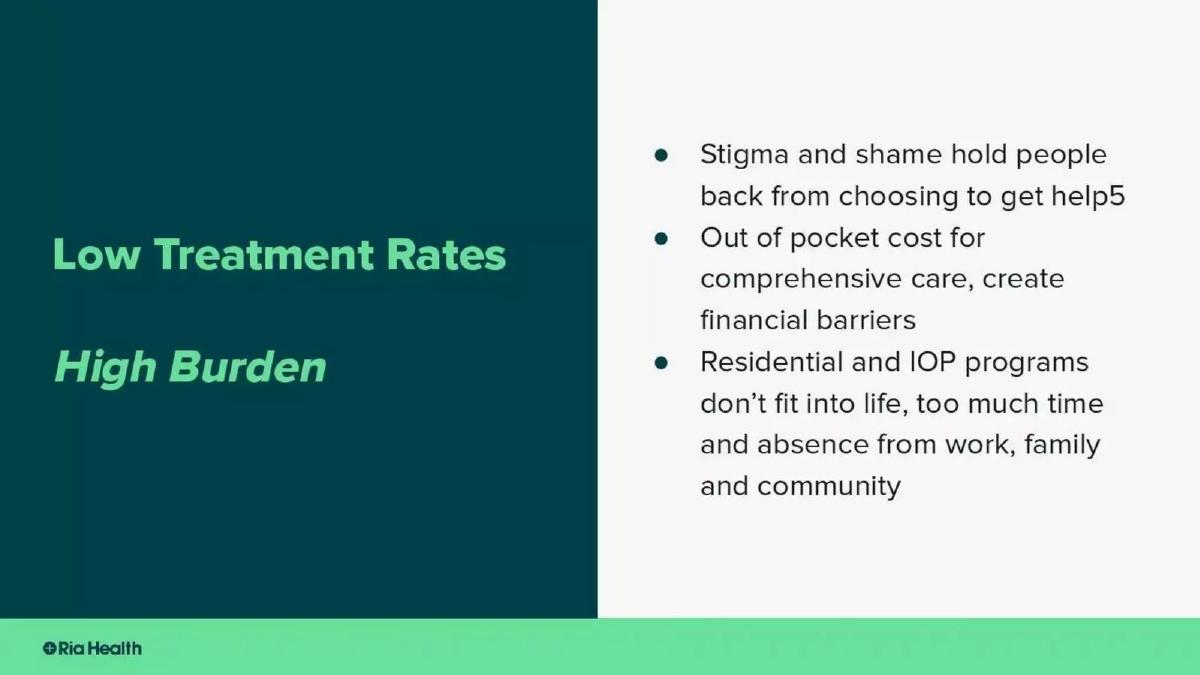
Slide 3 identifies the core friction points in the current AUD treatment market. It lists three primary barriers: Stigma and shame , Out of pocket cost , and the Incompatibility of residential programs with daily life (work, family, community). This slide is crucial because it sets the requirements for the solution. If the problem is stigma, the solution must be private. If the problem is cost, the solution must be covered by insurance or be affordable. If the problem is time, the solution must be remote. This slide creates a checklist that the subsequent 'About' slide systematically ticks off.
The Solution: An Integrated Telemental Practice
Slides 8-9: The Product and Journey
Slide 8 defines Ria Health as a Telemental health practice that leverages technology and evidence-based care. It lists the components of their 'suite': Medication-Assisted Treatment (MAT), digital therapeutics, coaching, peer support, and daily feedback. Notably, they mention being 'Hyper focused' on clinical outcomes. Slide 9, the Member Journey , visualizes how these components interact. It is an 8-step flow starting from a 24/7 phone consult to downloading the app, meeting the medical team, and—interestingly—tracking BAC with a physical breathalyzer. The inclusion of the breathalyzer (Step 4) is a key differentiator; it moves the platform from 'self-reported' data to 'objective' data, which is vital for clinical credibility.
The Data Moat: Persistence and Outcomes
Slides 10-13: Proving Efficacy
This is the 'meat' of the Series A deck. Slide 10, Ria Health’s Treatment System , presents a powerful retention graph. It shows that more than 55% of members stick to the program over 6 months . They contrast this against the 'Current Ambulatory Medical Management' average of 40-70 days. For an investor, this graph represents Lifetime Value (LTV) and proof of concept. If patients stay 4x to 6x longer than the industry average, the business is fundamentally more stable. Slide 13 reinforces this with Defensible Quality Outcomes , claiming an 85% alcohol risk reduction at one year. By using WHO (World Health Organization) risk scores, Ria Health speaks the language of healthcare payers and regulators, not just tech investors.
The Business Model: Bundled Payments
Slide 14: Pricing Strategy
Slide 14 reveals the Ria Health Bundled Payment Model . While some parts are marked as 'Redacted,' the visible table shows a two-phase pricing structure. Phase I (Months 1-3) costs $800/month , reflecting the high-touch nature of initial stabilization. Phase II (Months 4-12) drops to $200/month . This 'land and expand' approach within a single patient’s journey ensures high initial revenue to cover acquisition and clinical setup, followed by a long-tail subscription-like model for maintenance. This is a highly scalable SaaS-adjacent model applied to healthcare services.
Market Positioning and Reach
Slides 15-21: Scale and Competition
Slide 15 displays a map of Licensed Providers State Coverage , showing green across nearly the entire US. This slide is a 'de-risking' slide; it tells investors that the hard work of state-by-state medical licensing is largely complete. Slide 21 is the Competitive Landscape , a standard 2x2 matrix. Ria Health places itself in the top-right quadrant, defined by high AUD Treatment Outcomes and broad Geographic Reach . They distinguish themselves from competitors like Boulder Health and Bicycle Health by noting that those programs are often focused on OUD (Opioid Use Disorder), which has different regulatory and in-person requirements. Ria Health is carving out a specific niche: the 'Center of Excellence for AUD.'
What Works in This Deck
Clinical Rigor: The inclusion of Slide 26 (References) with ten academic citations is rare in most pitch decks but essential for Series A health-tech. It proves the founders have done the work to validate their methodology against established medical standards. Clear Unit Economics: The bundled payment slide (Slide 14) makes it very easy for an analyst to model out the revenue potential per patient. Comparative Data: By constantly benchmarking themselves against 'Current Ambulatory' standards (Slide 10), they make their superior performance feel objective rather than anecdotal.
What Is Missing
The Team Slide: In the 14 slides provided, there is no team slide. For a Series A, investors need to see the balance between medical expertise (MDs/PhDs) and scaling expertise (Product/Growth). The Ask: There is no slide detailing how the $18M will be spent. Usually, a Series A deck concludes with a breakdown of hiring, geographic expansion, or R&D goals. Financial Projections: While the pricing model is clear, the deck (in this selection) lacks a forward-looking revenue chart or a summary of current ARR/MRR growth. Customer Acquisition Cost (CAC): While they mention B2B and D2C channels in the editorial context, the slides do not explicitly show the cost to acquire a patient versus the LTV derived from the Phase I/II pricing.
What a Founder Should Copy
The 'Member Journey' Visualization: Slide 9 is an excellent way to explain a complex service. It combines human elements (counselors, medical teams) with digital elements (app, data tracking) in a way that feels cohesive. The Persistence Graph: If you are in a 'leaky bucket' industry (like fitness, mental health, or education), a graph like Slide 10 that shows your retention vs. the industry average is the most persuasive slide you can build. The 2x2 Matrix with a Twist: Instead of just 'Price' and 'Features,' Ria Health used 'Outcomes' and 'Geographic Reach.' Founders should choose axes that highlight the specific regulatory or clinical hurdles they have already cleared.
Frequently asked questions
- What is Ria Health's primary competitive advantage?
- According to Slide 10 and Slide 21, Ria Health’s advantage lies in its persistence rates and specific focus on Alcohol Use Disorder (AUD). While many competitors focus on Opioid Use Disorder (OUD) or general mental health, Ria Health demonstrates that its members stay on Medication-Assisted Treatment (MAT) for an average of 270 days, compared to the industry standard of 40-70 days.
- How does Ria Health make money?
- Slide 14 outlines a 'Bundled Payment Model.' This is split into two phases: Phase I (Months 1-3) is priced at $800 per month, likely covering the intensive initial medical consults and coaching. Phase II (Months 4-12) drops to $200 per month, focusing on long-term maintenance and monitoring.
- What technology does Ria Health use in its treatment?
- Slide 9 details the 'Member Journey,' which includes a mobile app, 24/7 phone consults, and a physical breathalyzer for tracking Blood Alcohol Content (BAC). This hardware-software integration allows for the 'daily feedback' mentioned on Slide 8.
- Is Ria Health available nationwide?
- Yes. Slide 15 shows a map of the United States where nearly every state is highlighted in green, indicating 'National Provider Coverage.' The slide explicitly states this infrastructure was built to support the needs of multi-state employers.
- What clinical evidence does the deck provide?
- Slide 13 provides a graph showing WHO (World Health Organization) risk level improvements. It claims 70% of patients see risk reduction within one month, and 85% see reduction by month 12. These claims are supported by a detailed 'References' list on Slide 26 citing peer-reviewed medical literature.