Neighborly’s 2012 Series A deck is a masterclass in identifying a massive, stagnant market and proposing a clear, disruptive solution. The company targets the $400 billion municipal bond market, which is currently bogged down by middlemen and high fees. Neighborly's value proposition is simple: disintermediate the process to allow individual investors to fund community projects directly. The deck effectively uses market size comparisons—notably showing that the muni bond market is over ten times larger than the entire 2012 VC and Seed equity market—to establish scale. While the deck is light…
Key takeaways
- The deck identifies a $400 billion municipal bond market that is currently inefficient and exclusive (Slide 10).
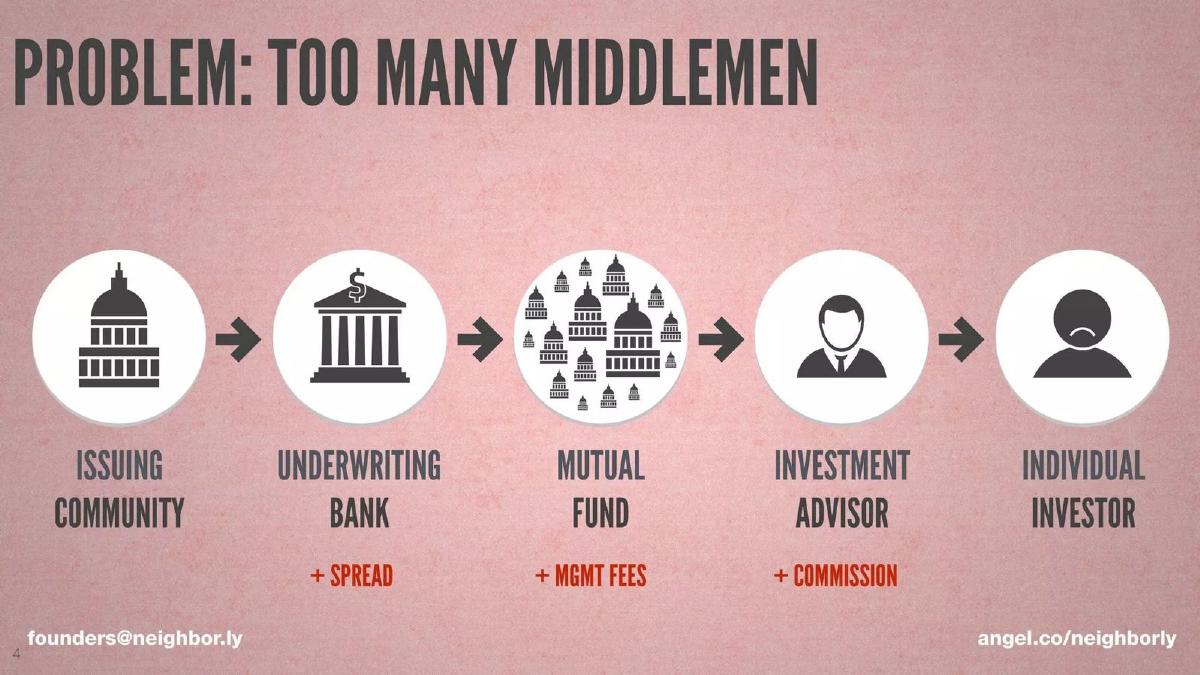
- Neighborly aims to remove middlemen like underwriting banks and mutual funds to lower costs for communities and investors (Slide 4).
- The market for municipal bonds is significantly larger than other fintech categories like student loans or payday lending (Slide 11).
- Individual investors already buy $100 billion in bonds annually but pay over $5 billion in fees (Slide 12).
- The platform allows users to find, review, and invest in local projects with as little as $500 (Slide 9).
- The founding team combines technical expertise from MIT with deep domain knowledge in bond trading (Slide 14).
- Neighborly sets a three-year goal to help 1,000 communities fund 1,000 projects by raising over $5 billion (Slide 15).
- The deck highlights that more municipal bonds are bought every week than Kickstarter has raised in its entire history (Slide 13).
Introduction: A Bold Vision for Public Infrastructure
Neighborly’s pitch deck from 2012 presents a clear and ambitious vision: to revolutionize how communities fund their infrastructure. By targeting the municipal bond market, Neighborly isn't just looking at a niche fintech play; they are looking at the bedrock of American public works. The deck is structured to first highlight the systemic failures of the current system before presenting Neighborly as the inevitable digital solution.
The Hook: History and the Problem
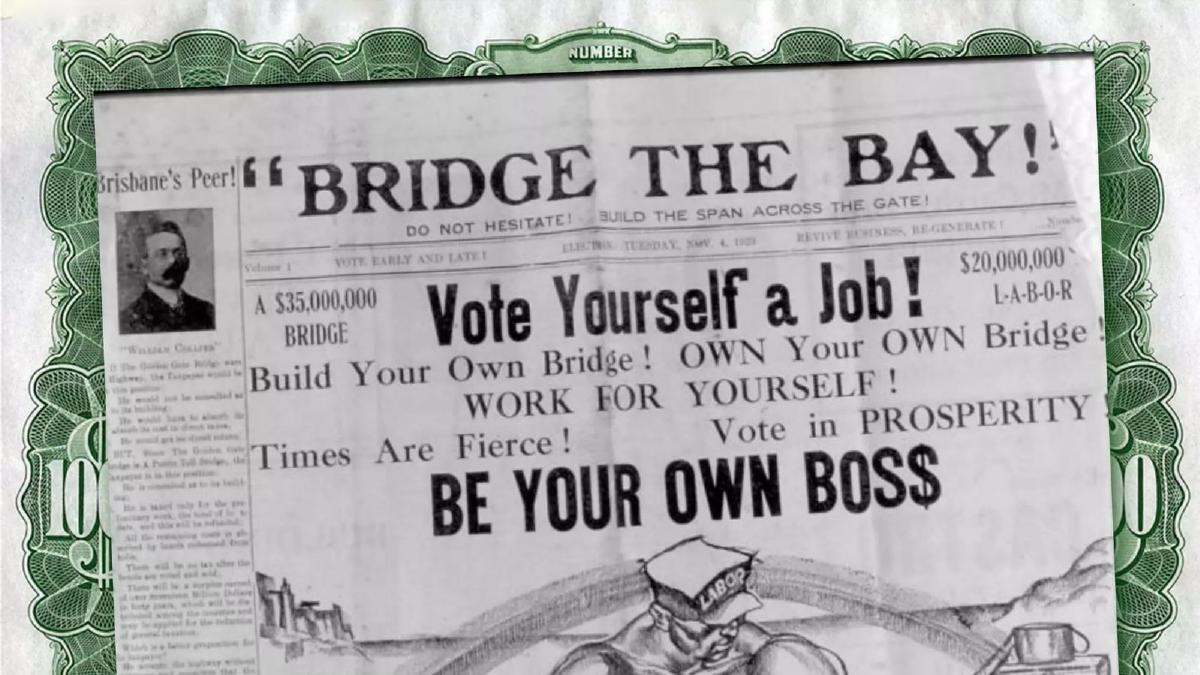
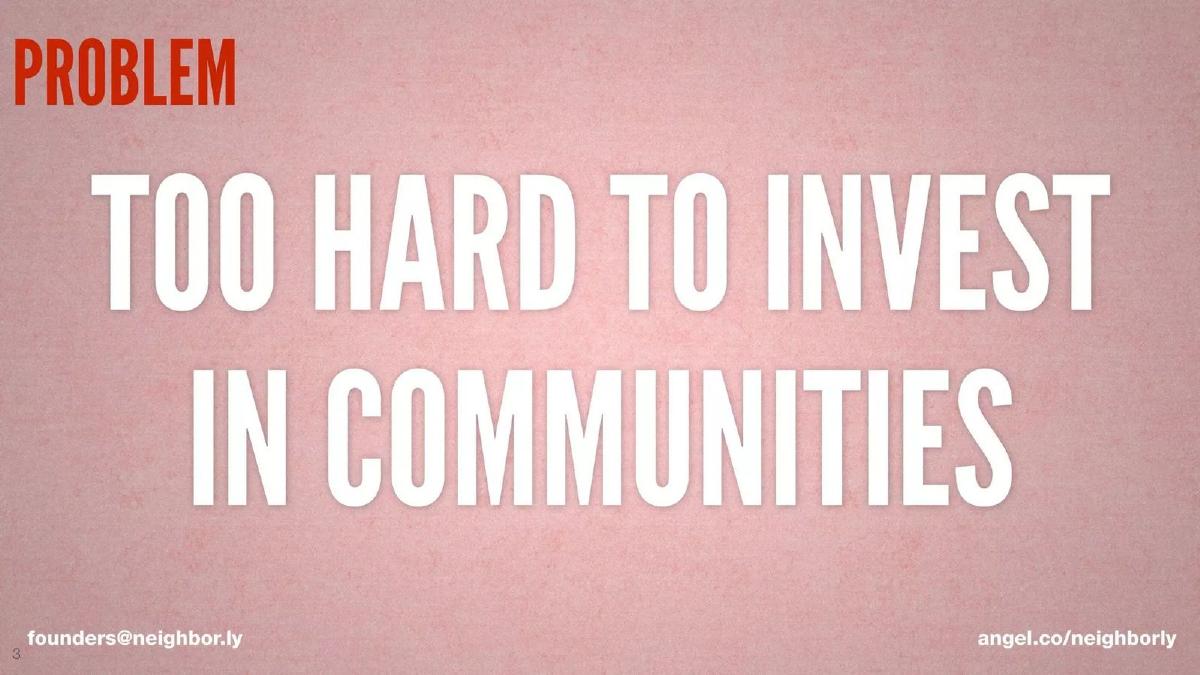
The deck opens with a nostalgic yet powerful image of a Golden Gate Bridge bond from the 1930s. This immediately grounds the company in a tradition of community-funded infrastructure. Slide 3 states the problem in three words: "TOO HARD TO INVEST IN COMMUNITIES." This simplicity is effective because it frames a complex financial issue as a social and accessibility problem.
The Problem: Middlemen and Complexity
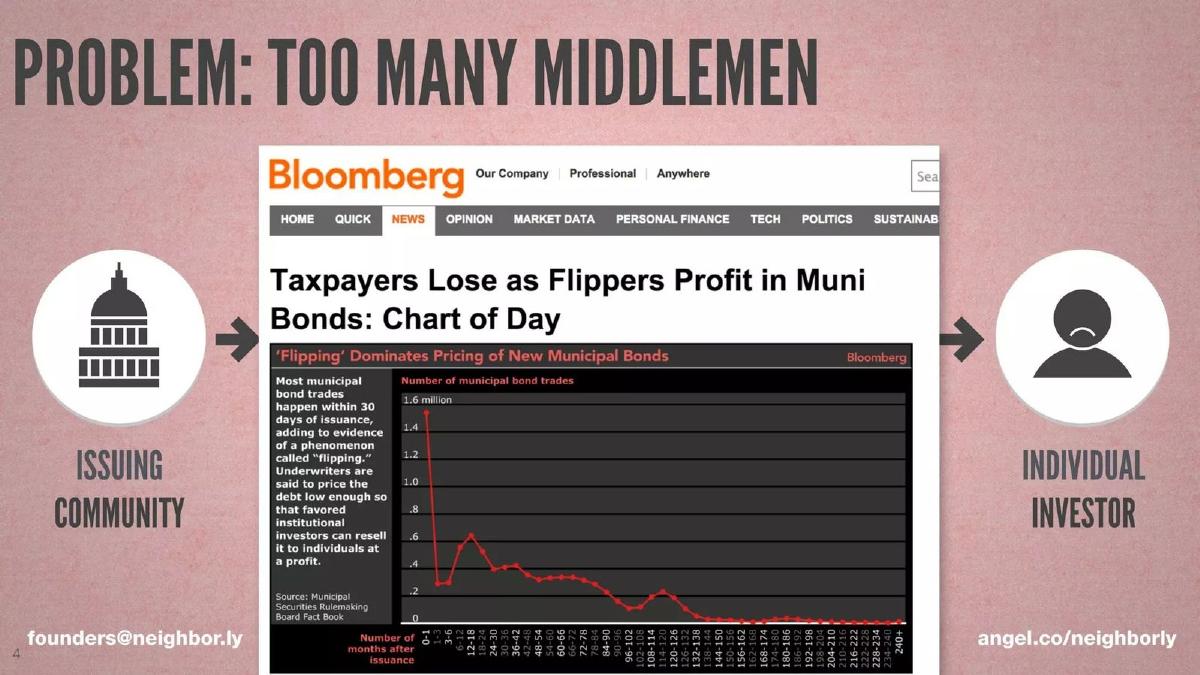
Neighborly spends significant time detailing why the current system is broken. Slide 4 uses a flowchart to show the long chain of middlemen between an "Issuing Community" and an "Individual Investor." It lists underwriting banks, mutual funds, and investment advisors, each adding spreads, management fees, and commissions. A Bloomberg headline is used as social proof, stating that taxpayers lose while 'flippers' profit.
Slide 5 focuses on exclusivity, showing how brokers prioritize high-net-worth individuals (HNWI), leaving average citizens out of the loop. A Wall Street Journal clipping notes that mom-and-pop investors pay twice as much for municipal debt as they do for corporate bonds. Finally, Slide 6 addresses complexity, showing a dense, jargon-filled bond statement and a mathematical formula, emphasizing that the current process is "TOO COMPLEX" for the average person.
The Solution: Disintermediate and Democratize
The solution is presented as a direct counter to the problems identified. Slide 7 shows a simplified three-step chain: Community -> Neighborly -> Investor. This is the classic 'disintermediation' play that has defined many successful tech startups. Slide 8 illustrates 'democratization,' showing many small investors participating instead of one large institutional player.
Slide 9 provides the first look at the product. It outlines a three-step user journey: 1. Find by Place, Type, Yield; 2. Review; 3. Invest! The screenshots show a clean, modern interface where users can browse projects like the "South San Francisco Unified School District" and invest with as little as $500. This is a crucial slide because it turns an abstract concept into a tangible product.
Market Size: The $400 Billion Opportunity
The market size section is perhaps the strongest part of the deck. Slide 10 uses a clever visual comparison, showing that the $400 billion municipal bond market is vastly larger than the $30 billion raised in all of Seed and VC equity in 2012. It also identifies $12 billion in annual fees as the immediate addressable revenue pool.
Slide 11 compares municipal bonds to other popular lending markets. It shows that municipal bonds ($400B) are larger than real estate ($230B), small business ($70B), and student loans ($59B). This positioning is vital for a Series A deck, as it tells investors that Neighborly is playing in the biggest possible arena. Slide 13 adds a final punchy stat: "People buy more muni bonds every week than Kickstarter has raised in its entire history."
The Team and the Future
The team slide (Slide 14) is brief but effective. It highlights a CEO with MIT and entrepreneurial roots, a COO with bond trading experience, and a CTO with high-level engineering skills. This combination addresses the three pillars of the business: tech, finance, and growth. Slide 15 sets a bold three-year goal: helping 1,000 communities fund 1,000 projects by raising $5 billion+ . The deck concludes with a call to action for beta access, creating a sense of urgency with "ONLY 99 SPOTS" available.
What Works in This Deck
Clear Problem/Solution Fit: The deck does an excellent job of identifying a specific, massive inefficiency and proposing a direct technological fix. · Powerful Market Comparisons: By comparing the muni bond market to the VC market and Kickstarter, the founders provide immediate context for the scale of the opportunity. · Visual Storytelling: The use of news clippings from Bloomberg and the WSJ provides external validation for the problem without requiring the founders to over-explain. · Tangible Product: Showing the actual platform interface (Slide 9) makes the vision feel achievable and ready for market.
What Is Missing from This Deck
Unit Economics: There is no mention of how much Neighborly earns per transaction or what their customer acquisition cost (CAC) looks like. · Regulatory Roadmap: Municipal bonds are highly regulated. The deck omits how Neighborly intends to navigate the complex legal landscape of public finance. · Competitive Landscape: While it compares market sizes, it doesn't mention other players or traditional banks that might fight to keep their market share. · Financial Projections: Beyond the $5 billion goal, there are no detailed revenue or expense projections.
What a Founder Should Copy
The "Status Quo" Flowchart: Use Slide 4 as a template to show exactly where money is being wasted in your industry and how your product removes those costs. · Relative Market Sizing: Don't just list a big number. Compare your market to something your investors already understand (like the VC market or a well-known startup like Kickstarter). · Simplified User Journey: Slide 9's "Find, Review, Invest" is a perfect way to show that a complex process can be made simple for the end-user. · Strong Visual Anchors: Using a historical document (the 1930s bond) to start the deck creates an emotional connection to the mission before the data-heavy slides begin.
Frequently asked questions
- What is Neighborly's primary business model?
- Neighborly operates as a community investment marketplace. It connects municipal issuers directly with individual investors, bypassing traditional middlemen like underwriting banks and brokers. By doing so, it aims to capture a portion of the $12 billion in annual fees paid by issuers and the $5 billion paid by individual investors.
- How does Neighborly differentiate itself from other lending platforms?
- Unlike platforms like LendingClub or SoFi, which focus on consumer or student debt, Neighborly targets the municipal bond market. Slide 11 shows that at $400 billion, this market is nearly as large as the consumer lending market and significantly larger than real estate or small business lending.
- Who is the target investor for Neighborly's platform?
- The platform is designed for 'mom-and-pop' individual investors who want to support their local communities. Slide 9 shows a user interface where individuals can invest as little as $500 in projects like school district improvements or transit lines.
- What are the main problems in the current municipal bond market according to the deck?
- The deck identifies three core problems: it is too hard to invest due to too many middlemen (Slide 4), it is too exclusive, favoring high-net-worth individuals (Slide 5), and it is too complex for the average person to understand (Slide 6).
- What is the background of the founding team?
- The team consists of a CEO described as an 'MIT Geek + Entrepreneur,' a COO who is a 'Bond Trader,' and a CTO labeled as a 'Jedi Rails Engineer.' This mix suggests a balance of technical skill, entrepreneurial experience, and deep financial industry expertise.