Nesta Impact Investments (NII) utilizes a 14-slide deck to outline a highly specialized investment strategy focused on three core pillars: A Healthy Life, A Sustainable Future, and A Fairer Start. Unlike traditional VC decks that lead with IRR, NII leads with societal challenges, such as the nine-year life expectancy gap between the UK's richest and poorest. The deck successfully positions the firm as more than a source of capital, highlighting their 'Unfair Advantage' in data science and policy influence. With a target of 4-6 deals per year and a specific EDI goal for 2025, the deck provides…
Key takeaways
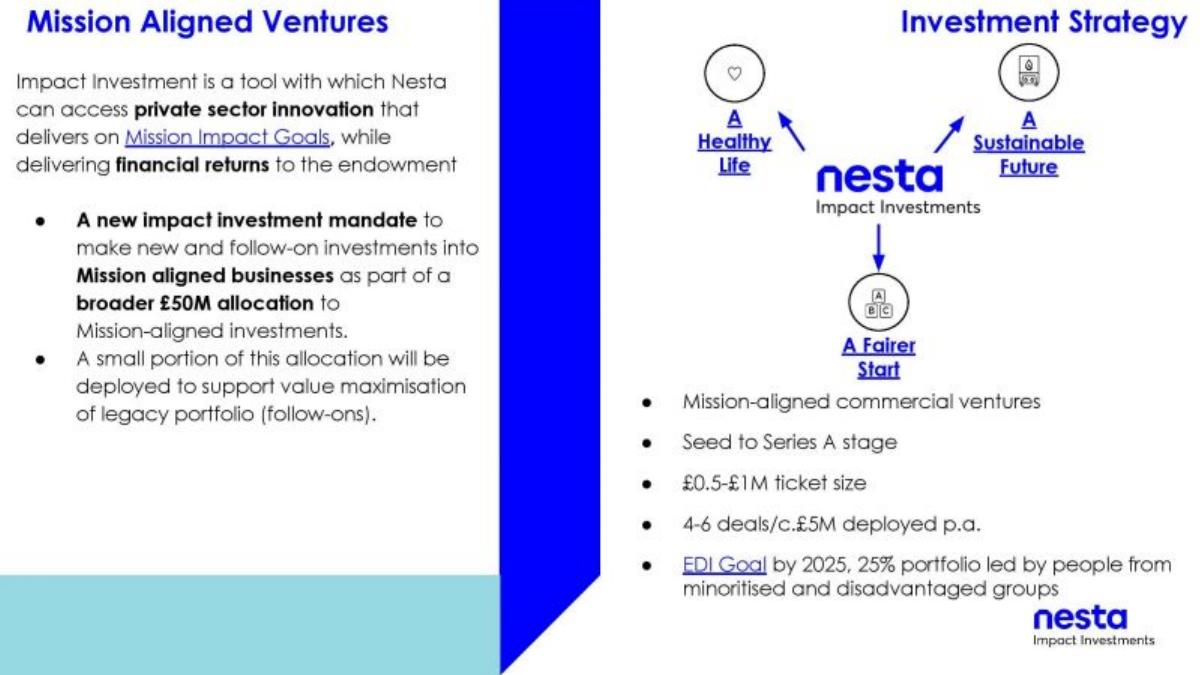
- The fund operates under a new impact investment mandate with a £50M allocation for mission-aligned businesses (Slide 4).
- Investment focus is strictly Seed to Series A with ticket sizes ranging from £0.5M to £1M (Slide 4).
- Nesta sets a specific Equity, Diversity, and Inclusion (EDI) goal: 25% of the portfolio to be led by minoritised groups by 2025 (Slide 4).
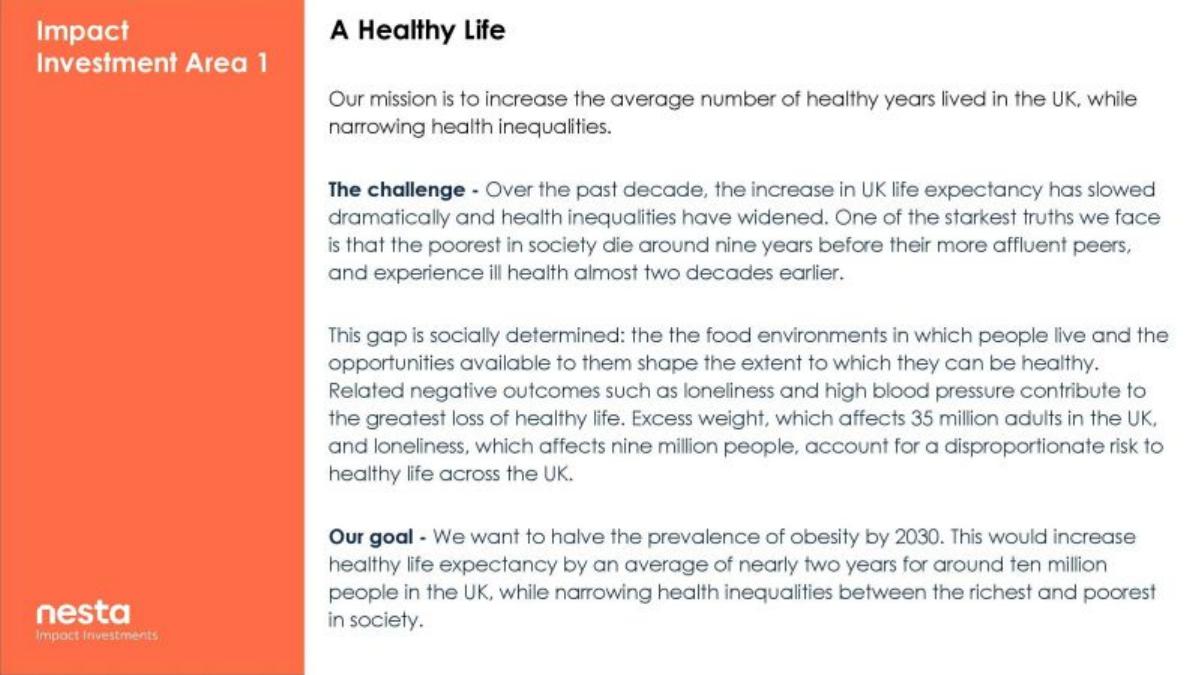
- The 'Healthy Life' mission targets a 50% reduction in obesity prevalence by 2030 (Slide 5).
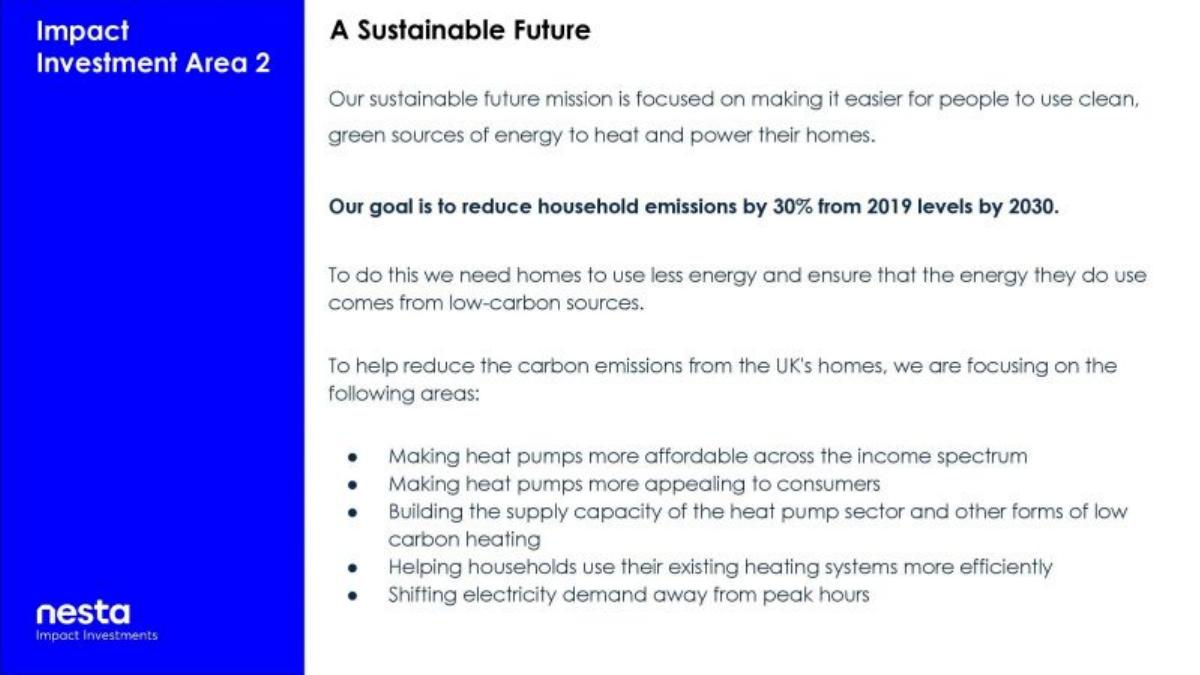
- The 'Sustainable Future' mission aims to reduce UK household emissions by 30% from 2019 levels by 2030 (Slide 6).
- NII claims an 'Unfair Advantage' through its ability to provide data science skills, testing environments, and sector insights to portfolio companies (Slide 8).
- The deal pipeline is robust, with 350-400 deals seen per annum, 80% of which align with their three core themes (Slide 9).
- The team is structured by mission area, with dedicated directors for 'Sustainable Future', 'Healthy Lives', and 'Fairer Start' (Slide 11).
Introduction and Context
Nesta Impact Investments (NII) presents a deck that is as much a manifesto as it is a financial proposal. As the investment arm of the UK's innovation agency, the deck reflects a sophisticated institutional approach to venture capital. The document consists of 14 slides, focusing heavily on the 'why' and 'how' of their impact-driven mandate.
Slide 1: Title Slide
The cover slide is minimalist, featuring the Nesta Impact Investments logo and contact information. It establishes a clean, professional brand identity that is consistent throughout the presentation. The use of geometric shapes suggests a structured approach to complex problems.
Slide 2: Nesta Investments History
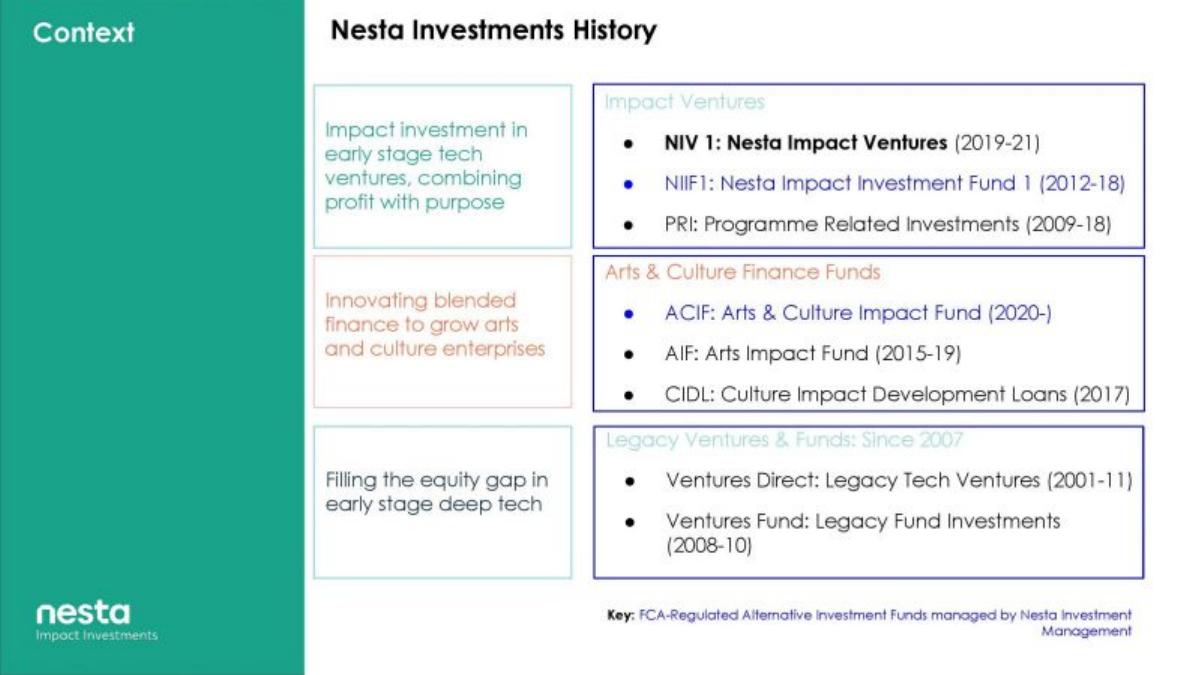
This slide provides essential institutional credibility. It breaks down the firm's history into three categories: Impact Ventures (including NIV 1 from 2019-21 and NIIF1 from 2012-18), Arts & Culture Finance Funds , and Legacy Ventures dating back to 2001. Notably, it mentions that these are FCA-regulated funds, which is a critical detail for institutional investors. It positions NII not as a new experiment, but as a seasoned manager with over two decades of experience in 'filling the equity gap'.
Slide 3: Venture Builder and 2030 Strategy
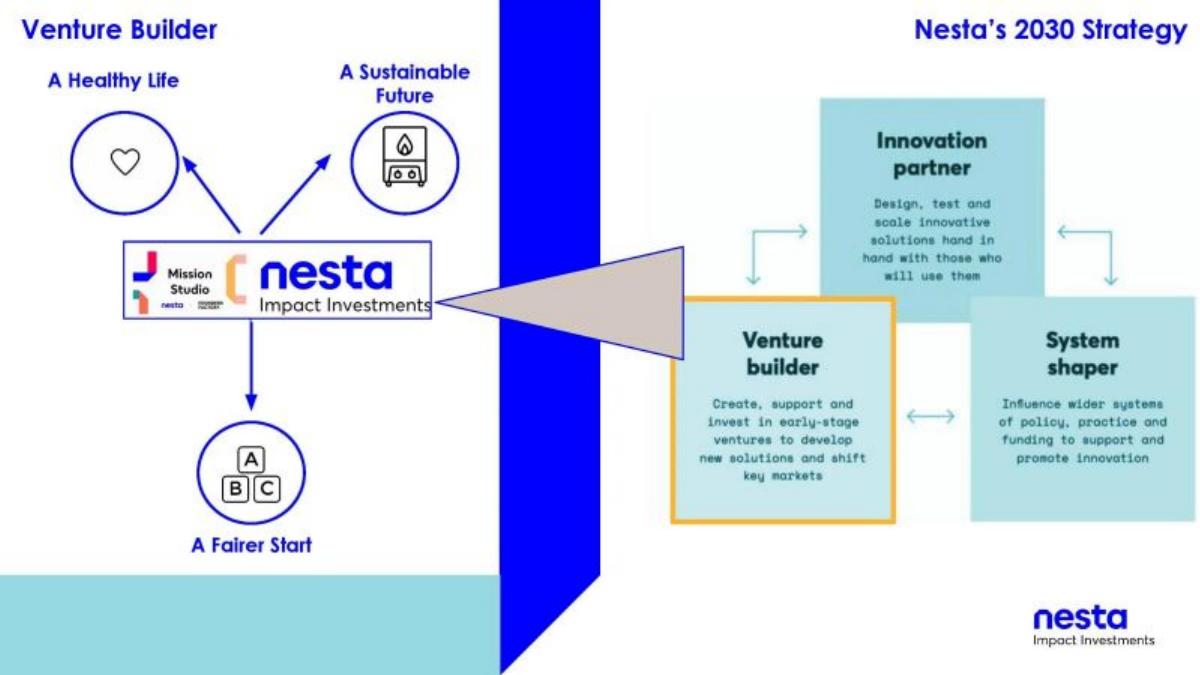
Slide 3 introduces the broader Nesta 2030 Strategy. It visualizes the relationship between being an Innovation Partner , a Venture Builder , and a System Shaper . This is a key differentiator; NII isn't just picking winners; they are part of a larger ecosystem that influences policy and practice. The slide connects their three missions—Healthy Life, Sustainable Future, and Fairer Start—to this tripartite operational model.
Slide 4: Investment Strategy and Mandate
This is the 'meat' of the fund's operational plan. It explicitly states a £50M allocation for mission-aligned investments. The strategy is clearly defined: Seed to Series A , £0.5-£1M ticket size , and 4-6 deals per year . A standout feature is the EDI Goal : 'By 2025, 25% portfolio led by people from minoritised and disadvantaged groups.' This level of specificity in diversity targets is rare in traditional VC decks and reinforces their impact credentials.
The Three Mission Pillars
Slide 5: Impact Investment Area 1 - A Healthy Life
Nesta leads with a problem-first approach. They cite a 'stark truth': the poorest in society die nine years before their affluent peers. The goal is quantitative: halve the prevalence of obesity by 2030 . This slide serves to narrow the investment focus to specific 'socially determined' factors like food environments and loneliness. For an investor, this defines the 'market' as health-tech and food-tech solutions that address inequality.
Slide 6: Impact Investment Area 2 - A Sustainable Future
The second pillar focuses on environmental impact, specifically reducing household emissions by 30% by 2030 . The slide lists specific sub-sectors for investment: heat pump affordability, consumer appeal of green tech, and shifting electricity demand. This provides a clear roadmap for founders and LPs alike on where capital will be deployed.
Slide 7: Impact Investment Area 3 - A Fairer Start
The final pillar addresses the 'outcome gap' in education. It notes that the early years (0-5) and secondary school (11-16) account for 80% of the divergence in life outcomes . The goal is to eliminate the school readiness gap by 2030. This slide identifies the 'challenge' as fragmented service delivery and an overstretched workforce, signaling an interest in ed-tech and childcare platforms.
Value Proposition and Pipeline
Slide 8: Nesta’s "Unfair" Advantage
This slide addresses the common question: 'Why you?' NII breaks its value-add into Portfolio Development (sourcing and due diligence) and Portfolio Value Creation . They highlight four specific levers: Data (data science skills), Testing (using products to test innovations), Sector Insight , and Network Connections . This suggests a hands-on investment style that leverages Nesta's internal 100+ person staff of researchers and designers.
Slide 9: Deal Origination and Pipeline
Evidence of deal flow is provided here. NII claims to see 350-400 deals per annum . A pie chart breaks down the pipeline by theme: 47% for A Sustainable Future (ASF), 19% for A Fairer Start (AFS), 16% for A Healthy Life (AHL), and 18% 'Other'. This data proves that the market for their specific mission-aligned criteria is sufficiently large to support their deployment target of 4-6 deals per year.
Slide 10: Our Portfolio
This slide is a logo wall featuring 30+ companies . Notable names include Applied , Arbor , BibliU , and Skin Analytics . The sheer volume of logos validates their history mentioned on slide 2. However, the slide does not indicate which companies belong to which fund or their current status (active vs. exited).
Slide 11: The NII Team
The team slide is well-structured, showing a group of 11 professionals. It includes roles like Exec Director , Senior Investment Director , and Investment Managers specifically assigned to the three mission areas (e.g., 'Investment Manager ASF'). This alignment of personnel to mission areas demonstrates organizational commitment to the strategy.
Slide 12: Case Study - Koru Kids
To make the 'Fairer Start' mission tangible, NII uses Koru Kids as a case study. It highlights how the company reinvents childminding with a tech backbone. The slide notes the investment supports a 'Home Nursery' model and mentions the 'Female Founder'—aligning with the EDI goals mentioned on slide 4. This slide is effective because it moves from abstract goals to a concrete business model.
Slide 13: Closing Slide
A repeat of the title slide's branding, providing a clean finish to the presentation.
What Works and What is Missing
What Works
Mission Clarity: The deck is exceptionally clear about what it will and will not invest in. The 2030 goals provide a North Star that differentiates the fund from 'generalist' impact funds. · Institutional Credibility: By highlighting a 20-year history and FCA regulation, NII overcomes the 'first-time fund' hurdle that many impact vehicles face. · Specific Value-Add: The 'Unfair Advantage' slide is specific. Many funds claim to 'help with hiring' or 'strategy,' but NII's claim to provide data science skills and testing environments is unique. · Pipeline Transparency: Showing the thematic breakdown of 400 annual deals proves that the investment strategy is grounded in market reality.
What is Missing
Financial Track Record: While the deck lists 30+ portfolio companies and multiple previous funds, it omits any mention of financial returns (IRR, TVPI). For a fund 'combining profit with purpose,' the 'profit' side is under-represented in the data. · Exit Data: There is no mention of successful exits or how capital has been returned to the endowment in previous cycles. · Unit Economics of the Fund: The deck does not detail the management fee or carry structure, though these are often reserved for the Private Placement Memorandum (PPM). · Competitor Landscape: The deck does not acknowledge other impact investors in the UK space, missing an opportunity to explain how NII co-invests or competes for deals.
Founder's Guide: What to Copy
The Problem-First Narrative: If you are building an impact-driven company, copy the way Nesta uses stark statistics (like the nine-year life expectancy gap) to create a sense of urgency. · The 'Unfair Advantage' Framework: Don't just say you have a good team. Break your advantage down into specific categories like 'Data,' 'Testing,' and 'Sector Insight' as seen on Slide 8. · Thematic Alignment: If you have multiple product lines or target markets, show how they align with a single overarching strategy, similar to how Nesta aligns its team and pipeline to its three missions. · Specific EDI Goals: Setting a concrete, time-bound diversity goal (Slide 4) is a powerful way to demonstrate that your values are operationalized, not just aspirational.
Frequently asked questions
- What is Nesta's primary investment stage and ticket size?
- According to slide 4, Nesta Impact Investments focuses on the Seed to Series A stage. Their typical ticket size is between £0.5M and £1M per investment, with a target of deploying approximately £5M across 4-6 deals per year.
- How does Nesta define its impact themes?
- Nesta categorizes its investments into three 'Mission Impact Goals': A Healthy Life (focusing on obesity and health longevity), A Sustainable Future (focusing on household carbon emissions and heat pumps), and A Fairer Start (focusing on narrowing the early-years education gap).
- What specific metrics does Nesta use to measure success?
- The deck lists high-level societal goals for 2030: halving obesity prevalence (Slide 5), reducing household emissions by 30% (Slide 6), and eliminating the school readiness gap (Slide 7). It also includes an internal EDI goal of 25% diverse leadership by 2025 (Slide 4).
- What is Nesta's 'Unfair Advantage' in the VC landscape?
- Slide 8 details that Nesta provides more than capital. They offer portfolio companies access to Nesta’s internal data science teams, testing platforms for products, and deep sector insights derived from their programmatic and policy work.
- Does the deck provide historical financial returns?
- No. While slide 2 lists a history of funds dating back to 2001, including NIV 1 and NIIF1, the deck does not disclose specific IRR, TVPI, or DPI figures for these previous vehicles.