NetBox Labs utilized a 12-slide deck to secure a $35M Series B in 2024, positioning itself as the 'commercial steward' of the widely adopted NetBox open-source project. The narrative centers on the transition from a popular community tool to a central nervous system for modern, AI-driven infrastructure. By highlighting 18,000+ GitHub stars and a presence in thousands of production environments, the company demonstrates massive bottom-up adoption. The deck focuses heavily on architecture and ecosystem integration, showing how NetBox acts as the 'Source of Truth' for network automation. While i…
Key takeaways
- The company positions itself as the 'Commercial Steward' of an existing, massive open-source project to prove market fit (Slide 3).
- NetBox claims a significant community footprint with 18,000+ GitHub stars and 300+ contributors (Slide 3).
- The deck uses a 'Virtuous Circle' model to explain how open-source sustainability drives commercial revenue (Slide 3).
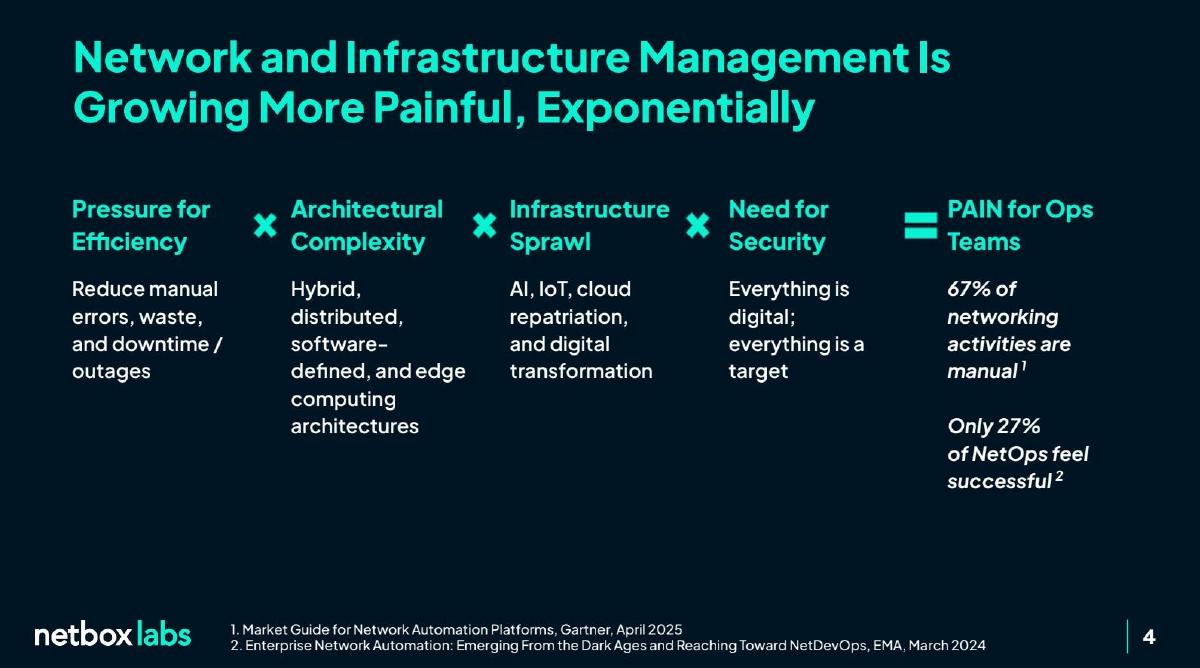
- Infrastructure complexity is framed as an exponential pain point driven by the boom in AI and connected devices (Slide 4).
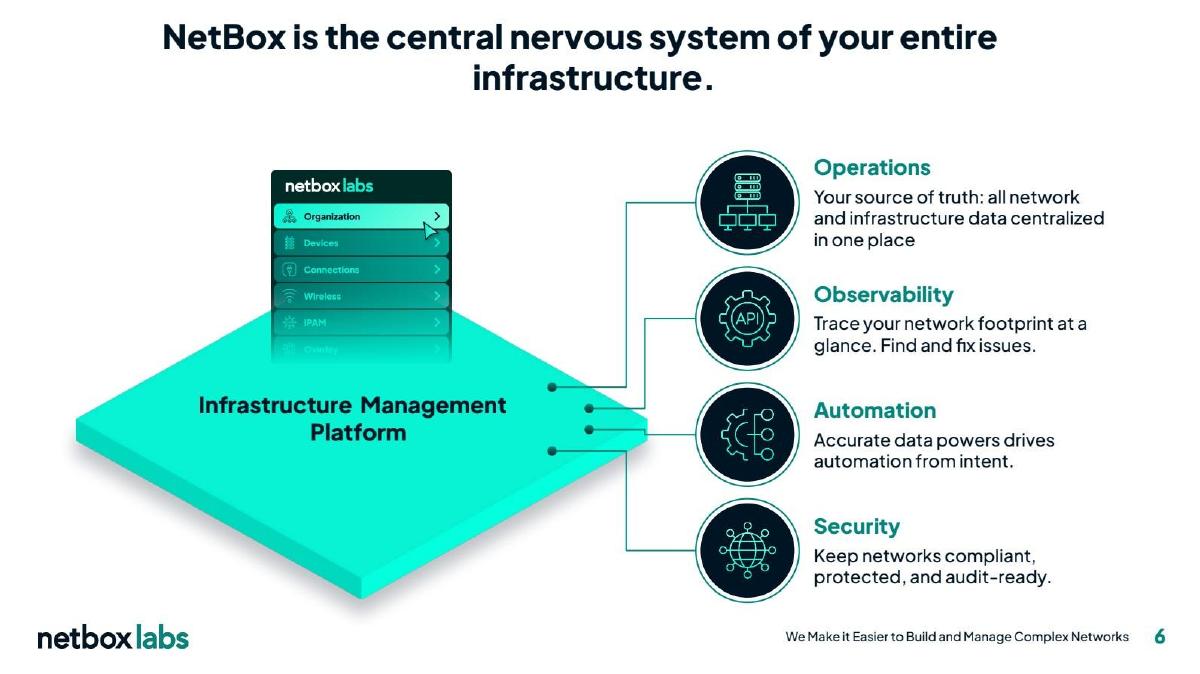
- NetBox is visualized as the 'central nervous system' connecting observability, operations, and automation (Slide 5).
- The product strategy is presented as a 'Massive Platform Play' spanning operations, observability, automation, and security (Slide 7).
- The deck emphasizes ecosystem compatibility, listing integrations with major vendors like Cisco, Juniper, Arista, and Fortinet (Slide 9).
- The leadership team includes the original founder of the NetBox project and the team that built NS1 (Slide 11).
The Open-Source to Enterprise Transition
NetBox Labs represents a classic 'open-core' or 'commercial open-source' (COSS) play. Their Series B deck, used to raise $35M in 2024, is a masterclass in leveraging existing community momentum to justify a high-growth enterprise valuation. The deck does not spend time proving that the software works; instead, it focuses on proving that NetBox is the inevitable center of the modern networking stack.
Slide 1: The Global Market Standard
The title slide establishes an ambitious claim: NetBox is 'The global market standard for infrastructure management.' By leading with this, the company bypasses the 'what is it' phase and moves straight to 'everyone uses it.' The branding is clean, utilizing a dark theme with high-contrast cyan accents, which is typical for high-end enterprise infrastructure startups.
Slide 2 & 3: The Power of Community Stewardship
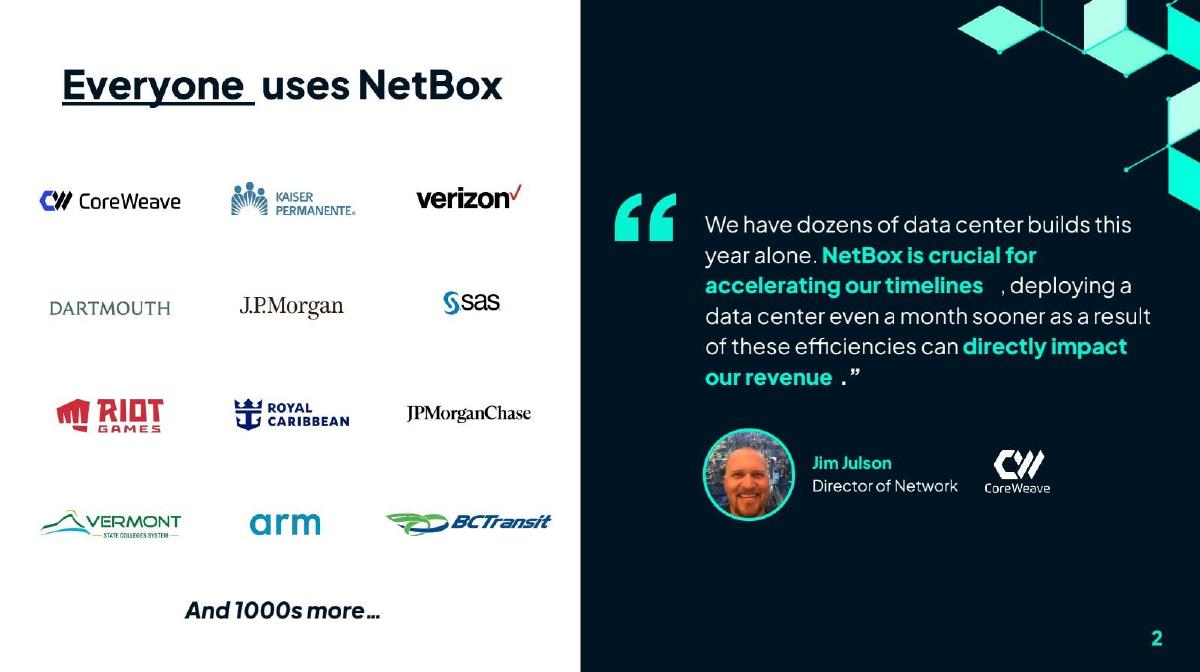
Slide 2, titled 'Everyone uses NetBox,' serves as a social proof anchor. Slide 3 provides the data to back this up. It defines NetBox Labs as the 'Commercial Stewards' of the project. The metrics cited are impressive for any Series B investor: 18,000+ GitHub stars, 3,000+ software commits, and 300+ contributors. Most importantly, it states that '1000s of companies run NetBox in production.' This slide introduces the 'Virtuous Circle'—a strategic framework explaining how the company generates revenue from open source and reinvests it to maintain the project's health. This addresses a common investor concern regarding the sustainability of open-source business models.
Slide 4 & 5: The Problem of Exponential Complexity
Slide 4 frames the problem: infrastructure management is growing 'painful, exponentially.' Slide 5 connects this pain to current market tailwinds, specifically the 'boom of AI' and 'connected applications.' The visual on Slide 5 is critical; it positions NetBox as a central cube (the 'central nervous system') surrounded by Observability, Operations, and Automation. This visual metaphor shifts NetBox from a 'documentation tool' to a 'platform enabler.'
Slide 6 & 7: The Massive Platform Play
Slide 6 reinforces the 'central nervous system' concept, while Slide 7 outlines the 'Massive Platform Play.' This is where the company expands its TAM (Total Addressable Market). By listing specific functions under Operations, Observability, Automation, and Security, NetBox Labs shows investors that they aren't just a niche tool. They are building a stack that includes inventory management, telemetry, config automation, and vulnerability identification. This slide is the 'roadmap' slide, showing where future revenue growth will come from.
Slide 8 & 9: The Linchpin of Automation
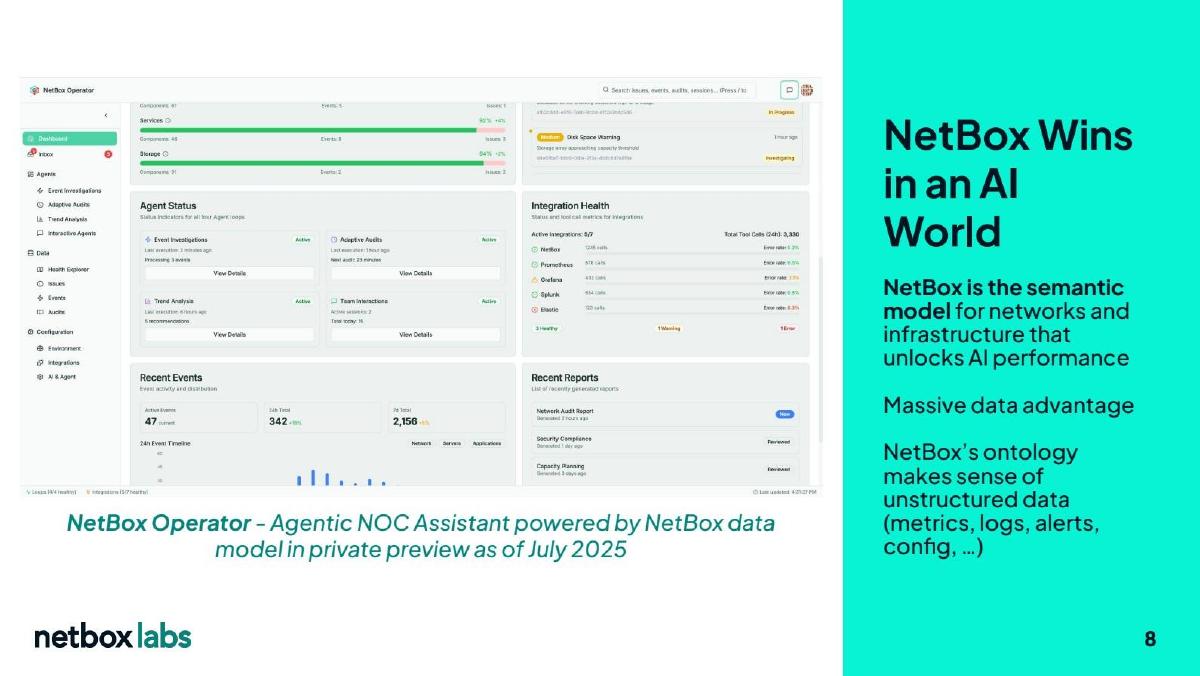
Slide 8 focuses on AI, claiming 'NetBox Wins in an AI World.' Slide 9 provides the technical 'how.' It labels NetBox as the 'Network Source of Truth.' This is a specific industry term that carries weight. The slide features logos of major industry players: Fortinet, Nokia, Cisco, Juniper, and Arista on the hardware side, and Terraform, Ansible, and Python on the automation side. By placing NetBox in the center of these logos, the deck argues that NetBox is the 'linchpin' that makes the rest of the ecosystem work. This is a powerful 'moat' argument—if you remove NetBox, the automation workflows of these other billion-dollar companies break.
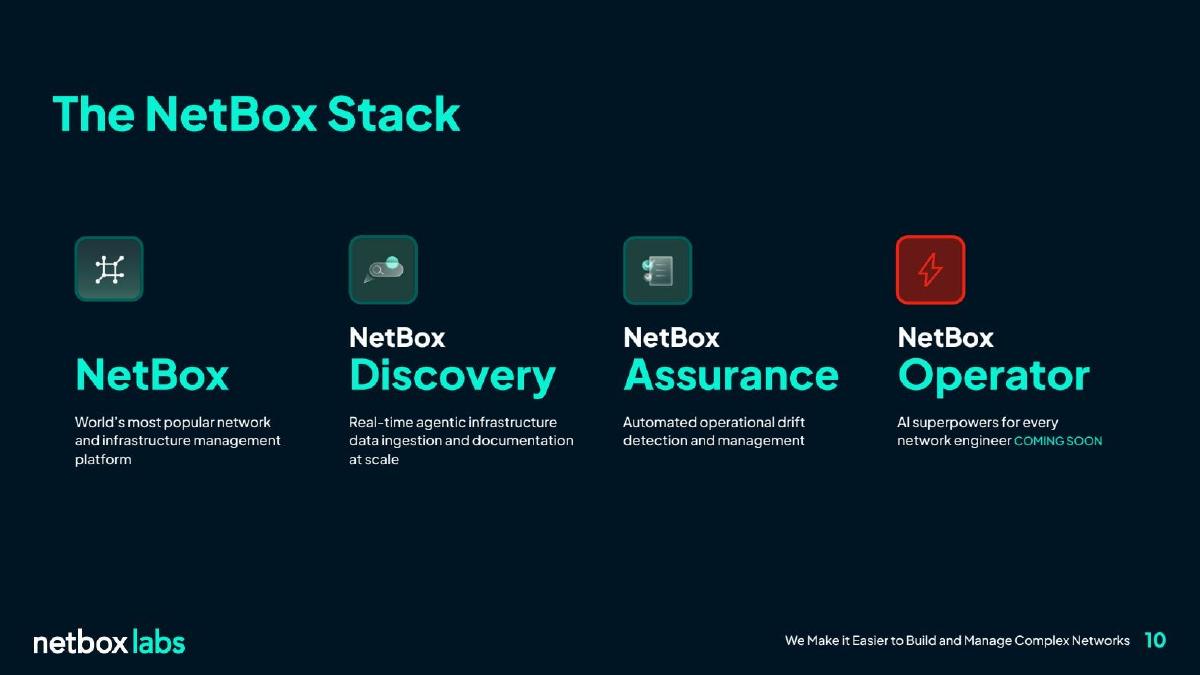
Slide 10: The NetBox Stack
Slide 10 (text only) likely detailed the specific product tiers or technical layers. In a Series B deck, this is where the distinction between the free open-source version and the paid 'NetBox Labs' version is usually made clear, though the specific text provided focuses on the 'Stack' as a whole.
Slide 11: Leadership Team
The team slide is a significant strength for this round. It features eight leaders, notably Kris Beevers (CEO) and Shannon Weyrick (CTO). The text highlights that the team 'built & lead NS1,' a successful company in the DNS and traffic management space. The inclusion of Jeremy Stretch as 'Chief NetBox Officer' is the ultimate credibility marker, as he is the original creator of the NetBox project. This tells investors that the 'stewardship' claimed on Slide 3 is authentic.
Slide 12: Investment Highlights
The final slide summarizes the case for the $35M round. While the specific bullet points aren't listed in the text, the title 'Investment Highlights' suggests a closing argument based on market dominance, team pedigree, and the 'Source of Truth' positioning. Notably, the deck ends without a specific 'Ask' slide or financial table, which is common in highly competitive Series B rounds where the terms are often discussed in separate data rooms rather than the primary pitch deck.
What NetBox Labs Does Well
The deck excels at positioning . It successfully moves the company from being 'a popular open-source tool' to 'the essential infrastructure for the AI era.' By using terms like 'Source of Truth' and 'Central Nervous System,' they create a sense of necessity. The 'Virtuous Circle' diagram on Slide 3 is also a very effective way to explain the COSS business model to investors who might be wary of 'free' software. Finally, the ecosystem slide (Slide 9) is a brilliant way to show market reach without needing to list every single customer logo; by showing they integrate with Cisco and Terraform, they imply they are present wherever those giants are.
What is Missing from the Deck
The most glaring omissions are financials and unit economics . There is no mention of ARR (Annual Recurring Revenue), NRR (Net Retention Rate), or CAC (Customer Acquisition Cost). While the publisher reports a $35M raise, the deck itself does not state the amount sought or the planned use of funds. There is also a lack of a formal Competitor Slide . While they position themselves as a 'standard,' they don't explicitly address how they displace legacy incumbents or other open-source alternatives. For a Series B, investors usually expect to see a clear path to $100M ARR, which is hinted at in the 'Platform Play' slide but not backed by a financial model in this specific presentation.
Founder Takeaways: How to Copy This Strategy
Lead with Traction: If you have an open-source project or a large free user base, make that your Slide 2 or 3. Use GitHub stars, contributors, and 'production installs' as your primary evidence of product-market fit. · Define Your Stewardship: Clearly explain the relationship between the free project and your company. The 'Virtuous Circle' terminology is a great way to frame this. · Position as a Linchpin: Don't just say what your tool does; show how it sits in the middle of other tools the customer is already paying for. Use an ecosystem diagram with recognizable logos to show your 'gravity.' · Connect to Macro Trends: NetBox didn't just say they manage networks; they said they manage networks in an AI world. Find the biggest trend in your industry and explain why your product is the foundation for it. · Highlight 'Second-Time' Founders: If your team has had a previous exit or built a well-known company in the same space, put that front and center on the team slide. It reduces the perceived risk of the 'stewardship' transition.
Frequently asked questions
- What is the core value proposition of NetBox Labs?
- NetBox Labs positions itself as the 'Source of Truth' for network infrastructure. As stated on Slide 9, it acts as the linchpin for modern infrastructure automation, providing the 'intended state' of a network that other tools—like Terraform, Ansible, and various hardware vendors—rely on to deploy and manage complex environments.
- How does the company monetize its open-source roots?
- Slide 3 describes a 'Virtuous Circle' where NetBox Labs leverages the open-source community to generate commercial value and revenue. This revenue is then reinvested into the community to ensure sustainability. While the deck doesn't detail specific pricing tiers, it emphasizes 'commercial stewardship' as the bridge between the free tool and enterprise-grade support and products.
- Who are the key people behind NetBox Labs?
- The leadership team, shown on Slide 11, includes CEO Kris Beevers and CTO Shannon Weyrick, who previously built and led NS1. Crucially, the team includes Jeremy Stretch, the Chief NetBox Officer, who founded the original NetBox open-source project, ensuring deep technical alignment with the community.
- What market trends is NetBox Labs capitalizing on?
- According to Slides 4 and 5, the company is targeting the 'exponential' growth in infrastructure complexity caused by AI, connected applications, and modern digital technology. They position NetBox as the necessary foundation for companies to operate and secure these increasingly complex systems.
- Does the deck include financial projections or an 'Ask' slide?
- No. The 12-slide deck focuses on vision, community traction, product architecture, and team. It omits specific revenue figures, burn rates, or a slide detailing the exact amount being raised or how the $35M Series B funds will be allocated.