StreamLoan’s 12-slide pitch deck, presented at the 500 Startups Demo Day in October 2016, is a study in minimalist persuasion. The deck eschews traditional bullet points in favor of high-contrast imagery and bold numerical claims. It effectively identifies the 'chaos' of the mortgage industry—represented by a web of ten different stakeholders—and positions its mobile-first collaboration platform as the unifying solution. With a clear traction story showing a jump from $1.7M to $7.8M in contract value over just a few months, the deck provides the necessary social proof to back its ambitious cl…
Key takeaways
- The deck uses a 'Before and After' narrative structure to highlight a reduction in mortgage processing time from 50 days (Slide 4) to 15 days (Slide 6).
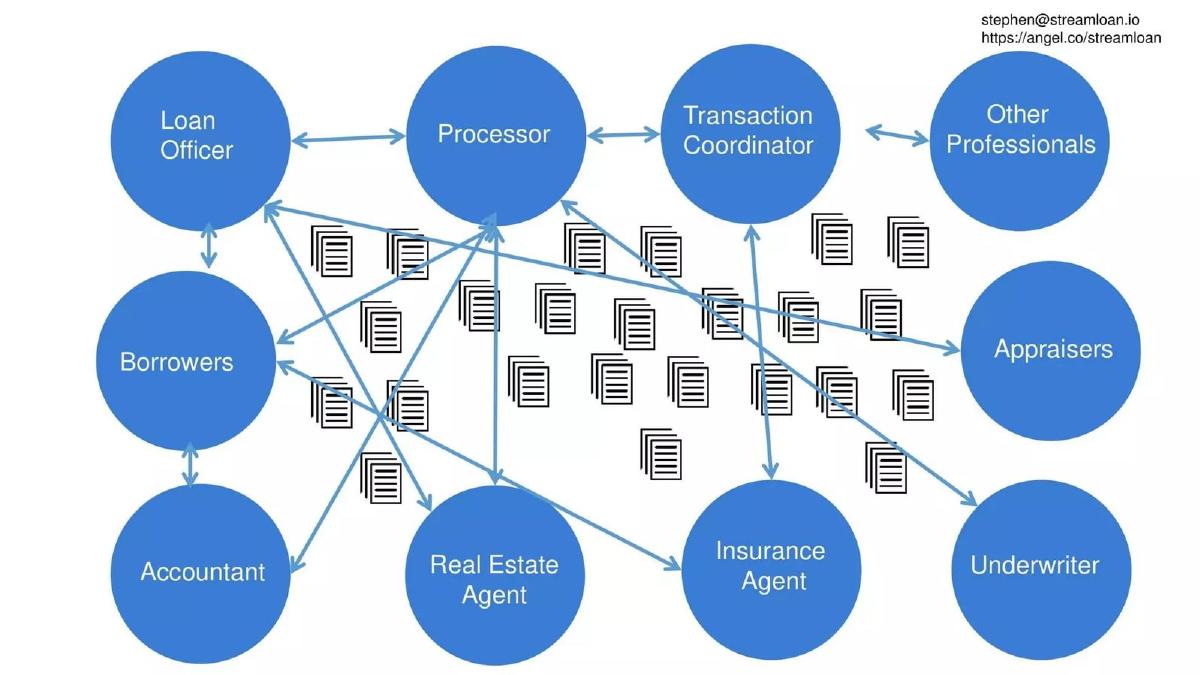
- Visual complexity is used as a proxy for market pain, showing ten distinct professional roles involved in a single loan transaction on Slide 3.
- Traction is presented with extreme clarity, showing a growth curve that scales from $1.7M in April to $7.8M by September (Slide 10).
- The team slide (Slide 11) emphasizes 'Big Four' and enterprise experience, citing Deloitte, Red Bull, and NetApp to build institutional trust.
- The product is positioned as a 'collaboration and workflow platform' rather than just a digital application, targeting the entire ecosystem of borrowers, lenders, and agents (Slide 7).
- The deck omits a specific 'Ask' slide, choosing instead to focus on the $1.5B annual volume of a key partner, Alterra Home Loans (Slide 8).
- Minimalist design is used throughout, with several slides containing fewer than five words to ensure the audience focuses on the speaker during a Demo Day presentation.
- The company identifies as a 9-person team based in San Francisco, California, as stated on Slide 11.
The StreamLoan Teardown: Efficiency Through Minimalism
StreamLoan entered the 500 Startups accelerator in 2016 with a clear mission: to fix the broken, paper-heavy mortgage industry. Their pitch deck is a classic example of Demo Day architecture. It is designed to be seen from the back of a crowded room, with large fonts, high-contrast imagery, and a narrative that moves at a breakneck pace. This teardown examines how they condensed a complex SaaS workflow into 12 high-impact slides.
The Hook and the Chaos (Slides 1-4)
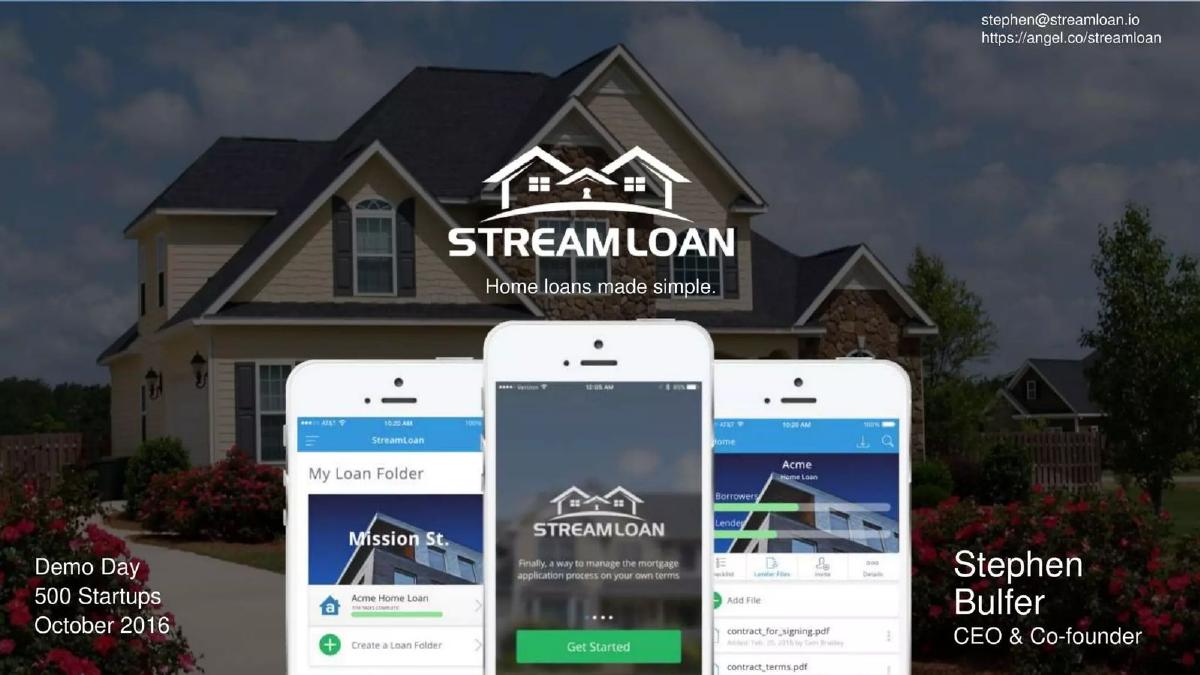
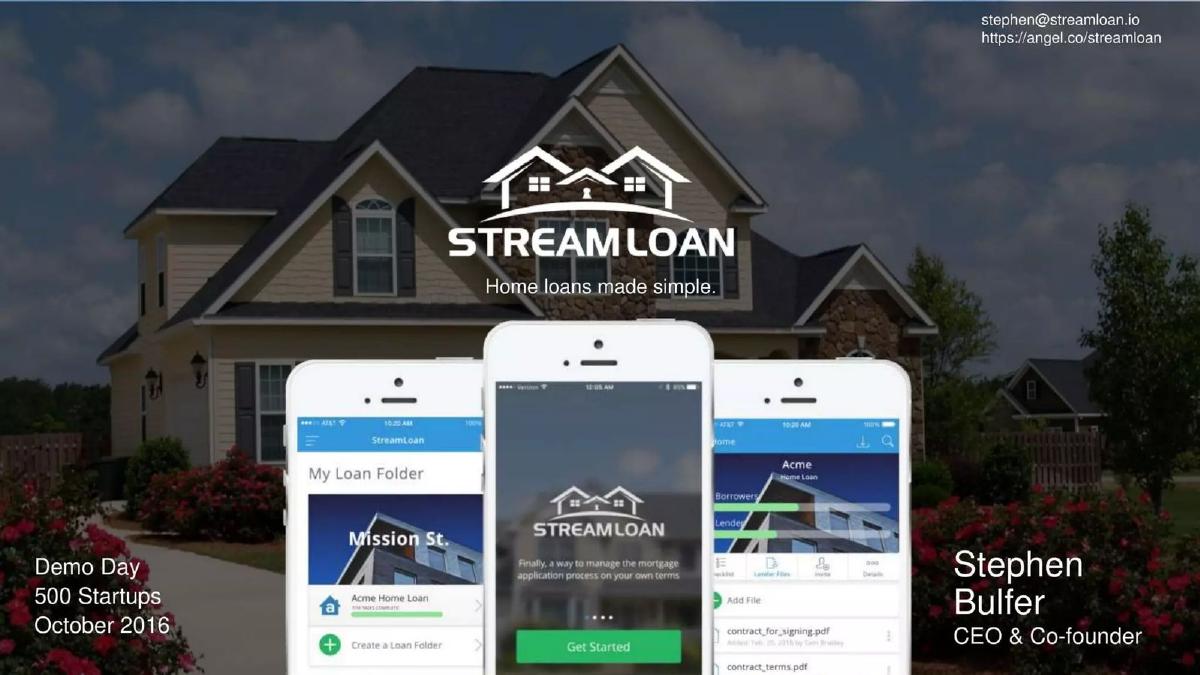
Slide 1: Title Slide The deck opens with a high-resolution image of a suburban home, immediately grounding the technology in the real world. The tagline, "Home loans made simple," is positioned beneath the logo. Notably, the slide includes the presenter's name (Stephen Bulfer) and contact information, as well as the 500 Startups Demo Day branding for October 2016. The mobile app mockups at the bottom of the slide signal that this is a mobile-first solution.
Slide 2: The Emotional Pain Point Slide 2 contains no text. It features a stock photo of a stressed professional buried under literal mountains of paperwork. This is a classic 'villain' slide. It identifies the enemy—paperwork and manual processing—without needing a single bullet point. It sets the stage for the digital transformation the company is about to propose.
Slide 3: The Ecosystem Complexity This slide is the most visually 'busy' in the deck, and that is intentional. It shows ten blue circles representing different stakeholders: Loan Officer, Processor, Transaction Coordinator, Other Professionals, Borrowers, Accountant, Real Estate Agent, Insurance Agent, Underwriter, and Appraisers. Dozens of arrows and document icons crisscross between them. This slide visualizes the 'chaos' of the current mortgage workflow, proving that the problem isn't just paperwork, but fragmented communication.
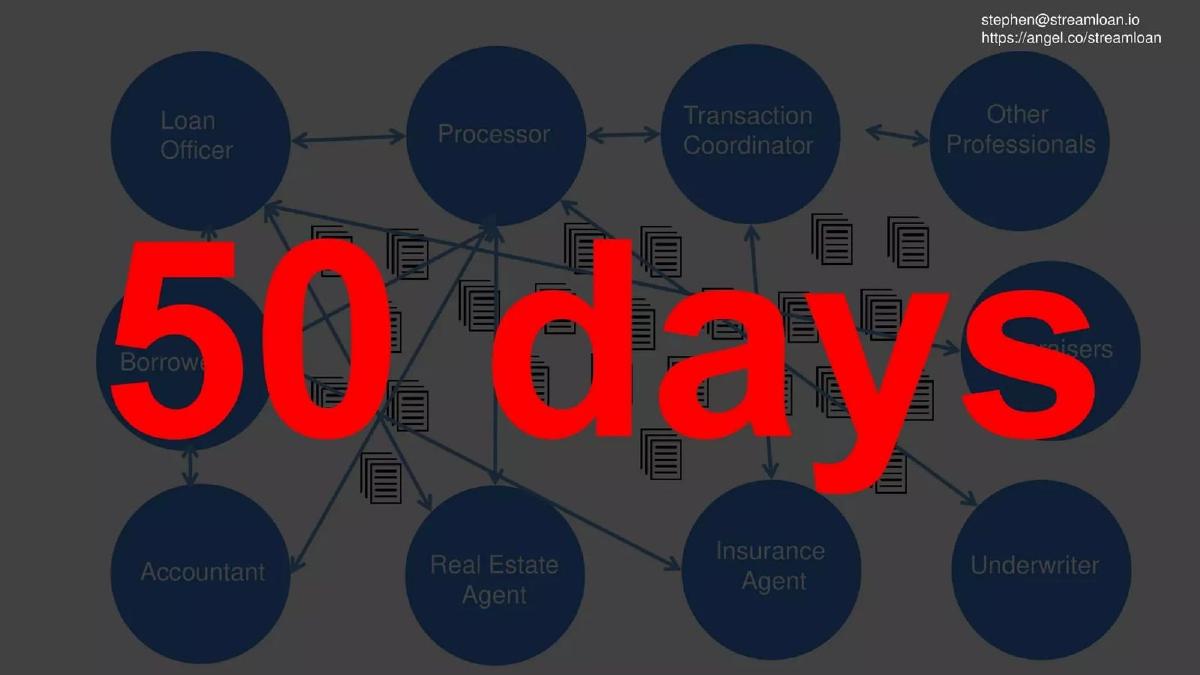
Slide 4: The Quantitative Pain Building on the complexity of the previous slide, Slide 4 overlays a massive red text block: "50 days." This is the industry standard for closing a loan at the time. By placing this over the chaotic stakeholder map, the founders link the complexity directly to the delay. It is a powerful use of data to validate the emotional pain shown in Slide 2.
The Solution and the Promise (Slides 5-7)
Slide 5: The Digital Future Slide 5 acts as the 'cleansing' slide. The background is a blurred image of the iconic 'Painted Ladies' houses in San Francisco, and the foreground is a crisp iPhone showing the StreamLoan app. The app interface looks clean, featuring a checklist for "Identity," "Income," and "Assets." This is the visual antidote to the paperwork piles seen earlier.
Slide 6: The Value Proposition Mirroring Slide 4, Slide 6 features a massive green text block: "15 days." This represents a 70% reduction in the loan processing cycle. By using green (the color of 'go' and money) to contrast with the previous red '50 days,' the deck creates a subconscious sense of relief and progress. This is the core 'Why' of the investment opportunity.
Slide 7: The Unified Workflow This slide revisits the stakeholder map from Slide 3 but replaces the chaotic arrows with a clean, hub-and-spoke model. The "Borrower" is at the center, surrounded by the Appraiser, Lender, Insurance Agent, Accountant, Inspector, and Real Estate Agent. This illustrates the product's function as a collaboration platform that brings all parties into a single digital environment.
Traction and Market Validation (Slides 8-10)
Slide 8: The Anchor Partner To prove that their 15-day promise isn't just theoretical, Slide 8 introduces a massive number: "$1.5B." Beneath it, the text reads "Alterra Home Loans (Annually)." This slide serves as a major piece of social proof, showing that a significant industry player is involved with the platform.
Slide 9: Revenue Momentum Slide 9 transitions from the partner's volume to StreamLoan's own performance. It displays "$1.7M in StreamLoan Contracts (Annually)." This is a crucial distinction; they aren't just processing loans, they are securing SaaS contracts. This slide establishes a baseline for the growth story that follows.
Slide 10: The Hockey Stick Slide 10 is the 'money slide.' It features a line graph showing annual contract value from January to September. The graph remains flat at $1.7M through June, then spikes sharply to $7.8M by September. This 4.5x growth in just three months is the primary driver for the Seed round. It suggests that the company has found product-market fit and is ready to scale.
The Team and Conclusion (Slides 11-12)
Slide 11: The Team The team slide highlights three key individuals: Armando Gonzalez (CTO), Stephen Bulfer (CEO), and Aaron Sturm (Head of BD). The pedigree is impressive, listing companies like Red Bull, Deloitte, NetApp, and Charles Schwab. They also mention academic credentials from Columbia Business School and UC Berkeley. The slide concludes with the fact that they are a "9 Person Team, HQ in San Francisco, California." This builds confidence that the team has both the technical and corporate experience to navigate the highly regulated mortgage industry.
Slide 12: Closing The final slide returns to the logo and the tagline: "Home loans made simple." It provides the website URL and contact email again. In a Demo Day setting, this slide usually stays on the screen during the Q&A or as the next presenter walks up, ensuring the brand name is the last thing the audience sees.
What Works in the StreamLoan Deck
Visual Contrast: The use of red for the "50 days" problem and green for the "15 days" solution is a simple but highly effective psychological tactic. It makes the benefit of the software feel tangible. · Stakeholder Mapping: Slide 3 is a brilliant way to show 'Market Pain.' Most people know mortgages are slow, but seeing the ten different people who have to talk to each other explains why they are slow. · Traction Clarity: The jump from $1.7M to $7.8M in contract value (Slide 10) is the strongest part of the deck. It answers the question "Does anyone want this?" with a resounding yes. · Minimalism: By keeping text to a minimum, the founders ensure that the audience listens to the pitch rather than reading the slides. This is essential for Demo Day success.
What is Missing from the StreamLoan Deck
The Ask: The deck never specifies how much money they are raising or what they intend to do with the funds. While common for Demo Day, a standalone investor deck would need a slide detailing the use of proceeds. · Business Model: The deck mentions "Contracts," but it doesn't explain the pricing structure. Is it per-loan, per-seat, or a flat enterprise fee? Investors would need to know the unit economics to value the $7.8M in contracts. · Competitive Landscape: There is no mention of competitors like Ellie Mae or other emerging fintech players. A slide showing how StreamLoan differentiates itself from legacy Loan Origination Systems (LOS) would be a standard requirement for a full diligence deck. · Regulatory/Compliance: Mortgages are one of the most regulated industries in the world. The deck doesn't touch on how they handle data security, SOC2 compliance, or state-by-state lending regulations.
What a Founder Should Copy
The 'Before and After' Slide: If your product saves time, don't just say "we are fast." Show the chaotic 'Before' (Slide 3) and the streamlined 'After' (Slide 7). · Big Numbers, Small Text: When you have a great metric, let it own the slide. Slide 8 ($1.5B) and Slide 9 ($1.7M) are impossible to ignore because they aren't buried in a paragraph. · Pedigree Highlighting: If your team has worked at major firms (Deloitte, Schwab), list them clearly. In enterprise SaaS, 'boring' corporate experience is often more valuable to investors than 'disruptive' startup experience because it suggests you understand the customer's procurement process. · The Traction Curve: If you have a period of flat growth followed by a spike, use a graph like Slide 10. It tells a story of 'The Turning Point,' which is a narrative investors love to buy into.
Frequently asked questions
- How much did StreamLoan raise with this deck?
- According to the catalogue facts, StreamLoan raised $2,100,000 in a Seed round following their 2015 founding and 2016 Demo Day presentation. The deck itself does not explicitly state the amount being sought, which is common for Demo Day decks designed to spark initial interest rather than close a deal on the spot.
- What is the primary problem StreamLoan solves?
- The deck identifies the extreme fragmentation and time-inefficiency of the residential mortgage process. Slide 3 and Slide 4 illustrate a chaotic web of ten different stakeholders—including loan officers, appraisers, and underwriters—that results in a 50-day closing cycle. StreamLoan aims to centralize this communication to reduce that cycle to 15 days.
- Who are the key members of the StreamLoan team?
- The team is led by CEO Stephen Bulfer, who has experience at NetApp and Deloitte, and CTO Armando Gonzalez, who previously worked at Red Bull and Deloitte. They are joined by Aaron Sturm, Head of Business Development, who brings a background from Charles Schwab. The deck notes they are a 9-person team based in San Francisco.
- What evidence of traction does the deck provide?
- The deck provides two major data points for traction. First, it highlights a partnership with Alterra Home Loans, which processes $1.5B annually (Slide 8). Second, it features a line graph on Slide 10 showing that StreamLoan's annual contract value grew from $1.7M in April to $7.8M by September of the same year.
- Is this a standard investor deck or a Demo Day deck?
- This is a Demo Day deck, specifically for 500 Startups in October 2016. This explains the minimalist style, the lack of dense financial tables, and the absence of a formal 'Ask' slide. It is designed to be a visual aid for a 2-3 minute rapid-fire pitch.