StreetHawk's 2014 seed deck is a textbook example of using founder pedigree to anchor a technical pitch. The deck identifies a specific, painful gap in the mobile ecosystem: the inability to turn 'siloed' analytics into automated marketing actions. With only 10 slides, the founders move quickly from a staggering problem (77% day-three churn) to a solution that integrates with existing giants like Mixpanel and Flurry. The deck's strength lies in its simplicity and its 'founder-funded' signal, showing they had already committed $600,000 of their own capital. While it lacks a detailed financial…
Key takeaways
- The team slide leads with a high-impact '8x exit $300M+ company' claim to establish immediate credibility (Slide 2).
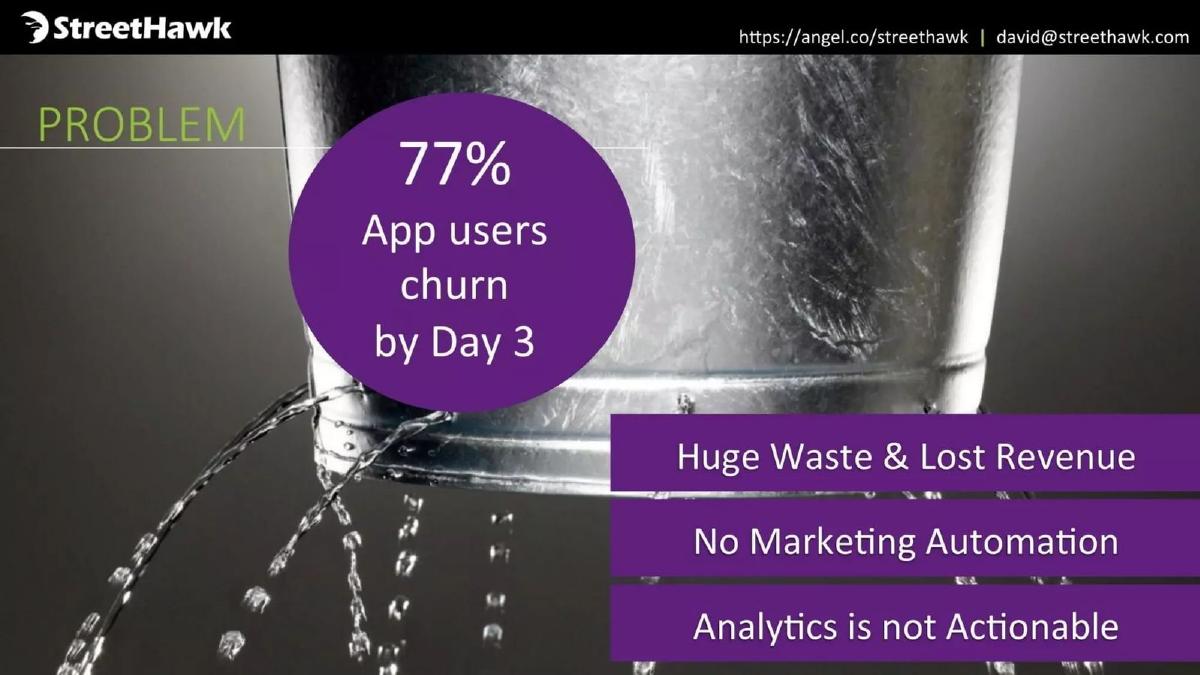
- The problem is quantified with a specific, industry-standard pain point: 77% of app users churn by Day 3 (Slide 4).
- The deck positions the product as an integration layer rather than a replacement, listing Segment.io, Mixpanel, and Flurry as partners (Slide 6).
- Traction is demonstrated through a 3.5x growth in Monthly Active Users (MAU) over a 90-day period (Slide 8).
- The solution claims to deliver a 120% improvement in Day 3 retention and a >250% activation uplift (Slide 7).
- Market size is framed by the existing installed base of 65,000 apps and 350 million users (Slide 9).
- The founders demonstrated significant 'skin in the game' by stating the company was already $600,000 founder-funded (Slide 10).
- The deck identifies a specific competitive friction: the 'cobble-together' nature of siloed tools like Branch, Urban Airship, and Localytics (Slide 5).
The 10-Slide Seed Strategy
StreetHawk’s 2014 seed deck is a study in brevity and authority. At just 10 slides, it manages to cover the essential narrative arc of a startup: who we are, why the current market is broken, how we fix it, and the proof that it’s working. In an era where decks often bloat to 20 or 30 slides, StreetHawk’s focus on high-level metrics and team pedigree stands out as a highly efficient fundraising tool.
Slides 1-2: The Hook and the Pedigree
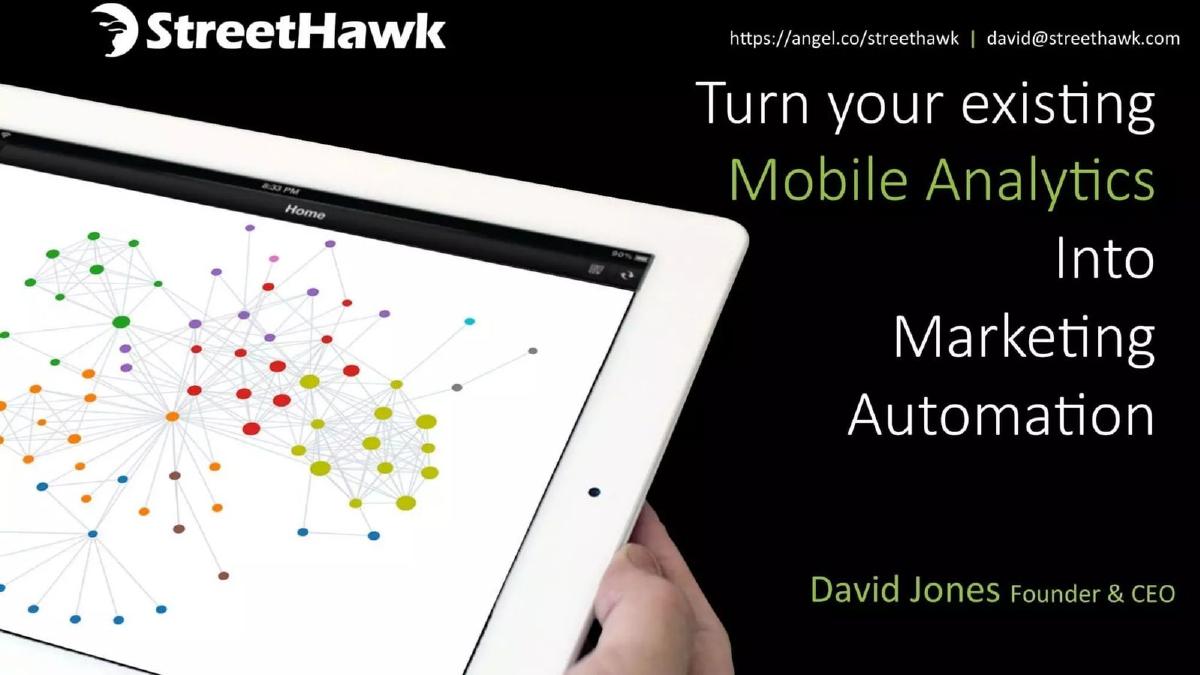
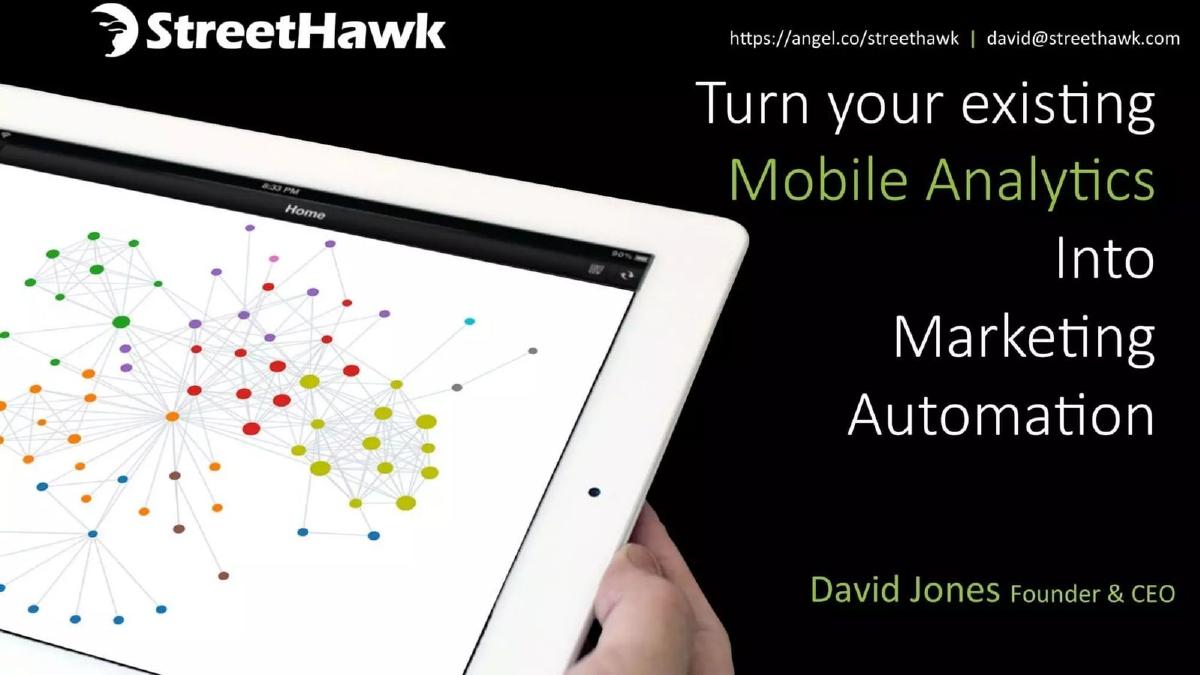
Slide 1 serves as the title page, immediately defining the product category: "Turn your existing Mobile Analytics Into Marketing Automation." This is a clear, functional value proposition. It doesn't use vague buzzwords; it tells the investor exactly what the software does. The inclusion of the CEO’s email and AngelList profile link on the cover is a practical touch for follow-up.
Slide 2 is the Team slide. Placing this second is a power move usually reserved for serial entrepreneurs. The slide features three key members: David Jones (CEO), Linda Fernandez (VP Customer Growth), and Tobias Fielitz (CTO). The most prominent text on the slide isn't a bio, but a purple circle stating "8x exit $300M+ company" and the phrase "15 years together." This immediately establishes that this is not a first-time team experimenting with an idea, but a seasoned unit with a history of generating significant investor returns.
Slides 3-5: Defining the Leaky Bucket
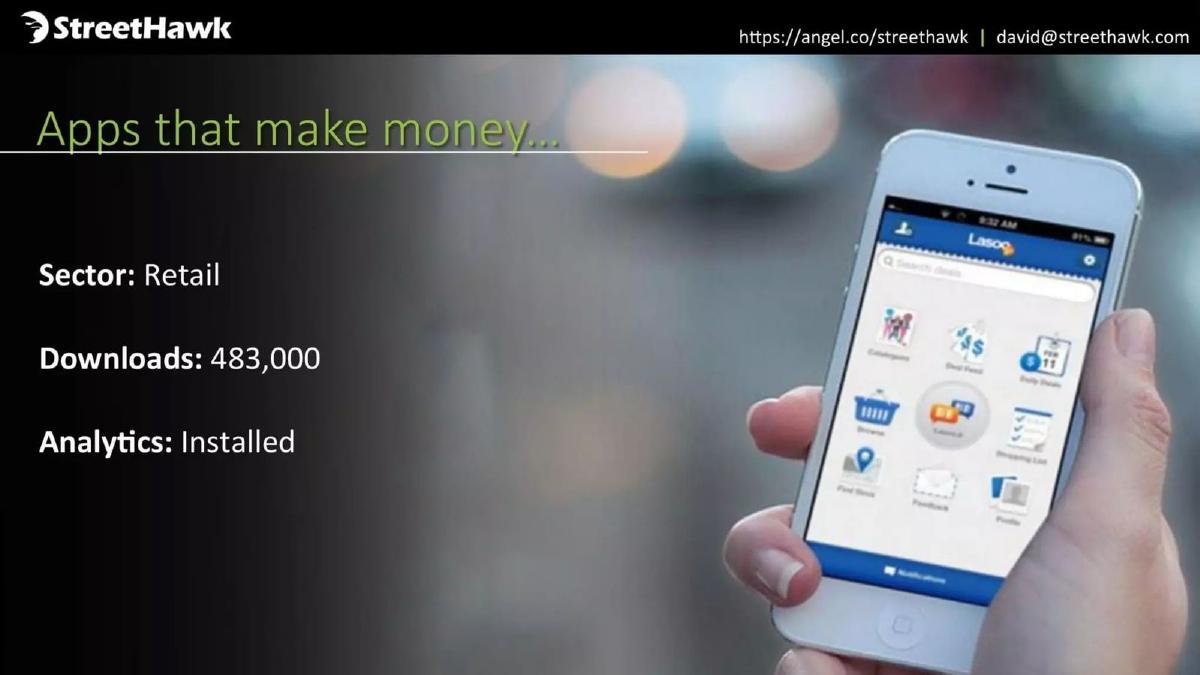
Slide 3 introduces a case study or persona: "Apps that make money..." It uses a retail app with 483,000 downloads as an example. This sets the stage for the scale of the problem. Even successful apps with high download counts face the issues described in the following slides.
Slide 4 defines the "Problem" using a visual metaphor of a leaking bucket. The core metric here is devastating: "77% App users churn by Day 3." The slide lists three consequences: Huge Waste & Lost Revenue, No Marketing Automation, and Analytics is not Actionable. By quantifying the churn, StreetHawk makes the problem feel urgent and expensive.
Slide 5 attacks the status quo. Titled "Cobble-together Siloed Tools," it features logos of competitors like Branch Metrics, Urban Airship, Localytics, and Kahuna. StreetHawk argues that using these tools leads to "Duplicate SDKs (& crashes!)" and takes "Months to rebuild data and get results." This slide is critical because it moves the conversation from "we need marketing automation" to "the current way of doing marketing automation is technically flawed."
Slides 6-7: The Integration Solution
Slide 6 presents the solution: "CONNECT YOUR ANALYTICS." Instead of fighting for SDK dominance, StreetHawk positions itself as a partner to existing infrastructure. It lists Segment.io, Mixpanel, and Flurry. The promise is that a developer can be "Up and Running in Hours" to trigger Push, Email, Deeplinks, and InApp Content. This lowers the barrier to entry for potential customers significantly.
Slide 7 provides the "Results & Customers." It claims a "120% better Day 3 Retention" and ">250% Activation Uplift." It also lists the sectors they are currently serving: Retail, Internet Banking, Real Estate, Loyalty, Travel, and Games. This slide validates the claims made in the problem section by showing that the "leaky bucket" can indeed be plugged.
Slides 8-10: Traction, Market, and The Ask
Slide 8 is a simple traction slide. It shows a large gray arrow and the text "3.5x MAU growth" over a "90 DAY" period. While the lack of absolute numbers (e.g., growing from 1,000 to 3,500 vs. 1M to 3.5M) is a common omission in seed decks, the growth rate itself is the primary signal intended for investors.
Slide 9 addresses the "HUGE & GROWING ADDRESSABLE MARKET." It estimates 350 million users across 65,000 apps that "Need Automation." A footnote predicts that within two years, mobile marketing automation will be the default. This slide attempts to show the ceiling for the business is high enough to justify venture capital.
Slide 10 is the closing slide. It repeats the contact information and adds a significant piece of data: "Founder Funded $600K." This tells investors that the founders have significant skin in the game and have already de-risked the early stages of the company with their own capital. The slide ends with a simple "...let's talk."
What Works in the StreetHawk Deck
The most effective element of this deck is the Team-First approach . By leading with a $300M exit, the founders essentially tell the investor, "We know how to do this, and we've done it before." This allows them to keep the rest of the deck very lean because they have already earned a degree of trust.
The Problem Quantification on Slide 4 is also excellent. Using the 77% churn rate gives the investor a specific number to anchor on. It transforms a vague concept like "retention is hard" into a specific, measurable business failure that needs a solution.
Finally, the Integration Strategy shown on Slide 6 is a brilliant tactical move. By showing logos of Mixpanel and Flurry, StreetHawk positions itself as a value-add to the tools the investor's portfolio companies are likely already using, rather than a disruptive new SDK that requires a difficult rip-and-replace sales cycle.
What is Missing from the StreetHawk Deck
The most glaring omission is a Business Model slide . There is no mention of how StreetHawk makes money. Is it a SaaS fee per MAU? A percentage of revenue uplift? A flat monthly fee? Investors need to know how the company captures the value it creates.
There is also no Use of Funds slide . While the deck mentions the founders put in $600,000, it doesn't state how much they are currently raising or what that money will be used for (e.g., hiring 5 engineers, expanding to the US market, etc.). A pitch deck is a request for a transaction, and this deck omits the terms of that transaction.
Lastly, the Market Size slide (Slide 9) is somewhat weak. It lists "65K Apps," but in 2014, there were millions of apps in the App Store. The deck doesn't explain the criteria for these 65,000 apps or provide a Bottom-Up TAM (Total Addressable Market) calculation based on their pricing model.
What a Founder Should Copy
Founders should emulate the visual simplicity of this deck. Each slide has one main point and very little text. This ensures that the audience listens to the presenter rather than reading the slides. The use of high-contrast colors (purple and green on black/white) makes the key metrics pop.
The "Skin in the Game" signal on the final slide is also worth copying if applicable. If you have self-funded or raised from friends and family, highlighting that capital shows commitment and provides a baseline valuation for new investors to consider.
Finally, the Competitive Framing on Slide 5 is a great way to handle a crowded market. Instead of a feature list, StreetHawk focuses on the "architectural pain" of using competitors. If your product solves a workflow or integration problem, framing competitors as "siloed" or "complex" is often more effective than claiming you have a better UI.
Final Summary
StreetHawk’s deck was successful because it combined a high-pedigree team with a clear, quantifiable problem. It didn't get bogged down in technical specifications, instead focusing on the business outcome: fixing the 77% churn rate. While it left out crucial financial and fundraising details, the strength of the team and the early traction (3.5x MAU growth) were sufficient to close a $759,200 seed round in 2014. For modern founders, this deck serves as a reminder that a clear narrative and strong founder-market fit can often outweigh a lack of detailed financial modeling in the early stages of a seed round.
Frequently asked questions
- What was the primary value proposition of StreetHawk?
- StreetHawk positioned itself as a marketing automation layer that sits on top of existing mobile analytics. Instead of requiring developers to install new, heavy SDKs to run marketing campaigns, StreetHawk promised to 'connect your analytics' (Slide 6) from tools like Mixpanel and Flurry to trigger push notifications, emails, and deep links, effectively turning passive data into active engagement.
- How did the founders use their past success to influence the pitch?
- The founders placed their team slide second, immediately following the title page. They highlighted that the team had been together for 15 years and previously achieved an 8x exit for a $300M+ company (Slide 2). This 'pedigree' move is designed to reduce perceived execution risk for seed investors, suggesting the team knows how to scale and exit a business.
- What specific metrics did StreetHawk use to prove product-market fit?
- StreetHawk focused on two types of metrics: internal growth and customer success. For internal growth, they cited 3.5x MAU growth over 90 days (Slide 8). For customer success, they claimed a 120% improvement in Day 3 retention and a >250% activation uplift (Slide 7). These figures directly addressed the 'leaky bucket' problem defined earlier in the deck.
- Who were the primary competitors identified in the deck?
- Slide 5 explicitly names Branch Metrics, Urban Airship, Localytics, and Kahuna. However, rather than a standard feature-comparison grid, StreetHawk framed these competitors as 'siloed tools' that cause 'duplicate SDKs' and 'crashes.' By doing so, they positioned StreetHawk as the unifying solution that fixes the mess created by these individual services.
- What was missing from the StreetHawk pitch deck?
- The deck is notably missing a 'Use of Funds' slide and a detailed business model or pricing slide. While Slide 10 mentions the founders had already invested $600,000, it does not specify how much new capital they were seeking or what milestones that capital would achieve. It also omits a detailed roadmap or long-term vision beyond the two-year market default prediction.