StradVision’s Series C deck is a masterclass in demonstrating industrial maturity within the high-stakes autonomous driving sector. By reporting partnerships with 13 OEMs and presence in over 50 vehicle models (Slide 3), the company moves past the 'visionary' stage into 'execution.' The deck identifies a specific $57B market opportunity by 2027 (Slide 2) and provides a transparent roadmap for its business model evolution, shifting from a 9:1 engineering-to-license fee ratio toward a 5:5 split by 2026 (Slide 7). While the deck is heavy on technical architecture and regulatory compliance—essent…
Key takeaways
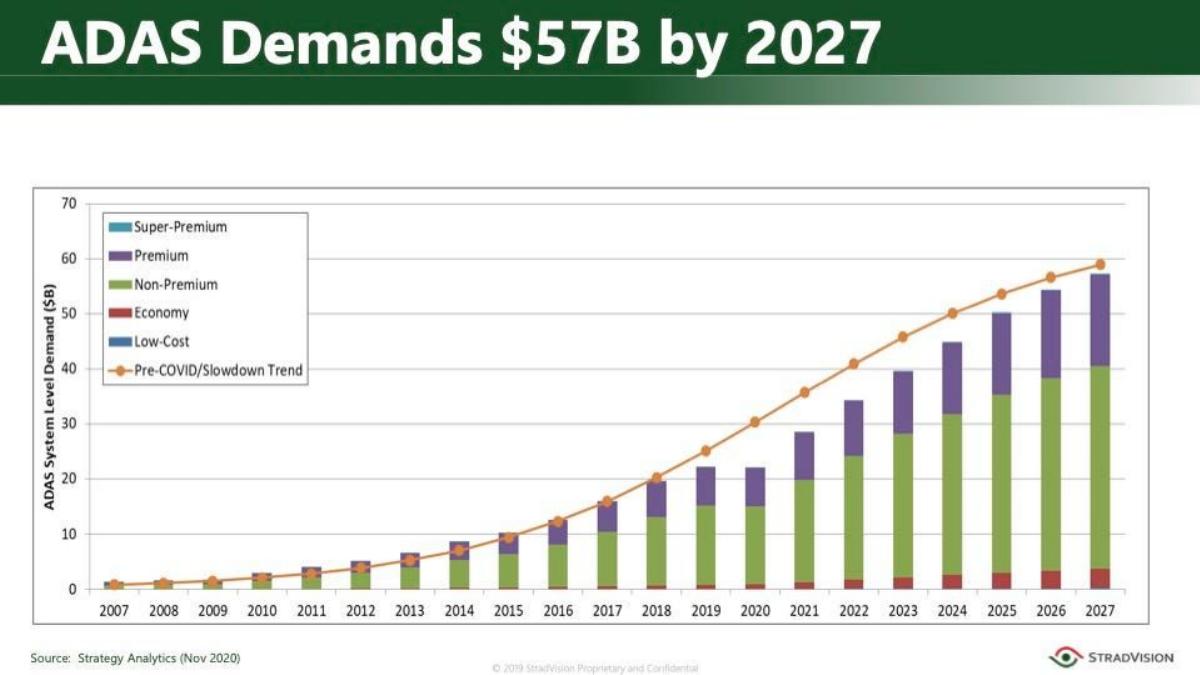
- The company projects the ADAS system level demand will reach $57B by 2027, citing Strategy Analytics (Slide 2).
- StradVision reports a total of $129M in funding prior to the Series C, with a global footprint across South Korea, USA, Germany, Japan, and China (Slide 3).
- The workforce is highly technical, with 82% of the 290 employees being engineers in data and algorithms (Slide 3).
- The core product, SVNet, is already integrated into 50+ vehicle models in partnership with 13 OEMs (Slide 3).
- A clear business model transition is outlined, moving from service-heavy engineering fees to a 50% license-based revenue mix by 2026 (Slide 7).
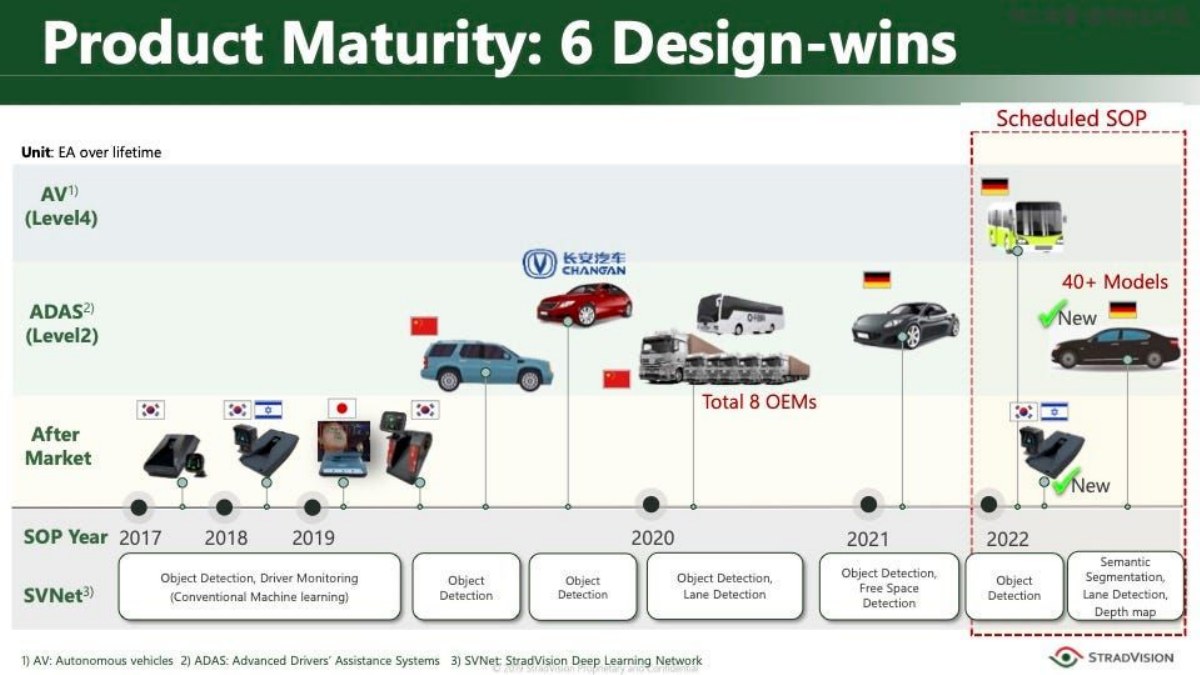
- Product maturity is evidenced by a timeline showing 'Design-wins' across multiple regions, including China and Germany, through 2022 (Slide 6).
- The deck highlights high market entry barriers, specifically citing compliance with EuroNCAP, ASPICE CL 2, and ISO 26262 (Slide 8).
- StradVision positions its DCU (Domain Control Unit) as the solution to ECU development bottlenecks in evolving vehicle architectures (Slide 5).
Executive Summary: The Industrialization of AI
StradVision’s Series C deck represents a pivotal moment for a deep-tech company: the transition from R&D to mass-market industrialization. While many autonomous driving decks focus on futuristic concepts, StradVision focuses on the 'here and now' of ADAS (Advanced Driver-Assistance Systems). With a reported $88M raised in 2024, this deck serves as the blueprint for how they convinced investors of their ability to scale across the global automotive supply chain. The deck is structured to prove three things: market demand is exploding, the product is already validated by major OEMs, and the business model is shifting toward high-margin software licensing.
Slide 1: Title and Positioning
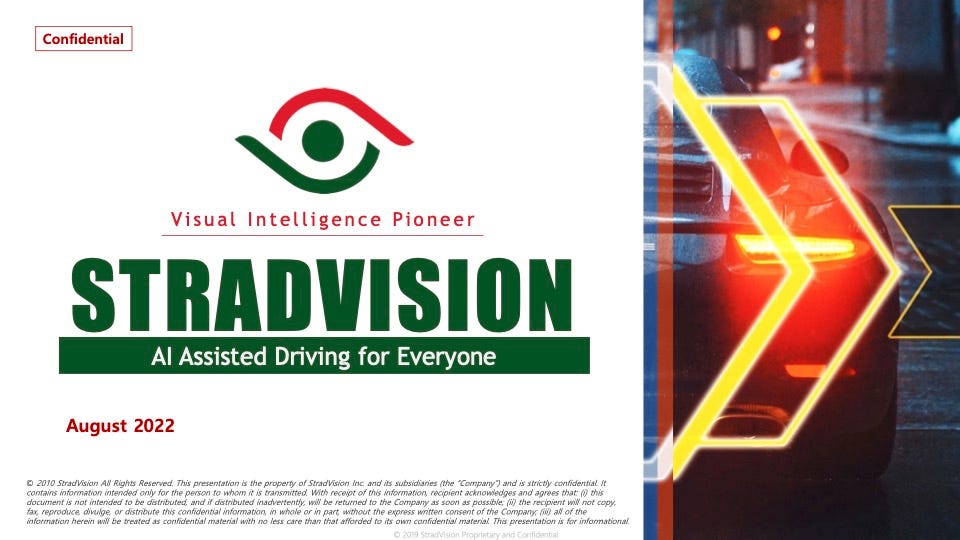
The cover slide establishes the brand identity with the tagline 'Visual Intelligence Pioneer' and the mission 'AI Assisted Driving for Everyone.' The date, August 2022, places this deck in the lead-up to their significant Series C activity. The inclusion of a 'Confidential' stamp and a detailed legal disclaimer at the bottom signals a professional, enterprise-grade fundraising process typical of late-stage rounds in the transportation sector.
Slide 2: The $57B Market Opportunity
StradVision uses this slide to establish the 'Why Now?' factor. Citing Strategy Analytics, the slide projects that ADAS system level demand will reach $57B by 2027. The bar chart is particularly effective because it segments the market by vehicle tier: Super-Premium, Premium, Non-Premium, Economy, and Low-Cost. This visualization supports their 'Driving for Everyone' mission by showing that the bulk of the market growth (the green and purple bars) lies in the Non-Premium and Premium segments, rather than just niche luxury vehicles. It also notes a 'Pre-COVID/Slowdown Trend' line, acknowledging macroeconomic shifts while maintaining a bullish outlook on long-term demand.
Slide 3: Company Overview and Global Footprint
This is a high-density 'traction' slide. It lists Junhwan Kim as CEO and notes a September 2014 incorporation date, proving the company is a seasoned player, not a new startup. Key metrics include $129M in total funding (prior to the Series C) and a headcount of 290, with a heavy emphasis on technical talent (82% engineers). The 'Production Status' section is the most critical piece of evidence here: 50+ vehicle models in partnership with 13 OEMs. The map shows a strategic global presence with offices in South Korea (HQ), USA (San Jose and Detroit), Germany (Munich), China (Shanghai), and Japan (Tokyo), covering every major automotive manufacturing hub.
Slide 4: Competitive Edge Section Header
A simple transition slide that prepares the investor for the technical and strategic differentiators of the StradVision platform.
Slide 5: Automotive Computer Controller Evolution
This slide addresses the technical shift in vehicle architecture. It contrasts 'Today' (Distributed E/E Architecture) with 'Tomorrow' (Cross-Domain Centralized) and the 'Future Vision' (Vehicle Centralized). StradVision positions its DCU (Domain Control Unit) as the solution to information security and ECU development bottlenecks. By aligning their software (SVNet) with the trend toward 'Vehicle Computers' and 'Cloud Computing,' they demonstrate that their technology is future-proofed for the next generation of electrified and automated vehicles. The slide cites Bosch as a source, lending third-party credibility to their architectural roadmap.
Slide 6: Product Maturity and Design-Wins
Slide 6 provides a chronological proof of execution. It maps out 'SOP' (Start of Production) years from 2017 to 2022. It shows a progression from 'After Market' devices in 2017-2019 to 'ADAS (Level 2)' wins with major brands like Changan in China. The right side of the slide, boxed in red, highlights 'Scheduled SOP' for 2022, including 40+ models and new entries into the German and South Korean markets. This timeline proves that SVNet has evolved from basic object detection to complex tasks like semantic segmentation, lane detection, and depth mapping, moving up the autonomy ladder from Level 2 toward Level 4.
Slide 7: The Business Model Pivot
For a Series C investor, this is arguably the most important slide. It addresses the 'service trap' that many AI companies fall into. StradVision explicitly states a goal to move from a 9:1 Engineering Fee vs. License Contribution ratio to a 5:5 ratio by 2026. The slide breaks down the 'Stages of Customer Engagement': 01 Evaluation (License), 02 Proof of Concept (Engineering Fee), 03 Product Development (Engineering Fee), and 04 Production (License per vehicle). This transparency shows investors exactly how the company plans to achieve non-linear revenue growth as more models move into the 'Production' phase.
Slide 8: Market Entry Barriers
The final slide in this sequence visualizes the 'moat.' StradVision depicts a staircase of requirements that a competitor must climb to reach 'Production.' Starting with DL Based Perception, it moves through Collision Estimation and Hardware-specific Optimization, finally reaching the 'Process' and 'Compliance' levels. By listing specific certifications like ASPICE CL 2, ISO 26262, and EuroNCAP, StradVision reminds investors that automotive software isn't just about code—it's about rigorous, multi-year safety certifications that are extremely difficult for new entrants to replicate.
What StradVision Does Well
The StradVision deck excels at demonstrating industrial readiness . In the automotive world, 'cool tech' is secondary to 'reliable tech.' By highlighting their 13 OEM partnerships and 50+ vehicle models on Slide 3, they immediately differentiate themselves from pre-revenue competitors. Their focus on the 'Economy' and 'Non-Premium' segments (Slide 2) also shows a pragmatic understanding of where the volume—and therefore the licensing revenue—actually lives.
Furthermore, the revenue roadmap on Slide 7 is exceptionally clear. Many founders are vague about how they will stop being a 'consultancy' and start being a 'software company.' StradVision puts a date (2026) and a specific ratio (5:5) on that transition, which builds significant trust with institutional investors who are looking for scalable margins.
What is Missing from the Deck
Despite the strong technical and traction data, there are several notable omissions in these 8 slides:
Unit Economics: While they mention a 'License per vehicle' model, they do not disclose the actual dollar value or range of these licenses. Investors would want to know if a license is $5 or $50 to model the total revenue potential. · Competitor Comparison: The deck mentions 'Market Entry Barriers' generally but does not name specific competitors like Mobileye or Wayve. A Series C deck usually includes a 'Why StradVision vs. X' slide to justify their specific slice of the market. · The Ask: The provided slides do not include a specific funding request or a 'Use of Proceeds' breakdown. While this may be in the remaining 23 slides of the full 31-slide deck, its absence here leaves the 'what's next' question unanswered. · Team Profiles: While the CEO is mentioned, the broader leadership team and their backgrounds (e.g., former Tier 1 auto execs or PhDs) are not showcased in this selection.
Founder Takeaways: How to Apply This to Your Deck
1. Quantify Your Moat with Compliance: If you are in a regulated industry (MedTech, Auto, Fintech), don't just say your tech is better. List the specific certifications (ISO, GDPR, EuroNCAP) you have achieved. As shown on Slide 8, these are 'Market Entry Barriers' that protect your business from faster-moving but less-disciplined startups.
2. Map the Revenue Evolution: If your early revenue is service-heavy (engineering fees, implementation costs), be honest about it. Use a slide like StradVision’s Slide 7 to show how that ratio will flip in favor of recurring or scalable revenue as the product matures. This prevents investors from valuing you as a low-margin service business.
3. Use 'Design-Wins' as Traction: In B2B or OEM sales cycles that take years, you can't always show immediate MRR growth. Instead, use a 'Product Maturity' timeline (Slide 6) to show 'Design-Wins' and 'Scheduled SOP.' This proves that the work has been done and the revenue is 'locked in' for future years.
4. Segment Your TAM: Don't just show one big number for your Total Addressable Market. Break it down by customer tier as StradVision did on Slide 2. This shows you understand which specific customer segments are driving the growth and where your product fits into the broader ecosystem.
Frequently asked questions
- What is StradVision's primary product and how is it used?
- StradVision’s primary product is SVNet, a deep-learning-based perception software. As stated on Slide 3, it uses camera sensors to enable Advanced Driver-Assistance Systems (ADAS). The software is designed to be lean enough to run on various hardware platforms while maintaining high accuracy for object detection and lane recognition.
- How does StradVision plan to change its revenue model over time?
- According to Slide 7, the company currently operates on a 9:1 ratio of engineering fees to license contributions. They aim to shift this to a 5:5 ratio by 2026. This indicates a strategic move toward a more scalable, high-margin software licensing business as their technology reaches mass production across more vehicle models.
- What specific market segments does StradVision target within ADAS?
- Slide 2 breaks down the $57B market demand into Super-Premium, Premium, Non-Premium, Economy, and Low-Cost segments. The chart shows that while Premium and Non-Premium segments currently drive the most volume, the 'Economy' and 'Low-Cost' segments are projected to grow, supporting their mission of 'AI Assisted Driving for Everyone'.
- What are the technical barriers to entry mentioned in the deck?
- Slide 8 outlines a five-tier 'Market Entry Barrier' stack. This includes Deep Learning Based Perception, Collision Estimation, Hardware-specific Optimization, Process compliance (ASPICE CL 2 & ISO 26262), and final Regulatory Compliance (EuroNCAP & Guobiao). These certifications are mandatory for automotive production, creating a significant moat against new software startups.
- How many employees does StradVision have and what is their focus?
- As of the deck's publication, StradVision employed 290 people. Slide 3 highlights that 82% of this workforce (over 230 individuals) are engineers focused on data, algorithms, and related technical fields, emphasizing the company's R&D-centric nature.