Strong Roots is a plant-based frozen food brand that successfully transitioned from a small startup to a major retail player. The deck emphasizes the company's ability to achieve massive retail distribution—including giants like Target, Whole Foods, and Tesco—with only €100,000 in initial capital. The narrative is built on the 'Future Food' concept, addressing global population growth and the resulting strain on resources. By positioning frozen vegetables as the solution to food waste and nutrient retention, Strong Roots carves out a unique niche. The deck is notable for its focus on executio…
Key takeaways
- The company achieved significant retail distribution across Ireland, the UK, and the USA with only €100,000 in startup capital (Slide 16).
- Strong Roots aims to scale from 16 to 34 grocery customers and from 11 to 36 frozen products (Slide 19).
- The brand positions frozen vegetables as a superior alternative to fresh produce, citing 47% less food wastage and double the nutrient retention (Slide 36).
- A competitive matrix shows Strong Roots as the only brand meeting all five criteria: Plant-Based, Responsible, Positive Food, For Everyone, and For Now (Slide 44).
- The company leverages a 'Future Food' narrative, citing a need for 1.5 planets to meet food demand by 2050 (Slide 27).
- Strong Roots has a proven track record of industry recognition, winning multiple Great Taste and The Grocer awards between 2016 and 2019 (Slide 78).
- The deck explicitly excludes chilled and ambient products from its current growth plan to focus on the frozen category (Slide 19).
- Consumer data indicates a 'megatrend' where 66% of people are prepared to pay more for socially and environmentally impactful products (Slide 31).
The 'Future Food' Narrative
Strong Roots opens its Information Memorandum with a bold, minimalist title: 'FUTURE FOOD' (Slide 1). This sets a high-level, visionary tone for the deck. Rather than starting with a product, they start with a philosophy. The branding is clean and sophisticated, using a dark palette that suggests a premium, modern identity. This is not your typical 'green and earthy' plant-based brand; it feels more like a tech-enabled consumer goods company.
The Origin and the Formula
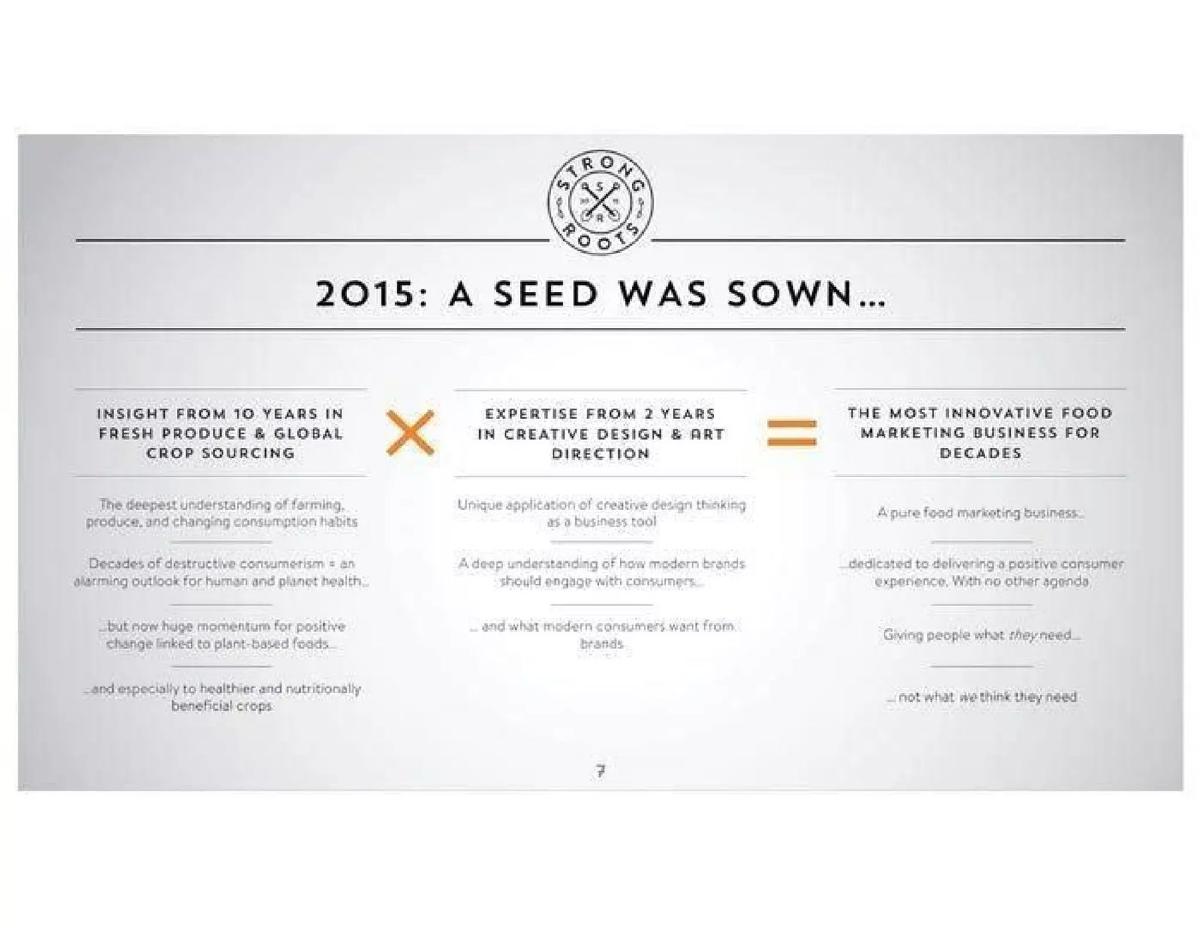
Slide 7 breaks down the company's DNA into a simple equation: 10 years of experience in fresh produce and global sourcing multiplied by 2 years of expertise in creative design and art direction equals 'the most innovative food marketing business for decades.' This is a critical slide because it establishes the founders' dual expertise in the 'unsexy' side of the business (supply chain and farming) and the 'sexy' side (branding and consumer engagement). It addresses a common investor concern: can these founders actually build a brand, and do they know how to source the ingredients?
Validation Through Retail Traction
One of the strongest slides in the deck is Slide 11, which displays a 'roster of leading retailers.' The logos are grouped by country: Ireland, the UK, and the USA. Seeing household names like Tesco, Asda, Target, Whole Foods, and Harrods on a single slide provides immediate, massive credibility. This isn't a pitch for a product that might sell; it's a pitch for a product that is already selling in the world's most competitive retail environments. The inclusion of Harrods alongside Aldi shows the brand's versatility—it can play in both the luxury and discount spaces.
Capital Efficiency and the Big Ask
Slide 16 is the 'mic drop' moment of the deck. It states that all the retail success shown previously was achieved with 'just €100,000 of start-up capital.' This is followed by the provocative question: 'What could we achieve with €15,000,000?' This is a masterclass in framing an investment ask. It shifts the conversation from 'we need money to survive' to 'we have a proven engine, and we need fuel to go faster.' It highlights the team's ability to execute under constraints, which is a trait highly valued by venture capitalists and private equity investors.
Strategic Focus: The Growth Plan
Slide 19, 'How will we achieve this?', provides a clear roadmap. The company is doubling down on what works: the US, UK, and Irish markets, and the frozen category. They explicitly cross out 'Chilled' and 'Ambient' products, as well as the 'Rest of world' markets. This level of focus is refreshing. Many startups try to do too much too soon; Strong Roots is signaling that they will stay disciplined and dominate their current niche before expanding further. The slide also includes specific targets: growing from 16 to 34 grocery customers and from 11 to 36 frozen products.
The Macro Problem: Population and Planets
The World is Growing Too Fast
Slides 24 and 27 pivot to the 'Why Now?' and the global problem. Slide 24 uses a population growth chart to show the 'extraordinary rate' of increase, with 2 billion more people expected in the next 30 years. Slide 27 takes this further, quoting Chad Frischmann of Project Drawdown, stating that by 2050, we will need '1.5 planets to meet demand.' This positions Strong Roots as a solution to a global crisis, not just another food brand. It taps into the 'ESG' (Environmental, Social, and Governance) investment trend, making the company an attractive target for impact-focused capital.
The Consumer Megatrend
Slide 31 connects the global problem to consumer behavior. It cites statistics showing that 42% of shoppers think about the environment when buying food, and 66% are prepared to pay more for products from companies committed to positive impact. This slide bridges the gap between 'the world is in trouble' and 'people are changing how they spend money.' It provides the market validation needed to support the company's premium positioning.
The Solution: Frozen as the Answer
Frozen vs. Fresh
Slide 36 is a tactical defense of the frozen food category. It challenges the common perception that fresh is always better. Strong Roots argues that frozen is 'nature's original preservation method,' resulting in 47% less food wastage and double the nutrient retention compared to fresh produce. This is a crucial pivot. By reframing 'frozen' as a sustainable and healthier choice, they remove the stigma often associated with the frozen aisle. The quote from a professor at Sheffield Hallam University adds academic weight to these claims.
Mission and Competitive Positioning
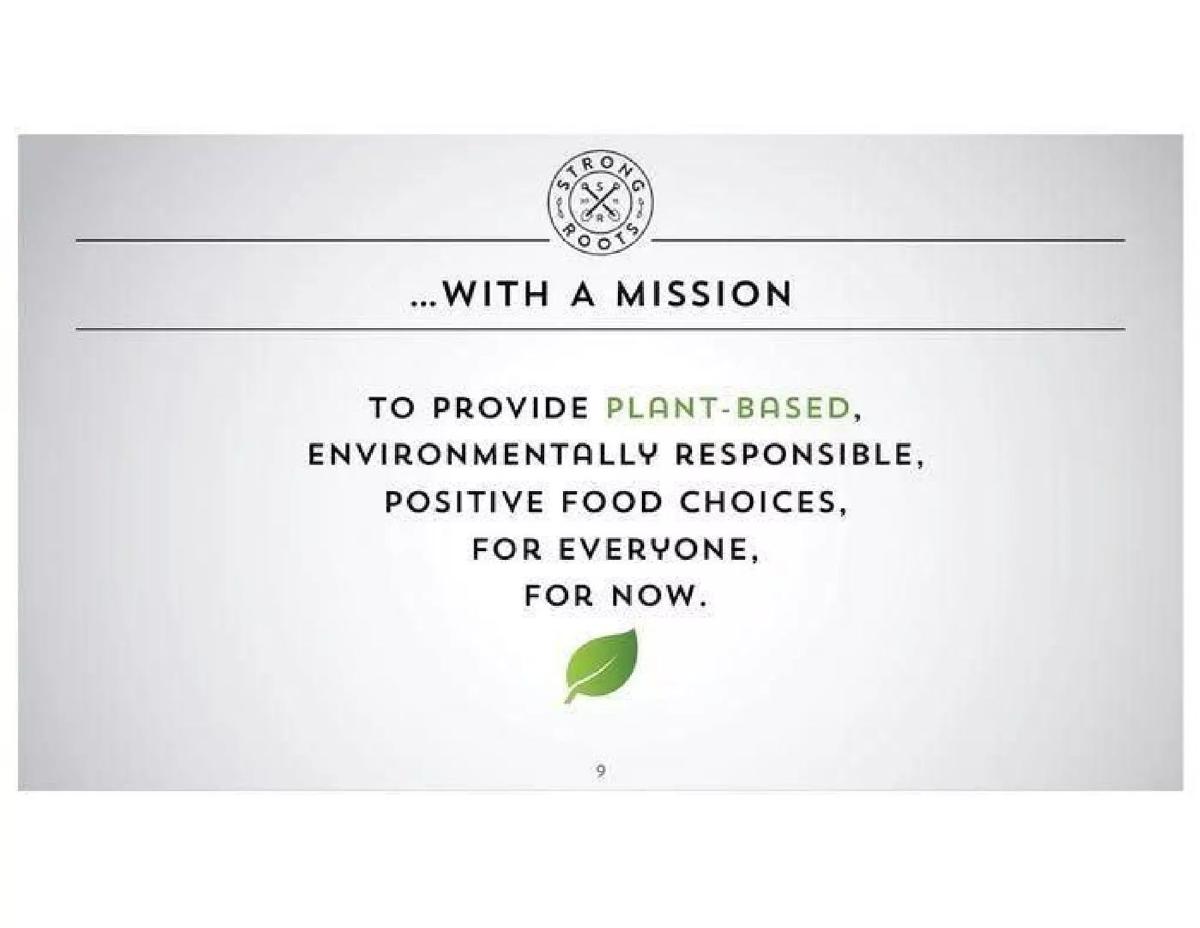
Slide 40 states the mission: 'To provide plant-based, environmentally responsible, positive food choices, for everyone, for now.' This leads directly into the competitive matrix on Slide 44. The matrix compares Strong Roots to legacy brands like McCain and Birds Eye, as well as newer competitors like Quorn and Amy's. Strong Roots is the only brand that checks every box. While competitive matrices are often biased, this one clearly defines the brand's 'five pillars' of differentiation: Plant-Based, Responsible, Positive Food, For Everyone, and For Now.
Data-Driven Insights and Recognition
The Streetbees Partnership
The latter part of the deck (Slides 1, 4, 11, 14 of the second section) introduces Streetbees, a consumer insights platform. These slides explain how Strong Roots uses 'real, in-the-moment interactions' to understand consumer emotions and context. This suggests that the company isn't just guessing what people want; they are using AI and deep data to drive their marketing, R&D, and strategy. This 'tech-forward' approach to a traditional industry like frozen food is a significant differentiator for investors looking for modern CPG (Consumer Packaged Goods) plays.
Awards and Milestones
Slide 78 provides a timeline of 'multiple industry awards' from 2016 to 2019. The brand has consistently won Great Taste awards and The Grocer's 'New Product' awards. This timeline serves as a proxy for product quality. In the food industry, taste is king, and these awards prove that Strong Roots isn't just sustainable and well-branded—it also tastes good. The mention of being the 'first ever frozen food brand stocked in Harrods' is a particularly strong prestige signal.
What Works and What is Missing
What Works
Massive Retail Traction: The list of global retail partners is the strongest asset in the deck. It proves market fit and scalability. · Capital Efficiency: The contrast between the €100k initial capital and the current scale is a powerful narrative tool. · Reframing the Category: Successfully turning the 'frozen' label from a negative into a positive (sustainability/nutrition) is a key strategic win. · Data-Driven Strategy: The inclusion of Streetbees data shows a level of sophistication beyond typical food startups.
What is Missing
Detailed Financials: While the 'ask' is clear, the provided slides do not show revenue growth, margins, or burn rate. Investors would need to see the unit economics of their retail partnerships. · Team Slide: The provided selection lacks a dedicated team slide. While Slide 7 mentions the founders' expertise, a slide showing the full leadership team and their backgrounds is essential. · Supply Chain Details: For a company scaling from 11 to 36 products, details on manufacturing capacity and supply chain resilience would be critical. · Exit Strategy: There is no mention of potential acquirers or an IPO path, though the scale and retail presence suggest a clear path to acquisition by a major food conglomerate.
What a Founder Should Copy
The 'Equation' Slide: Use a simple formula to explain why your team is uniquely qualified to solve the problem (Slide 7). · The 'All This with X' Slide: If you have been capital efficient, highlight it. It builds immediate trust with investors (Slide 16). · The Focused Growth Plan: Don't be afraid to show what you are not doing. It demonstrates maturity and strategic discipline (Slide 19). · Third-Party Validation: Use awards, retail logos, and academic quotes to back up your claims. Don't just say your product is great; show that the industry agrees (Slides 11, 36, 78).
Frequently asked questions
- What is the primary value proposition of Strong Roots?
- Strong Roots positions itself as a 'Future Food' company, providing plant-based, environmentally responsible frozen food. It differentiates itself by focusing on 'honest' frozen vegetable recipes that reduce food waste by 47% compared to fresh produce while maintaining higher nutrient retention. The brand aims to make high-quality, sustainable plant-based options accessible to the mass market, not just a niche audience.
- How does Strong Roots justify its expansion into the US market?
- The deck shows a roster of leading US retailers already carrying the brand, including Target, Whole Foods, Wegmans, and Sprouts (Slide 11). This existing traction serves as proof of concept. The expansion plan involves increasing the number of grocery customers from 16 to 34 and expanding the product range from 11 to 36 items, focusing specifically on the frozen category where they have already seen success.
- What is the significance of the €100,000 startup capital mention?
- By highlighting that they achieved a global retail footprint with only €100,000 (Slide 16), Strong Roots demonstrates extreme capital efficiency. This is a powerful signal to investors that the management team knows how to stretch a budget and achieve high ROI. It sets the stage for their €15,000,000 ask, implying that if they did 'all this' with a small amount, the larger investment will lead to exponential growth.
- How does the company view the competitive landscape?
- Strong Roots uses a competitive matrix (Slide 44) to compare itself against major players like McCain, Birds Eye, and Quorn. They claim to be the only brand that is simultaneously plant-based, environmentally responsible, 'positive food' (no artificial colors/flavors), accessible to everyone, and designed for current consumer needs. This 'clean sweep' positioning is intended to show a clear white space in the market.
- Why does the deck include slides from Streetbees?
- The inclusion of Streetbees slides (Slides 1, 4, 11, 14 in the latter section) suggests that Strong Roots uses third-party data and AI-driven consumer insights to inform their strategy. Streetbees provides 'real-time' emotional and contextual data on consumer choices. This indicates that Strong Roots is a data-driven organization that bases its marketing and R&D on actual consumer behavior rather than assumptions.