What Your Raise Doesn't Fund: Show the Plan's Scope
How to show investors what your funding plan includes and deliberately leaves out: markets, products and revenue streams outside the forecast.
What Your Raise Doesn't Fund: Show Investors the Edges of Your Plan
Most decks list everything the company could do. Investors also want to know what the money will not be spent on, and which possible revenue is not in the numbers. A clear boundary shows focus, makes the forecast easier to check, and stops an investor from assuming every opportunity you mention is already priced into the ask. This guide uses four real slides from two consumer food brands that drew that boundary in different ways.
TL;DR
Next to your ask or use of funds, add one short statement of scope: which markets, products, channels and revenue streams the raise and the forecast include, and which are deliberately excluded. For each exclusion, say whether you will spend nothing on it, or spend on it without counting its revenue. Then make sure every other page agrees: an opportunity you describe as part of the plan must either be in the forecast or be labelled as upside outside it.
Four real slides that draw the plan's boundary
Each slide is shown as it appears in the company's original deck, with what it says, what we checked and what an investor still can't tell. Page numbers are positions in the stored deck file; where the printed page number differs, we say so.
Strong Roots ask slide — slide 10
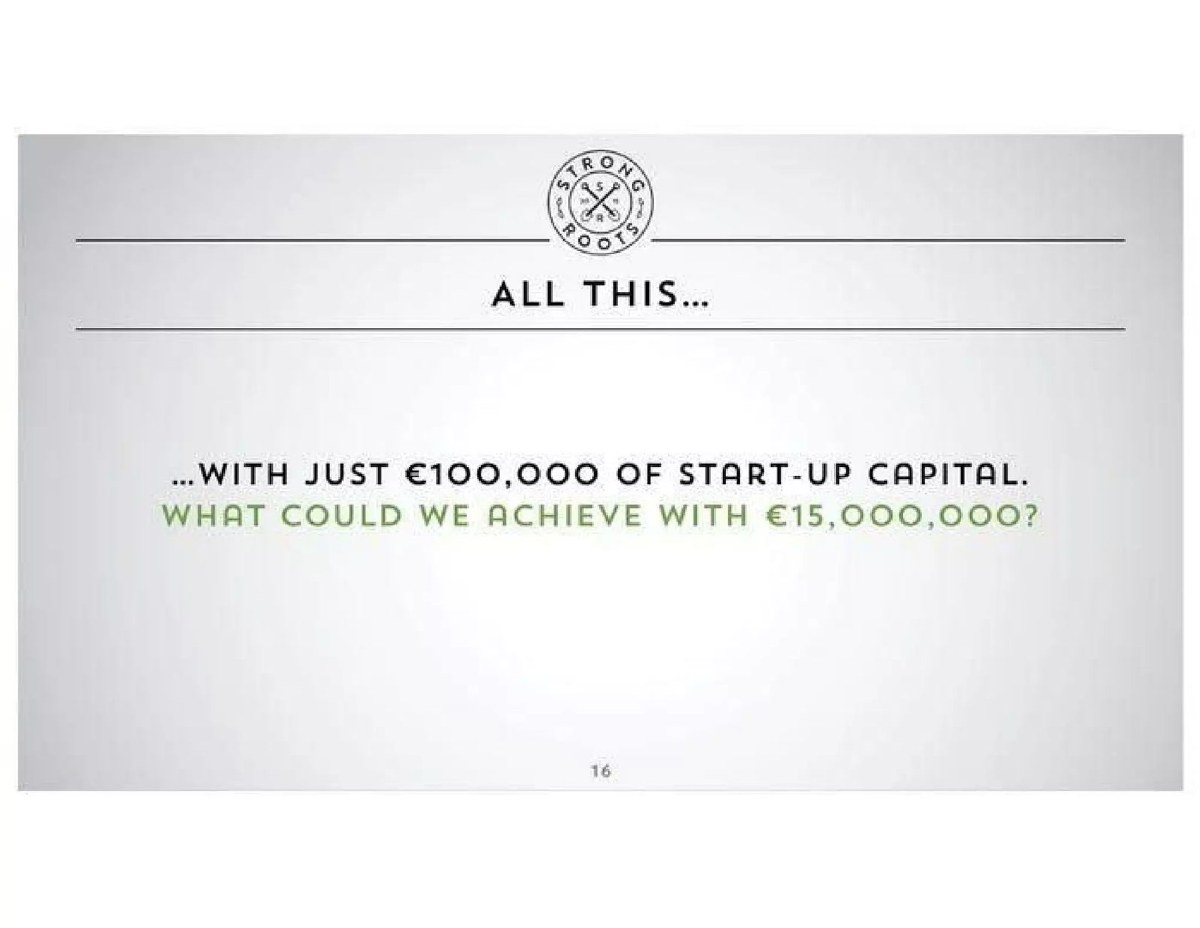
Irish frozen plant-based food brand; page 10 of a 59-page deck (printed page 16), the page that introduces the size of the raise.
Strong Roots deck, slide 10. Exact stored slide matched to this analysis.
Our analysis: Asking "what could we achieve" invites the reader to imagine everything. The grid that follows narrows it, which is what makes this pairing useful: the deck raises a big number, then shows the edges of what it buys.
Evidence and limitation: Directly visible: the ask (€15,000,000) and the starting capital (€100,000), framed as a question. Our check: the answer comes three pages later on the included/excluded grid (page 13, printed 19), after a founder message and a vision page.
What a founder can adapt: Put the answer on the same page or the next one: "€15M funds: [included]. Not in this plan: [excluded]."
Supporting analysis
What the deck claims: "All this… with just €100,000 of start-up capital. What could we achieve with €15,000,000?"
Presentation choice: It shows the ask that the scope grid answers, so the reader can see why the boundary is needed.
When it does not fit: Don't leave a large ask open-ended for several pages.
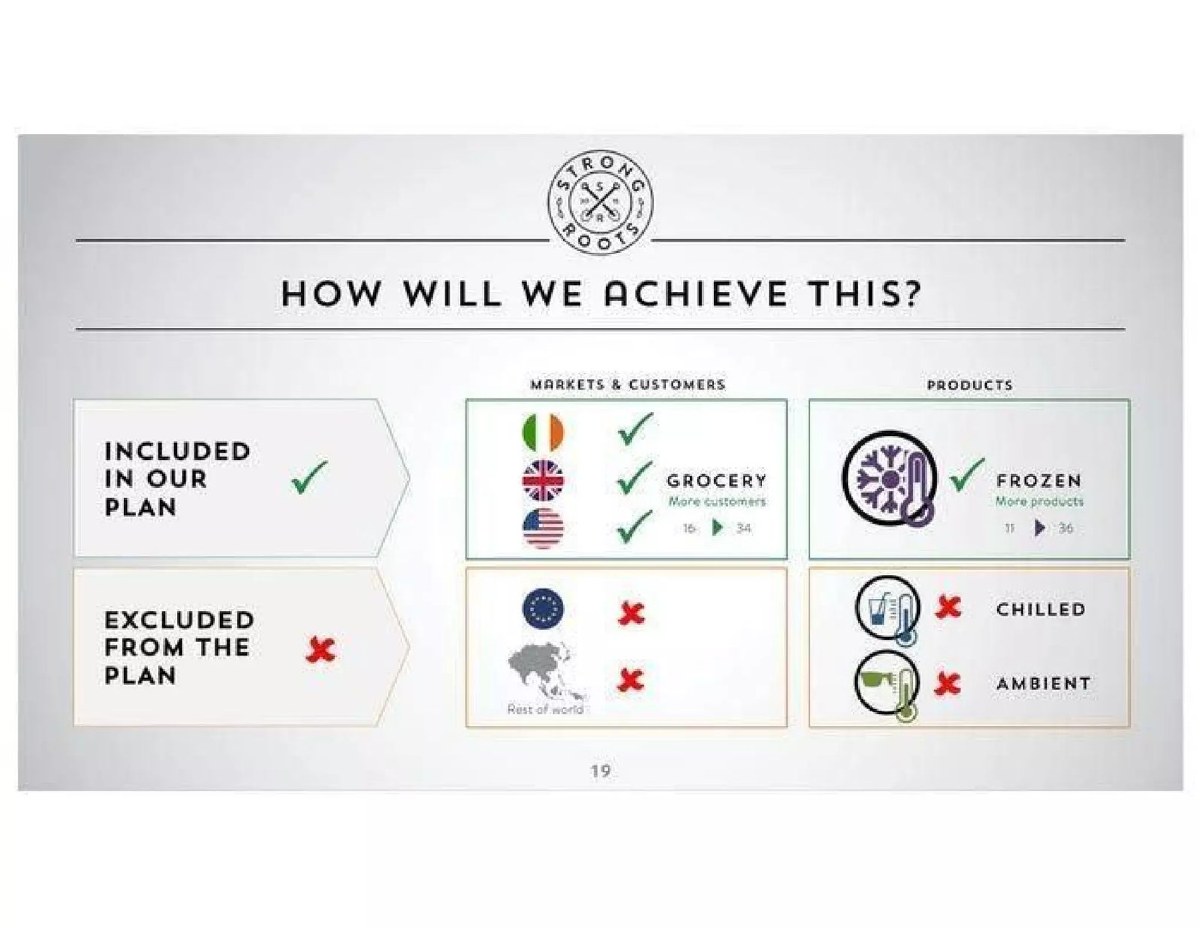
The same deck's "How will we achieve this?" page (printed page 19).
Strong Roots deck, slide 13. Exact stored slide matched to this analysis.
Our analysis: The clearest scope statement we found: an investor can see in seconds which markets and product temperatures the €15,000,000 covers. Its weaknesses are the missing period on the targets and silence on channels such as food service or online.
Evidence and limitation: Directly visible: a two-row grid by markets and products, with a tick or cross for each, and two growth targets on the included side. Our check: the target figures are small on the slide and give no period or unit beyond "customers" and "products". Channels other than grocery are not mentioned either way.
What a founder can adapt: Add the period ("by [year]") to each target and a third column for channels.
Supporting analysis
What the deck claims: "Included in our plan": markets and customers Ireland, UK and US, "Grocery — More customers 16 ▸ 34"; products "Frozen — More products 11 ▸ 36". "Excluded from the plan": EU and "Rest of world"; "Chilled" and "Ambient" products.
Presentation choice: It shows a funded plan defined by explicit inclusions and exclusions across markets and products.
When it does not fit: Don't print the targets smaller than the labels.
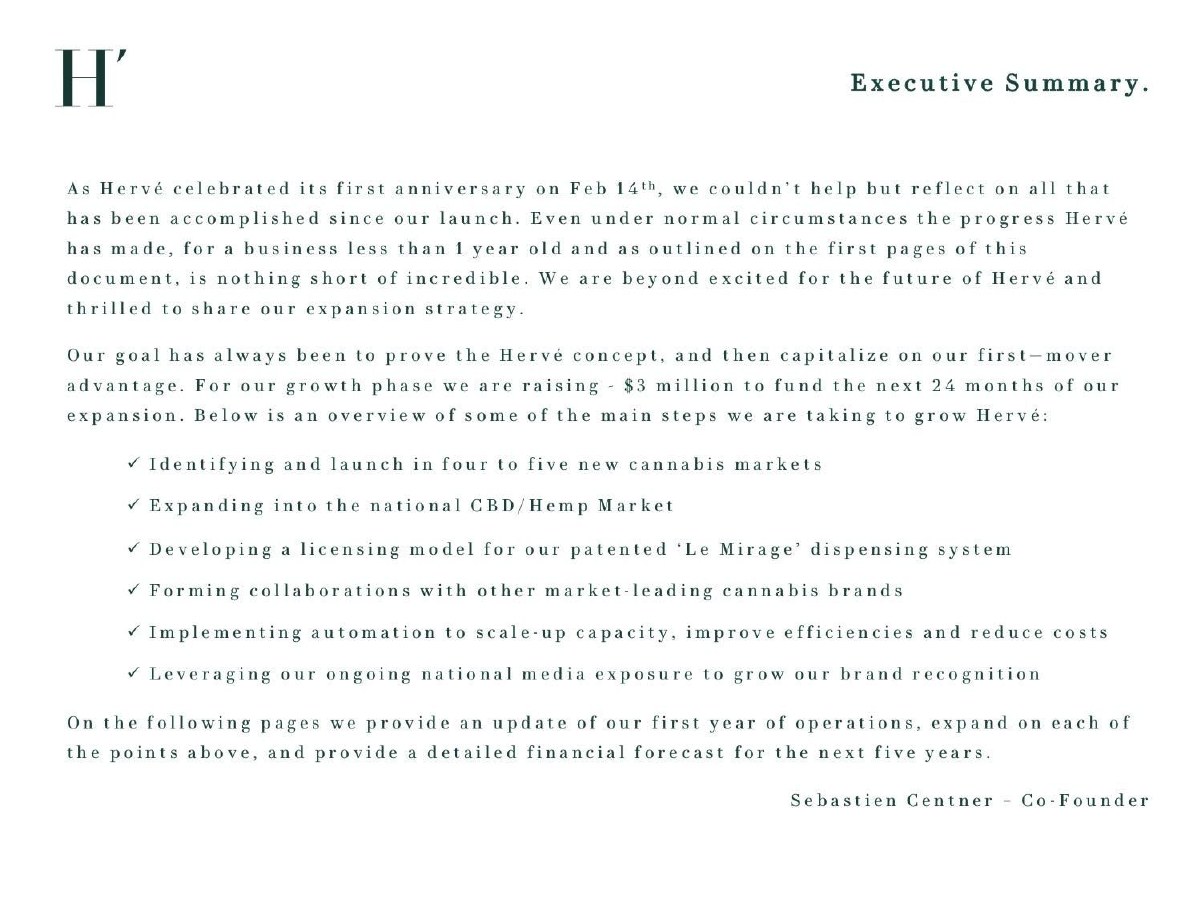
US luxury cannabis-edibles brand (macarons and a patented dispenser called Le Mirage); page 4 of a 31-page growth deck.
Hervé deck, slide 4. Exact stored slide matched to this analysis.
Our analysis: A clear ask with a period. Listing licensing as a funded step is fine; the deck simply needs to say, here or beside the forecast, that this step's revenue is not counted and roughly what it costs.
Evidence and limitation: Directly visible: the amount, the period and six funded steps, including licensing. Our check: page 26 says licensing revenue is excluded from the 2021 forecasts, so one funded step has no revenue in the forecast. We found no forecast page in the stored 31-page deck, although this page promises one.
What a founder can adapt: Mark each step "in forecast" or "upside, not in forecast", with its share of the $3 million.
Supporting analysis
What the deck claims: "For our growth phase we are raising $3 million to fund the next 24 months of our expansion." Steps include "Identifying and launch in four to five new cannabis markets", "Expanding into the national CBD/Hemp Market", "Developing a licensing model for our patented 'Le Mirage' dispensing system" and "Forming collaborations with other market-leading cannabis brands". "On the following pages we … provide a detailed financial forecast for the next five years."
Presentation choice: It shows a funded step whose revenue the same deck later leaves out of the forecast.
When it does not fit: Don't promise a forecast page the deck doesn't contain.
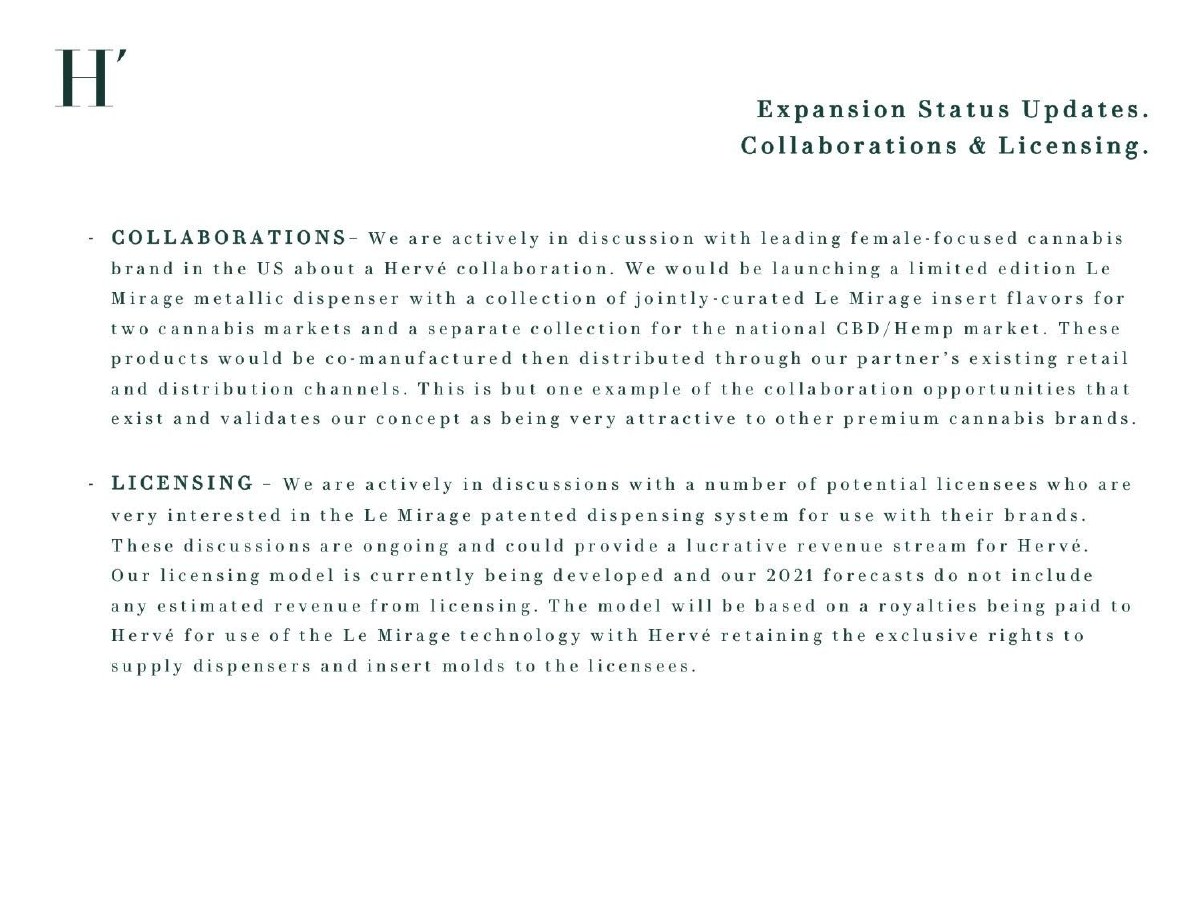
The same deck's "Expansion Status Updates. Collaborations & Licensing." page.
Hervé deck, slide 26. Exact stored slide matched to this analysis.
Our analysis: The most useful single sentence in the set. It tells the investor that licensing is upside, not a forecast assumption, so a stalled licensing deal doesn't break the plan. Extending it to every forecast year, and stating the cost of the licensing work, would complete it.
Evidence and limitation: Directly visible: an explicit statement that one revenue stream is excluded from the forecast, the reason (the model is still being developed) and how it would earn (royalties plus exclusive supply of dispensers and molds). Our check: the exclusion covers 2021 only; the page doesn't say whether later years include licensing.
What a founder can adapt: "Licensing: not in forecast for any year; [cost] of team time included in operating costs."
Supporting analysis
What the deck claims: "We are actively in discussions with a number of potential licensees … These discussions are ongoing and could provide a lucrative revenue stream for Hervé. Our licensing model is currently being developed and our 2021 forecasts do not include any estimated revenue from licensing. The model will be based on a royalties being paid to Hervé for use of the Le Mirage technology with Hervé retaining the exclusive rights to supply dispensers and insert molds to the licensees."
Presentation choice: It shows how to keep a promising but unproven revenue stream out of the forecast and say so.
When it does not fit: Don't limit an exclusion to one year without saying what happens after.
The questions a scope statement should answer, and which each slide covers.
Slide
What's funded
What's excluded
Kind of exclusion
Targets or period
Strong Roots p10
€15,000,000 ask
Not on this page
Not applicable
Not on this page
Strong Roots p13
IE, UK, US grocery; frozen
EU, rest of world; chilled, ambient
Out of the plan
16 → 34 customers, 11 → 36 products; no period
Hervé p4
$3M, 24 months, six steps
Not on this page
Not applicable
24-month period
Hervé p26
Licensing work continues
Licensing revenue
In the plan, out of the forecast
2021 forecasts only
Key Takeaways
Draw the boundary next to the ask. Strong Roots asks what €15,000,000 could achieve and answers with an included/excluded grid.
Exclude by market, product and channel, so the investor can see what the forecast covers.
Tie the included scope to measurable targets. Strong Roots adds grocery customers 16 to 34 and frozen products 11 to 36.
Name revenue you've left out of the forecast. Hervé says its 2021 forecasts include no licensing revenue.
If the raise pays for an effort whose revenue you exclude, say so. Hervé lists licensing among the steps its $3 million funds.
Check that the deck you send contains every page it promises; Hervé's summary promises a five-year forecast the stored deck doesn't include.
Write your scope statement
Answer each prompt, then put the result beside your ask or use of funds.
Markets. Which countries, regions or segments does the raise cover, and which are out?
Products. Which products or ranges are in the plan, and which are not?
Channels. Which sales channels are funded, and which are deliberately left alone?
Forecast. Which revenue streams are in the forecast, and which are upside outside it? For which years?
Cost of upside. If you spend on an effort whose revenue you exclude, how much of the raise does it use?
Consistency. Does every other page (vision, market, summary) agree with this boundary?
Copyable framework: This raise funds [markets], [products] and [channels], reaching [targets] by [date]. Not in this plan: [exclusions]. In the plan but not in the forecast: [stream] ([cost] budgeted, $0 revenue assumed, all years).
Illustrative example 1 — written by us
Before: What could we achieve with €15,000,000?
After: €15M funds Ireland, UK and US grocery (16 → 34 customers) and frozen products (11 → 36) by [year]. Not in this plan: EU, rest of world, chilled, ambient.
What improved: Built from Strong Roots' pages 10 and 13. Markets, products and targets are from its grid; the year is a placeholder the slide doesn't give.
Illustrative example 2 — written by us
Before: Our 2021 forecasts do not include any estimated revenue from licensing.
After: Licensing is upside: $0 revenue in every forecast year; about [cost] of the $3M is budgeted for building the model.
What improved: Built from Hervé's pages 4 and 26. The cost and the all-years scope are placeholders the deck doesn't give.
Why the edges of a plan matter to investors
An investor reading a funding plan is testing two things: is the money enough for what you promise, and is the forecast built on the same plan as the ask? Both questions get easier when you say what is out. A plan that covers three markets and one product range needs less money and carries less risk than one that quietly includes everything on your vision slide.
Official small-business guidance asks founders to explain clearly what the funding is for and to back the request with projections. Scope is the link between the two: the projections should cover exactly the activities the money pays for.
Out of the plan: you will not spend on it during this raise. Strong Roots puts the EU (outside Ireland and the UK), the rest of the world, chilled products and ambient products in this group. The investor can assume none of the €15,000,000 goes there and none of the forecast comes from there.
In the plan, out of the forecast: you will spend time or money on it, but you don't count its revenue yet. Hervé's licensing model is in this group. It is listed among the steps the raise funds, yet its 2021 forecasts "do not include any estimated revenue from licensing". That is a conservative choice, but it means part of the spending has no matching revenue in the forecast, and the investor should know roughly how much.
Say which kind each exclusion is. The first narrows the plan; the second keeps upside out of the numbers.
Make the included scope measurable
Listing what's in only helps if it connects to targets. Strong Roots' grid puts small figures under each included block: "Grocery — more customers — 16 ▸ 34" and "Frozen — more products — 11 ▸ 36". A reader can turn that into questions for the forecast: how much revenue per grocery customer, and how much per product?
The grid doesn't say when those targets are reached or which period they cover, and the small figures are hard to read at slide size. Put the period on the slide ("by end of year 3") and make the targets as large as the labels.
A quick test before you send the deck: multiply each included target by your average revenue per unit (per customer, per store, per product) and compare the total with the forecast for the same year. If the forecast is much larger, something outside the stated scope is in the numbers; if it is much smaller, the targets need a lower bar or a longer period.
Keep every page consistent with the boundary
Scope statements fail when other pages contradict them. If your vision slide says "global" and your plan slide excludes the rest of the world, that's fine as long as the plan is clearly the funded phase. If your summary lists a revenue stream as a funded step and your forecast leaves it out, say so in both places.
Hervé does this partly well. The executive summary lists "Developing a licensing model for our patented 'Le Mirage' dispensing system" among the main steps for the $3 million raise, and page 26 states that licensing revenue is excluded from the 2021 forecasts. The summary also promises "a detailed financial forecast for the next five years", but no forecast page appears in the 31-page deck stored in our collection. An investor would have to ask for it, and also ask whether the exclusion applies beyond 2021.
Which items usually need a scope line
Markets: countries, regions or customer segments. Investors want to know whether a second country is funded now or depends on a later round, because entering a market brings its own hiring, regulation and marketing costs. Strong Roots names three countries in and two regions out, which answers that in one glance.
Products: ranges, formats or versions. A food brand that adds chilled or ambient lines needs different factories, logistics and shelf space; a software company that adds a second product needs a second team. Excluding them keeps the cost base in the forecast believable.
Channels: retail, online, food service, wholesale, partners. A channel left unmentioned is the most common gap, because founders often assume it's obvious. Neither deck here addresses channels beyond grocery and distribution partners, so an investor would have to ask.
Revenue streams: licensing, data, advertising, services. These are the items most often mentioned on a vision or business-model slide and quietly assumed in the numbers. Say whether each is in the forecast, and from which year.
How to word an exclusion so it reads as focus
An exclusion should sound like a decision, not an apology. "Not in this plan: EU expansion (next round, once UK grocery margin reaches [x]%)" tells the investor what would trigger it. "We may also look at the EU" tells them nothing and invites the question of whether it's funded.
Give a reason in a few words where you can: capital, team, regulation or proof needed first. Hervé's reason for leaving licensing out of the forecast, that "our licensing model is currently being developed", is short and sufficient. A reason also helps in diligence, because the investor can check whether the condition is being met.
Finally, don't exclude something the rest of the deck depends on. If your margin story needs a cheaper channel that sits outside the plan, the forecast and the scope disagree, and an experienced investor will spot it.
Worked example: one plan, shown both ways (hypothetical)
This is our illustration, not a figure from any deck. A plant-based snack brand raises $4M for 24 months. Its deck mentions UK and US retail, online sales, a food-service line and a licensing deal under discussion.
Weak version: a use-of-funds pie and a forecast with no scope statement. The investor can't tell whether food service or licensing is in the $4M or the revenue line.
Strong version: "Included: UK and US grocery (40 → 120 stores), online; snacks range (6 → 14 products). Excluded from spending: food service, EU. In the plan but not in the forecast: licensing (about $150K of team time budgeted, $0 revenue assumed)." Now the investor knows that licensing costs about 4% of the raise ($150K ÷ $4M = 3.75%) and that any licensing income is upside.
Common mistakes
No boundary at all. If you don't say what's out, investors assume your vision slide is the plan.
Exclusions with no kind. Say whether an item gets no money, or gets money but no forecast revenue.
Targets without a period. "16 → 34 customers" needs a date.
Funded effort, hidden cost. If revenue from an effort is excluded, show what it costs.
Exclusion for one year only. State whether later forecast years include the stream.
Promised pages missing. If the summary promises a forecast, include it in the deck you send.
Diagnostic checklist
A scope statement sits next to the ask or use of funds.
Markets, products and channels are each marked included or excluded.
Each exclusion is labelled: out of the plan, or in the plan but out of the forecast.
Included scope has targets with a period.
Revenue left out of the forecast is named, for all forecast years.
The cost of any funded but unforecast effort is shown.
Vision, market and summary pages agree with the boundary.
Frequently asked questions
Should I show what my raise won't fund?
Yes. A short list of exclusions shows focus and makes the ask easier to check, because the investor can see that the money and the forecast cover the same activities. (U.S. Small Business Administration)
Should I include unproven revenue streams in my forecast?
If a stream depends on a deal or model that doesn't exist yet, it's usually clearer to leave it out and label it as upside, as Hervé does with licensing. If you include it, show it as a separate line so investors can remove it.
Doesn't excluding markets make the opportunity look smaller?
Your market slide can still show the full opportunity. The scope statement only says which part this raise pays for. Strong Roots' deck pairs a global vision with a plan limited to three countries and frozen products.
Where should the scope statement go?
Beside the ask or use-of-funds slide, or on the page that answers "what will this money achieve". Strong Roots places it three pages after the ask; the same page or the next is easier to follow.
How we chose these examples
Discovery (2026-10-04, runs 49 and 53): reading Strong Roots' 59-page deck end to end surfaced its included/excluded grid; a targeted corpus search for forecast exclusions found Hervé's licensing statement. Closest existing content: the use-of-funds and runway guides (how the money is split and how long it lasts), the scenarios guide (base, downside and upside cases) and the international-expansion guide (market sequencing, which uses Hervé's map on page 23). None teaches stating the plan's boundary and the revenue left out of the forecast.
Four pages were read from images rendered from the original deck files: Strong Roots 10 and 13 (printed 16 and 19), Hervé 4 and 26. All images were prepared at 1200px wide. The absence of a forecast page refers to the 31-page Hervé deck stored in our collection. The worked example is hypothetical. Company figures are reported as stated in each deck and not verified. This guide explains presentation, not financial, legal or investment advice. Slide readings and analysis are an AI editorial model review, not human-checked.