StudentFinance's 17-slide Series A deck is a masterclass in positioning a social impact mission within a high-growth fintech framework. By framing the global reskilling crisis as a $1.4 trillion opportunity, the company successfully moved beyond simple student lending into 'career mobility infrastructure.' The deck relies heavily on institutional credibility, citing backing from the European Investment Fund and regulatory authorizations from the FCA and BAFIN. Financially, they use a sophisticated interest margin benchmark against public giants like Affirm and Klarna to prove their unit econo…
Key takeaways
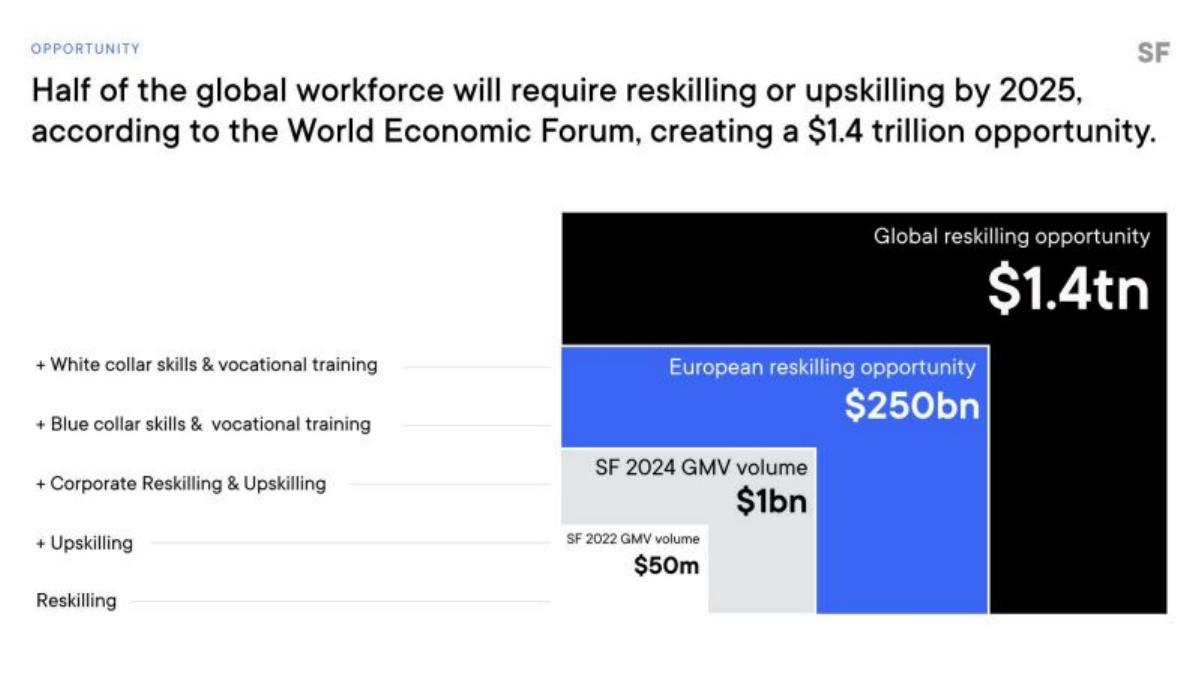
- The company identifies a $1.4 trillion global reskilling opportunity, with a specific focus on a $250bn European market (Slide 3).
- StudentFinance positions its core product as 'BNPL for global reskilling,' utilizing a modular, API-enabled infrastructure (Slide 5).
- The platform claims to generate a 50% average salary increase for users, moving from €16k pre-program to €24k post-program (Slide 7).
- Unit economics are validated by comparing their 3.48x interest margin to industry leaders like Affirm (6.04x) and Klarna (5.13x) (Slide 9).
- The deck highlights significant regulatory moats, including FCA authorization and BAFIN compliance (Slide 12).
- A €30m forward flow facility was secured in March 2022 to accelerate European rollout (Slide 12).
- The growth roadmap projects a massive leap from €90m platform volume in 2023 to €5bn by 2026 (Slide 14).
- The team slide emphasizes institutional pedigree with former experience at Goldman Sachs, Credit Suisse, and PayPal (Slide 15).
The Infrastructure of Career Mobility
StudentFinance’s Series A deck is a clinical example of how to pitch a fintech company that carries a heavy social mission. By the time they reached this €39M round in 2023, the company had moved past the 'experiment' phase and into the 'infrastructure' phase. The deck focuses on scalability, regulatory moats, and the massive macroeconomic tailwinds of the global reskilling crisis.
Slide 1-2: Mission and Vision
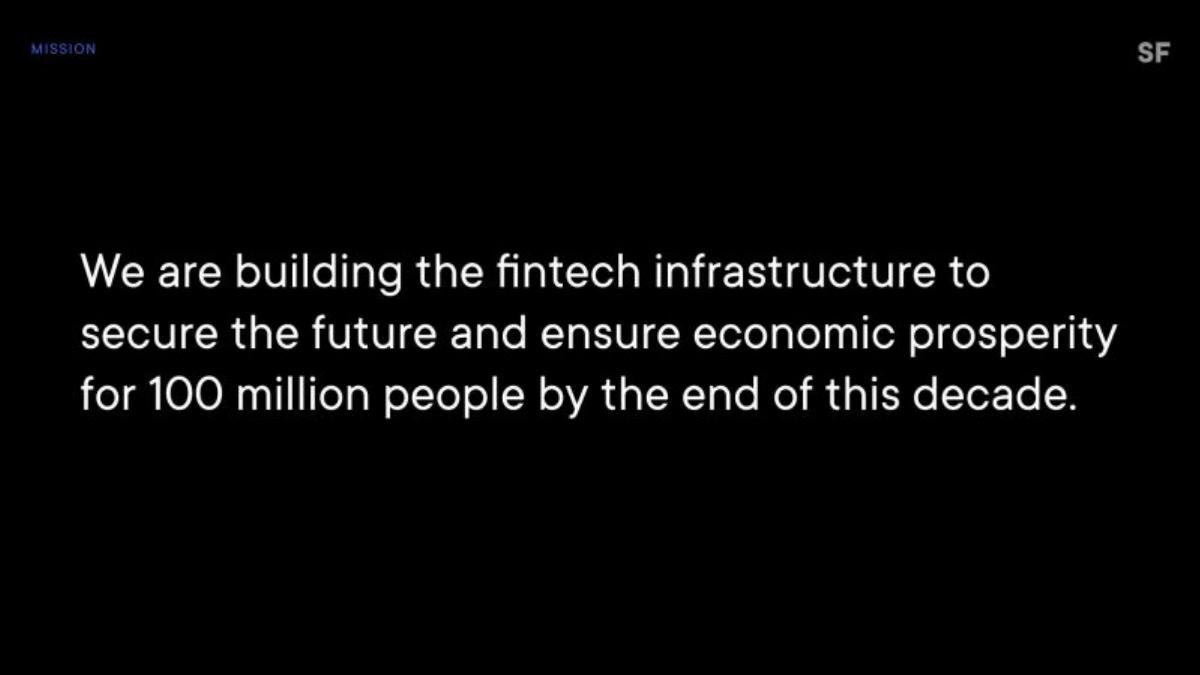
The deck opens with a bold title: Global Career Mobility Fintech Platform . This is a strategic choice; they are not calling themselves a 'student loan company.' Slide 2 sets a massive target: securing the future for 100 million people by the end of the decade. This establishes the 'North Star' for the company, framing the investment as a play for global scale rather than a niche European edtech tool.
Slide 3-4: The $1.4 Trillion Opportunity
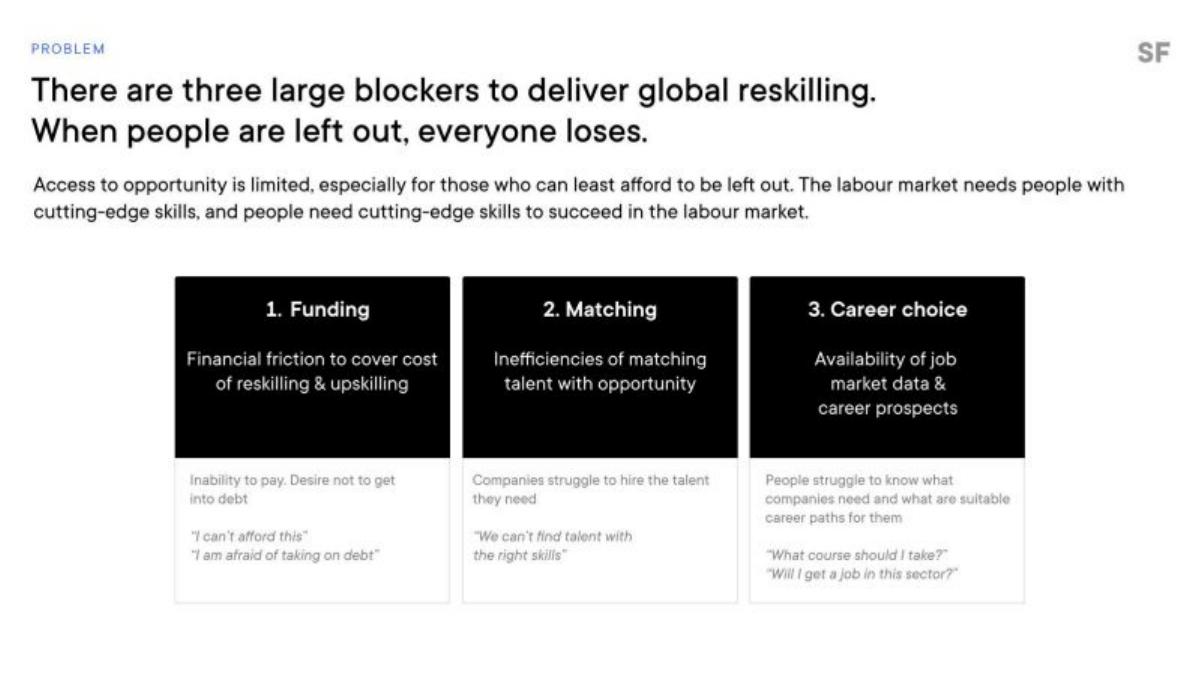
Slide 3 uses World Economic Forum data to anchor the problem. They identify a $1.4tn global reskilling opportunity , with the European market valued at $250bn . Crucially, they overlay their own growth on this chart, showing a jump from $50m GMV in 2022 to a projected $1bn in 2024 . Slide 4 breaks down the 'blockers' to this opportunity: Funding, Matching, and Career Choice. This sets the stage for a multi-product solution.
Slide 5: The Three-Pronged Solution
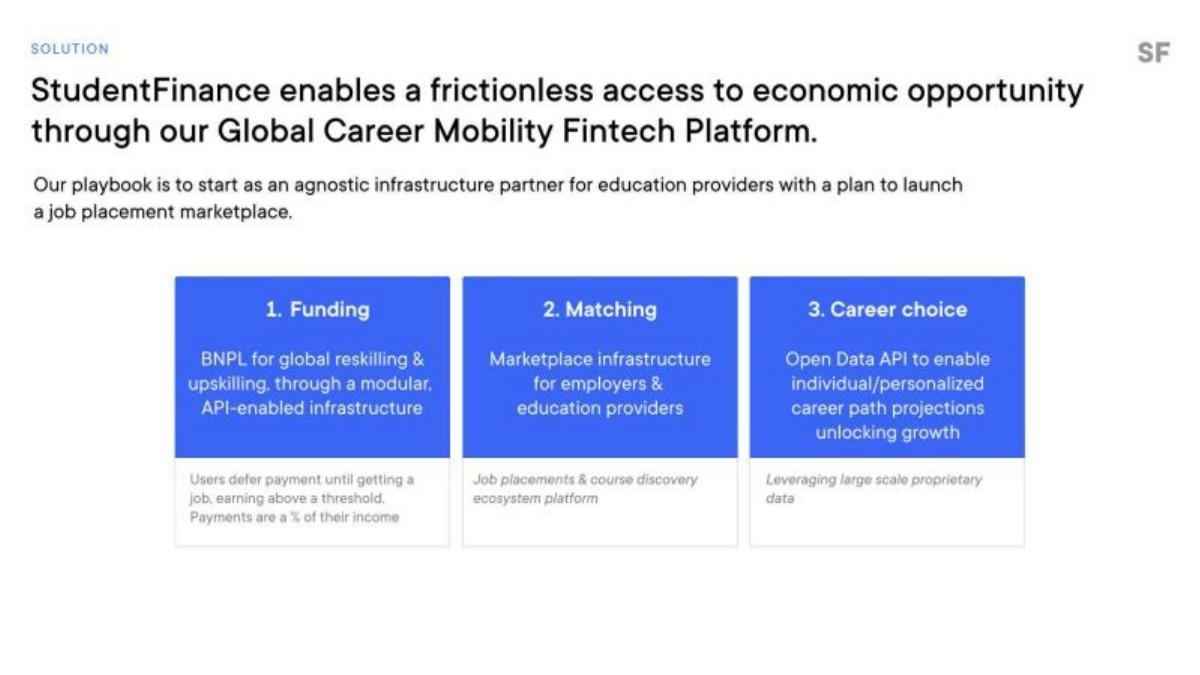
StudentFinance defines its 'playbook' on Slide 5. They start as an agnostic infrastructure partner for education providers. Their solution includes:
Funding: BNPL for reskilling via API. · Matching: Marketplace infrastructure for employers. · Career Choice: An Open Data API for personalized career projections.
This slide is vital because it explains how they plan to capture value beyond just the interest on loans.
Slide 6-8: Value Proposition and User Profile
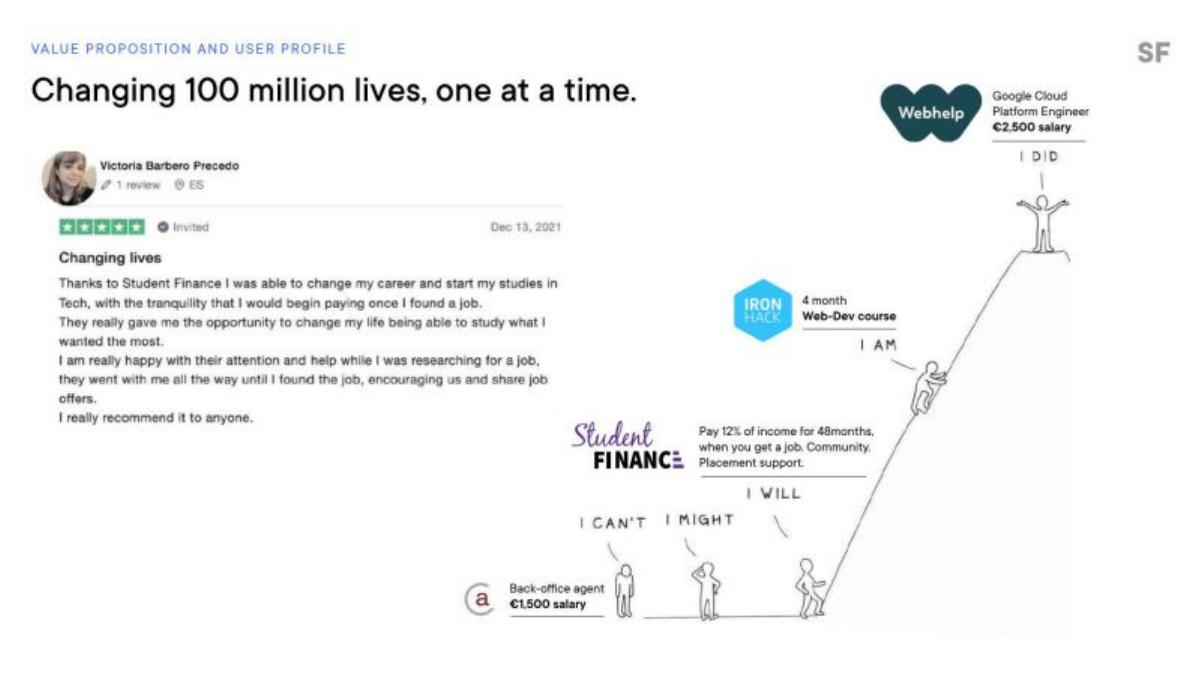
Slide 6 provides a human element with a testimonial from a user who transitioned to a Google Cloud Platform Engineer role. Slide 7 dives into the data of their current portfolio. They claim an average 50% salary increase for users, with salaries rising from €16k pre-program to €24k post-program . The slide also notes that 70.6% of their users are in the 'Prime Cohort' for credit, which helps de-risk the investment for fintech VCs. Slide 8 highlights their 'plug-and-play' nature, listing partners like Ironhack, Le Wagon, and IE Business School , and noting 40+ partnerships are already in place.
Slide 9: Business Model and Unit Economics
This is arguably the most important slide for a Series A fintech. StudentFinance compares its interest margin benchmark (interest income / interest expense) against Affirm (6.04x), Klarna (5.13x), and Afterpay (3.76x) . At 3.48x , StudentFinance is currently at the bottom of this list, but they include a sensitivity chart showing that as their cost of funding decreases from 8.9% to 4%, their margin will scale to 7.6x . This tells investors that the business becomes significantly more profitable as it gains institutional scale.
Slide 10: Technology Infrastructure
Slide 10 illustrates the 'SF Brain,' an AI intelligence platform that powers scoring and underwriting. They show integrations with major data providers like Equifax, TransUnion, and Onfido . This slide is intended to prove that they are a tech-first company, not just a traditional finance house using spreadsheets.
Slide 11-12: Impact and Regulatory Moats
Slide 11 aligns the company with UN Sustainable Development Goals, reporting 1,386 users reskilled and €12m in tuition fee value in ISAs . Slide 12 shifts to 'hard' milestones: securing a €30m forward flow facility and becoming the first platform to obtain FCA authorization . These regulatory hurdles are difficult to clear and represent a significant competitive advantage (moat) against new entrants.
Slide 13-14: Expansion and Projections
The expansion strategy on Slide 13 shows a clear path from Spain and the UK (2022) to Europe (2023), LATAM (2024), and Global (2025). They even list 'local players' in each market that they likely view as M&A targets or competitors. Slide 14 delivers the 'hockey stick' chart: projecting a move from 10,000 users reskilled in 2023 to 425,000 in 2026 , reaching €5bn in platform volume . This is an aggressive 5x growth target for 2023.
Slide 15: The Team
The team slide is heavy on institutional pedigree. CEO Mariano Kostelec (Uniplaces, Goldman Sachs, Groupon) and CFO Marta Palmeiro (Credit Suisse) provide the necessary 'finance' credibility. The slide also lists a high-profile roster of institutional investors (Giant, Seedcamp, Armilar) and angel investors from unicorn businesses like Monzo, Bolt, and Trivago .
What StudentFinance Does Well
The deck excels at comparative benchmarking . By placing themselves on the same chart as Klarna and Affirm, they force the investor to view them as a high-scale fintech rather than a small education lender. They also do a great job of stacking credibility . Between the EIF backing, the FCA authorization, and the high-profile angel list, they make it very difficult for an investor to question their operational legitimacy.
What is Missing
The most glaring omission is the Specific Use of Funds . While we know they raised €39M, the deck doesn't explicitly state how much is equity vs. debt (though the catalogue facts clarify this) or how the equity portion will be spent (e.g., % on engineering vs. % on geographic expansion). Additionally, for a credit-based business, there is a lack of vintage data . Investors usually want to see how different 'vintages' of loans are performing over time to ensure that default rates are stable as the company scales.
What Founders Should Copy
Founders should emulate the Regulatory Moat slide (Slide 12) . If your industry requires licenses or government backing, highlighting these as 'secured' milestones is a powerful way to show that you have already done the 'unsexy' work that competitors have yet to face. Also, the Sensitivity Analysis (Slide 9) is a brilliant way to show a path to 'best-in-class' economics even if your current margins are currently below industry leaders.
Frequently asked questions
- What is the primary business model of StudentFinance?
- StudentFinance operates as a B2C fintech platform that provides 'Buy Now, Pay Later' (BNPL) infrastructure for education. They partner with education providers to offer Income Share Agreements (ISAs) and other deferred payment models. Users pay a percentage of their income only after securing a job above a certain salary threshold. The company also plans to expand into a job placement marketplace and an open data API for career path projections.
- How does StudentFinance justify its market size?
- The deck cites the World Economic Forum, stating that half of the global workforce will require reskilling or upskilling by 2025. They quantify this as a $1.4 trillion global opportunity. They further narrow this down to a $250bn European opportunity, which serves as their primary theater of operations before planned expansions into LATAM and global markets.
- What are the key regulatory milestones mentioned?
- Regulatory compliance is a central theme of the deck. StudentFinance highlights being the first platform to obtain FCA (UK) authorization in April 2022. They also secured regulatory compliance confirmation from BAFIN (Germany) in November 2022 and have backing from the European Union through the European Investment Fund (EIF).
- How does the company compare to other fintechs?
- On Slide 9, StudentFinance compares its interest margin (interest income divided by interest expense) to public fintech companies. While their actual margin of 3.48x is lower than Affirm (6.04x) and Klarna (5.13x), they show a sensitivity analysis suggesting that as their cost of funding drops to 4%, their interest margin could reach 7.6x, outperforming current industry leaders.
- What is missing from the StudentFinance pitch deck?
- The deck lacks a specific 'Ask' slide detailing exactly how the Series A funds will be allocated. It also omits detailed Customer Acquisition Cost (CAC) metrics and specific churn or default rates for their existing ISA portfolio. While they show 'Economic Impact' and 'Gender Distribution,' a deeper dive into the performance of their credit tranches would be expected in a full due diligence room.