Styra’s 13-slide Series B deck from 2021 successfully raised $40M by positioning the company as the commercial engine behind a global technical standard. The narrative centers on the transition from monolithic to cloud-native architectures, which creates a 'trillions of access possibilities' risk profile that legacy systems cannot handle. The deck relies heavily on the team’s pedigree as the creators of the Open Policy Agent (OPA), a CNCF Graduated project. While the deck is light on specific financial metrics like CAC or LTV, it compensates with a clear 'Proven Model' comparison to industry…
Key takeaways
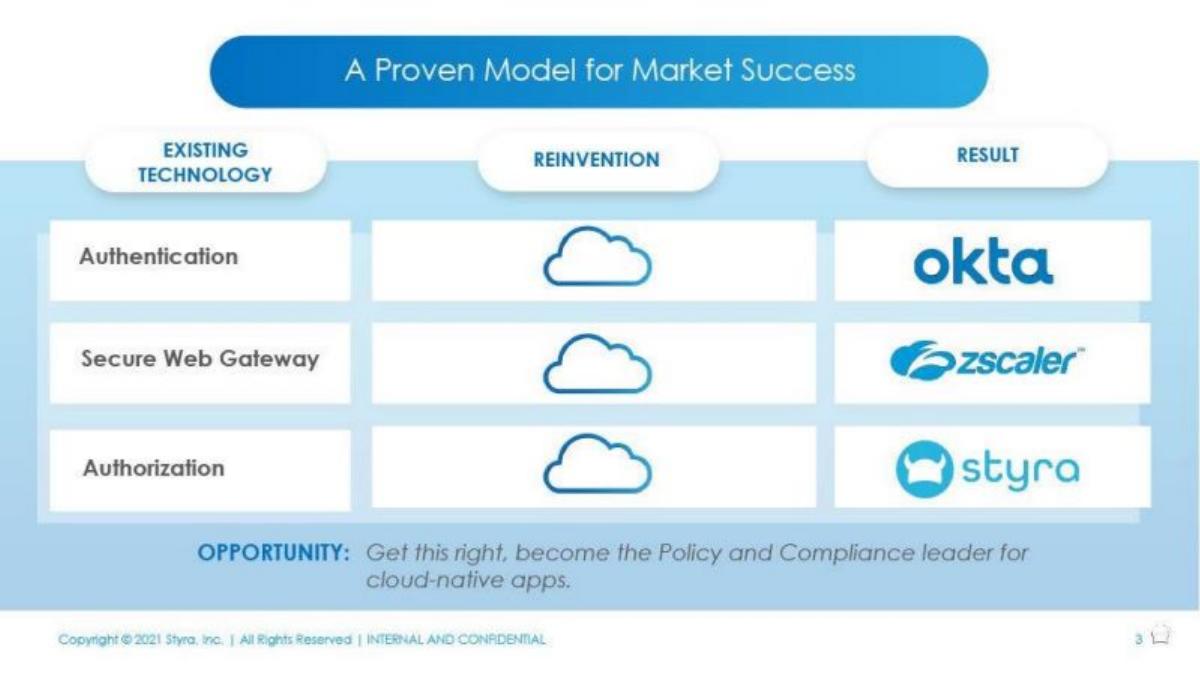
- The deck positions Styra as the third pillar of cloud security, following Okta for authentication and Zscaler for gateways (Slide 3).
- The team slide emphasizes deep technical roots, noting the founders are co-leads for OPA and hold over 100 patents (Slide 4).
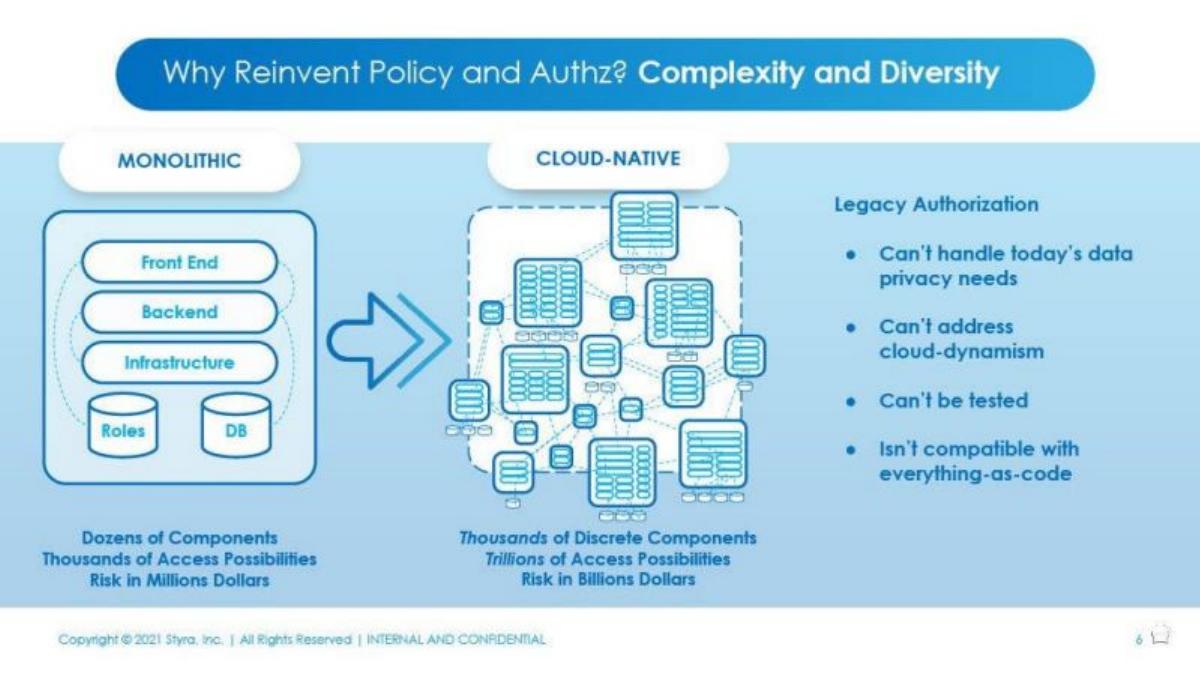
- The problem is defined by the shift from monolithic systems (millions in risk) to cloud-native systems (billions in risk) (Slide 6).
- Styra uses its status as the founder of the Open Policy Agent (OPA) to claim the 'New Authz Standard' (Slide 7).
- The product, Styra DAS, is presented as the management plane for authoring, impact analysis, and auditing across the entire stack (Slide 9).
- The deck includes a specific Series B investment strategy to raise $20M+ to extend runway for 18-24 months (Slide 11).
- The summary slide reinforces their position as the 'First-to-market with OPA control plane' (Slide 12).
- The deck omits specific revenue figures, customer counts, and churn rates, focusing instead on market positioning and technical architecture.
Executive Summary: The Authority Play
Styra’s Series B pitch deck is a concise, 13-slide presentation that leans heavily into the company's role as the creator of the Open Policy Agent (OPA). In the world of enterprise software, being the author of the industry standard is a powerful moat. The deck avoids the clutter of early-stage 'vision' slides and instead focuses on the mechanics of scaling a standard into a commercial powerhouse. It identifies a clear architectural shift—the move to cloud-native—and positions Styra as the only logical choice for securing that new environment.
Slides 1-3: Identity and Market Positioning
Slide 1: Title The cover slide is minimalist, featuring the Styra logo and the critical subtitle: 'Creators of Open Policy Agent (OPA)'. This immediately establishes the company’s primary value proposition: they own the intellectual and community leadership of the space they are disrupting.
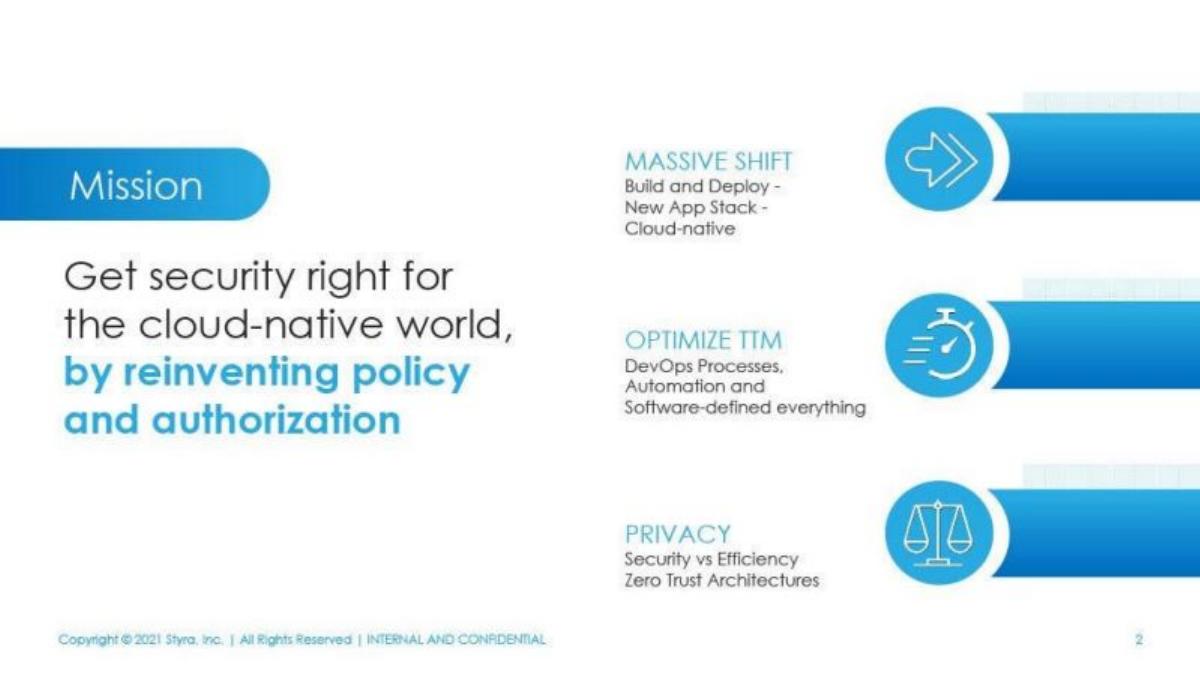
Slide 2: Mission The mission is stated as 'Get security right for the cloud-native world, by reinventing policy and authorization.' It highlights three drivers: a Massive Shift to cloud-native, the need to Optimize Time-to-Market (TTM) via DevOps, and Privacy concerns within Zero Trust Architectures. This slide sets the stage for why the status quo is no longer sufficient.
Slide 3: A Proven Model for Market Success This is one of the most effective slides in the deck. It uses a 3x3 grid to compare 'Existing Technology' to 'Reinvention' and the resulting 'Market Leader'. It lists Authentication (Okta) and Secure Web Gateway (Zscaler) as solved problems in the cloud era. It then positions Authorization as the final frontier, with Styra as the inevitable winner. This framing bypasses small competitors and places Styra in the company of multi-billion dollar incumbents.
Slides 4-5: The Human Capital
Slide 4: Team The team slide is dense with technical pedigree. It lists Tim Hinrichs (Co-founder & CTO) and Teemu Koponen (Co-founder & Chief Architect) as co-leads for OPA. Notably, Koponen is credited with a PhD and 100+ patents. The inclusion of a CEO (Bill Mann) with experience at Centrify and CA suggests a balance between academic innovation and enterprise sales experience.
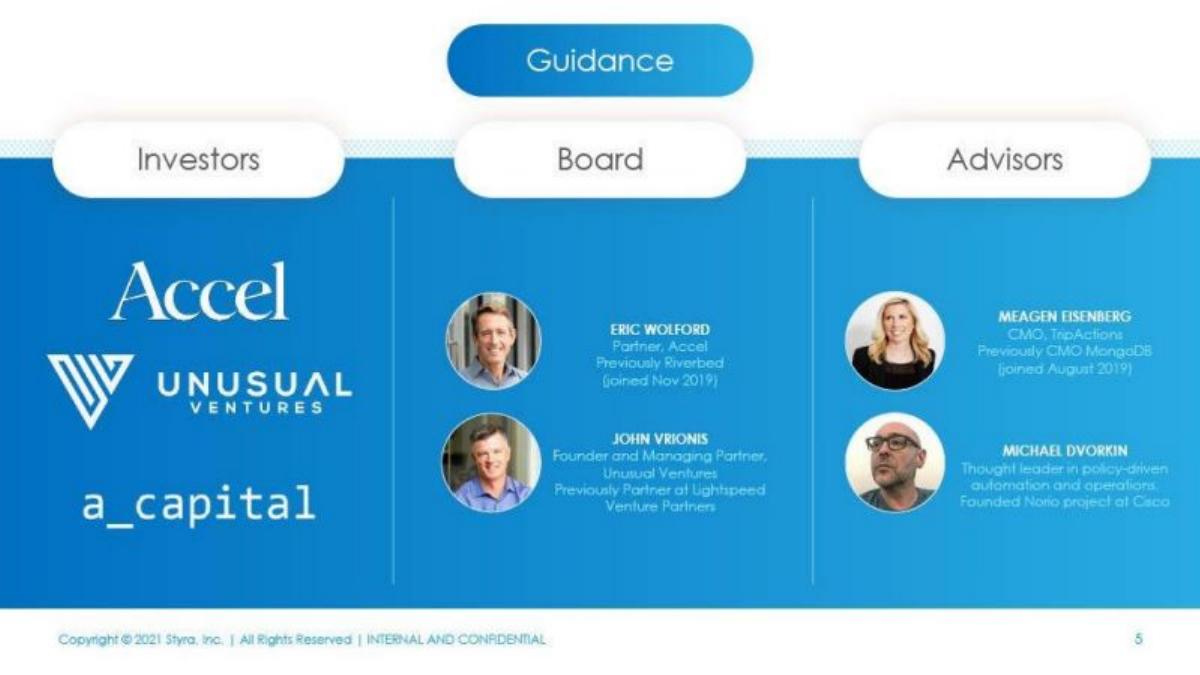
Slide 5: Guidance This slide reinforces the company’s backing. It lists Accel, Unusual Ventures, and acapital. By highlighting specific board members like Eric Wolford and John Vrionis, Styra signals to new investors that they are already vetted by top-tier Silicon Valley firms. The advisors from MongoDB and Cisco further validate their 'policy-driven automation' approach.
Slides 6-8: The Technical Problem and Open Source Solution
Slide 6: Why Reinvent Policy and Authz? This slide visualizes the transition from 'Monolithic' to 'Cloud-Native'. It quantifies the risk: Monolithic systems have 'Dozens of Components' and 'Risk in Millions Dollars', while Cloud-Native has 'Thousands of Discrete Components' and 'Risk in Billions Dollars'. It explicitly states that legacy authorization 'Can’t be tested' and 'Isn’t compatible with everything-as-code'.
Slide 7: Founded Open Policy Agent Styra doubles down on its OPA heritage here. It defines OPA as a 'General purpose policy-as-code solution designed for cloud-native.' It lists five key attributes: Declarative, Decoupled, Portable, Open, and Context-Aware. This slide is meant to prove that the foundation Styra built is technically superior to any proprietary alternative.
Slide 8: OPA: Unified Policy Across the Stack This is a technical architecture slide showing OPA integrated into every layer of the modern stack: CI/CD pipelines (Jenkins, GitHub Actions), Orchestration (Kubernetes), Service Mesh (Envoy, Kong), and Databases (Kafka, SQL). It visually demonstrates the ubiquity of the open-source project, which serves as the top-of-funnel for their commercial product.
Slides 9-10: The Commercial Product (Styra DAS)
Slide 9: Styra DAS: Operationalized Policy at Scale Here, the deck introduces the 'Management Plane'. While OPA lives at the edge, Styra DAS sits in the center. It lists the commercial features: Authoring, Impact Analysis, Distribution, Monitoring, and Audit. This is the 'Why Buy' slide—explaining that while OPA is free, managing it at scale requires Styra’s paid platform.
Slide 10: Styra Declarative Authorization Service This slide provides a screenshot of the product interface, specifically showing 'Example policies (PCI)'. It highlights 'Label Safety' and 'Repository Safety'. This grounds the abstract concept of 'policy-as-code' into a tangible enterprise use case: compliance and risk mitigation.
Slides 11-12: The Ask and Summary
Slide 11: Series-B Investment The strategy is clear: 'Build upon open source momentum to scale'. The deck notes a goal to 'Raise $20M+' (though the catalogue indicates they eventually raised $40M). The funds are earmarked for OPA innovation, engineering for enterprise use cases, and scaling sales/marketing to hit ARR growth targets. Note: specific ARR targets are not disclosed on the slide.
Slide 12: Summary The final slide reiterates four pillars: Founders of a CNCF Graduated project, First-to-market with an OPA control plane, a strong technical team, and a huge market opportunity. It is a concise wrap-up of the 'Authority Play'.
What Styra Does Well
Styra excels at category creation. By framing 'Authorization' as the third leg of the security stool alongside Okta and Zscaler, they make the investment feel like a mandatory piece of a larger portfolio. They also handle the 'Open Source vs. Commercial' tension perfectly. They don't hide the fact that OPA is free; instead, they use its popularity as proof of market fit and then clearly define the 'Management Plane' as the necessary enterprise upgrade. The technical depth of the team is presented as a competitive moat that would be nearly impossible for a newcomer to replicate.
What is Missing from the Styra Deck
The most glaring omission is any mention of traction metrics. For a Series B, investors typically expect to see a 'hockey stick' graph of ARR, net revenue retention (NRR), or at least a list of Fortune 500 logos. While the deck mentions 'widely adopted' and 'proven at scale', it lacks the hard data to back those claims. There is no mention of the sales cycle length, the average contract value (ACV), or the competitive win rate. Additionally, the 'Market Opportunity' is described as 'Huge' but is not quantified with a Total Addressable Market (TAM) figure.
Founder Takeaways: The 'Standard-Bearer' Strategy
Founders building in the open-source space should study how Styra uses their project's success to validate their commercial product without cannibalizing it. Key lessons include:
Own the Standard: If you created the open-source tool, make that the centerpiece of your credibility. · The Management Plane: Clearly distinguish between what the open-source tool does (the 'doing') and what the enterprise platform does (the 'managing'). · Analogous Positioning: Use well-known successful companies (like Okta) to explain your category by association. · Quantify the Shift: Don't just say the old way is bad; show how the new architecture (cloud-native) makes the old way mathematically impossible to maintain.
Frequently asked questions
- How much did Styra raise with this deck?
- According to the catalogue facts, Styra raised $40M in a Series B round in 2021. Interestingly, Slide 11 of the deck explicitly states a strategy to 'Raise $20M+', suggesting the round was significantly oversubscribed or the target was adjusted upward during the fundraising process.
- What is the core business model described in the deck?
- The deck describes a 'Commercial Open Source' model. Styra created the Open Policy Agent (OPA), which is a free, open-source standard. The company then sells the Styra Declarative Authorization Service (DAS) as a 'Management Plane' to help enterprises operationalize, monitor, and audit OPA at scale across complex cloud-native environments.
- Who are the key investors mentioned?
- Slide 5 lists Accel, Unusual Ventures, and a_capital as the primary investors. It also highlights board members Eric Wolford (Accel) and John Vrionis (Unusual Ventures), along with advisors from companies like MongoDB and Cisco, providing significant institutional credibility to the round.
- What specific problem does Styra solve?
- As shown on Slide 6, legacy authorization cannot handle the complexity of cloud-native apps, which involve thousands of discrete components and trillions of access possibilities. Styra provides a 'Policy-as-code' solution that allows for automated, testable, and scalable authorization that is compatible with modern DevOps processes.
- Is there a competitor analysis in the deck?
- No, the deck does not include a traditional competitor matrix. Instead, it uses Slide 3 to place Styra in a category of its own alongside non-competing market leaders like Okta and Zscaler. By doing this, they frame the 'Authorization' category as an empty throne that Styra is destined to occupy.