BMDSys Optical GmbH, led by Volker Schall and Dr. Gertrud Lembke, seeks 10 million Euro for a 33% stake in their medical technology firm, valuing the company at 32 million Euro (Slide 41). The core value proposition centers on a second-generation Magnetocardiography (MCG) system that operates at room temperature, eliminating the 700,000 to 900,000 Euro liquid helium cooling expense required by their first-generation model (Slide 11). The deck emphasizes a 'nearly finished' product and a non-invasive, 5-minute examination process (Slide 16). While the financial projections for operational cost…
Key takeaways
- The company is seeking 10 million Euro in exchange for a 33% equity stake, implying a post-money valuation of approximately 30 million Euro (Slide 41).
- The primary technical innovation is the removal of liquid helium cooling, which cost 700k-900k Euro over a 10-year system life cycle in previous models (Slide 11).
- The diagnostic procedure, referred to as MFI, is non-invasive, takes maximum 5 minutes, and requires no patient preparation or undressing (Slide 16).
- CTO Dr. Gertrud Lembke is positioned as the technical cornerstone, having received the 'Young Investigator Award' in 2010 for her work in biomagnetism (Slide 21).
- Target markets are broad, spanning hospitals, sports centers, and medical prevention facilities, utilizing both direct sales and distributors (Slide 26).
- Operational costs are projected to more than double over three years, specifically driven by massive increases in exhibition and marketing spend (Slide 36).
- The deck claims the company is 'completely free from encumbrances,' suggesting a clean cap table or legal structure for new investors (Slide 31).
- A potential 50% matching loan from a German government institution (TBG) is mentioned as a leverage option for institutional investors (Slide 41).
Executive Summary and Company Identity
Slides 1-2: The Formal Opening
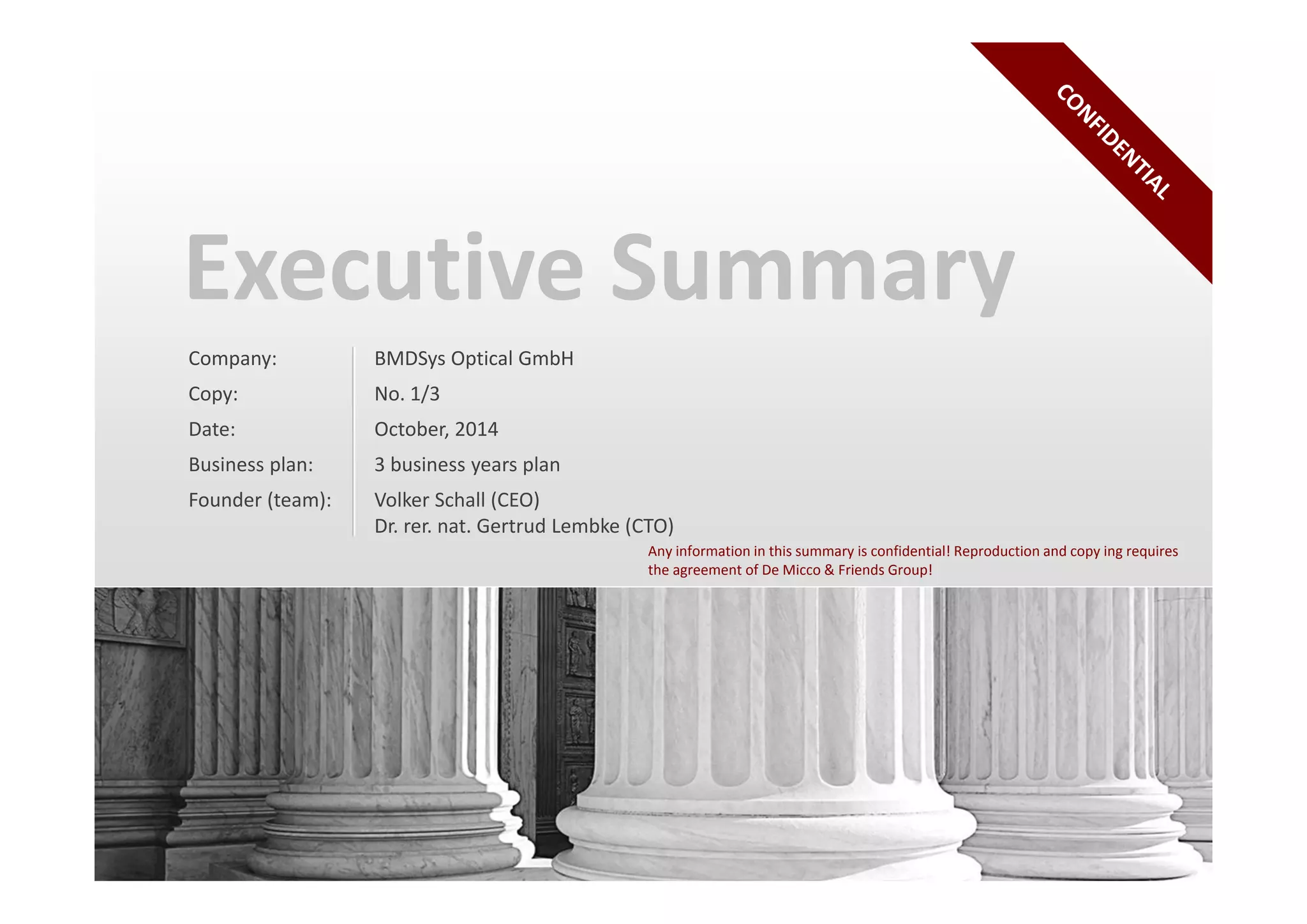
The deck opens with a highly formal, almost bureaucratic aesthetic. Slide 1 identifies the company as BMDSys Optical GmbH and dates the document to October 2014. It lists the leadership as Volker Schall (CEO) and Dr. rer. nat. Gertrud Lembke (CTO) . Notably, the slide includes a 'Copy No. 1/3' designation and a 'Confidential' ribbon, which, combined with the image of classical columns, suggests a traditional, high-stakes investment environment rather than a modern tech startup vibe. Slide 2 serves as a simple section break for the Executive Summary, utilizing a magnifying glass over financial charts to signal a focus on due diligence and growth.
The Product and Technical Pivot
Slide 11: The Economic Barrier
This is arguably the most important slide for establishing the 'Why Now.' It describes the first generation of their technology as 'working perfectly' but failing commercially due to an expense of approx. 700 to 900 K EURO for liquid helium cooling over a 10-year life cycle. The slide admits that the former company could not reach sustainable profit because of this lack of economical efficiency. This sets the stage for the new company's value proposition: providing the same diagnostic power without the crippling overhead of cryogenic cooling.
Slide 16: Advantages of the New System
Slide 16 outlines the clinical benefits of the APOLLO CXS system. The 'Quick and easy' nature of the test is emphasized, noting a 5-minute duration with no patient preparation or undressing required. The technology is described as 'pure passive,' meaning no ionizing radiation or contrast agents are used. The most critical point, however, is 'Cost efficient,' explicitly stating that no helium cooling and room temperature operation lead to minimum operational costs. This slide successfully bridges the gap between a technical achievement and a marketable medical benefit.
Management and Expertise
Slide 21: The CTO Profile
The deck places significant weight on Dr. Gertrud Lembke . Her biography notes a doctorate in physics (2007) and a tenure as a scientific employee at University Hospital Jena. The slide highlights her 2010 'Young Investigator Award' in the field of instrumentation. By detailing her experience in 'simulation and construction of complex coil systems,' the deck attempts to de-risk the technical execution of the project. It explicitly labels her as the 'technical developer from the start of the company,' ensuring investors know where the intellectual property resides.
Market Strategy and Risk Assessment
Slide 26: Target Groups and Sales Channels
BMDSys identifies a broad target market including special hospitals, universities, sports centers, and cardiologists. The slide uses a Venn diagram to show overlapping interests in medical prevention, sports, and facilities . Interestingly, the sales strategy is three-pronged: direct sales, sales via distributors, and 'Admission of health insurances.' The text notes that the APOLLO CXS can detect risk stratification of future life-threatening arrhythmias and ischemia, which are high-value diagnostic categories.
Slide 31: Chances and Risks
This slide is a standard SWOT-style analysis but contains a key claim: the company is 'completely free from encumbrances.' This suggests that while they are building on 'first generation' technology mentioned earlier, the current legal entity is unburdened by the debts or failures of previous iterations. The 'Chances' column claims a 'nearly finished and market-ready product,' while the 'Risks' column honestly identifies supply bottlenecks and the challenge of 'handling the expected growth.' The claim that copying the technology is 'very difficult' serves as a placeholder for a deeper discussion on patent protection.
Financials and The Ask
Slide 36: Operational Costs
The financial planning slide provides a granular look at non-personnel operational costs over three periods (P1, P2, P3). Total costs scale from 945,870.00 € to 2,294,101.60 € . Several line items stand out: Exhibitions grow from 0 € to 800,000 €, suggesting a heavy push into medical trade shows. Marketing triples from 60,000 € to 180,000 € by P3. The 'Movement of company location' cost of 50,000 € in P1 indicates a planned relocation or expansion immediately following the round.
Slide 41: The Offer for Investors
The final slide delivers the 'Ask.' BMDSys Optical GmbH is seeking 10 million EURO for a company share of up to 33% . This implies a post-money valuation of roughly 30 million Euro, though the slide claims the company is already 'rated with minimum 32 mio. EURO.' A unique incentive is mentioned: the possibility of securing an additional 50% of the investment amount as a loan from a German government institution (TBG), provided a lead institutional investor is on board. This is a classic 'leverage' play to make the 10 million Euro equity investment feel like a 15 million Euro total capital injection.
What Works and What is Missing
What Works
Clear Economic Moat: The transition from liquid helium to room temperature is a massive, quantifiable cost-saving measure that any hospital administrator would understand. · Technical Credibility: The focus on Dr. Lembke's awards and academic background provides a strong foundation for a deep-tech medical play. · Granular Financials: Unlike many decks that hide behind 'General & Administrative' buckets, this deck breaks down everything from internet costs (500 €/month) to car expenses (6,000 €/month).
What is Missing
Revenue Projections: While the deck shows operational costs (Slide 36), the provided slides do not show the top-line revenue expectations. We see the costs of selling, but not the projected returns. · Competitive Landscape: Slide 31 mentions that copying the technology is 'very difficult,' but there is no slide comparing BMDSys to other non-invasive cardiac diagnostic companies (e.g., traditional EKG/ECG or other MCG competitors). · Regulatory Roadmap: For a medical device company in 2014, a detailed slide on CE marking or FDA approval timelines is a glaring omission in this selection of slides. · Unit Economics: We know the system saves 900k Euro in helium, but we don't know the manufacturing cost (COGS) or the intended MSRP of the APOLLO CXS unit itself.
Founder Takeaways
Founders in the medical device space should note how BMDSys monetizes the 'pain' of existing solutions . They didn't just say their system is better; they put a 900,000 Euro price tag on the inefficiency of the status quo. Additionally, the use of a government matching loan (Slide 41) is a sophisticated way to de-risk the round for private investors. However, founders should avoid the 'Copy No. 1/3' and 'Confidential' watermarking seen here; in modern fundraising, these are often viewed as unnecessary friction that doesn't actually protect IP but does slow down the sharing of the deck among partner-level decision-makers.
Frequently asked questions
- What is the specific problem BMDSys is solving?
- BMDSys is addressing the 'lack of economical efficiency' in first-generation biomagnetism systems. According to Slide 11, previous models required liquid helium cooling, which added roughly 700,000 to 900,000 Euro in costs over a 10-year period. By developing a room-temperature sensor system, they aim to make high-precision cardiac diagnostics sustainable for clinical use.
- How does the technology improve the patient experience?
- The system, called APOLLO CXS, offers a passive, non-invasive examination. Slide 16 highlights that the process takes under 5 minutes, requires no contrast agents or ionizing radiation, and allows the patient to remain fully dressed. This positioning suggests a significant comfort advantage over traditional invasive cardiac diagnostics or radiation-heavy alternatives.
- What are the projected operational expenses?
- The company forecasts a steep ramp-up in spending. Slide 36 shows total operational costs (excluding personnel) starting at 945,870 Euro in Period 1, rising to 1,666,078 Euro in Period 2, and reaching 2,294,101 Euro in Period 3. A major driver of this growth is 'Exhibitions,' which jumps from 0 Euro in year one to 800,000 Euro by year three.
- Who is leading the technical development?
- Technical leadership is provided by CTO Dr. rer. nat. Gertrud Lembke. Slide 21 details her background in physics and her 2007 doctorate, followed by research at University Hospital Jena. Her expertise in multichannel optical magnetic field sensor systems is cited as the core 'know-how' for the company's clinical routine optimization.
- What is the investment offer and valuation?
- As of the October 2014 deck date, BMDSys Optical was seeking 10 million Euro for up to a 33% share of the company. Slide 41 explicitly states the company is 'rated with minimum 32 mio. EURO.' They also suggest that an institutional investment could trigger an additional 50% in loan-based funding from the German government.