EchoMe is a music social network designed to allow users to broadcast live music to friends and fans by integrating with premium streaming services like Spotify and Apple Music. The 8-slide deck positions the product as a solution to the lack of direct monetization on social media for artists and the decline of traditional radio among younger demographics. While the deck provides a clear competitive matrix and basic UI mockups, it is significantly lacking in business fundamentals. There is no mention of the founding team, no financial projections, no specific funding ask, and no go-to-market…
Key takeaways
- The product aims to turn every user into a DJ who can broadcast music directly from their smartphone (Slide 2).
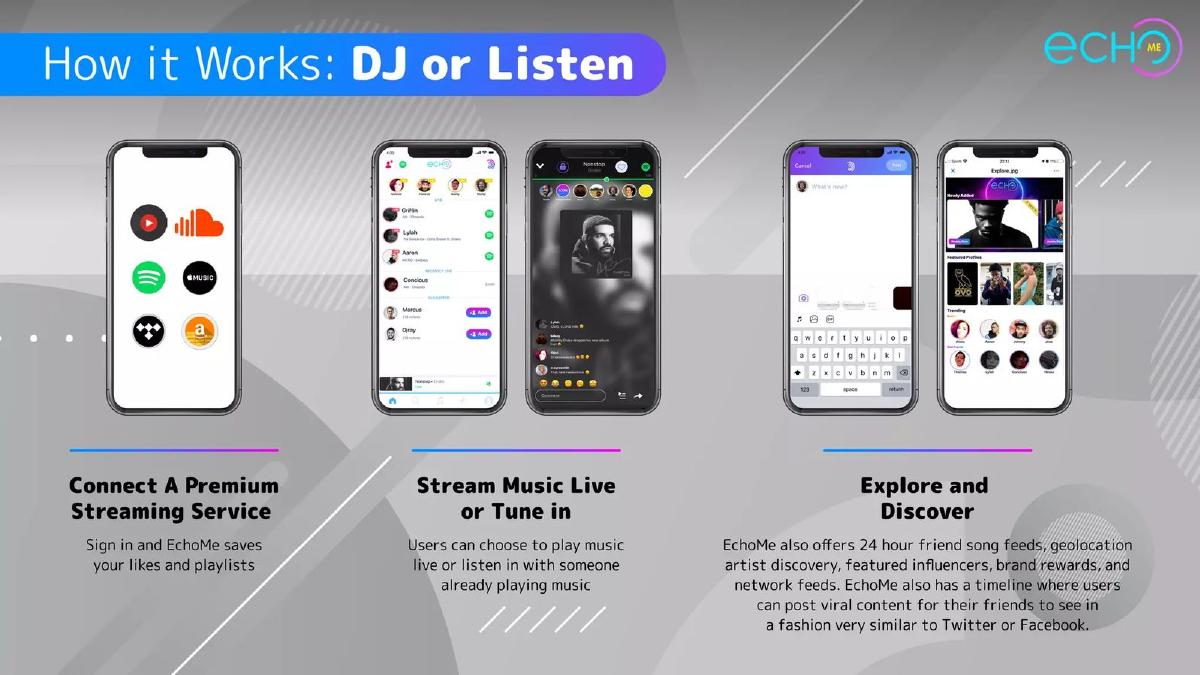
- EchoMe relies on integrations with premium services like Spotify, Apple Music, SoundCloud, and Tidal to handle licensing and royalties (Slide 3).
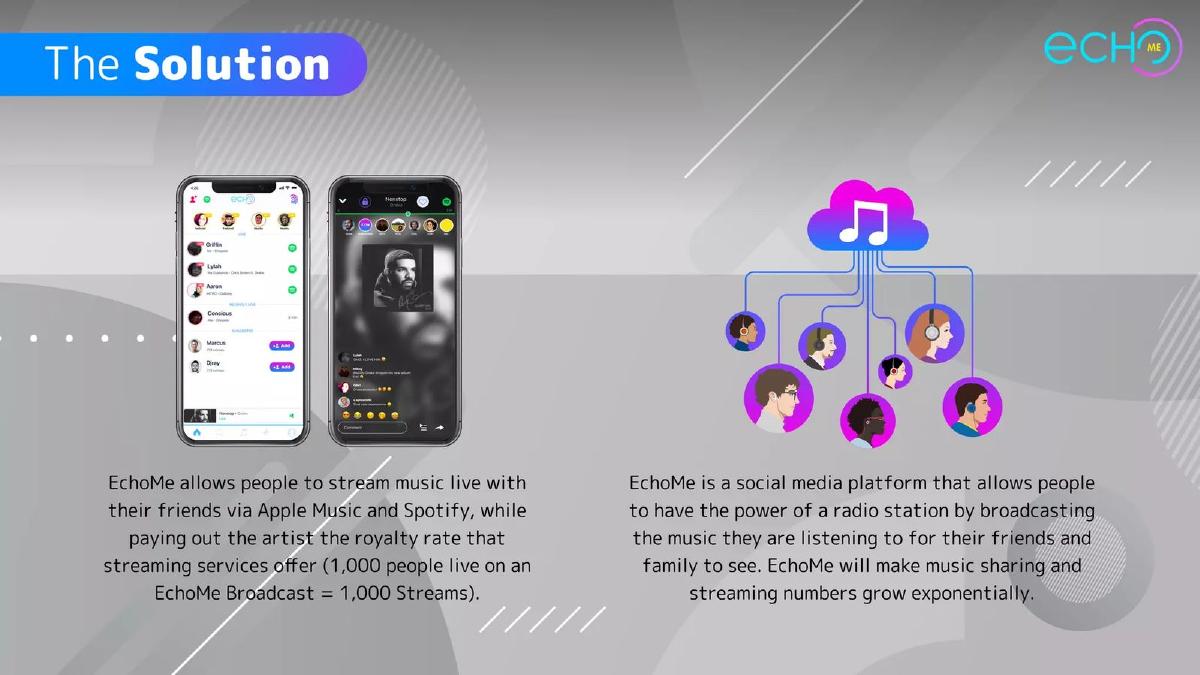
- The core value proposition is that 1,000 people listening to a live EchoMe broadcast equals 1,000 streams for the artist (Slide 5).
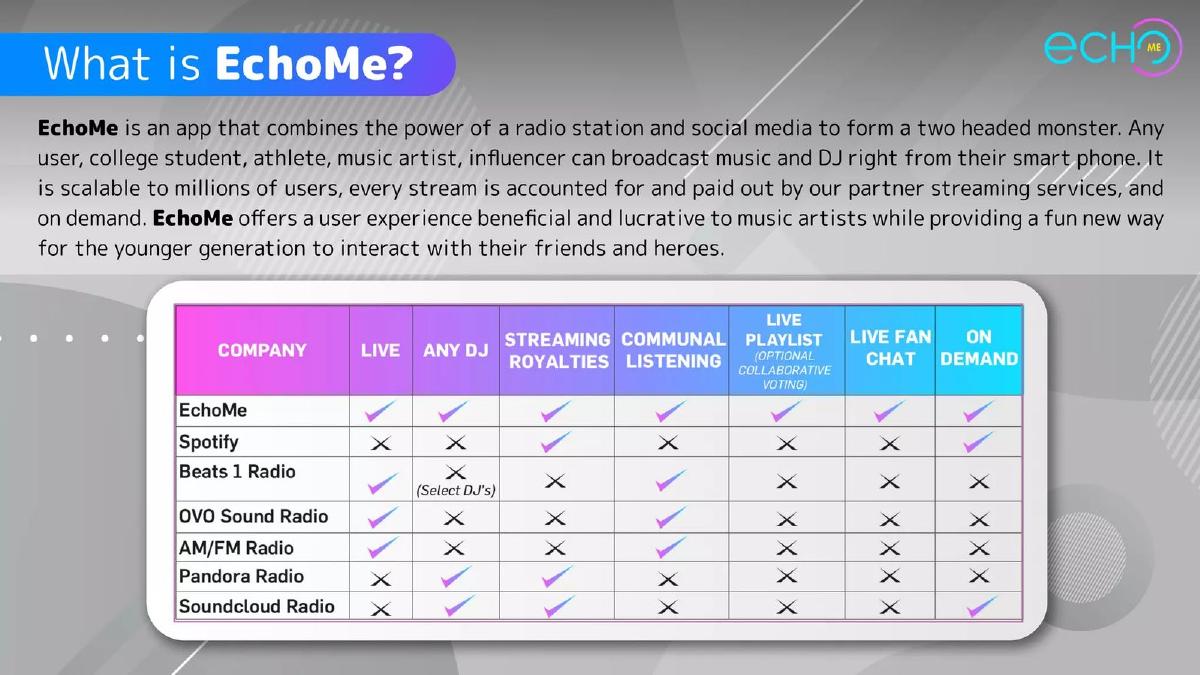
- A competitive matrix compares EchoMe against seven incumbents, claiming it is the only service offering live fan chat and communal listening simultaneously (Slide 2).
- The deck identifies a problem where artists use social media for promotion but cannot monetize those platforms directly (Slide 4).
- The presentation completely omits a team slide, providing no information on the founders' backgrounds or technical capabilities.
- There are no business metrics, user growth targets, or financial requirements listed in the 8-slide sequence.
- The final slide indicates the product is 'Launching Soon,' suggesting a pre-revenue, pre-launch stage at the time of the deck's creation (Slide 8).
Slide-by-Slide Analysis
Slide 1: Title Slide
The title slide features the EchoMe logo and the tagline 'The Music Social Network.' It uses a cartoon illustration of three diverse young people looking at a smartphone, signaling a target demographic of Gen Z or younger millennials. The branding uses a purple and blue gradient theme that persists throughout the deck.
Slide 2: What is EchoMe?
This slide defines the product as an app that 'combines the power of a radio station and social media to form a two-headed monster.' It specifies that any user, including college students, athletes, and influencers, can broadcast and DJ from their phone. A competitive matrix compares EchoMe to Spotify, Beats 1 Radio, OVO Sound Radio, AM/FM Radio, Pandora Radio, and Soundcloud Radio. EchoMe is the only company with checkmarks for all categories: Live, Any DJ, Streaming Royalties, Communal Listening, Live Playlist, Live Fan Chat, and On Demand. Notably, it claims Spotify and Pandora lack communal listening and live features.
Slide 3: How it Works: DJ or Listen
This slide outlines a three-step user journey. Step 1 is 'Connect A Premium Streaming Service,' showing icons for Spotify, Apple Music, SoundCloud, Tidal, and Amazon Music. Step 2 is 'Stream Music Live or Tune in,' showing UI mockups of a live broadcast with a chat interface and a Drake album cover. Step 3 is 'Explore and Discover,' which mentions a 24-hour friend song feed, geolocation artist discovery, and a timeline for viral content described as 'very similar to Twitter or Facebook.'
Slide 4: The Problem
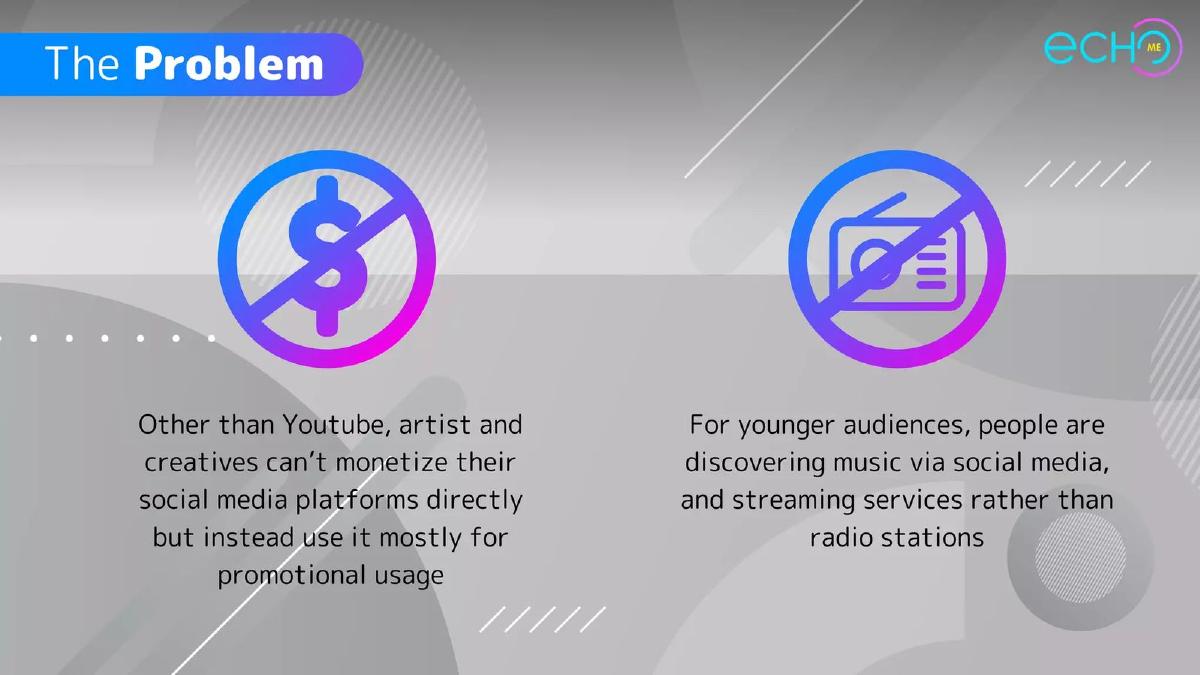
The problem is presented in two parts. First, it states that artists and creatives cannot monetize social media platforms directly, using them only for promotion. Second, it notes that younger audiences discover music via social media and streaming rather than traditional radio stations. The slide uses simple icons (a crossed-out dollar sign and a crossed-out radio) to illustrate these points.
Slide 5: The Solution
The solution slide reiterates that EchoMe allows live streaming via Apple Music and Spotify. It includes a specific metric: '1,000 people live on an EchoMe Broadcast = 1,000 Streams.' It positions the platform as a way to make music sharing and streaming numbers grow exponentially by turning passive social media browsing into active listening sessions.
Slide 6: Why partner with us?
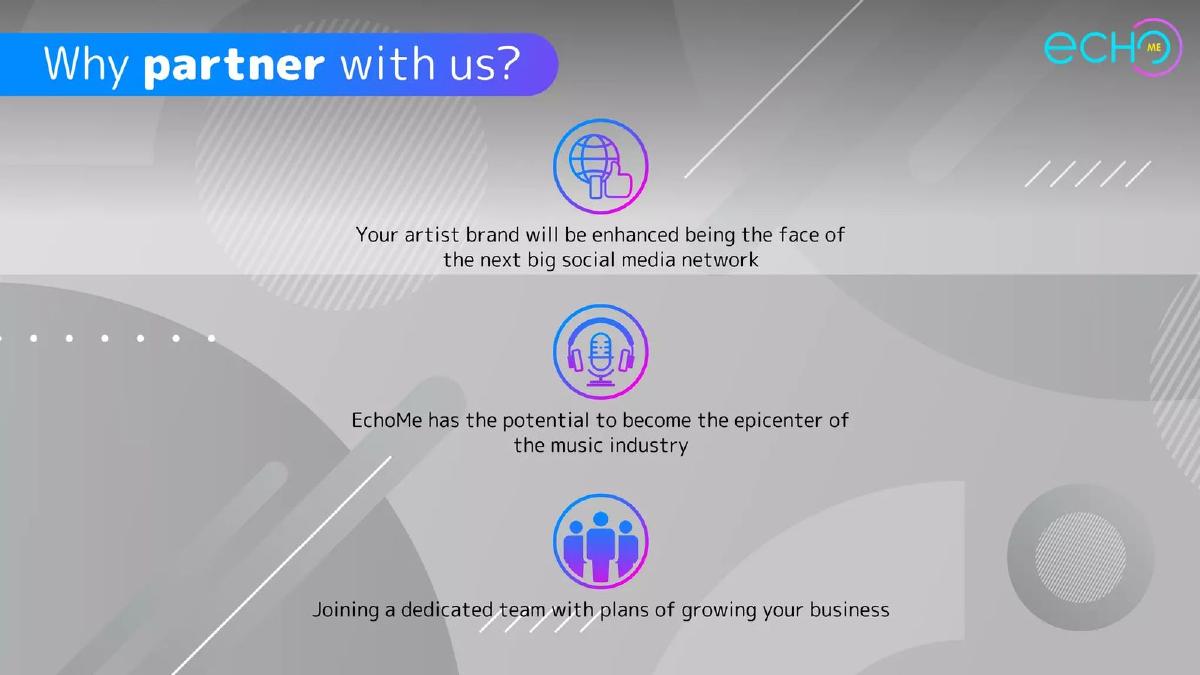
This slide shifts the tone toward a partnership proposal. It lists three value propositions: enhancing the artist's brand by being the 'face of the next big social media network,' the potential for EchoMe to become the 'epicenter of the music industry,' and joining a 'dedicated team.' This slide is vague and lacks data-driven arguments for why a partner should choose this platform over established social giants.
Slide 7: Artist Benefits
This slide expands on the benefits for artists, categorized into five columns: More Streams, More Money, Leveraging Social Influence, Effective Marketing, and Being Ahead of The Curve. It uses a hypothetical example: 'Imagine if Lebron plays your song on EchoMe? He would directly be boosting your streaming numbers.' It claims EchoMe will be the best place for music artists to advertise their business to 'music hyper fans.'
Slide 8: Closing Slide
The final slide features a photo of a large concert crowd with the EchoMe logo overlaid. A large red button reads 'LAUNCHING SOON.' There is no contact information, no call to action for investors, and no link to a website or social media handles.
What EchoMe Does Well
The deck excels at explaining a relatively complex technical integration in simple terms. By using the '1,000 listeners = 1,000 streams' equation, the founders clearly communicate how the app benefits the music industry ecosystem without needing to explain the intricacies of API hooks. The competitive matrix is also well-structured, identifying a specific gap in the market (live communal listening with full royalty accounting) that established players have historically struggled to implement due to licensing complexities.
The visual consistency of the deck is strong. The use of UI mockups on Slide 3 gives a sense of product maturity, even if the 'Launching Soon' tag suggests it is not yet live. By positioning the app as a 'social layer' on top of existing services rather than a competitor to Spotify, the company avoids the 'licensing death trap' that sinks most music startups.
What is Missing from the Deck
The most glaring omission is the Team Slide . In early-stage startup investing, the team is often more important than the idea. There is no indication of who is building this, whether they have experience in the music industry, or if they have the technical expertise to handle low-latency audio synchronization.
There is also a complete lack of Business Model details. While the deck explains how artists get paid (via the streaming services), it never explains how EchoMe makes money. Is there a subscription fee? A cut of the ad revenue? A tip jar for DJs? Without a revenue model, this is a product, not a business.
The Ask is missing entirely. A pitch deck is a tool to raise capital, yet there is no mention of how much money is being raised, what the valuation is, or how the funds will be allocated. Furthermore, there is no Go-To-Market (GTM) strategy. Launching a social network requires a massive 'cold start' solution; the deck assumes that if they build it, influencers like LeBron James will simply show up and use it.
Founder Takeaways: What to Copy and What to Avoid
Copy the clarity of the value proposition. Slide 5 is a masterclass in explaining a benefit to a stakeholder. By showing that a broadcast scales stream counts linearly, they make a compelling case for artists to bring their audiences to the platform. If you are building a B2B2C tool, always include a slide that shows exactly how your middle stakeholder (in this case, the artist) wins.
Avoid the 'Launching Soon' trap. Ending a deck with 'Launching Soon' and no contact information is a missed opportunity. Every slide should lead the viewer toward a specific action. If this is an investor deck, the final slide should include the founder's email, a link to a data room, and a summary of the funding round terms.
Avoid generic 'Problem' slides. Slide 4 identifies that artists can't monetize social media, but it doesn't quantify the pain. A stronger deck would cite the average revenue per follower on Instagram versus the potential revenue on EchoMe. Using data to validate the problem makes the solution feel necessary rather than just 'nice to have.'
Include a roadmap. For a product that relies on 'viral content' and 'geolocation discovery,' a roadmap is essential to show how these features will be rolled out. The current deck feels like a static snapshot of an idea rather than a dynamic plan for a growing company.
Frequently asked questions
- How does EchoMe handle music licensing and royalties?
- According to Slide 2 and Slide 5, EchoMe does not host the music itself. Instead, it requires users to connect a premium streaming service like Spotify or Apple Music. The deck states that every stream is accounted for and paid out by these partner services. This allows EchoMe to bypass direct licensing negotiations while ensuring artists receive their standard per-stream royalty for every listener in a broadcast.
- What is the primary problem EchoMe is trying to solve?
- Slide 4 identifies two main problems: the inability of artists to monetize social media platforms directly (using them only for promotion) and the fact that younger audiences are abandoning traditional radio stations in favor of social media and streaming for music discovery. EchoMe seeks to bridge this gap by creating a social platform where discovery leads directly to monetized streams.
- Who is the target audience for this pitch deck?
- While it follows a pitch deck format, the language on Slide 6 ('Why partner with us?') and Slide 7 ('Artist Benefits') suggests the deck may be intended for music artists and influencers rather than venture capital investors. It focuses heavily on 'artist brand enhancement' and 'leveraging social influence' rather than ROI, exit strategies, or market share capture.
- What features distinguish EchoMe from Spotify or Pandora?
- Slide 2 features a comparison table showing that while Spotify and Pandora offer on-demand music and royalties, they lack 'Live' broadcasting, 'Any DJ' capabilities (allowing any user to broadcast), 'Communal Listening,' and 'Live Fan Chat.' EchoMe claims to be the only platform that checks all seven feature boxes listed in the matrix.
- What critical information is missing from the EchoMe deck?
- The deck is missing almost all standard investment criteria. There is no team slide, no business model (how EchoMe makes money beyond the streaming services), no marketing or user acquisition plan, no timeline of past milestones, and no financial ask. It lacks a 'Why Now' slide and does not address the technical hurdles of synchronizing audio across multiple devices.