Media Startup Solution Slide: Real Pitch Deck Examples
How media, music, streaming and creator startups present the solution in a pitch deck: show where the content, the audience and the money flow.
Media Startup Solution Slide: Real Pitch Deck Examples
Eight solution slides from media, music, streaming and creator startups, shown in full, compare how each shows the path of the content, audience and money through the product, who uses it, and whether it gives a result.
TL;DR
A media startup solution slide should show three things: where the content, audience and money flow once the product is in place, which group uses it (audience, creator or the business that pays), and one result. Audoo draws the full path from a café playing a song, through its audio meter and the royalty organisations, to the artist being paid. Restream shows a creator's single stream going out to YouTube, Twitch and "30+" platforms and claims creators "save up to 5X" on streaming costs. The Hustle explains itself as "The Wall Street Journal + The Daily Show". ZewindTV gives one sentence and no product, which is the weaker pattern.
Media startup solution slides from real pitch decks
Each example shows the exact stored slide above its analysis and links to the full teardown. Claims are as shown on the slides; we have not verified them.
Audoo solution slide — slide 6
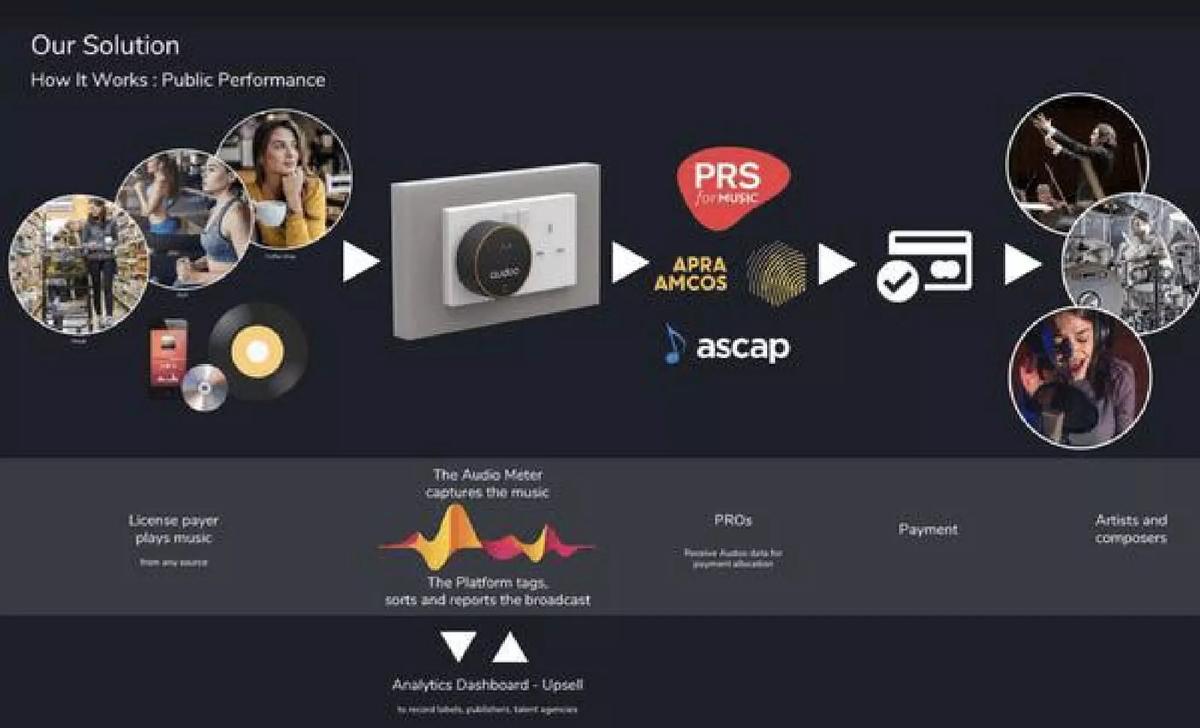
Music recognition for public performance royalties. A left-to-right diagram from the venue to the artist.
Audoo deck, slide 6. Exact stored slide matched to this analysis.
Our analysis: Its problem slide showed royalties lost because PROs estimate plays; this slide replaces the estimate with a device that captures every play.
Evidence and limitation: A diagram with the device pictured; no figures.
What a founder can adapt: Draw your product's place in the chain from where content is used to where money arrives.
Supporting analysis
What the deck claims: "Our Solution. How It Works: Public Performance." Steps: licence payer plays music; "The Audio Meter captures the music"; "The Platform tags, sorts and reports the broadcast"; PROs (PRS, APRA AMCOS, ASCAP) receive the data for payment; payment reaches artists and composers. Below: "Analytics Dashboard – Upsell" for record labels, publishers and talent agencies.
Presentation choice: Every party in the chain is on one line, including a second revenue source (analytics for labels).
When it does not fit: The labels are small; make the device and the PRO step readable, and say who pays for the meter.
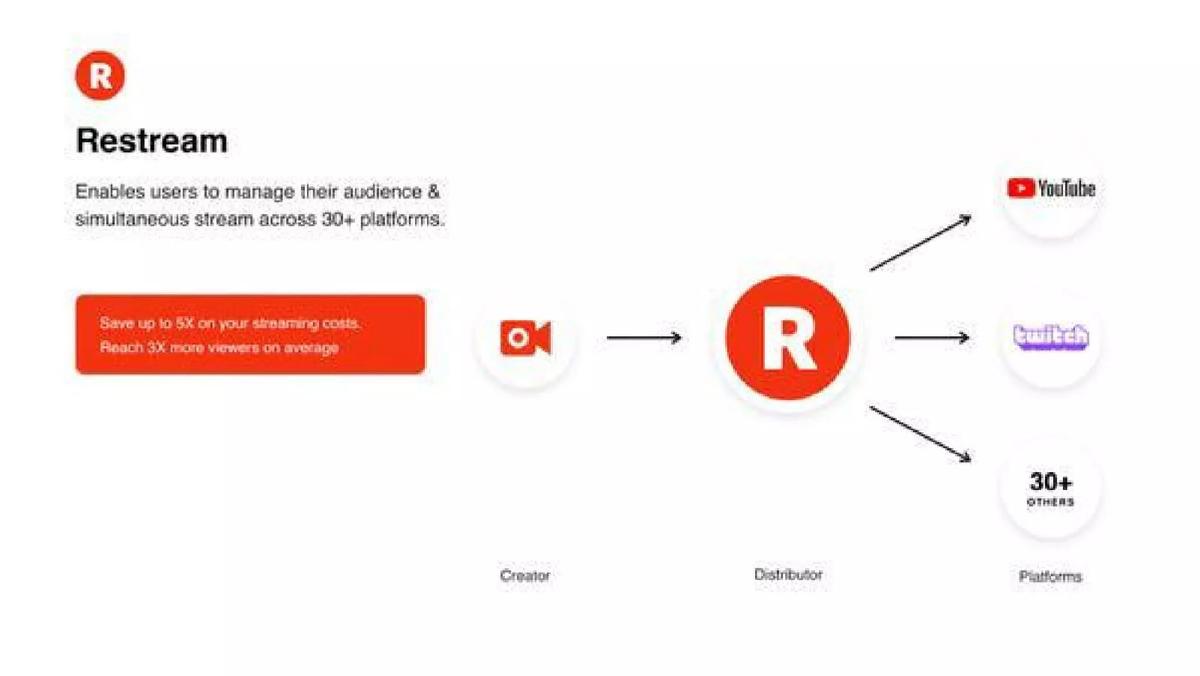
Multi-platform live streaming. Creator, distributor and platforms in a simple diagram, with a result claim.
Restream deck, slide 4. Exact stored slide matched to this analysis.
Our analysis: Its problem slide asked six questions; this slide answers the first ("where to stream?") with "everywhere at once".
Evidence and limitation: "5X" and "3X" are not sourced.
What a founder can adapt: Show the one path your product creates and put one result beside it.
Supporting analysis
What the deck claims: "Restream enables users to manage their audience & simultaneous stream across 30+ platforms." Diagram: Creator → Restream (Distributor) → YouTube, Twitch, "30+ others" (Platforms). "Save up to 5X on your streaming costs. Reach 3X more viewers on average."
Presentation choice: One diagram and one result line explain the product and why a creator would pay.
When it does not fit: Say how the 3X figure was measured (across which creators and what period).
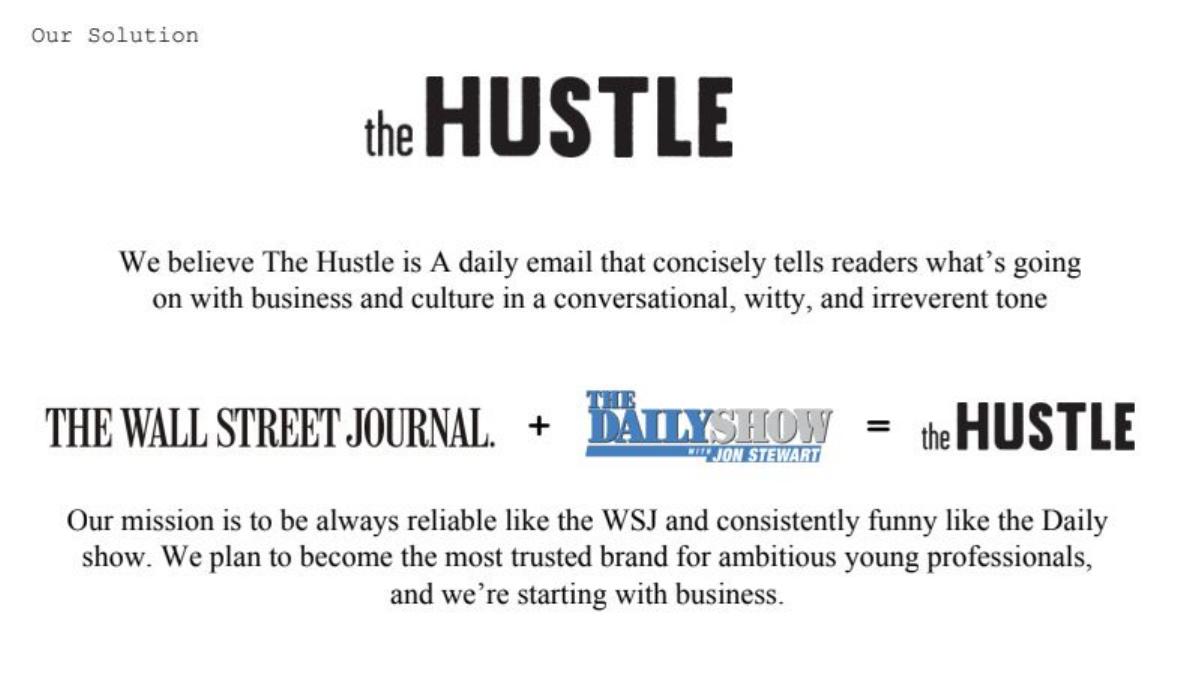
A daily business newsletter. A positioning equation and a mission line.
The Hustle deck, slide 4. Exact stored slide matched to this analysis.
Our analysis: Its problem slide said millennials don't read legacy business outlets; this slide says what format and tone would win them.
Evidence and limitation: No figures or screens.
What a founder can adapt: If you are a content brand, state format, frequency and voice, and name the reader.
Supporting analysis
What the deck claims: "We believe The Hustle is a daily email that concisely tells readers what's going on with business and culture in a conversational, witty, and irreverent tone." "The Wall Street Journal + The Daily Show = The Hustle." "Our mission is to be always reliable like the WSJ and consistently funny like the Daily Show. We plan to become the most trusted brand for ambitious young professionals, and we're starting with business."
Presentation choice: For a content brand, the product is the format and voice; the equation communicates both in five words.
When it does not fit: Add one real issue or subject line so investors can judge the voice themselves.
Online video publishing for businesses. One product screen with annotations around it.
ProVDN deck, slide 6. Exact stored slide matched to this analysis.
Our analysis: Each annotation is a step the publisher no longer does by hand.
Evidence and limitation: An annotated product screen.
What a founder can adapt: Annotate one real screen with the steps your user no longer does.
Supporting analysis
What the deck claims: "Now there's a solution! ProVDN." Annotations: upload videos and ProVDN will compress and encode them into professional quality files ready to stream; choose a thumbnail; quickly modify the meta title and description; choose a player size, then copy and paste the embed code; video is automatically encoded into several formats and the best one is delivered based on the viewer's connection; high-level video data and analytics; natively publish to iPhone and iPad.
Presentation choice: Labelling the real screen shows the product exists and what each part does, without a separate feature list.
When it does not fit: Seven callouts is a lot; number them in the order a user would follow.
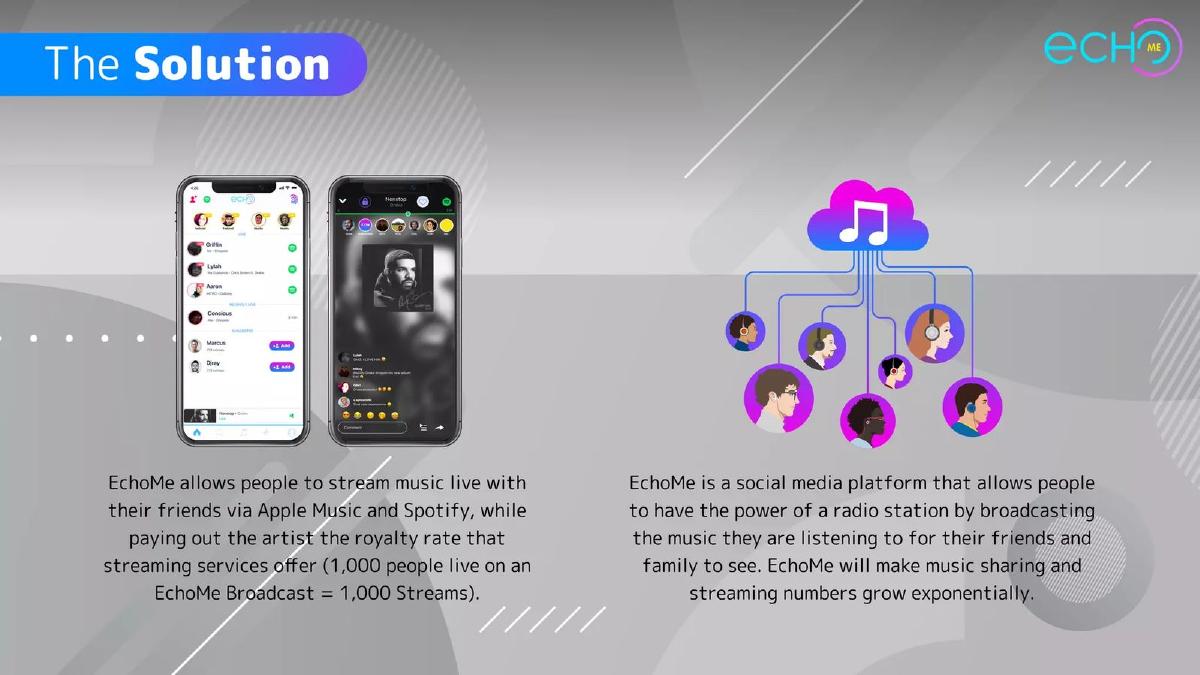
Social live music listening. Two panels: the app, and how one broadcast turns into streams for the artist.
EchoMe deck, slide 5. Exact stored slide matched to this analysis.
Our analysis: The "1,000 people = 1,000 streams" line connects the listener's action to the artist's payment in one step.
Evidence and limitation: App screens; the stream conversion is stated, not measured.
What a founder can adapt: State the rule that turns audience activity into money for the creator.
Supporting analysis
What the deck claims: "EchoMe allows people to stream music live with their friends via Apple Music and Spotify, while paying out the artist the royalty rate that streaming services offer (1,000 people live on an EchoMe Broadcast = 1,000 Streams)." "EchoMe is a social media platform that allows people to have the power of a radio station by broadcasting the music they are listening to for their friends and family to see."
Presentation choice: It answers the problem slide (artists can't earn from social platforms) with a specific payout rule.
When it does not fit: Say who pays EchoMe: listeners, artists or the streaming services.
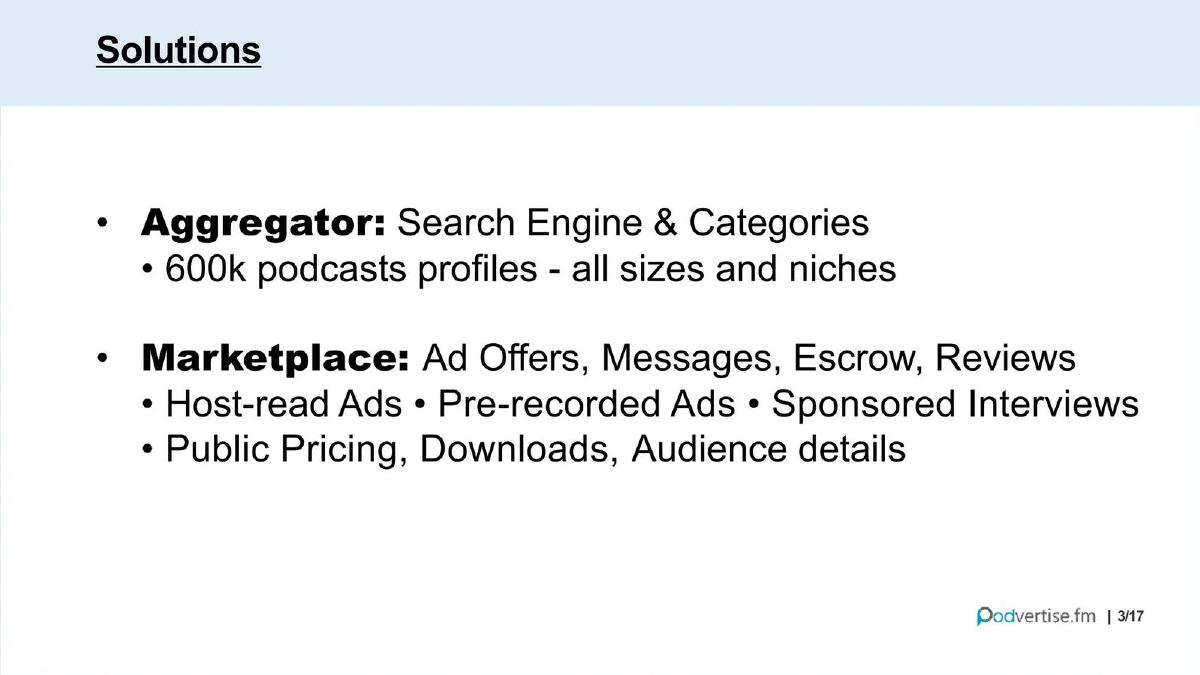
A podcast advertising marketplace. Two parts: a search engine for advertisers and a marketplace to buy ads.
Podvertise.fm deck, slide 3. Exact stored slide matched to this analysis.
Our analysis: It shows both sides: advertisers find podcasts, and small podcasts get paid, answering its problem slide's "no monetization for small & mid size podcasts".
Evidence and limitation: "600k podcasts profiles" is the only figure.
What a founder can adapt: For a marketplace, show what each side does in one line each.
Supporting analysis
What the deck claims: "Aggregator: Search Engine & Categories. 600k podcasts profiles – all sizes and niches." "Marketplace: Ad Offers, Messages, Escrow, Reviews. Host-read Ads, Pre-recorded Ads, Sponsored Interviews. Public Pricing, Downloads, Audience details."
Presentation choice: Listing the ad formats and "public pricing" tells advertisers exactly what they can buy.
When it does not fit: Add a screen of a podcast profile; text alone makes it hard to judge.
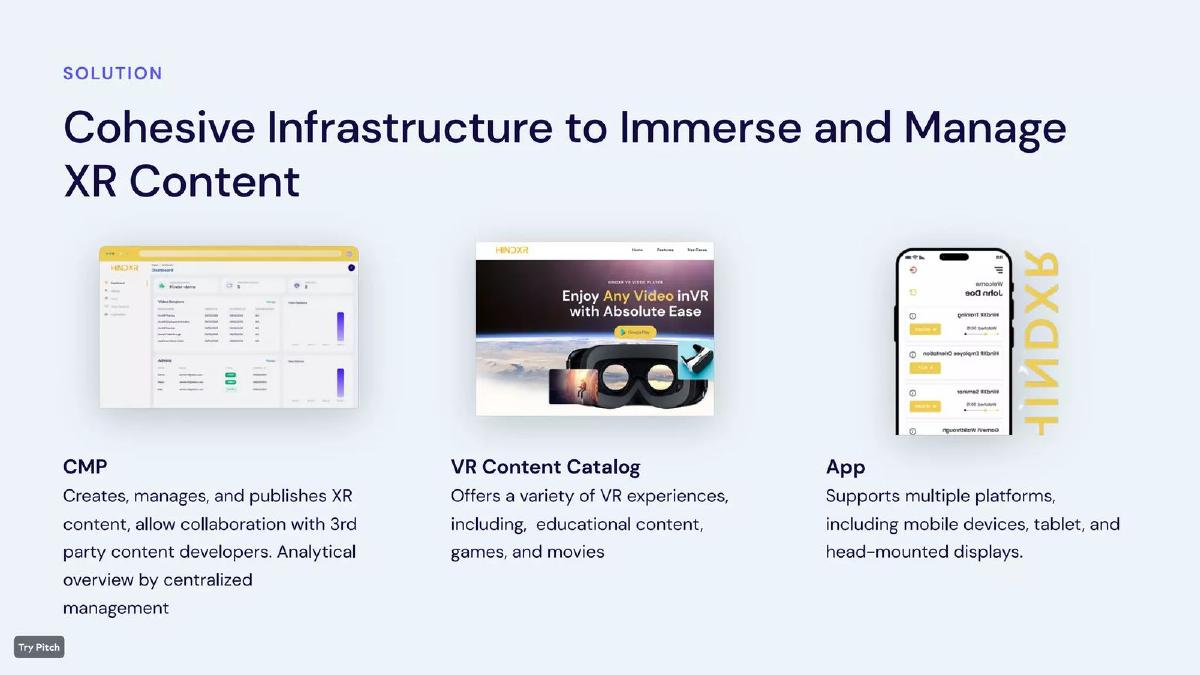
Virtual reality content management. A partial example: three products with screens, but no flow or user.
HindXR deck, slide 6. Exact stored slide matched to this analysis.
Our analysis: It shows the product exists, but not who uses each part or how they connect.
Evidence and limitation: Three screens; no figures.
What a founder can adapt: Name who uses each of the three parts (a school, a content developer, a student) and draw how content moves between them.
Supporting analysis
What the deck claims: "Cohesive Infrastructure to Immerse and Manage XR Content." "CMP: Creates, manages, and publishes XR content, allow collaboration with 3rd party content developers. Analytical overview by centralized management." "VR Content Catalog: Offers a variety of VR experiences, including educational content, games, and movies." "App: Supports multiple platforms, including mobile devices, tablet, and head-mounted displays."
Presentation choice: It shows how screens alone fall short without a user and a flow.
When it does not fit: "Cohesive infrastructure" is abstract; say what the customer publishes and to whom.
Catch-up summaries for streaming viewers. A weaker example, included on purpose: one sentence on a blank background.
ZewindTV deck, slide 3. Exact stored slide matched to this analysis.
Our analysis: Its problem slide tied viewer distraction to churn; this slide never shows what a viewer sees or how churn falls.
Evidence and limitation: No screens or figures.
What a founder can adapt: Show one catch-up screen and state the effect on the streaming service's churn or watch time.
Supporting analysis
What the deck claims: "Solution." "ZewindTV helps streaming users get back on track when they get distracted or confused, with fun and engaging content that make it easy to pick up where they left off."
Presentation choice: It shows the minimum a media solution slide needs: the product, the user and a link back to the problem's cost.
When it does not fit: "Fun and engaging content" describes nothing a viewer or buyer can picture.
Whether each slide shows the flow of content, audience or money, names who uses it, and gives a result.
Example
Flow shown
User named
Result
Audoo
Yes (venue to artist)
Yes (licence payers, PROs)
No
Restream
Yes (creator to 30+ platforms)
Yes (creators)
Yes (5X costs, 3X viewers)
The Hustle
No
Yes (young professionals)
No
ProVDN
Partly (upload to publish)
Partly (publishers)
No
EchoMe
Yes (listeners to streams)
Yes (listeners, artists)
Partly (1,000 = 1,000 streams)
Podvertise.fm
Partly (two sides)
Yes (advertisers, podcasts)
No
HindXR
No
No
No
ZewindTV
No
Partly (viewers)
No
Key Takeaways
Draw the flow. Media products sit between content, audiences and money; show where each goes.
Say who uses it: audience, creator, or the studio, label, advertiser or platform that pays.
Answer the problem slide: the lost royalties, missed viewers or scattered platforms should visibly change.
Give one result in the payer's units: costs saved, viewers reached, streams or payouts.
A one-line positioning ("X meets Y") helps a consumer media brand, but it does not replace showing the product.
Build your media startup solution slide
One flow, one user, one result.
Flow. Where does content come from, where does the audience arrive, and where does the money come from once your product is used?
User. Who acts on the product: audience, creator, or the business that pays? Show their view.
Answer to the problem. Which loss from your problem slide (royalties, viewers, platforms) changes, and how?
Result. What one result can you show in the payer's units: costs, viewers, streams, payouts?
Copyable framework: [User] [action] in [product]; [content / audience] now [flow], so [payer] [result in their units].
Illustrative example 1 — written by us
Before: An innovative platform revolutionising how audiences engage with content.
After: Podcast hosts list their show once; advertisers search, book and pay through escrow, so shows under 10,000 downloads earn about $300 a month they earned nothing from before.
What improved: Our illustrative rewrite; the figures are invented for the example. It names the users, the flow of money and a result.
What this guide adds
The general solution slide guide covers any business, and the consumer solution guide covers consumer apps. Media products usually sit in the middle of a chain: content goes one way, audiences arrive another, and money comes from advertisers, licence payers or subscribers. Strong media solution slides draw that chain so investors can see where the product earns.
This guide follows on from the media startup problem slide guide. Audoo, Restream, The Hustle and ZewindTV appear in both, so you can see how each deck moves from its problem to its solution.
Three things a media solution slide proves
The flow: how content, audience and money move once the product is used (Audoo, Restream, EchoMe).
The user: which side acts (creators for Restream and ProVDN, brands and podcasters for Podvertise.fm, readers for The Hustle).
A result: a cost saved, an audience reached or a payout made (Restream, EchoMe).
Common mistakes
No flow. Media products sit in a chain; show where content, audience and money go.
No user. Say which side acts; audiences and payers need different slides.
Positioning only. "X meets Y" helps, but show the product too.
Screens without order. Number annotations or products in the order a user meets them.
Abstract language. "Infrastructure" and "engaging content" describe nothing.
Diagnostic checklist
The flow of content, audience or money is drawn.
The user is named and shown.
It answers the problem slide directly.
One result is given in the payer's units.
A real product screen or sample is shown.
Frequently asked questions
How we chose these examples
Corpus: published pitch deck teardowns on StartupFundraising.com. Founder-uploaded private decks are excluded.
Selection (2026-09-25): we read slides 3–7 of the decks in the media problem guide and other media, music, streaming and publishing decks, searching for solution, product and how-it-works slides. Twelve stored images were inspected. Circulate, Music Coco, Story Plant Media and The Untz were set aside as weaker than those chosen. ZewindTV is kept as a weaker contrast.
Overlap check: none of these eight slides appears in another guide. Audoo, Restream, The Hustle and ZewindTV appear in the media problem guide with different slides.
Review: all eight stored slide images were inspected on 2026-09-25 and matched to company, deck and slide number (editorial model review). No person has yet completed an editorial review of this page.
Claims are as shown on the slides; we have not verified them. We make no claim that any slide caused a fundraising outcome.