The Hustle’s 13-slide seed deck from 2017 successfully positioned a daily business newsletter as a high-growth media property by focusing on two key pillars: a specific, high-value demographic and industry-leading engagement rates. At the time of the raise, the company reported 200,000 daily subscribers and an impressive 43% open rate—more than double the industry average. The deck effectively uses the 'WSJ meets The Daily Show' analogy to define its brand voice while backing up the personality with hard revenue data, including $490k in total event revenue. By targeting 'HENRYs' (High Earning…
Key takeaways
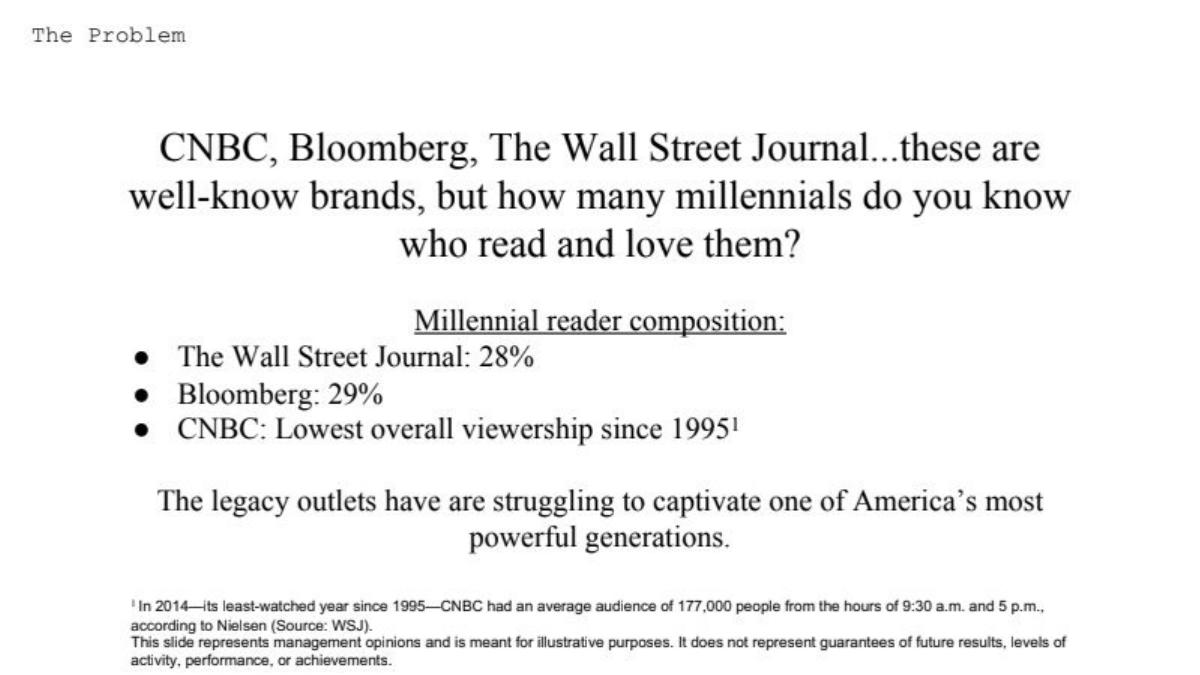
- The company identified a clear gap in the market by noting that legacy brands like WSJ and Bloomberg have millennial reader compositions of only 28% and 29% respectively (Slide 3).
- The Hustle achieved a 43% daily open rate, which they claim is 2x the industry average of 19.3% (Slide 7, Slide 9).
- Revenue was already diversified at the seed stage, showing $25k in average monthly advertising revenue and $490k in total event revenue over 16 months (Slide 7).
- The audience is highly targeted, with 65% of readers aged 18-34 and a focus on 'HENRYs' (High Earning, Not Rich Yet) (Slide 5).
- The deck highlights a strong community element through 1,000+ brand ambassadors who use custom URLs to drive signups (Slide 7, Slide 9).
- Growth was demonstrated through a 'Monthly Readers' chart showing a climb from approximately 750k in April 2016 to over 1.5M by December 2016 (Slide 8).
- The founders emphasize their track record, noting this is their second startup together and their previous one was acquired (Slide 13).
- The deck lacks a specific 'Ask' slide detailing the exact valuation or breakdown of how the $1M would be spent (Slide 1-13).
The Hustle Pitch Deck Teardown: Scaling Media via Engagement
In 2017, the media landscape was shifting from massive, low-quality reach to high-affinity, niche communities. The Hustle was at the forefront of this movement. Their seed deck is a masterclass in showing, not just telling, a brand's personality while anchoring that personality in rigorous data. With 13 slides, the company secured $1M from some of the most influential names in tech and lifestyle marketing.
Slide 1: Title Slide
The deck opens with a minimalist title slide featuring 'the HUSTLE' logo in bold, black typography against a textured white background. The words 'INVESTMENT DECK' appear in small print at the bottom. It is clean, professional, and establishes the brand's aesthetic immediately.
Slide 2: Legal Disclaimer
A standard forward-looking statements disclaimer. It notes that the presentation contains management’s views and that actual results could differ materially. While dry, it is a necessary inclusion for a seed-stage raise involving multiple angel investors.
Slide 3: The Problem
The Hustle identifies a clear generational gap in business media. They cite that legacy brands like The Wall Street Journal and Bloomberg have millennial reader compositions of only 28% and 29% respectively. Most strikingly, they note that CNBC hit its lowest overall viewership since 1995. The slide concludes that legacy outlets are struggling to captivate 'one of America’s most powerful generations.'
Slide 4: Our Solution
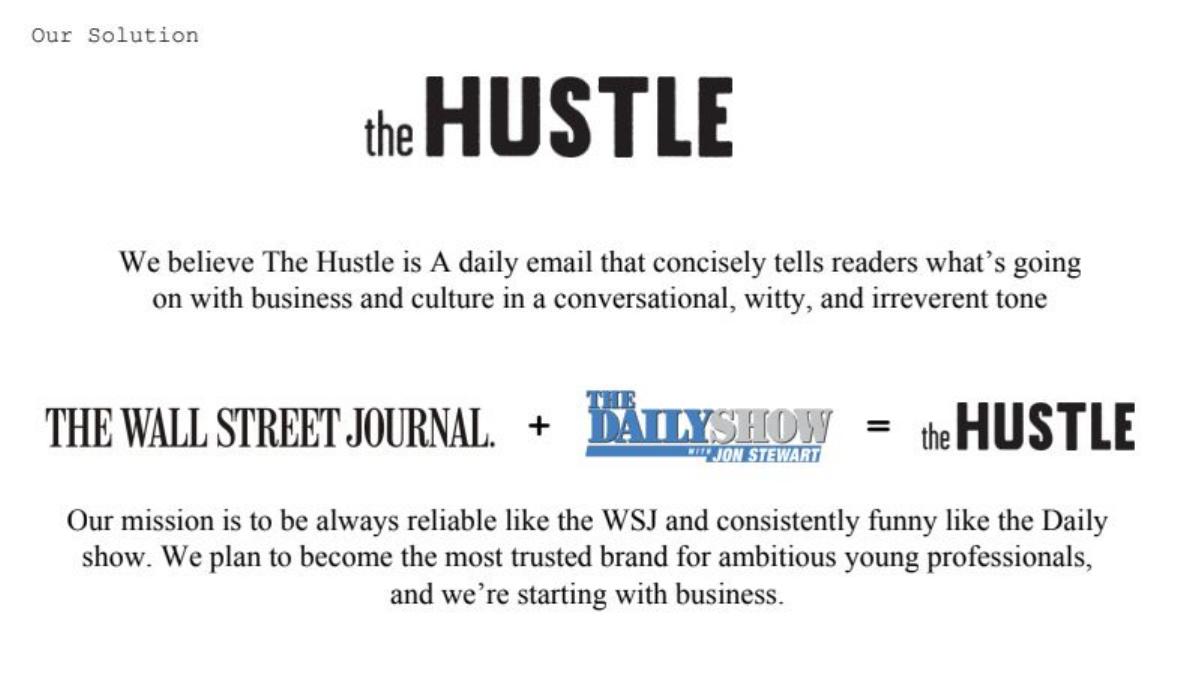
The solution is defined as a daily email that is 'conversational, witty, and irreverent.' They use a classic 'X + Y = Z' positioning statement: The Wall Street Journal + The Daily Show = The Hustle . This tells the investor exactly what the product sounds like and who it is for: ambitious young professionals.
Slide 5: Our Audience (Demographics)
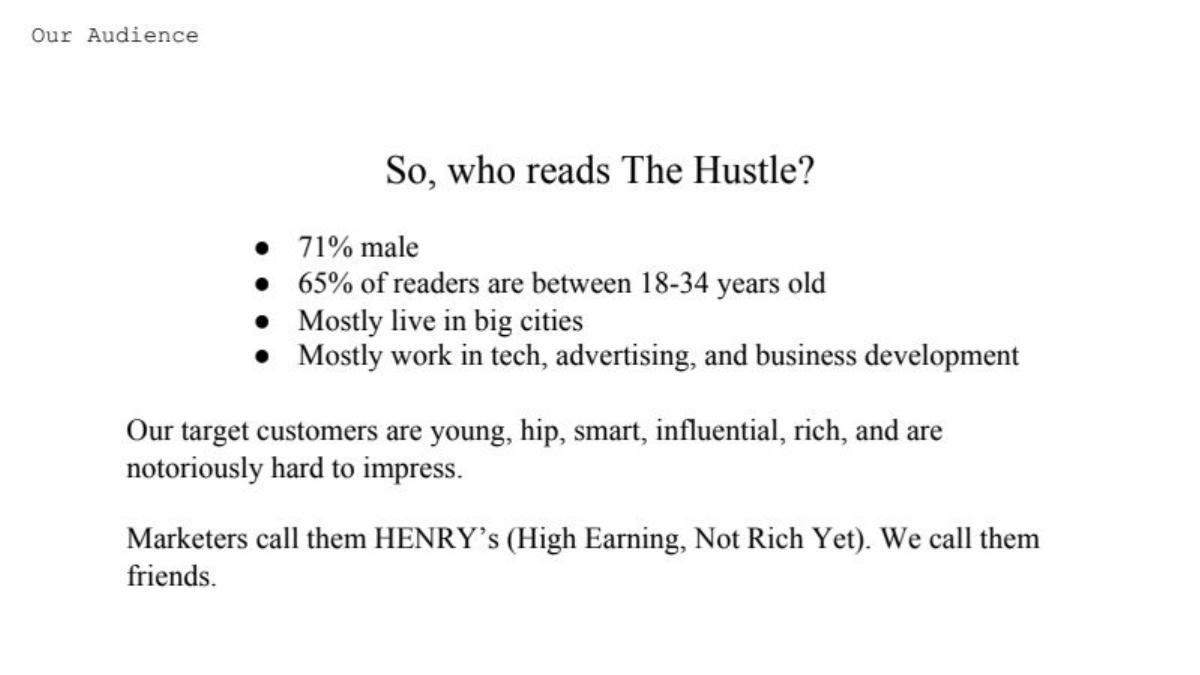
This slide defines the 'who.' The audience is 71% male, 65% aged 18-34, and mostly located in big cities working in tech, advertising, and business development. They introduce the term 'HENRYs' (High Earning, Not Rich Yet) , a marketing acronym that signals high future lifetime value to potential advertisers.
Slide 6: Our Audience (Visual Proof)
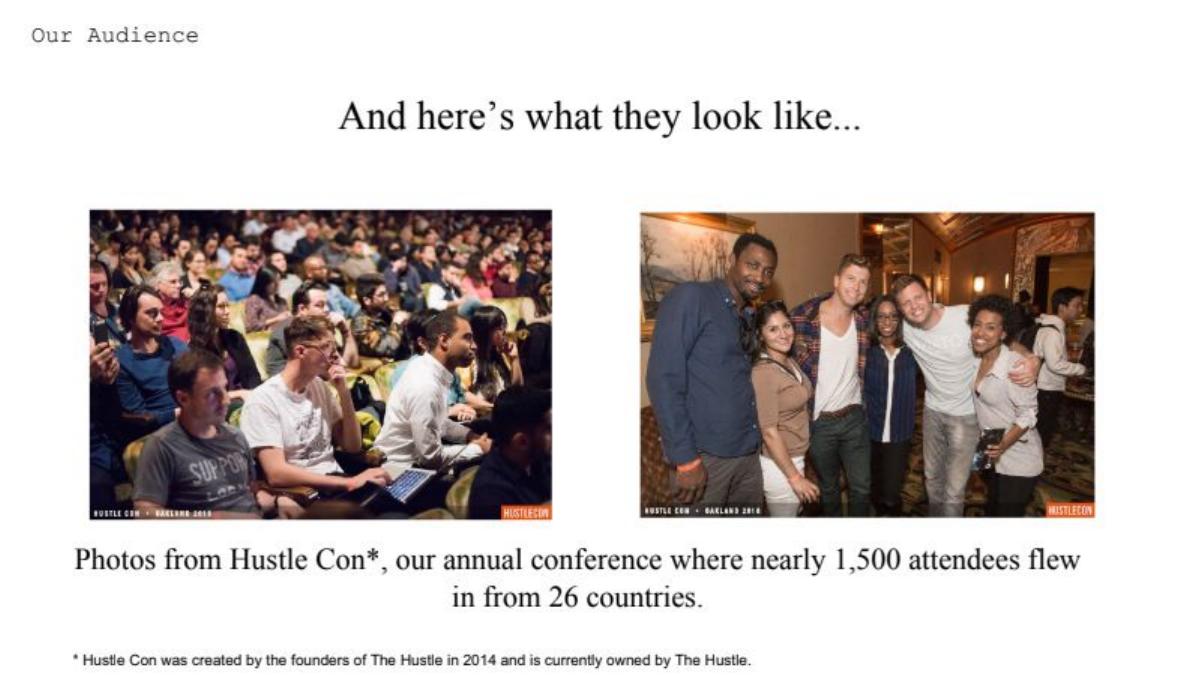
To move beyond stats, Slide 6 shows photos from Hustle Con , their annual conference. They mention nearly 1,500 attendees flew in from 26 countries. This provides social proof that the digital audience translates into a physical, paying community. A footnote clarifies that Hustle Con was created by the founders in 2014 and is owned by the company.
Slide 7: Current Traction
This is the 'meat' of the deck. The Hustle lists five key metrics:
200,000 Daily Subscribers (since April 2016) · 43% Daily Open Rate · $25k Average Monthly Advertising Revenue (Jun 2016 to Jan 2017) · $490k Total Events Revenue (over 16 months) · 1,000+ Brand Ambassadors
These numbers prove the business model is already working across both ads and ticket sales.
Slide 8: Growth Trajectory
A simple line chart titled 'Monthly Readers - 2016' shows a steady upward trend. The chart begins around 750,000 in April and ends at approximately 1,750,000 in December. A footnote explains that 'Monthly Readers' includes both unique website users and email opens, a common metric for cross-platform media companies.
Slide 9: Competitive Advantage
The Hustle doubles down on why they are 'special.' They compare their metrics to industry benchmarks:
Open rate: 42% vs. 19.3% industry average. · Ad click-through rates: 3.15% vs. 0.15% industry average (an 18x difference). · Net Promoter Score: 73 (based on 800 respondents).
This slide effectively argues that their audience isn't just large; it is exceptionally attentive.
Slide 10: Testimonials
The deck includes quotes from readers and high-profile founders. Notable names include Walker Williams (founder of Teespring), Nikhil Arora (founder of Back to the Roots), and Scott Belsky (founder of Behance and partner at Benchmark). Belsky’s quote specifically praises the 'consistency of tone,' which validates the brand's core value proposition.
Slide 11: The Next Goal
A transition slide featuring a dark photo of the founders. The text is bold: 'We plan to grow to 1 million daily users with an industry crushing open rate.' It sets the stage for the 'Future' slide.
Slide 12: The Future (5-Year Plan)
Advertising: Charging ~$30 CPM (cost per thousand) with examples like Refinery29 and Bleacher Report ($80m-$100m+ revenue). · Events: Citing Web Summit and TED as models. · Products: Using data to create products, citing Twitch and PopSugar (ShopStyle) as examples of media-to-commerce transitions.
Slide 13: The Team
The final slide introduces the four-person core team. It highlights that John and Sam (the cofounders) are on their second startup together and their last one was acquired. Kendall is noted as being formerly from Bleacher Report, providing relevant industry experience. This slide builds confidence in their ability to execute the ambitious 5-year plan.
What Works in This Deck
The 'HENRY' Hook: By identifying their audience as 'High Earning, Not Rich Yet,' The Hustle spoke the language of both VCs and advertisers. This demographic is the 'holy grail' for brands because they are forming buying habits that will last decades.
Engagement as a Moat: In a world of 'fake news' and 'clickbait,' The Hustle leaned heavily into their 43% open rate. By showing they were 2x the industry average, they reframed the newsletter not as a commodity, but as a high-trust platform.
Revenue Diversification: Most seed-stage media companies rely solely on 'growth now, monetization later.' The Hustle showed nearly half a million dollars in event revenue and consistent monthly ad spend, proving they had a 'real' business from day one.
What Is Missing
The Ask: The deck does not include a slide detailing how much they are raising, at what valuation, or how the funds will be allocated. While this information is often removed from public versions of decks, its absence makes it harder to judge the 'deal' being offered.
Unit Economics: While they show revenue, they don't show the cost of acquisition (CAC) for a new subscriber. For a newsletter business, the ratio of CAC to the Lifetime Value (LTV) of a subscriber is the most critical metric for scaling.
Content Strategy Detail: The deck explains the 'tone' (witty/irreverent) but doesn't detail the editorial process or how they ensure the 'reliability' they claim on Slide 4. Investors might wonder how they scale a 'voice' without it becoming diluted.
What a Founder Should Copy
The Comparison Formula: Use the 'X of Y' or 'X + Y = Z' formula to explain your product. 'WSJ + Daily Show' is an instant mental model that requires zero further explanation.
Benchmark Comparisons: Don't just list your metrics; list them next to the industry average. A 42% open rate is good, but saying it is '2x industry average' makes it an investment thesis.
Social Proof via Testimonials: If you have influential users or customers, put their names in the deck. Seeing a partner at a top-tier VC (Scott Belsky) praise the product is a massive signal to other investors.
Visual Traction: Use photos of real people using your product or attending your events. It breaks up the monotony of charts and proves that there is a human element to your digital growth.
Frequently asked questions
- How much did The Hustle raise with this deck?
- According to the catalogue facts, The Hustle raised $1M in a Seed round in 2017. The deck itself focuses on traction and future goals rather than the specific terms of the round, which is common for decks shared publicly after the close.
- What was The Hustle's primary competitive advantage?
- Their primary advantage was audience engagement. Slide 9 explicitly states their open rate of 42% was double the industry average, and their ad click-through rate of 3.15% was 18x the industry standard of 0.15%. This high intent allowed them to charge premium ad rates.
- Who were the key investors in this round?
- The round included a mix of VCs and high-profile angels. Notable names from the catalogue listing include Tim Ferriss, Scott Belsky (founder of Behance), Ramit Sethi, and Tucker Max, alongside firms like Social Starts and Transmedia Capital.
- What was the business model described in the deck?
- The business model was multi-pronged. Slide 12 outlines a three-pillar strategy: Advertising (charging ~$30 per 1,000 sends), Events (modeled after Web Summit and TED), and Products (leveraging reader data to create commerce or software offerings).
- Is there a team slide in The Hustle's pitch deck?
- Yes, Slide 13 introduces the team: John (Cofounder), Sam (Cofounder), Kera (Advertising/Events), and Kendall (Content). It highlights that the founders previously built and sold a startup together, providing 'founder-market fit' and execution credibility.