Themis successfully raised a $9M Seed round in 2022 by positioning itself as the 'single platform to manage risk and compliance workflows.' The deck focuses heavily on the macro-economic and regulatory tailwinds, specifically citing the $70 million FINRA penalty against Robinhood as a catalyst for market demand. While the deck excels at defining the problem—a 'hodgepodge of compliance point solutions'—it is notably light on specific team biographies and historical traction metrics. Instead, it relies on a visual product roadmap and a massive $50 billion total addressable market figure to sell…
Key takeaways
- The company identifies a $50B annual spend on compliance within the US Financial Industry on slide 7.
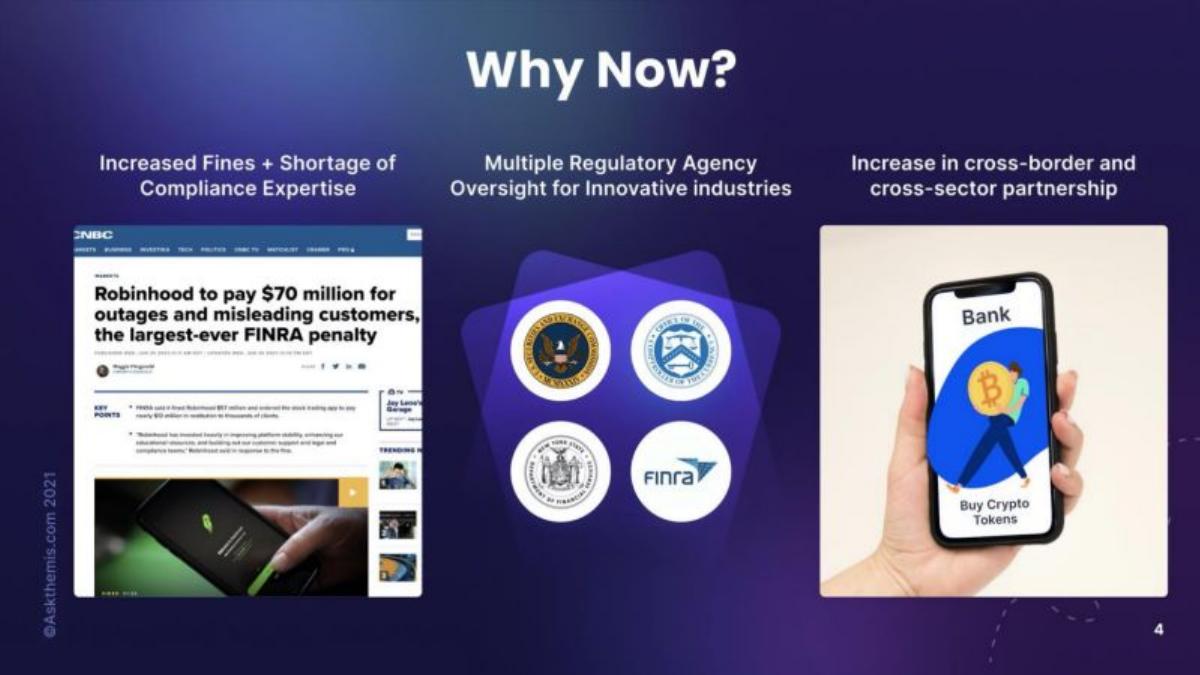
- The 'Why Now' argument is anchored by a $70 million FINRA penalty against Robinhood shown on slide 4.
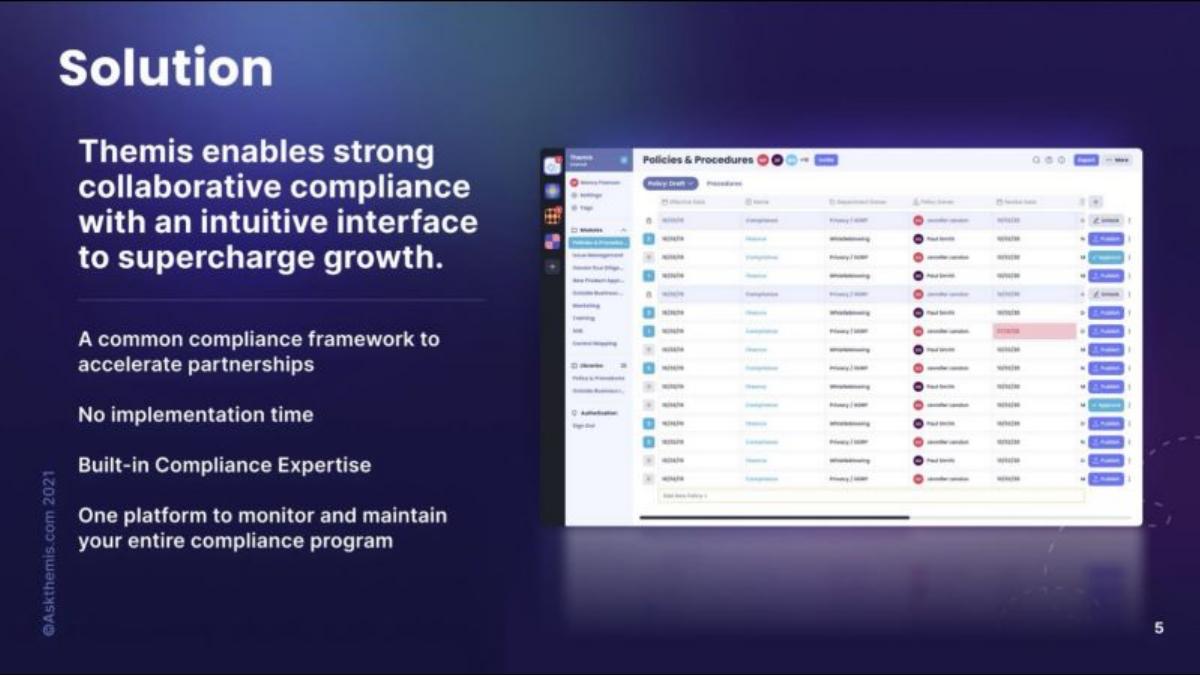
- Themis positions its solution as having 'No implementation time' and 'Built-in Compliance Expertise' on slide 5.
- The market size analysis projects growth across five sectors, including crypto companies and midsize financials, through 2024 on slide 7.
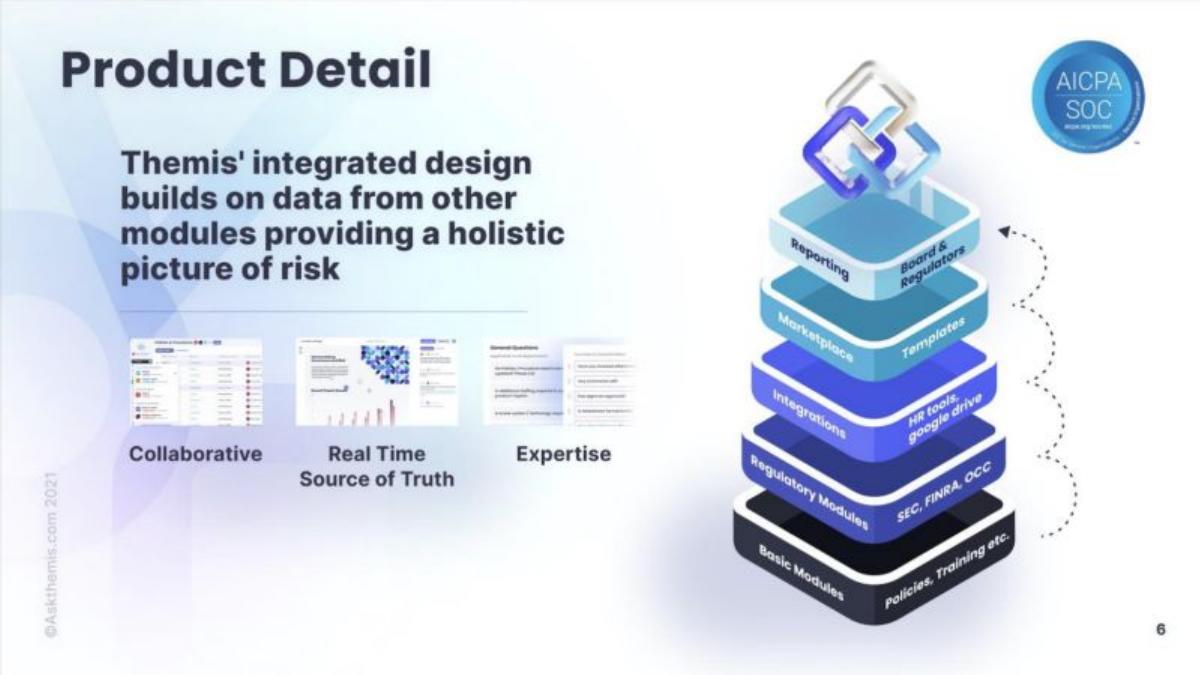
- The product architecture is described as an integrated design building on data from other modules on slide 6.
- A three-phase roadmap outlines a transition from serving Fintechs to helping companies 'Be a Bank' on slide 8.
- The deck claims the team is 'Built by regulators, compliance officers and innovative thinkers' on slide 9, though individual names are omitted.
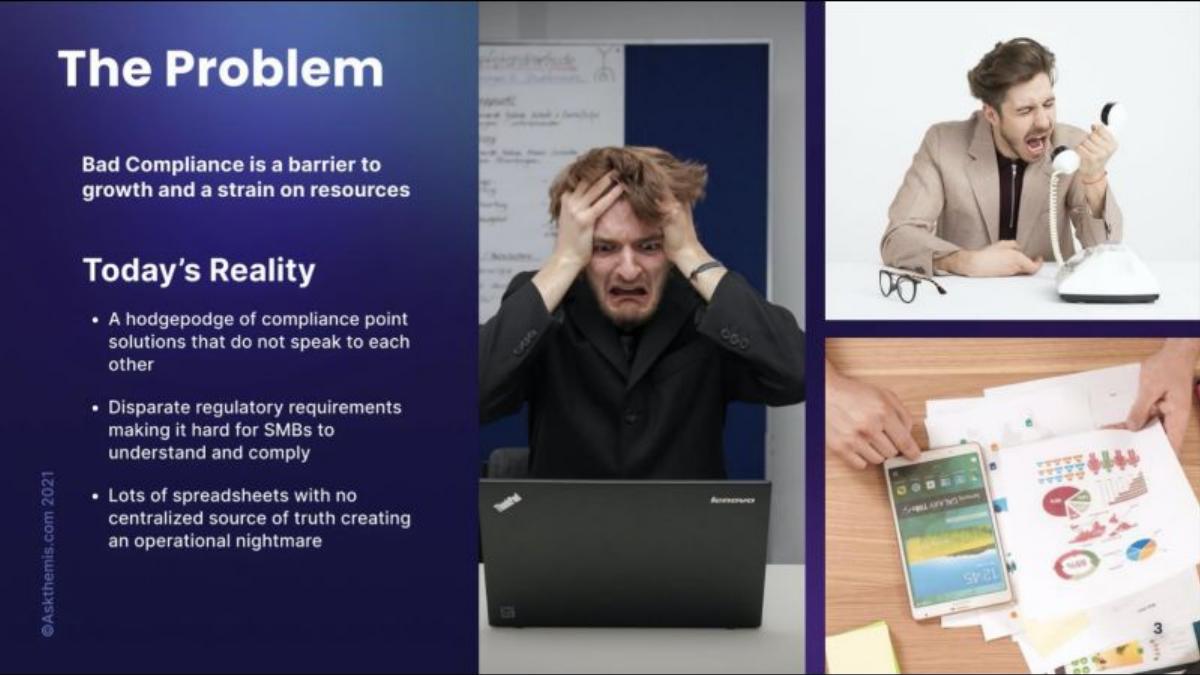
- The problem is defined as an 'operational nightmare' caused by spreadsheets and disparate regulatory requirements on slide 3.
The Narrative: Compliance as a Growth Lever
Themis positions itself not just as a defensive tool, but as a platform to 'supercharge growth.' In the world of enterprise software, compliance is often viewed as a cost center or a bottleneck. Themis attempts to flip this narrative by suggesting that a 'common compliance framework' actually accelerates partnerships, particularly between fintechs and traditional banks. The deck is structured to move the investor from the chaos of current manual processes to a future of integrated, automated regulatory oversight.
Slide 1: Title and Tagline
The opening slide introduces the logo and the tagline: 'Create a Culture of Compliance.' The visual language is abstract and corporate, using a blue and purple gradient that suggests professional software. There are no specific metrics or claims on this slide, purely branding.
Slide 2: The Purpose
Slide 2 serves as an executive summary in a single sentence: 'A single platform to manage risk and compliance workflows.' This is a standard 'North Star' slide designed to ensure the investor understands the product category immediately before diving into the problem space.
Slide 3: The Problem
This slide uses high-friction imagery (people looking stressed at desks) to illustrate 'Today's Reality.' The text identifies three specific pain points: 1) A hodgepodge of point solutions that don't talk to each other, 2) Disparate regulatory requirements that confuse SMBs, and 3) An over-reliance on spreadsheets with no centralized source of truth. The slide explicitly states that 'Bad Compliance is a barrier to growth.'
Slide 4: Why Now?
This is arguably the strongest slide in the deck. It uses external validation to create a sense of urgency. It features a screenshot of a CNBC article detailing Robinhood's $70 million FINRA penalty. The slide lists three catalysts: increased fines combined with a shortage of expertise, multiple agency oversight (represented by the logos of the SEC, OCC, and FINRA), and an increase in cross-border and cross-sector partnerships. This slide answers why a solution like Themis is needed at this specific moment in time.
Slide 5: The Solution
The solution slide introduces the interface. It claims that Themis enables 'strong collaborative compliance' and offers an 'intuitive interface.' Key value propositions listed include a common framework to accelerate partnerships, 'No implementation time,' and 'Built-in Compliance Expertise.' The screenshot shows a 'Policies & Procedures' dashboard with columns for Effective Date, Department Owner, Policy Owner, and Review Date, indicating a workflow management tool.
Slide 6: Product Detail
Slide 6 uses a 3D pyramid graphic to explain the product architecture. The base consists of 'Basic Modules' (Policies, Training), followed by 'Regulatory Modules' (SEC, FINRA, OCC), 'Integrations' (HR tools, Google Drive), a 'Marketplace' for templates, and finally 'Reporting' for Boards and Regulators. This visualizes how the platform scales from simple document storage to a full regulatory reporting engine. It also features an 'AICPA SOC' badge, signaling security readiness.
Slide 7: Market Size
Themis presents a massive opportunity, citing a $50B / yr spend on compliance within the US Financial Industry. They break this down into a $22.8B TAM and a $4.6B SAM . A line graph projects growth from 2019 to 2024 across five segments. By 2024, they project the market to include 54,688 midsize financials, 35,686 EMEA + APAC fintechs, 24,273 US Fintechs, 13,000 traditional finance entities, and 3,021 global crypto companies.
Slide 8: The Roadmap
The roadmap is divided into three phases. Phase 1 (Fintech): Focuses on starting a fintech with policies and marketing modules. Phase 2 (Collaboration): Focuses on partnering with banks via collaborative workspaces and vendor due diligence. Phase 3 (Be a Bank): Focuses on becoming fully regulated with FINRA 4530 upgrades, risk assessments, and a direct FINRA API. This indicates the company's ambition to move up the value chain as its customers grow.
Slide 9: The Team
The team slide is surprisingly light on detail. It features an illustration of Themis (the Greek goddess of law) and states the platform was 'Built by regulators, compliance officers and innovative thinkers.' However, it does not name the founders or provide their specific professional histories. In a $9M Seed round, this information is usually front and center; its absence here suggests this may be a version of the deck intended for wider circulation or that the founders' reputations preceded them in private discussions.
Slide 10: Closing
The final slide is a standard 'Thank You' or contact slide, though in this specific version, it has been replaced by a call to action for the pitch deck library itself. The original deck concludes without a specific 'Ask' slide detailing how the $9M will be spent or what the specific milestones for the next 18 months are.
What Themis Does Well
The deck is exceptionally good at contextualizing the problem . By using the Robinhood fine as a centerpiece, they move the conversation from 'this is a nice tool' to 'this is a mandatory insurance policy against $70M fines.' The visual representation of the product as a stack (Slide 6) is also effective at showing how they intend to become a 'sticky' platform that integrates with a company's existing HR and file storage tools.
What is Missing from the Themis Deck
The most glaring omission is traction . There are no mentions of current pilot programs, number of customers, or revenue. For a Seed round of $9M, one would expect to see some evidence of product-market fit or at least a list of design partners. Additionally, the Team slide lacks the 'social proof' of previous successful exits or specific roles at major regulatory bodies. Finally, the Unit Economics and Competition slides are missing. The deck assumes there are no direct competitors, focusing instead on the 'hodgepodge' of manual tools, which ignores other GRC (Governance, Risk, and Compliance) software players.
Founder Takeaways: The 'Why Now' Hook
Founders should study Slide 4. If you are building in a 'boring' or highly technical space like compliance, you must find a high-profile failure in your industry to serve as your 'Why Now.' Themis uses the Robinhood headline to bypass the need for a long explanation of why compliance matters. It creates an immediate emotional and financial hook for the investor. Furthermore, the roadmap on Slide 8 is a great example of how to show expansion potential . They aren't just selling a policy tool; they are selling the infrastructure for a company to eventually become a bank.
Frequently asked questions
- What is the core problem Themis is solving?
- According to slide 3, Themis addresses the 'hodgepodge of compliance point solutions' that do not communicate with each other. They highlight that SMBs struggle with disparate regulatory requirements and that the reliance on spreadsheets creates a lack of a centralized source of truth, resulting in an operational nightmare and a strain on growth resources.
- How does Themis define its market opportunity?
- On slide 7, Themis cites a $50 billion annual spend on compliance in the US Financial Industry. They further break this down into a Total Addressable Market (TAM) of $22.8 billion and a Serviceable Addressable Market (SAM) of $4.6 billion. Their projections include midsize financials, traditional finance, US Fintechs, EMEA/APAC Fintechs, and global crypto companies.
- What specific regulatory events does the deck use to create urgency?
- Slide 4, titled 'Why Now?', features a CNBC headline regarding Robinhood paying a $70 million penalty to FINRA for outages and misleading customers. The deck uses this to illustrate a trend of increased fines, a shortage of compliance expertise, and multiple regulatory agencies (SEC, OCC, FINRA) increasing oversight for innovative industries.
- What is the long-term product vision for Themis?
- Slide 8 outlines a three-phase roadmap. Phase 1 focuses on basic Fintech needs like policies and marketing. Phase 2 moves into collaboration, vendor due diligence, and issue management. Phase 3, titled 'Be a Bank,' introduces advanced features like FINRA 4530 reporting, risk assessment, and direct FINRA API integrations, suggesting a move toward full-stack regulatory infrastructure.
- Does the deck provide details on the founding team's background?
- Slide 9 states the company was 'Built by regulators, compliance officers and innovative thinkers,' but it does not list specific names, previous companies, or individual track records. This is a significant omission for a Seed round, as investors typically look for deep domain expertise in highly regulated sectors like Fintech compliance.