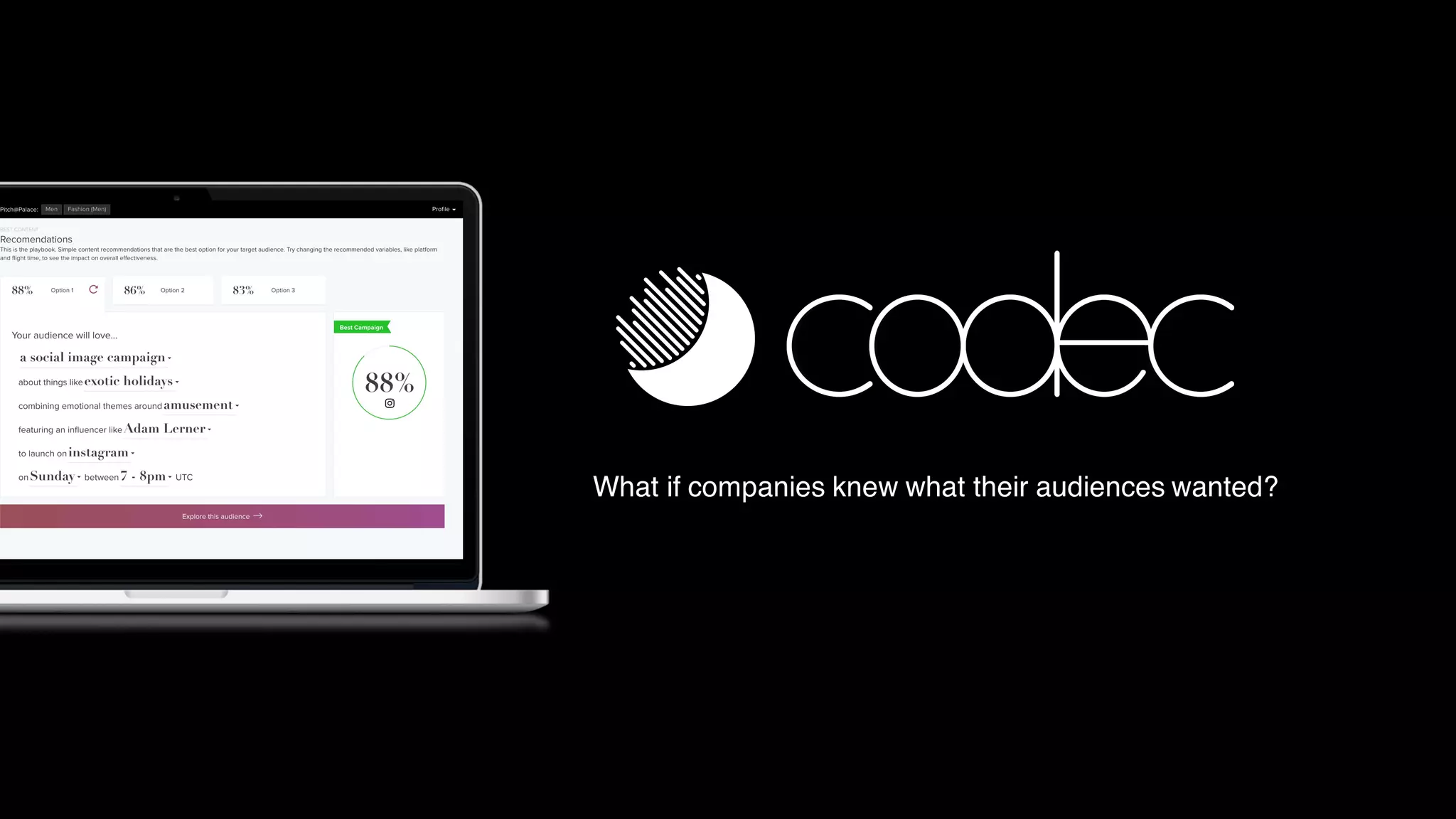
Codec’s pitch deck, presented at ad:tech 2014-2016, is a study in minimalism and high-signal data. The company addresses the 'customer-centric' gap in marketing, citing a £144bn market opportunity (Slide 2) and contrasting it with high-profile marketing failures like Apple’s $100 million U2 debacle (Slide 4). The deck transitions quickly from problem to proof, showcasing a 50% Compound Monthly Growth Rate (CMGR) and £50k in monthly revenue (Slide 6). With a client list featuring Unilever, L'Oréal, and Ben & Jerry's, the deck relies on social proof and momentum rather than dense technical expl…
Key takeaways
- The deck identifies a £144bn market opportunity centered on 'customer-centric' marketing (Slide 2).
- High-profile failures, such as Apple's $100 million U2 album giveaway, are used to illustrate the cost of not understanding audience desires (Slide 4).
- The product interface suggests a 'playbook' approach, offering specific recommendations for content, influencers, and launch times (Slide 1).
- The business model is clearly defined as a subscription service based on marketing-specific audiences and billions of interactions (Slide 5).
- Codec demonstrates significant early traction with £50k in monthly revenue and a 50% CMGR (Slide 6).
- The deck leverages massive social proof, displaying logos from global brands like BP, Castrol, and Electrolux (Slide 6).
- The presentation is highly visual, using a dark mode aesthetic with minimal text to maintain focus on key figures and logos.
- There is no explicit team slide, financial forecast, or competitive landscape analysis included in this 7-slide sequence.
Slide-by-Slide Analysis
Slide 1: Title and Value Proposition
The deck opens with a clean, dark-themed slide featuring the Codec logo and a laptop mockup showing the product interface. The central question, "What if companies knew what their audiences wanted?" , immediately establishes the company's mission. The product mockup on the screen is particularly effective because it shows actionable insights: a 'Best Campaign' score of 88% and specific recommendations for a 'social image campaign' featuring an influencer like 'Adam Lerner' to launch on 'Instagram' on 'Sunday between 7-8pm UTC.' This slide does double duty as a title and a product-in-action teaser.
Slide 2: The Market Opportunity
Slide 2 is a minimalist 'big number' slide. It displays "£144bn" in a large, bold font, followed by the phrase "customer-centric." This slide is designed to anchor the investor's mind to the massive scale of the marketing industry. By linking the dollar amount to the term 'customer-centric,' Codec implies that the current market is shifting toward data-driven audience understanding, and that they are positioned to capture a slice of this multi-billion pound pie.
Slide 3: The Creative Context
This slide features a print advertisement for 'eve' mattresses. The text focuses on the comfort and 'new-generation memory foam' of the product. In the context of the deck, this slide likely serves as a 'before' or 'current state' example of how brands attempt to communicate with customers. It sets the stage for the 'Problem' slide that follows, illustrating the traditional way brands try to reach audiences through copy and product claims.
Slide 4: The Problem (The U2 Debacle)
Codec uses a powerful negative case study to illustrate the 'Problem.' The slide features a headline: "Apple's $100 million U2 debacle." It shows Tim Cook and Bono at the 2014 Apple event where the U2 album was forced into every iTunes user's library. This is a visceral example of a brand—even one as sophisticated as Apple—misunderstanding its audience. It provides a clear 'why now' and 'why this matters' argument: without audience intelligence, even $100 million can be wasted on a campaign that alienates customers.
Slide 5: The Business Model
Slide 5 breaks down the mechanics of the business in three simple lines: "subscription," "marketing-specific audiences," and "billions of content interactions." This defines Codec as a SaaS (Software as a Service) platform. It tells the investor that the revenue is recurring (subscription), the output is actionable (audiences), and the moat is data-driven (billions of interactions). The simplicity of this slide avoids the 'black box' problem often found in AI startups by clearly stating what they sell and how they power it.
Slide 6: Traction and Social Proof
This is the 'money slide.' On the left, it lists two staggering growth metrics: "50k /month" and "50% CMGR." A 50% monthly growth rate is top-tier for any startup. On the right, it displays a 'wall of logos' including Unilever, L'Oréal, BP, Ben & Jerry's, and Electrolux. This slide proves that the product is not just a concept; it is being paid for and used by some of the largest spenders in the advertising world. The presence of agencies like adam&eveDDB also suggests a B2B2B distribution model.
Slide 7: Contact and Closing
The final slide repeats the product mockup and logo, providing the name "Tom Graham" and the email address "tom.graham@codec.ai." It maintains the minimalist aesthetic of the rest of the deck, leaving the focus on the product interface and the contact information for the next steps.
What Codec Does Well
Minimalism and Focus: The deck avoids the common pitfall of cluttering slides with too much text. Each slide has a single, clear purpose—whether it's establishing market size, showing a failure, or proving traction. This is ideal for a presentation deck where the speaker needs the audience to listen rather than read.
High-Signal Traction: Showing a 50% CMGR alongside logos like Unilever and L'Oréal is a powerful combination. It tells investors that the company has found a way to sell into notoriously slow-moving enterprise organizations at a very high velocity.
Concrete Examples: Using the Apple/U2 example (Slide 4) makes the problem tangible. Every investor in 2016 would have remembered that event, making the 'pain point' of the product immediately relatable.
What is Missing from the Deck
The Team: There is no slide dedicated to the founders' backgrounds. In early-stage investing, the 'who' is often as important as the 'what.' While Tom Graham's name is on the final slide, his credentials and the technical expertise of the team are absent.
Competitive Landscape: The deck doesn't mention other audience intelligence tools or how Codec differs from traditional market research firms like Nielsen or Kantar. Investors would want to know why a brand would choose Codec over existing solutions.
The Ask: There is no mention of how much capital the company is looking to raise or the milestones they intend to hit with that capital. This suggests the deck may have been used for a pitch competition (like ad:tech) rather than a direct investor meeting.
Founder's Playbook: What to Copy
The 'Big Number' Anchor: Use a single, massive market figure (Slide 2) to frame the opportunity. Don't bury it in a paragraph; let the number speak for itself.
The Negative Case Study: Instead of just saying 'marketing is hard,' show a famous, expensive failure (Slide 4). It creates an emotional hook and justifies the need for your solution.
Actionable Mockups: If you show your product, show it delivering a result (Slide 1). Codec doesn't just show a dashboard; they show a 'playbook' with specific times, influencers, and platforms. This makes the value proposition concrete.
Traction vs. Logos: If you have both revenue growth and big-name clients, put them on the same slide (Slide 6). The revenue proves the business works; the logos prove the market trusts you.
Frequently asked questions
- What is the core problem Codec is trying to solve?
- Codec addresses the disconnect between brands and their audiences. Slide 1 asks, 'What if companies knew what their audiences wanted?' and Slide 4 highlights the 'Apple $100 million U2 debacle' as a primary example of brands forcing content on users without data-driven insights. The deck suggests that even the world's largest companies waste significant capital on marketing that fails to resonate because it lacks a customer-centric foundation.
- How does Codec generate revenue according to the deck?
- Slide 5 explicitly outlines the business model as a 'subscription.' This model is built upon providing 'marketing-specific audiences' derived from 'billions of content interactions.' By positioning itself as a SaaS platform rather than a creative agency, Codec signals to investors that the business is scalable and produces recurring revenue, which is further validated by the traction metrics shown later.
- What specific traction metrics does the deck provide?
- Slide 6 provides two critical data points: the company is generating '50k /month' (presumably in GBP, given the market slide currency) and maintaining a '50% CMGR' (Compound Monthly Growth Rate). This level of growth is exceptionally high for an early-stage startup, suggesting strong product-market fit and a rapid sales cycle among the enterprise logos displayed on the same slide.
- Which brands were already using Codec at the time of this pitch?
- Codec displays a dense 'wall of logos' on Slide 6, indicating a high level of enterprise adoption. Notable clients and partners include Unilever, L'Oréal, BP, Electrolux, Giorgio Armani Beauty, Ben & Jerry's, and Sky Bet. The inclusion of agency partners like adam&eveDDB suggests that Codec integrates into the existing workflow of major advertising holding companies.
- What is missing from this pitch deck that an investor would need?
- This version of the deck is missing several standard components: a Team slide (though a contact name, Tom Graham, is provided on Slide 7), a detailed Competition slide, a Go-to-Market strategy, and a specific Ask (how much money they are raising and what they will do with it). It functions more as a 'teaser' or a presentation deck meant to accompany a live talk rather than a standalone due diligence document.