The Right Stuff’s 12-slide seed deck is a study in hyper-niche market positioning. By explicitly labeling itself as a 'dating app for the right wing,' the company bypasses the need for complex feature comparisons and instead focuses on a cultural gap in the $37 billion dating market dominated by Match Group. The deck relies heavily on macro-market statistics—citing 175 billion annual app downloads and 270 million dating app users—to validate the medium, while using the 'invite-only' model as a primary differentiator for safety and quality. Despite raising $1.5M, the deck notably lacks a team…
Key takeaways
- The tagline 'A dating app for the right wing' appears on almost every slide, ensuring the core value proposition is never lost (Slide 1-11).
- The deck identifies a massive market inefficiency, noting that while there are over 1,500 dating apps, few cater to specific political alignments (Slide 3).
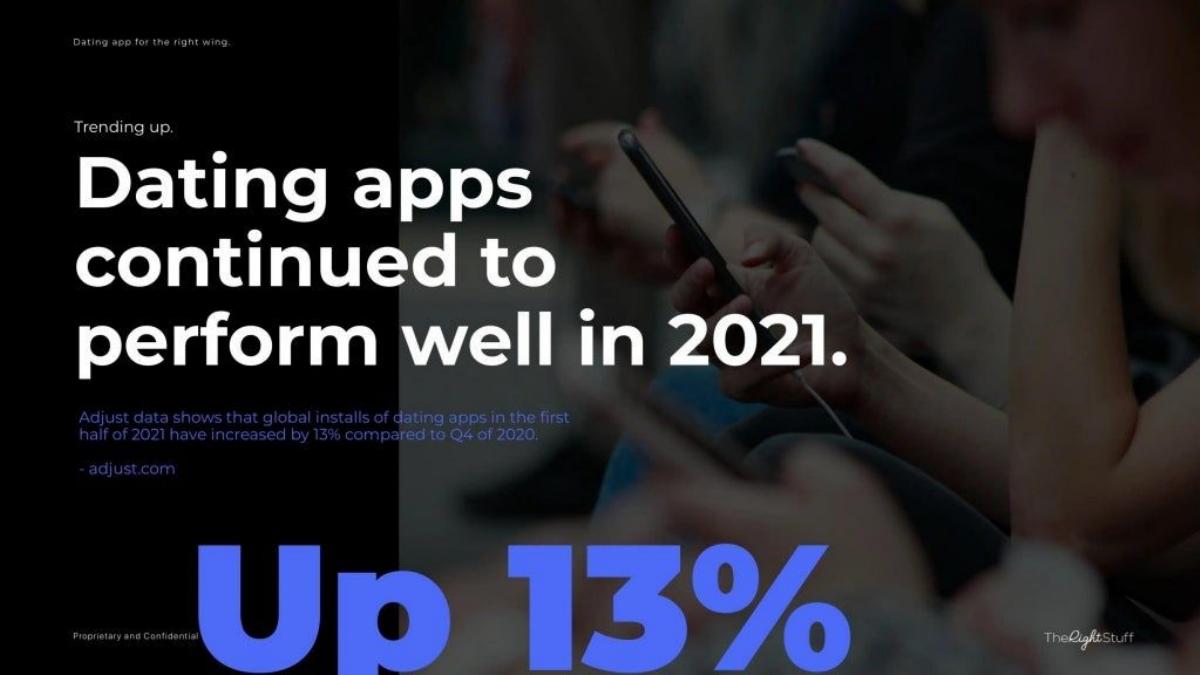
- Macro-validation is used to prove the sector's health, citing that dating app installs increased by 13% in the first half of 2021 (Slide 6).
- The competitive analysis focuses entirely on Match Group's $37 billion valuation to highlight the scale of the opportunity (Slide 8).
- The product is positioned as an 'invite-only' platform to ensure a 'consistent' experience and filter for 'real people' (Slide 10).
- The UI showcases a 'Dates' feature where users can post specific events, like a 'Nationals Baseball Game,' to encourage in-person meetings (Slide 11).
- The deck completely omits a team slide, which is highly unusual for a $1.5M seed round (Omission).
- There is no mention of unit economics, customer acquisition costs, or revenue models within the 12 slides (Omission).
The Niche Play: Analyzing The Right Stuff’s $1.5M Seed Deck
The Right Stuff entered the market in 2022 with a very specific goal: to capture the conservative dating market. In a world where dating apps are often criticized for being 'too woke' or politically homogeneous, this deck leans heavily into a polarizing but clear identity. Raising $1.5M for a B2C app in a saturated market requires a compelling narrative, and this deck provides a blueprint for how to pitch a niche community play.
Slides 1-2: The Unambiguous Hook
The deck opens with a minimalist blue cover slide. The tagline is immediate: "Dating app for the right wing." This is repeated on Slide 2, which adds a secondary value proposition: "This invite-only dating app is built on the idea that good 'ol fashion in-person dates are far more effective than overly complicated algorithms."
From a fundraising perspective, this is a filtration strategy. By being this direct, the founders immediately signal to the investor exactly what the product is. If an investor has a thesis against political apps or dating apps, they can stop reading here. For those interested in the 'Riches in the Niches' strategy, it sets a clear stage.
Slides 3-6: Market Validation and Macro Trends
Slide 3 addresses the 'crowded market' objection head-on. It notes there are "over 1,500 dating apps" but claims there are "so few real dating options." This sets up the 'Quality vs. Quantity' argument that the rest of the deck relies on.
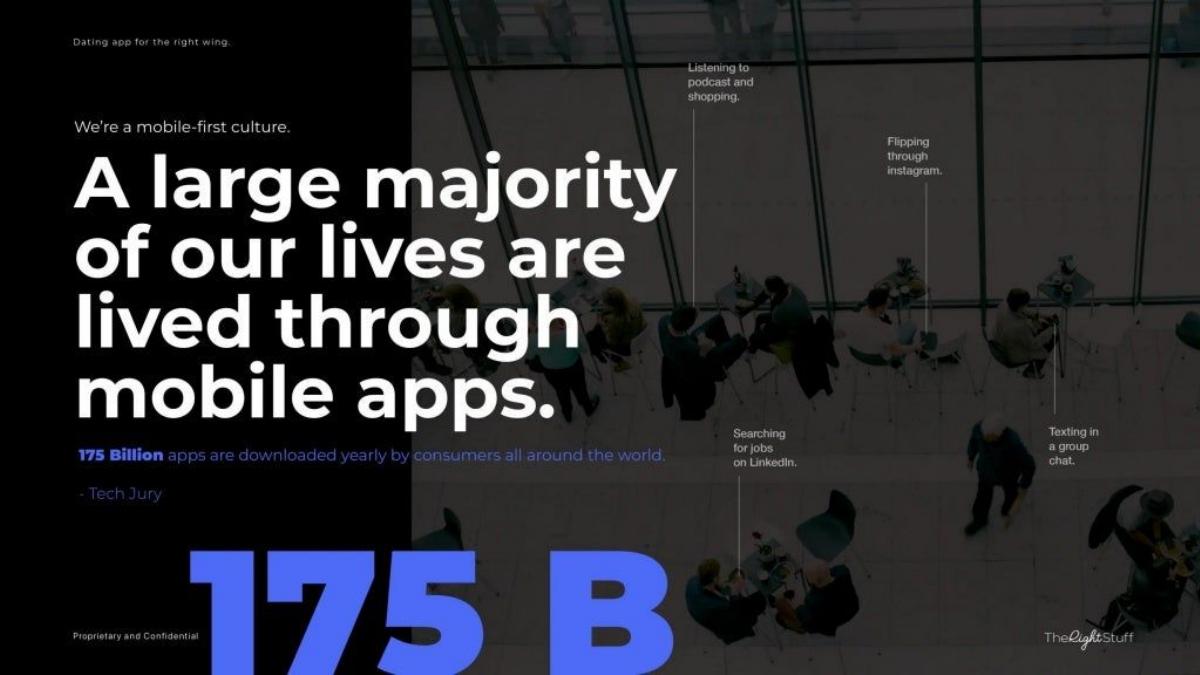
Slides 4, 5, and 6 provide the macro-economic justification for the business. The deck cites "175 Billion apps" downloaded yearly (Slide 4) and "270 million adults" using dating apps worldwide in 2020 (Slide 5). Slide 6 adds recent momentum, stating that installs were "Up 13%" in the first half of 2021 compared to Q4 2020. These slides aren't about The Right Stuff specifically; they are about proving that the 'Digital Dating' category is a massive, growing, and permanent fixture of modern culture.
Slides 7-9: The Niche Thesis and Competitive Landscape
Slide 7 gets to the heart of the 'Problem.' It uses a bold statement: "True conservative women, are looking for conservative men (period)." The text argues that other apps, even those giving women control, fail because the 'right people' aren't on the platform to begin with. This is a classic 'Community First' pitch—the value isn't the code, it's the user base.
Slide 8 introduces the 'Goliath.' It highlights Match Group , listing its portfolio (Tinder, Hinge, OkCupid, etc.) and its "$37 Billion" valuation in 2021. The key takeaway at the bottom of the slide is crucial: "There's not a single App that is exclusively made for the Conservative market." This frames the entire Match Group empire not as a competitor to be defeated, but as a proof of market size that has left a specific, lucrative door open.
Slide 9 is a transition slide that simply restates the mission in large, bold font: "TheRightStuff is the dating app for conservatives."
Slides 10-11: Product Differentiators and UI
Slide 10, titled "WHY WE'RE DIFFERENT," lists three pillars: Invite Only , For the Right Wing , and Real Profiles . The emphasis on 'Real Profiles' (no fake profiles to inflate user count) is a direct jab at the common industry practice of using bots to create the illusion of liquidity in new dating apps.
Slide 11 shows the 'How it works' via four mobile mockups. The UI is standard for the industry, which is a smart move—users don't want to relearn how to use a dating app. However, the 'Dates' screen (Mockup 2) is the most interesting. It shows a user named 'Luke, 30' posting a specific event: "Nationals Baseball Game." This reinforces the 'in-person' philosophy mentioned on Slide 2. It moves the app away from endless swiping and toward event-based matching.
Slide 12: The Missing Pieces
Slide 12 is a promotional slide for a pitch deck library and is not part of the company's actual pitch content. This means the deck ends without several critical components usually found in a Seed round presentation.
What Works in This Deck
1. Clarity of Purpose: There is zero ambiguity. By the time an investor reaches Slide 3, they know exactly who the customer is and what the product does. In a sea of 'AI-powered social discovery' pitches, this level of plain English is refreshing.
2. Market Sizing by Proxy: By focusing on Match Group’s $37B valuation, the founders don't have to spend time proving that dating is a business. They only have to prove that their specific slice of that $37B is large enough to justify a $1.5M seed investment.
3. Use of Macro Data: Citing sources like Tech Jury, Google, and Adjust.com gives the deck a level of professional rigor that helps balance the more emotional, politically-charged problem statements.
What is Missing
1. The Team: This is the most significant omission. Dating apps live and die by their ability to generate buzz and manage community growth. Knowing who is behind the curtain—whether they have political connections, tech experience, or marketing prowess—is vital. The catalogue facts mention the round was $1.5M, which is a significant sum to raise without a visible team slide in the deck.
2. Business Model: How does The Right Stuff make money? Is it a subscription model like Tinder Gold? Is it ad-supported? Is there a pay-per-invite fee? The deck is silent on monetization.
3. Traction and Roadmap: There are no mentions of current user numbers, waitlist sizes, or a launch timeline. While this may have been a pre-launch deck, investors usually want to see a 'Go-To-Market' strategy, especially for a two-sided marketplace like a dating app where 'liquidity' (having enough men and women in the same city) is the hardest problem to solve.
4. The Ask: The deck does not state how much money is being raised or what the milestones are for the next 18 months. While the catalogue facts tell us they raised $1.5M, a founder using this as a template should remember to include a slide detailing the funding goal and use of proceeds.
Founder’s Takeaway
If you are building a product for a specific, underserved subculture, copy this deck’s boldness. Don't try to appeal to everyone. The Right Stuff leans into its niche so hard that it becomes its primary strength. However, unless you have a very famous founding team or a pre-existing relationship with your investors, do not omit the team and traction slides. A niche is a great starting point, but investors still need to know that the people building the 'stuff' are the 'right' ones for the job.
Frequently asked questions
- How does The Right Stuff justify a new dating app in a crowded market?
- The deck argues that despite the existence of 1,500+ dating apps (Slide 3), the market is saturated with options that lack 'real dating options' for conservatives. It positions the 'Right Wing' as an underserved niche that the $37 billion Match Group (Slide 8) fails to address exclusively. By focusing on 'value alignment' rather than feature sets, they create a unique category for themselves.
- What is the primary product differentiator mentioned in the deck?
- The primary differentiator is the 'invite-only' nature of the app (Slide 10). This is presented as a way to ensure 'real profiles' and prevent the inflation of user counts with fake accounts. Additionally, the UI (Slide 11) emphasizes 'viewing dates'—specific activities like baseball games—to shift the focus from digital chatting to 'good 'ol fashion in-person dates.'
- Why are there so many macro-statistics about mobile apps in general?
- Slides 4, 5, and 6 function as a 'tide is rising' argument. By citing 175 billion app downloads and 270 million dating app users, the founders are telling investors that the medium (mobile apps) and the category (dating) are proven and growing. This reduces the perceived risk of the business model, allowing the investor to focus solely on the niche's potential.
- What are the most significant risks or omissions in this pitch deck?
- The most glaring omission is the team. In a seed round, the 'who' is often as important as the 'what.' The deck also lacks a business model (how they make money), a roadmap, and a slide detailing how the $1.5M will be spent. These omissions suggest the deck may have been a high-level teaser or supported by a very strong verbal narrative.
- How does the deck handle the 'Problem' slide differently than most startups?
- Instead of a technical problem, The Right Stuff presents a social and emotional problem. Slide 7 states, 'True conservative women, are looking for conservative men (period).' It frames the problem as a lack of 'meaningful ways' to connect outside of apps that don't share their values, turning a political preference into a market gap.