The Swatch Box presents a clear, analogy-driven value proposition: 'Stitch Fix for home decor.' By leveraging personal stylists and seasonal deliveries, the company targets a high-income demographic (AGI $100K-$1M) with a curated, low-friction shopping experience. The deck highlights a $228.5B total market and a specific $1.27B target opportunity based on 126,000 customers. While the deck successfully communicates the product experience through detailed personas and beta milestones—including a jump from 25 to 430 boxes delivered—it lacks a dedicated team slide and granular unit economics. The…
Key takeaways
- The company positions itself as a subscription service similar to Trunk Club and Stitch Fix on slide 2.
- Market sizing is based on a $228.5B US home furnishings market as of 2013, according to slide 4.
- Target customers are defined as households with an AGI between $100K and $1M in the 26-45 age group on slide 4.
- The Serviceable Obtainable Market (SOM) is calculated at $1.27B, representing 2% of the SAM or 126,000 customers on slide 4.
- Customer acquisition relies on a multi-pronged approach including direct mail, social media, and commission-based stylist outreach as shown on slide 5.
- Beta milestones show growth from 25 boxes delivered in June to 430 boxes delivered by the following March on slide 6.
- The company instituted an $85 styling fee in August of their beta phase, per slide 6.
- Early traction included features on InStyle.com and Domino.com, noted on slide 6.
The Swatch Box: A Curation-First Approach to Interior Design
The Swatch Box pitch deck is a classic example of a 'model-transfer' pitch. By explicitly comparing themselves to Stitch Fix and Trunk Club, the founders bypass the need to explain the mechanics of subscription styling and instead focus on why this model works for the home furnishings sector. The deck is visually driven, mirroring the aesthetic nature of the product itself, and uses a single customer persona to anchor the entire business case.
Slide 1: Title and Positioning
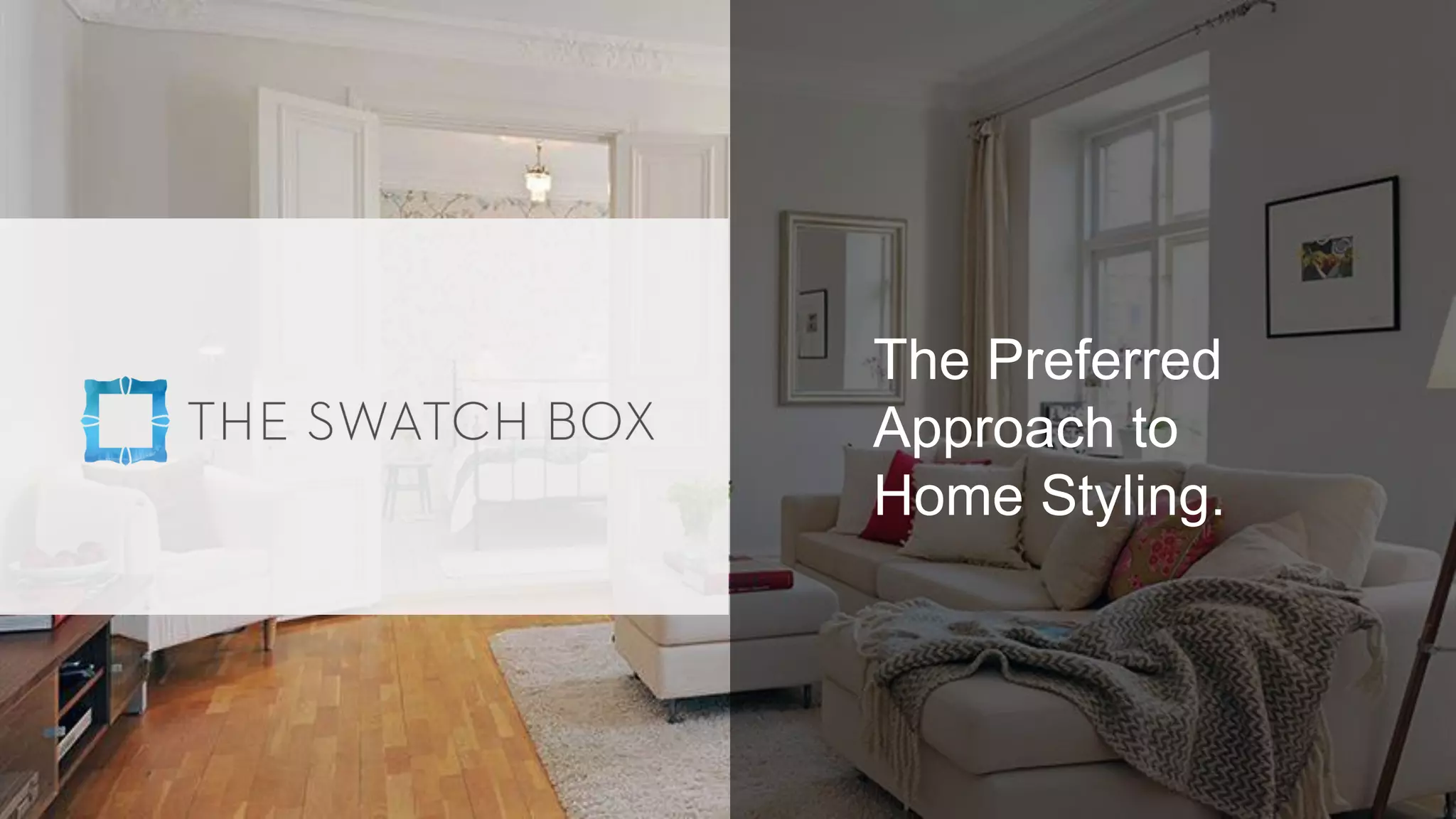
The cover slide establishes the brand identity with a clean, minimalist logo and the tagline: "The Preferred Approach to Home Styling." The background image of a well-appointed living room immediately signals the premium nature of the service. It sets a professional tone without over-complicating the initial message.
Slide 2: The Solution and Business Model
Slide 2 is the most critical for establishing the company's category. It defines the service as "A subscription based service similar to Trunk Club and Stitch Fix." By using these high-profile benchmarks, the company explains its operations in a single sentence. The slide lists three pillars: Personal stylists, Regular seasonal deliveries, and Hassle-free returns. This addresses the three biggest friction points in home decor: lack of design expertise, the time required to shop, and the difficulty of returning bulky items.
Slide 3: The 'Kate' Persona
Instead of a generic product description, slide 3 uses a persona named "Kate," a 31-year-old Corporate Attorney. This slide visualizes a sample "Swatch Box" containing items ranging from an $18 set of napkins to a $739 rug. A quote from "Rachael - Stylist" adds a human element to the curation process. This slide effectively demonstrates the price point and the variety of goods, showing that the service handles everything from small accents to significant furniture pieces.
Slide 4: Market Sizing and Demographics
The market slide (Slide 4) uses a top-down approach. It starts with the $228.5B US home furnishings market (citing 2013 data) and narrows it down to a target of 6.34M households. The math is specific: they target households with $100K-$1M AGI who spend 5% of their income on furnishings. This results in a SAM of $63.72B. Their conservative goal is to capture 2% of that SAM, which they value at $1.27B from 126,000 customers. Citing IRS.gov for demographic data adds a layer of credibility to these projections.
Slide 5: Customer Acquisition Strategy
Slide 5 illustrates the marketing funnel around the daily routine of their target persona. The strategy is divided into "at home," "at work," and "everywhere." Notable tactics include targeted mailers for home addresses, commission-based stylist outreach for professional networking, and social media awareness via Instagram. The inclusion of "purchased lists" for direct email suggests a more aggressive, traditional outbound approach alongside modern digital marketing.
Slide 6: Beta Milestones and the $1.5M Ask
This slide serves as both a traction report and a funding request. The timeline shows a steady progression from an initial $150K Angel Round in June to a projected $1.5M Seed Round in December. The growth in "Delivered Boxes" is the primary metric here, moving from 25 to 430 over a nine-month period. The slide also notes the introduction of an $85 styling fee in August, which is a significant business model validation step, proving that customers are willing to pay for the curation service itself, not just the products.
Slide 7: Q&A and Reiteration
Slide 7 repeats the cover imagery but adds a "Q&A" heading. This is a standard transition slide designed to remain on the screen during the discussion phase of a pitch. It reinforces the brand and the core value proposition one last time.
Slide 8: Client Testimonials and Unit Economics Case Study
Slide 8 provides a detailed breakdown of a single transaction ("Jennie’s First Box"). This is a clever way to show unit economics without a spreadsheet. The box had a $1,162 retail value; the customer kept 7 items and returned 9, resulting in $685 in merchandise sold. This 43% 'keep rate' by item count (and roughly 59% by value) provides a tangible data point for investors to model potential revenue per user.
Slide 9: Company Mission
The mission slide is simple: "To help people create a home they love by offering a shopping experience that delights." The background photo of a young family in a stylish home reinforces the emotional benefit of the product. It moves the conversation from logistics and margins to the ultimate goal of customer satisfaction.
Slide 10: Contact Information
The final slide provides a dedicated investor relations email address. It is clean and professional, though it lacks social media handles or a physical office location, which are sometimes included to show scale.
What The Swatch Box Pitch Deck Does Well
The deck excels at clarity through analogy . By anchoring the business model to Stitch Fix, the founders save time on mechanics and spend more time on the specific nuances of the home decor market. The use of a detailed persona (Kate) makes the target market feel real and reachable, rather than just a set of statistics. Furthermore, the merchandise breakdown on slide 8 is a transparent way to show how the business actually makes money, providing a clear look at the 'keep rate' which is the lifeblood of any subscription box company.
What Is Missing from The Swatch Box Pitch Deck
The most glaring omission in the provided slides is a Team Slide . Investors at the seed stage are primarily betting on the founders' ability to execute, and without bios or relevant experience in retail, logistics, or design, there is a significant trust gap. Additionally, there is no Competitor Analysis . While they mention Stitch Fix as a model, they do not address direct competitors in the home space (like Havenly or Modsy) or traditional retailers moving into curation. Finally, the deck lacks a Use of Funds breakdown. A $1.5M ask should be accompanied by a clear plan for how that capital will be deployed—whether it's for inventory, technology development, or scaling the stylist network.
Founder's Guide: What to Copy from This Deck
The 'Keep Rate' Case Study: Slide 8 is a brilliant way to demonstrate how the business model works in practice. Showing exactly what was in a box, what was kept, and the resulting revenue is far more effective than a generic revenue chart. · Specific Demographic Targeting: Instead of saying "everyone who buys furniture," the deck uses IRS data to pinpoint a specific income bracket. This makes the marketing plan on slide 5 feel much more credible. · Visual Curation: For any aesthetic-led business, the deck must look as good as the product. The Swatch Box uses high-quality photography and a consistent color palette that reflects the brand's premium positioning. · Milestone-Based Traction: Slide 6 doesn't just show revenue; it shows the evolution of the business, including the introduction of a styling fee and PR wins. This tells a story of a company that is learning and refining its model.
Frequently asked questions
- What is the core business model of The Swatch Box?
- The Swatch Box operates as a subscription-based home styling service. As detailed on slide 2, it uses personal stylists to curate seasonal deliveries of home decor items. Customers receive a box of goods, keep what they like, and return the rest. The model includes an $85 styling fee, which was instituted during their beta phase to help offset curation costs and qualify leads.
- How does the company define its target market?
- The company targets a very specific affluent demographic. According to slide 4, they focus on 6.34 million households with an Adjusted Gross Income (AGI) between $100,000 and $1,000,000, specifically in the 26-45 age bracket. They estimate this group spends approximately 5% of their AGI on home furnishings, creating a Serviceable Addressable Market (SAM) of $63.72 billion.
- What evidence of traction does the deck provide?
- Traction is demonstrated through a delivery growth timeline on slide 6. The company grew from 25 boxes in June to 430 boxes by the following March. Additionally, they secured an initial $150K Angel Round and gained significant PR exposure through features on InStyle.com and Domino.com, along with reaching 1,000 Facebook likes early in their beta.
- What is the customer acquisition strategy?
- Slide 5 outlines a 'multi-pronged' strategy centered around the daily life of their target persona, 'Kate.' This includes digital tactics like social media (Facebook, Pinterest, Instagram) and search engine remarketing, alongside traditional methods like direct mail to home addresses and purchased email lists. They also plan to use a commission-based sales structure for stylist outreach.
- What are the key financial metrics missing from the deck?
- While the deck mentions a retail value of $1,162 for a sample box on slide 8, it lacks comprehensive unit economics. There is no data on Customer Acquisition Cost (CAC), Lifetime Value (LTV), or average margins on the goods sold. Furthermore, the deck does not provide a clear breakdown of how the $1.5M seed funding will be allocated across operations, marketing, or inventory.