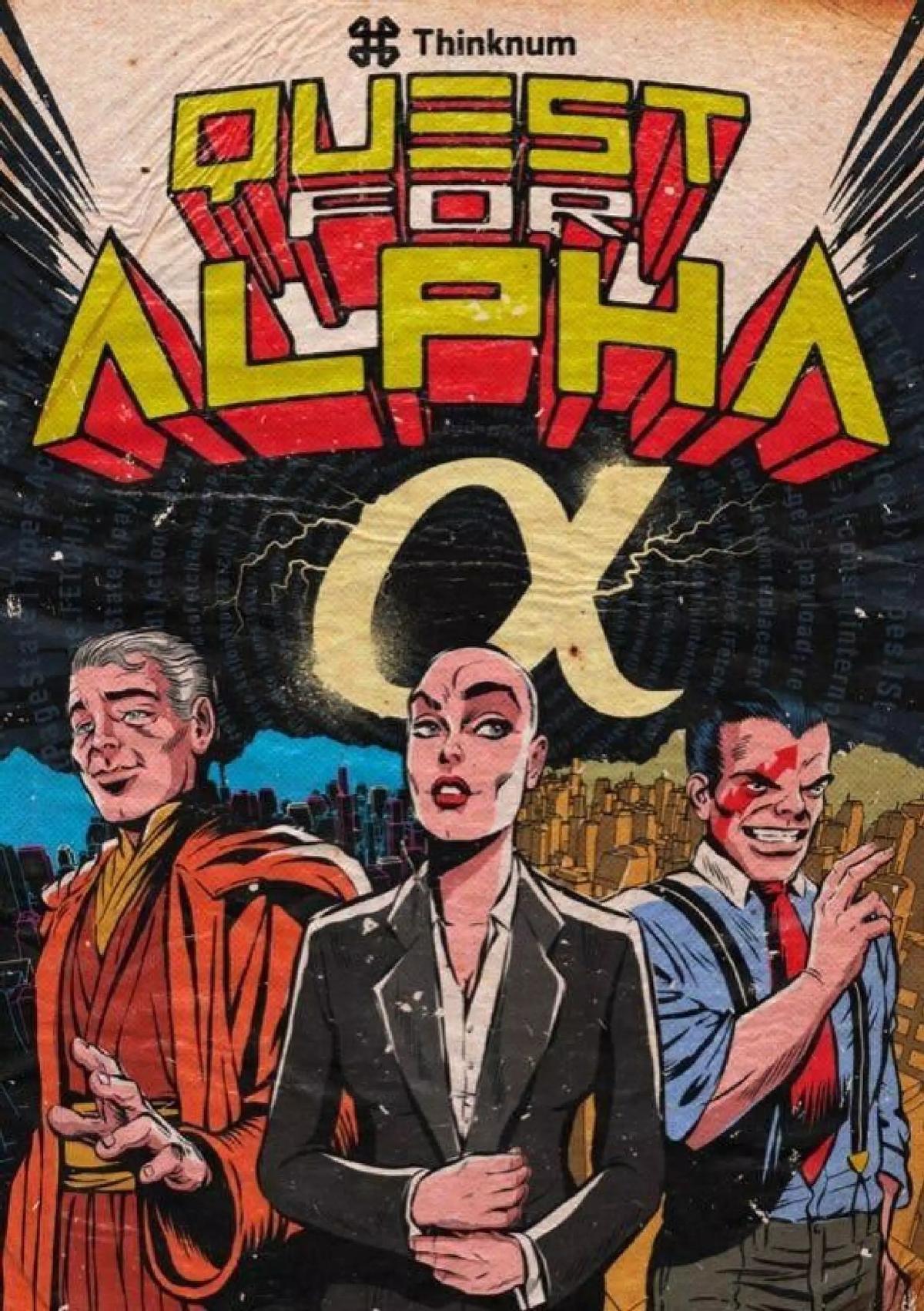
Thinknum raised $12.6 million for its Series A in 2014 using a deck that functions entirely as a comic book. The 17-slide presentation, titled 'Quest for Alpha,' uses characters like Amaya and Old Titan to dramatize the struggle of finding investment alpha in a world dominated by High-Frequency Trading (HFT) firms. The deck is a masterclass in narrative positioning, framing the company's data platform as the 'Promised Land' for investors. However, from a traditional analyst perspective, the deck is remarkably thin on substance. It contains zero slides on revenue, zero slides on the actual fou…
Key takeaways
- The deck is presented as a 17-slide comic book titled 'Quest for Alpha' (Slide 1).
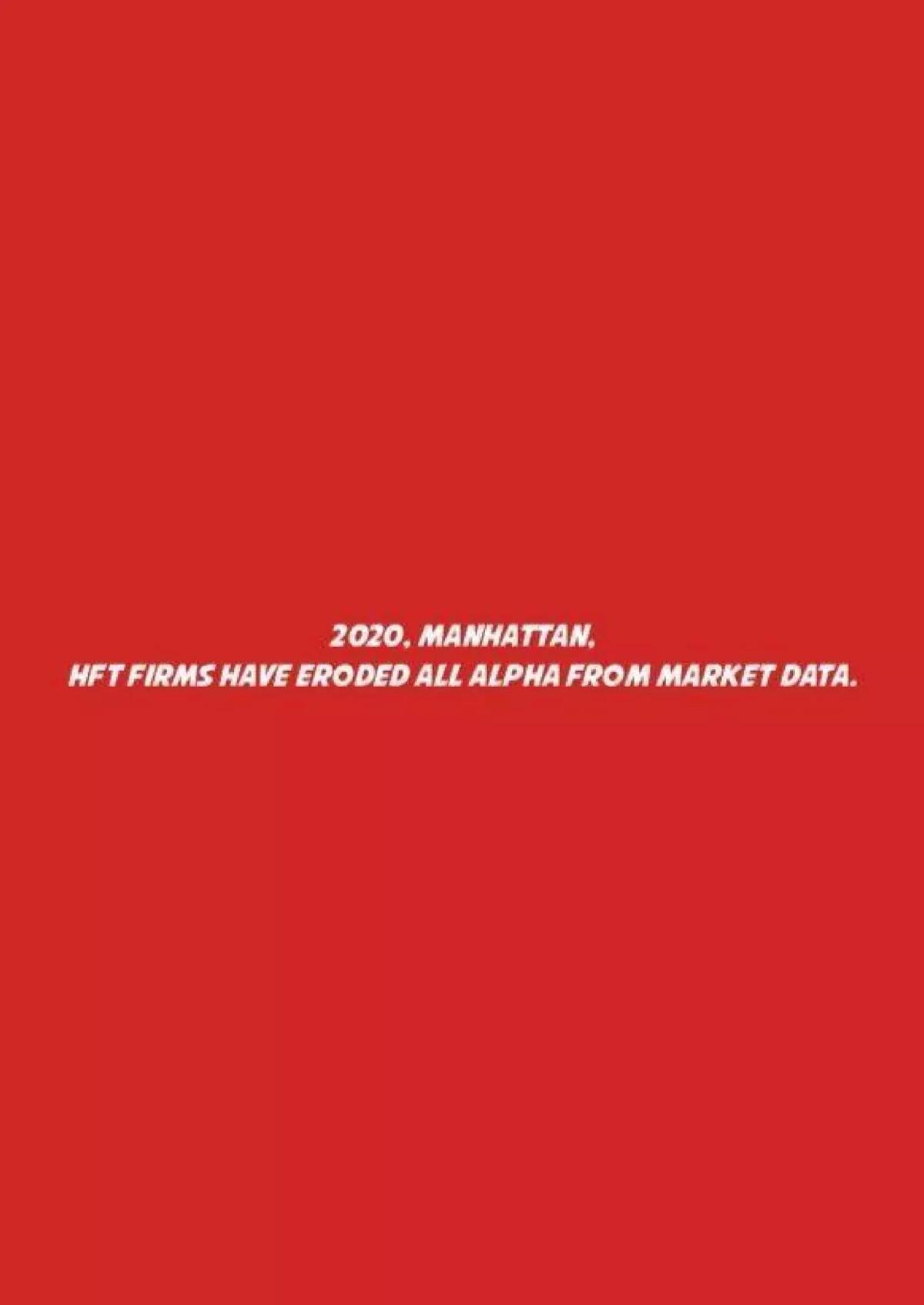
- The core problem is identified as HFT firms eroding alpha from traditional market data (Slide 2).
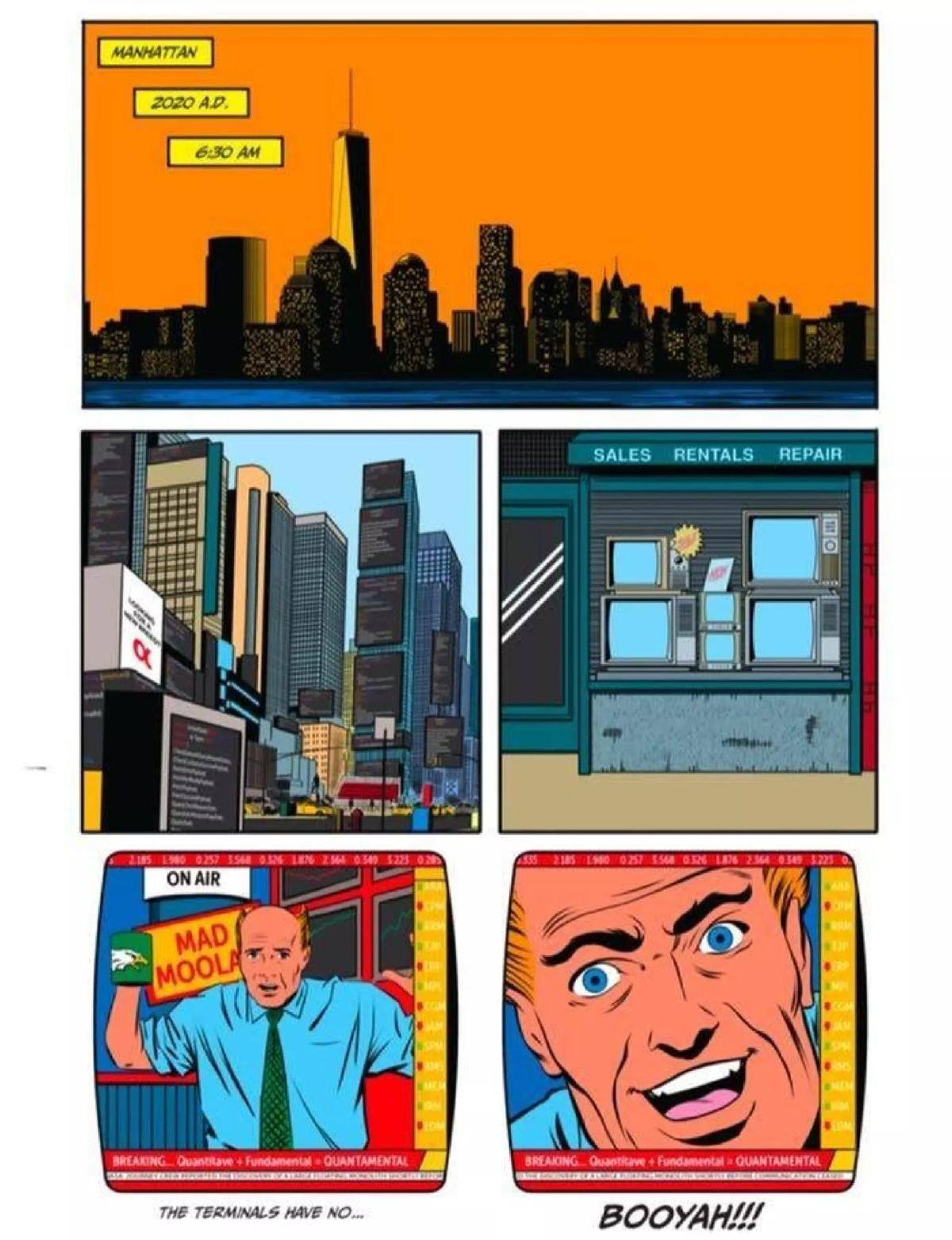
- The deck introduces a 'Quantamental' investment thesis, combining quantitative and fundamental analysis (Slide 3).
- It uses fictional characters like 'Amaya' and 'Old Titan' to represent different market personas (Slide 17).
- The 'Promised Land' is revealed to be a physical location at coordinates 40.7592673, -73.9755419 (Slide 12).
- There are no slides dedicated to business model, unit economics, or market sizing.
- The team slide is replaced by a credits page for artists Joe McDermott, Butcher Billy, and producer Marta Lopata (Slide 17).
- The deck ends with a 'To Be Continued...' cliffhanger rather than a formal call to action or investment ask (Slide 16).
The Narrative Gamble: Thinknum's Comic Book Pitch
Thinknum's Series A pitch deck is one of the most unconventional documents in the history of venture capital. Eschewing the standard Sequoia-style template, the company opted for a 17-slide comic book titled Quest for Alpha . According to catalogue facts, the company raised $12,600,000 in 2014, suggesting that this high-concept narrative resonated with investors in the 'Other' (Alternative Data) sector. The deck is less a business plan and more a manifesto on the state of modern finance.
Slides 1-5: Setting the Dystopian Scene
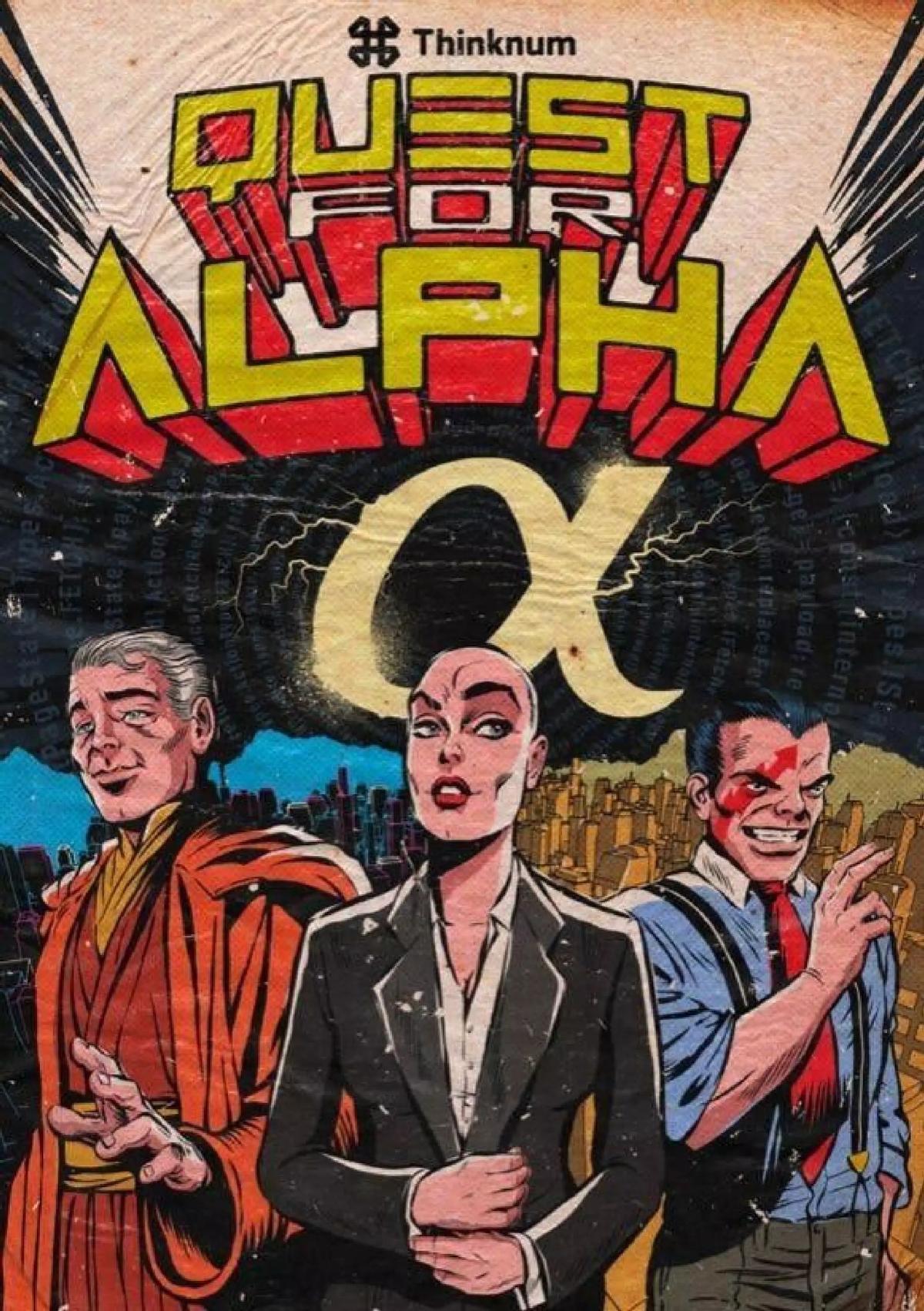
The presentation opens on Slide 1 with a cover page that looks like a vintage Marvel or DC comic. The title 'Quest for Alpha' immediately signals the target audience: institutional investors and hedge fund managers. Slide 2 establishes the 'villain' of the story: High-Frequency Trading (HFT) firms. The text reads, '2020, MANHATTAN. HFT FIRMS HAVE ERODED ALL ALPHA FROM MARKET DATA.' This sets a ticking clock and a clear problem statement.
Slide 3 introduces the setting—Manhattan at 6:30 AM. It features a parody of financial news media, 'MAD MOOLA,' where a character resembling Jim Cramer screams 'BOOYAH!!!' while a news ticker at the bottom defines the solution: 'Quantitative + Fundamental = QUANTAMENTAL.' This is the only slide in the first section that hints at the company's actual methodology.
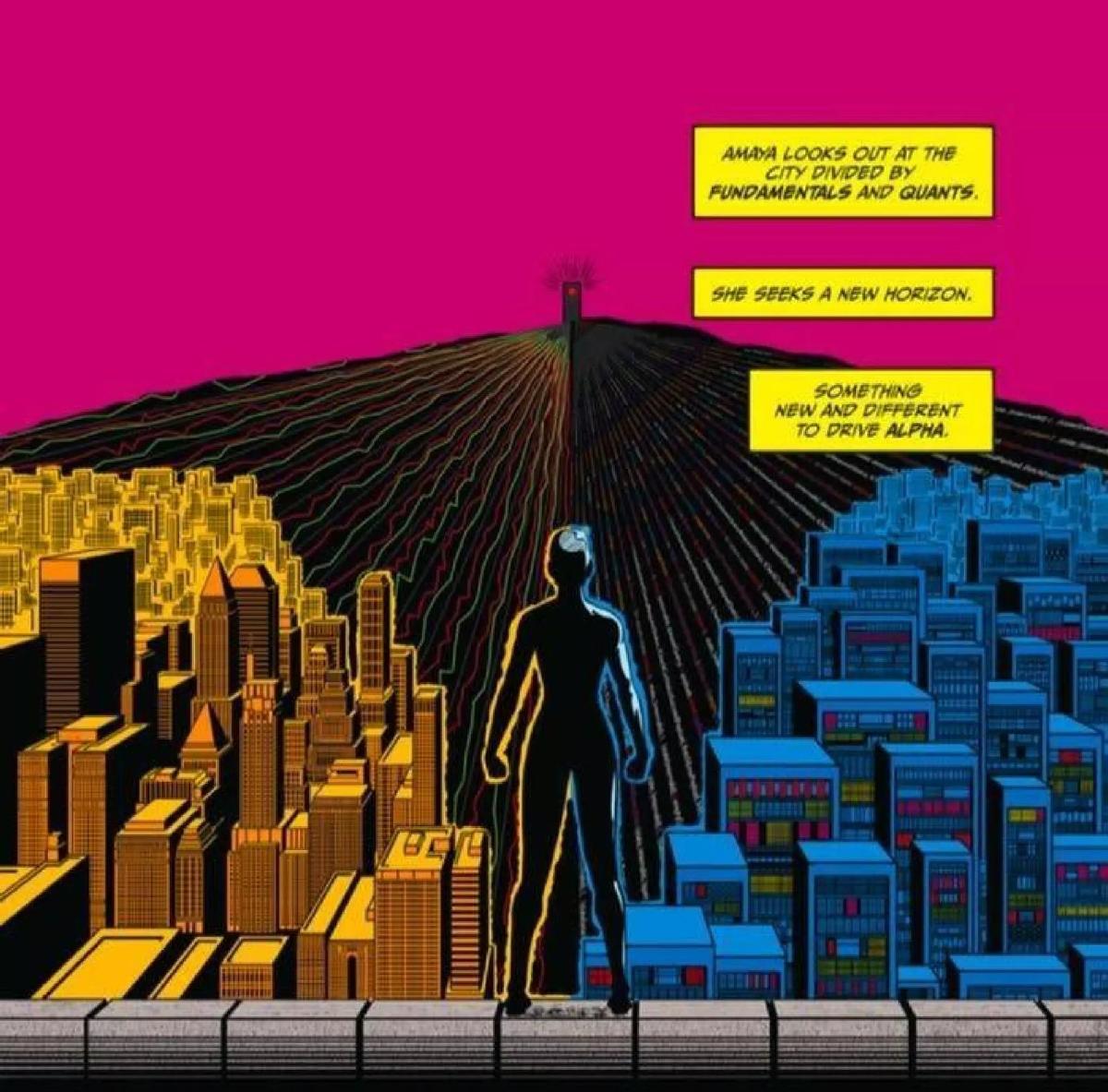
On Slide 4 , we meet the protagonist, Amaya. She is depicted looking out over a city 'divided by fundamentals and quants.' The narrative tension is built on her search for a 'new horizon' to drive alpha. Slide 5 is a minimalist transition showing Amaya's eyes, signaling a change in perspective or a 'vision' of the future.
Slides 6-10: The Conflict of Old vs. New
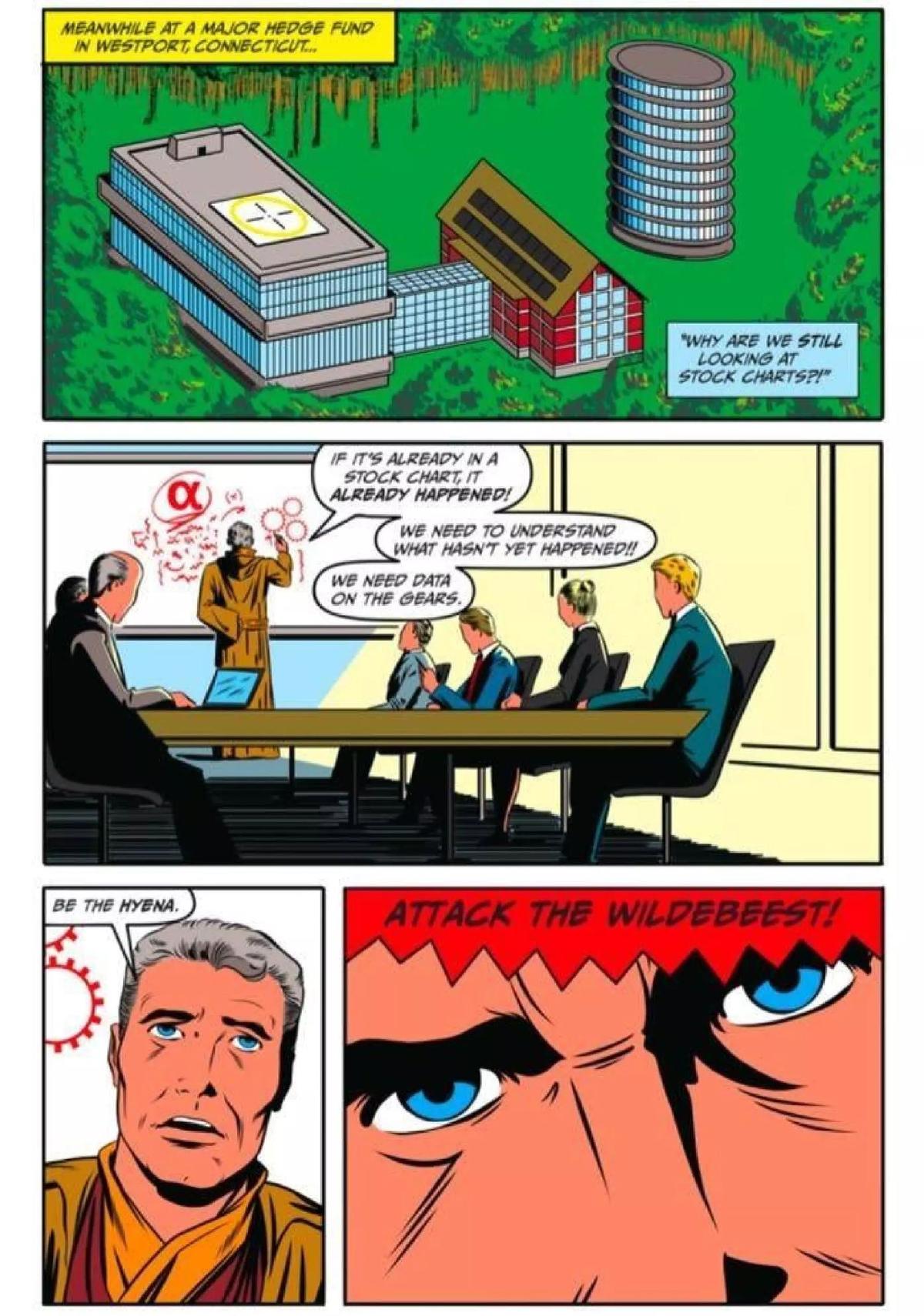
Slide 6 shifts the scene to Westport, Connecticut, a well-known hub for major hedge funds. Inside a boardroom, an 'Old Titan' character expresses frustration: 'Why are we still looking at stock charts?! If it's already in a stock chart, it already happened!' This is a direct attack on traditional financial analysis. The character demands 'data on the gears,' which is a metaphor for the raw, alternative data Thinknum provides.
Slide 7 introduces a major investment bank in Downtown New York. Characters are shown distracted by social media icons (Uber, LinkedIn, Facebook, Instagram), suggesting that even the giants are losing their way. A character named 'Gods Worker' (a play on the 'doing God's work' quote often attributed to Goldman Sachs) expresses a desire to quit, while 'Linda' deals with a literal fire in her office. This dramatizes the chaos of the current market.
Slide 8 and Slide 9 focus on Amaya's epiphany. She dreams of the 'new horizon' (Slide 8) and tells a colleague, 'Untapped data is the key to alpha' (Slide 9). The colleague dismisses her, saying she is 'overthinking this,' which represents the institutional inertia Thinknum is fighting against.
Slide 10 provides the closest thing to a product slide. It shows a character at a desk surrounded by data visualizations and code snippets. The code includes imports for 'redux-actions' and 'FetchDatasetQueryRequest,' suggesting a sophisticated web-based platform for data retrieval. This is the only technical evidence provided in the entire deck.
Slides 11-16: The Battle for the Promised Land
Slide 11 depicts a 'Secret Meeting' in Westport where 'Gods Worker' and 'Old Titan' conspire. The dialogue 'No one ever got fired for hiring us!' is a satirical take on the safety of legacy vendors. Slide 12 shows Amaya receiving a tip that she has been sold out, along with coordinates: 40.7592673, -73.9755419 . She drives to the 'Entry Gate to Promised Land,' which is a high-rise building in Manhattan.
Slides 13, 14, and 15 are pure action sequences. Amaya transforms into a silver, superhero-like figure to battle the 'Old Titan,' who attacks with mechanical tentacles (reminiscent of Doctor Octopus). The dialogue 'Data is business. Business is war!' (Slide 13) reinforces the high stakes. Amaya eventually defeats the legacy players, and Slide 15 shows her entering the 'Promised Land' of alpha, represented by the same data-stream visuals seen in her earlier dream.
Slide 16 concludes the narrative with a simple 'TO BE CONTINUED...' This is a bold choice for a Series A deck, as it lacks a traditional 'Ask' slide or a summary of why the investor should write a check right now.
Slide 17: The Credits (Team)
The final slide functions as a back cover. It summarizes the plot and lists the characters: Amaya, Gods Worker, Old Titan, Jay the Screamer, and Linda. Most notably, the 'Team' section does not list the founders' backgrounds at Palantir or top-tier banks. Instead, it lists the Artists (Joe McDermott, Butcher Billy) and the Writer & Producer (Marta Lopata). The copyright is dated 2018, though the funding round occurred in 2014, suggesting this version of the deck may have been updated for later use or public release.
What Works
Unforgettable Branding: In a sea of blue-and-white SaaS decks, this is impossible to forget. It ensures that Thinknum is the 'comic book company' in every partner meeting, which is a powerful way to stay top-of-mind during a competitive fundraise.
Clear Market Thesis: The deck does an excellent job of explaining the 'Alternative Data' trend without using jargon. By framing HFT as the destroyer of traditional alpha, it makes the need for a new data source feel urgent and inevitable.
Emotional Resonance: By using characters like the 'Old Titan' and 'Jay the Screamer,' the deck taps into the real frustrations of financial analysts who feel their tools are outdated. It positions Thinknum as the hero of their professional lives.
What is Missing
Business Fundamentals: There is no mention of the business model. We don't know if this is a subscription service, a per-seat license, or a data marketplace. There are no pricing tiers or revenue figures.
Traction and Growth: The deck contains no metrics. There are no charts showing user growth, no logos of existing hedge fund clients, and no case studies demonstrating how their data actually generated alpha for a real user.
The Real Team: While the creative team is credited, the actual engineers and data scientists building the platform are invisible. For a Series A, investors typically want to see the technical pedigree of the founders.
The Ask: There is no slide detailing how much capital is being raised, what the milestones for the next 18 months are, or how the $12.6M will be deployed.
What a Founder Should Copy
The 'Why Now' Story: Founders should emulate the way Thinknum identifies a massive shift in their industry (the erosion of alpha by HFT) and positions their product as the only logical response to that shift.
Bold Narrative Choice: While a full comic book is risky, using a consistent visual metaphor can help explain complex products. If your startup is 'fighting' a specific legacy problem, personifying that problem as a villain can make your pitch more engaging.
Focus on the 'Promised Land': The deck spends a lot of time describing the future state of the world where the user is empowered. Founders often spend too much time on features; Thinknum spends all its time on the outcome of using those features.
Frequently asked questions
- How did Thinknum raise $12.6M with no metrics in their deck?
- While the comic book deck is the public-facing narrative, it is highly likely that a secondary 'data room' containing financials, churn rates, and customer lists was provided to serious investors. This deck serves as a 'hook' to establish a unique brand identity and a clear market thesis—that traditional data is dead and 'alternative data' (the Promised Land) is the only way to win.
- What is the 'Quantamental' approach mentioned in the deck?
- Slide 3 defines 'Quantamental' as the intersection of Quantitative and Fundamental analysis. In the context of Thinknum, this refers to using web-scraped data (quantitative) to gain insights into a company's actual operations (fundamental), such as tracking job listings or store traffic, before those insights appear in official stock charts.
- Who are the people listed on the final slide?
- Slide 17 lists the 'Artists' (Joe McDermott, Butcher Billy) and the 'Writer & Producer' (Marta Lopata). Marta Lopata was a co-founder of Thinknum. Notably, the deck credits the creative team behind the comic rather than providing the professional resumes of the founders, further leaning into the narrative-first approach.
- What does the coordinate 40.7592673, -73.9755419 represent?
- Appearing on Slide 12, these coordinates point to an address in Midtown Manhattan, specifically near Rockefeller Center. In the narrative, this is the 'Entry Gate to Promised Land,' which likely represented Thinknum's physical office or the heart of the financial district they were disrupting.
- Is this deck style recommended for other founders?
- Only for those with extreme confidence and a pre-existing reputation. This style works for Thinknum because the 'alternative data' space was nascent and required a strong 'why now' story. For most startups, omitting the business model, team, and traction slides is a high-risk strategy that could lead to immediate rejection by institutional VCs.