Third Eye is a 2014 concept-stage pitch by Simon Belousoff for a global medical professional rating and transparency platform. The deck is notable for its heavy emphasis on 'Service Design Frameworks' and personal family medical challenges to establish a problem-solution fit. It positions the product as a 'TripAdvisor for Professional Services,' aiming to provide visibility into doctor success rates and pricing transparency. However, the deck lacks critical investment data: there is no market sizing (TAM/SAM/SOM), no business model or revenue strategy, no competitive analysis beyond name-drop…
Key takeaways
- The deck defines its vision as 'Globally democratize professional services,' starting with medical specialists (Slide 7).
- The founder uses a 'Service Design Framework' involving experience design themes like 'Simple, Fast, Easy, Playful, and Reliable/Secure' (Slide 3).
- Problem identification is driven by three specific family medical anecdotes involving orthopaedic surgery, ear specialists, and obstetricians (Slide 5).
- The product concept includes a 'booking engine' and 'local rehabilitation follow-up' integrated into the package (Slide 7).
- User validation plans include an 'IDV check' and the collection of health profile data such as weight, height, and smoking status (Slide 8).
- The deck proposes using sports analytics (referencing LeBron James and SAP insights) as a prototype for how deep medical stats should be visualized (Slide 11).
- Corporate culture is explicitly borrowed from Atlassian, listing values like 'Open company, no bullshit' and 'Don't #@!% the customer' (Slide 14).
- There is a total absence of financial metrics, revenue models, or a specific funding request across all 16 slides.
Executive Summary: A Vision for Healthcare Transparency
The Third Eye pitch deck, dated November 14, 2014, is a conceptual presentation by Simon Belousoff. It proposes a platform designed to bring the transparency of TripAdvisor and Amazon to the medical industry. The deck is heavily rooted in service design principles and personal narrative, aiming to solve the information asymmetry between doctors and patients. While the vision is expansive—targeting a global market for all professional services—the deck lacks the quantitative rigor typically required for a seed or Series A round, omitting market size, revenue models, and a specific capital ask.
Slide 1: Title and Branding
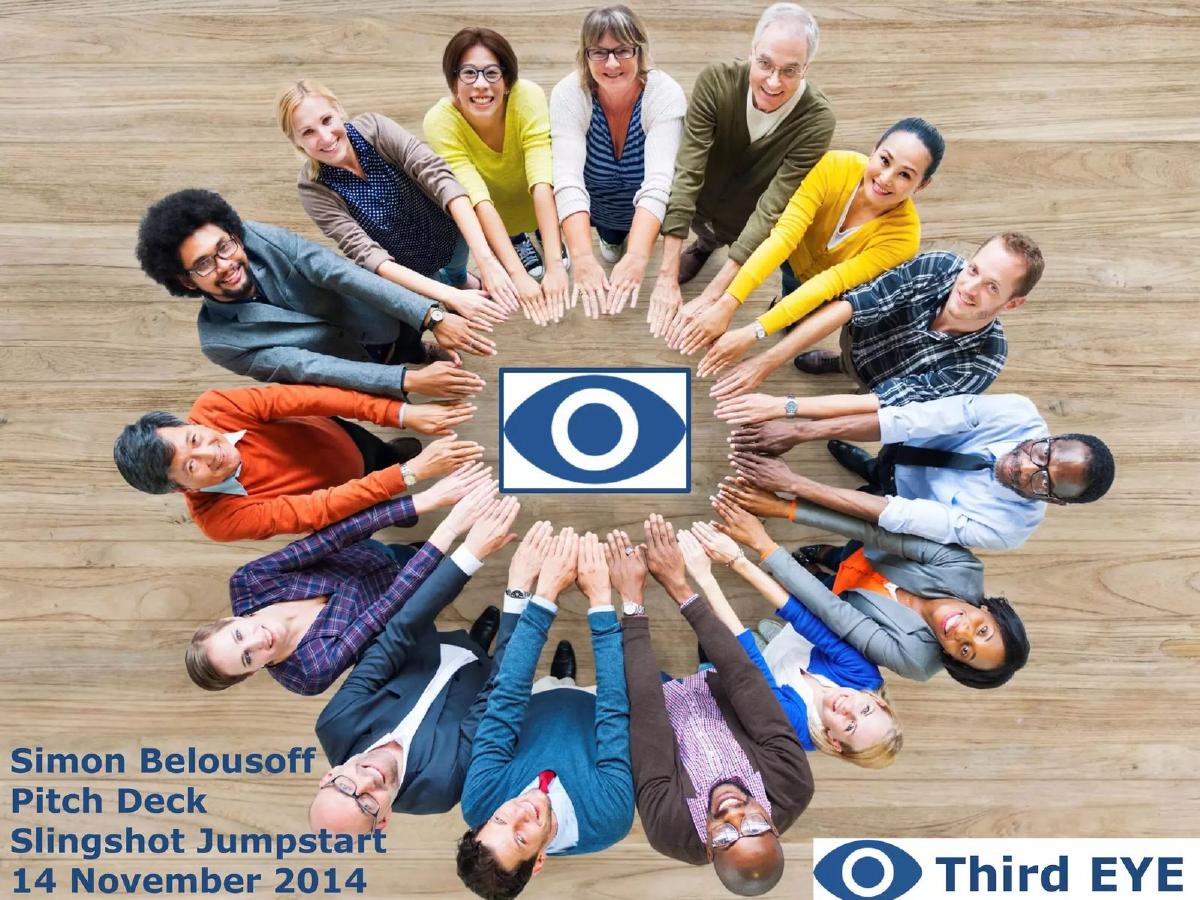
The cover slide introduces the company name, Third Eye , and the presenter, Simon Belousoff . It is dated 14 November 2014 and mentions 'Slingshot Jumpstart,' suggesting this may have been part of an accelerator or incubator program. The imagery features a diverse group of people in a circle, emphasizing a community-centric approach.
Slide 2: Founder Profile
This slide serves as a team slide, though it only features the founder. It includes a screenshot of Belousoff’s LinkedIn profile, highlighting his role as an 'Executive Leader' at Tabcorp . He claims 'extensive digital strategy, product and business development experience.' The focus here is on establishing professional credibility in digital transformation rather than specific healthcare expertise.
Slide 3: Service Design Framework
Belousoff introduces a Service Design Framework used for concept ideation. The slide shows a physical photo of a whiteboard with sticky notes. It lists 'Experience Design Themes' such as Simple, Fast, Easy, Playful, and Reliable/Secure . It also references 'NRMA Brand Values' and 'NRMA Themes' (Connected Cars, Connected Members), which suggests the framework may have been adapted from a previous corporate context or a specific workshop.
Slide 4: The 'New Normal' of Customer Expectations
This slide sets the stage for the market need by comparing the 'Former Normal' to the 'New Normal.' It argues that customers now expect intuitive design, anytime/anywhere access, social engagement, and proactive personalization . The final point, 'More Informed,' explicitly states that digital access empowers research and product comparisons, which is the core thesis of Third Eye.
Slide 5: The Problem - Real Life Medical Challenges
The deck uses three personal anecdotes to illustrate the problem:
1: A mother-in-law who was told she needed surgery for a fractured arm, only to find a second opinion that recommended a sling and rest, which worked. · #2: A son who had a failed grommet operation due to poor communication and a long waiting list for a better specialist. · #3: The birth of three sons where the family had no choice or visibility into the cost of the anaesthetist until the invoice arrived.
These stories highlight three pain points: unnecessary surgery, poor communication/quality, and lack of price transparency.
Slide 6: The 'Aha!' Moment
Belousoff connects the personal problems to a systemic issue. The slide features logos for GetPrice, eBay, Amazon, and TripAdvisor . The text states: 'The internet enables visibility of price & reviews... Think.' This slide functions as the 'Why Now' and 'Market Analogy' slide, suggesting that healthcare is the next logical industry for this digital shift.
Slide 7: The Service Concept
This slide defines the product. The vision is to 'Globally democratize professional services.' The pitch line is 'TripAdvisor for Professional Services, starting with Medical Practitioners.' It clarifies that the model is intended to be global (USA, UK, Western Europe) and will eventually include lawyers, accountants, and dentists. Key differentiators include price visibility via user input and a mobile-first approach . It also describes a 'Customer Use Case' involving a hip replacement in Dubai, suggesting a play in medical tourism.
Slide 8: User Onboarding (Use Case)
This slide shows a mock-up of a sign-up form. It notes that users need to be validated via an 'IDV check' and suggests using social logins (LinkedIn, Facebook). A sticky note indicates the platform would collect a 'Health Profile' including weight, height, gender, and smoking status to better contextualize reviews.
Slide 9: Rating a Specialist
The rating interface is shown as a combination of a digital directory listing (featuring Dr. Jonathan Herald ) and a handwritten review form. The review criteria are: Service with a personal touch, Informs and educates, Value for money, Positive outcome, and Recommend to friends and family. Crucially, it includes a field for 'The cost to you,' citing an example of AUD $15,000 .
Slide 10: Researching Doctors
This slide demonstrates the search functionality. It includes a mock-up of a search bar filtered by location and profession. A handwritten diagram shows how 'selections determine query outcomes,' allowing users to weight what is important to them (e.g., 100% weight on 'Positive outcome' vs. 0% on 'Cost').
Slide 11: Detailed Stats and Data Visualization
To illustrate the depth of data intended for the platform, the deck uses an analogy of NBA player stats . It shows a profile of LeBron James with detailed career stats and a shot chart. A sticky note says: 'Use PRO/Elite sports as the prototype for the depth of stats & the visual presentation.' This suggests the founder wants to move beyond simple star ratings to objective performance metrics.
Slide 12: Comparison Tools
This slide visualizes how a user would compare two surgeons (Dr. Herald vs. Dr. Alfeez). It uses bar charts to show Cost and Positive Outcomes relative to Sydney, Australia, and Global averages. The slide notes: 'Being able to compare empowers the customer.'
Slide 13: Success Factors (Steve Jobs)
The deck shifts from product to philosophy. Belousoff lists 14 'Success Factors' attributed to Steve Jobs , including 'Focus,' 'Simplify,' 'Products before profits,' and 'Stay hungry, stay foolish.' This slide acts as a proxy for a management strategy, though it remains entirely theoretical.
Slide 14: Corporate Values (Atlassian)
Continuing the theme of borrowed frameworks, this slide explicitly states that Third Eye will adopt Atlassian’s corporate values . It displays Atlassian's icons for 'Open company, no bullshit,' 'Build with heart and balance,' 'Don't #@!% the customer,' 'Play, as a team,' and 'Be the change you seek.'
Slide 15: Inspirational Quote
A full-slide quote from Steve Jobs (1993) about doing 'something wonderful' rather than being the 'richest man in the cemetery.' This reinforces the mission-driven narrative of the pitch.
Slide 16: Conclusion
The final slide repeats the cover imagery with the text 'LET'S GO FOR IT!' in a red box. There is no contact information, no summary of the ask, and no next steps provided on the slide itself.
What Works Well
Strong Emotional Hook: The use of specific family medical stories (Slide 5) effectively humanizes the problem. Investors often look for 'founder-market fit,' and these anecdotes demonstrate a personal obsession with solving the lack of transparency in healthcare.
Clear Product Vision: The 'TripAdvisor for X' analogy is a classic pitch technique that immediately communicates the business model and user behavior without needing complex explanations.
Emphasis on Data Visualization: The comparison to sports analytics (Slide 11) is a clever way to explain how complex medical data could be made accessible and engaging for laypeople.
What Is Missing
Business Model and Revenue: There is no mention of how Third Eye will make money. Will it charge doctors for leads? Will it sell anonymized data? Will it take a commission on the 'booking engine' mentioned on Slide 7? The lack of a monetization strategy is a significant gap.
Market Sizing (TAM/SAM/SOM): The deck claims the opportunity is 'Global' (Slide 7) but provides no data on the number of specialists, the volume of elective surgeries, or the potential value of the medical transparency market.
Competitive Landscape: While it mentions TripAdvisor and Amazon as inspirations, it does not address existing medical directories (like Healthgrades or Zocdoc, which were active in 2014). Investors need to know why Third Eye will win against incumbents.
The Ask: The deck concludes with 'Let's go for it!' but does not specify how much capital is being raised, what the milestones are, or what the valuation expectations might be.
Founder Takeaways
Show, Don't Just Tell: The mock-ups and handwritten diagrams (Slides 8-12) are excellent for conveying the user journey. Founders should use these to illustrate unique features that a text description cannot capture.
Avoid 'Borrowed' Culture: While it is fine to be inspired by Atlassian or Steve Jobs, dedicating two full slides (Slides 13-14) to their values rather than your own unique team culture can come across as a lack of original thought regarding organizational design.
Balance Narrative with Data: A pitch deck needs both a 'heart' (the problem/story) and a 'brain' (the numbers). This deck is almost entirely heart. Founders must include a slide on unit economics or market opportunity to be taken seriously by institutional investors.
Frequently asked questions
- What is the primary problem Third Eye aims to solve?
- Third Eye addresses the lack of transparency in the medical sector. According to Slide 6, the founder identifies a systemic lack of information regarding the quality of service, success benchmarks, and price visibility. The deck argues that while the internet has enabled visibility for retail and travel, healthcare remains opaque, leading to poor patient outcomes and unexpected costs.
- How does the company plan to differentiate itself from existing directories?
- The differentiation, as stated on Slide 7, lies in being 'customer-centred' rather than 'system-centred.' Key features include user-contributed success benchmarks, price visibility via user input, and data visualization to model the 'best options' based on metrics like price and outcome, rather than just a simple list of names.
- What is the proposed user experience for rating a doctor?
- Slide 9 illustrates a review process where users provide an 'Alias' for privacy and input specific surgery dates and costs (e.g., 'AUD $15,000'). The rating system uses a 'No Fence' toggle (Yes/No) for metrics like 'personal touch,' 'value for money,' and 'positive outcome,' alongside a free-text 'Your Words' section.
- Does the deck provide a roadmap for global expansion?
- Slide 7 lists the UK, USA, Western Europe, and developing countries as targets, noting that developing nations often follow an 'exported professional services model.' However, the deck provides no timeline, budget, or specific go-to-market strategy for these regions, remaining at a high conceptual level.
- What is the background of the founder?
- Slide 2 features a LinkedIn profile for Simon Belousoff, describing him as an 'Executive Leader' with experience at Tabcorp, DashLuxe, and Little Red Box. His expertise is listed in digital strategy, product development, and e-commerce. The deck positions him as a 'value builder' rather than a medical professional.