Twine is a marketplace connecting companies with creative freelancers specializing in design, music, and film. The deck, which successfully raised over $1 million according to the source listing, emphasizes a 'supply-first' strategy. By June 2016, the platform had registered 175,000 creatives globally, with 30% based in the US and 10% in the UK. The business model relies on a 20% commission from project budgets, utilizing user ratings and milestones to prevent platform circumvention. While the deck provides a clear competitive landscape and strong founder pedigree—noting CEO Stuart Logan's pr…
Key takeaways
- The platform reached 175,000 registered creatives across 169 countries by June 2016 (Slide 4).
- Twine operates on a 20% commission model for facilitating hires and payments (Slide 5).
- Founder and CEO Stuart Logan is a second-time founder who previously built an ad-tech company to £1.4m gross annual revenue (Slide 6).
- The supply-side growth showed a consistent upward trajectory from April 2015 to June 2016 (Slide 4).
- Competitive positioning places Twine at the intersection of 'Marketplace' and 'Social,' differentiating it from pure marketplaces like Upwork or social portfolios like Behance (Slide 7).
- The team consists of 5 full-time staff including a CEO, CTO, System Architect, and Community & UX Designer (Slide 6).
- Existing investors at the time of the deck included Seedcamp, Creative England, and AXM VC (Slide 6).
- The deck identifies a specific niche in 'audio-visual content' rather than general freelancing (Slide 3).
Twine Pitch Deck Analysis
Twine's deck is a study in marketplace sequencing. By focusing heavily on the supply side of their network in the early slides, they demonstrate a 'liquidity-first' approach to building a two-sided platform. The deck is visually clean, utilizing dark purple overlays and high-quality background imagery related to the creative arts, which aligns with their target audience of designers, musicians, and filmmakers.
Slide 1: Title Slide
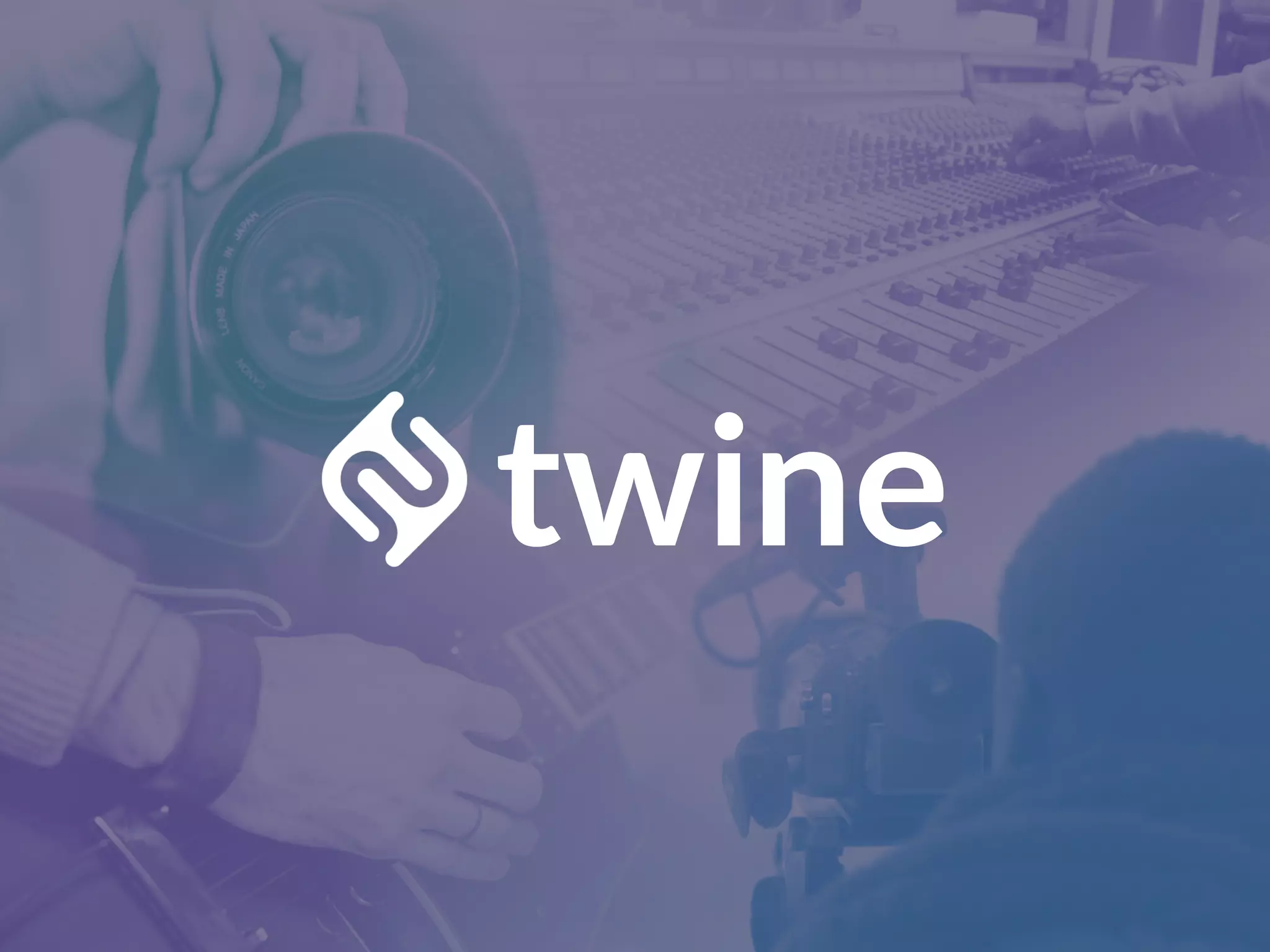
The cover slide features the Twine logo and name against a montage of creative work: a photographer, a sound engineer at a mixing desk, and a videographer. It immediately establishes the industry context without needing a tagline. The branding is professional and minimalist.
Slide 2: The Problem
Slide 2 identifies the core pain point: companies need audio-visual content to succeed and engage customers. The background features faded icons of Instagram, Facebook, and Snapchat, implying that the explosion of social media platforms has created an insatiable demand for high-quality creative assets that companies struggle to produce internally.
Slide 3: Introducing Twine
This slide provides the solution summary. It defines Twine as a marketplace connecting companies to a huge network of creative freelancers. Crucially, it narrows the scope to three specific verticals: design, music, and film . This specialization is a key differentiator from 'everything' marketplaces. The slide also explains the mechanism: companies post briefs, and the community pitches on them.
Slide 4: Phase 1 - Supply Growth
This is the primary traction slide. It shows a linear growth chart of registered creatives from April 2015 to June 2016. The headline figure is 175,000 creatives across 169 countries . By labeling this 'Phase 1 Complete,' the founders signal to investors that they have successfully solved the 'cold start' problem on the supply side and are now ready to scale the demand side (revenue).
Slide 5: Business Model
Twine keeps the revenue model simple: a 20% commission on project budgets. The slide addresses a common investor concern regarding marketplaces—platform circumvention (users taking the deal off-platform to avoid fees). Twine argues that their user-ratings and project milestones create enough trust and utility that users prefer to stay within the ecosystem.
Slide 6: Team and Existing Investors
The team slide is strong on pedigree. CEO Stuart Logan is noted as a second-time founder with a previous exit or revenue milestone of £1.4m gross annual revenue . CTO Damien Shiells provides technical stability with a Computer Science degree and a four-year working relationship with the CEO. The slide also lists impressive early backers: Seedcamp, Creative England, and AXM VC , which provides significant social proof.
Slide 7: Competition
The competitive matrix is a standard 2x2 grid. The Y-axis measures 'Marketplace' utility, and the X-axis measures 'Social' engagement. Twine places itself in the top-right quadrant. It positions Fiverr, Upwork, and Toptal as high-utility but low-social, and Behance and Dribbble as high-social but low-utility. This suggests Twine is the only platform that offers both a community feel and a streamlined hiring process.
Slide 8: Mission
The final slide in this set outlines the company's daily goals: helping creatives find success and providing buyers with a smooth, quality service. It acts as a cultural wrap-up, emphasizing the dual-sided nature of their commitment to the marketplace participants.
What Works in the Twine Deck
Supply-Side Validation: Many marketplace startups fail because they cannot attract enough talent to make the platform useful for buyers. By showing 175,000 registered creatives, Twine proves they have a 'moat' of talent that would be difficult for a new competitor to replicate quickly.
Founder-Market Fit: Stuart Logan's previous success in ad-tech is highly relevant. Ad-tech and creative marketplaces both serve the same end-users: brands and agencies looking for content. His experience in scaling a company to seven-figure revenues reduces the perceived execution risk for investors.
Vertical Focus: By specifically targeting design, music, and film, Twine avoids the 'race to the bottom' pricing often seen on generalist platforms like Fiverr. These are high-value, specialized skills that require a more nuanced portfolio and pitching system, which Twine provides.
What is Missing from the Twine Deck
Demand-Side Metrics: While the supply growth is impressive, the provided slides do not show the number of active buyers, the number of projects posted, or the Gross Merchandise Volume (GMV). Investors need to see that the 175,000 creatives are actually getting work.
Unit Economics: There is no mention of Customer Acquisition Cost (CAC) or Lifetime Value (LTV). For a marketplace to be sustainable, the cost of acquiring a company (the buyer) must be significantly lower than the 20% commission earned over that company's tenure on the platform.
The Ask: The provided slides do not include a 'The Raise' slide. We know from the source listing that they raised over $1 million, but the deck itself (in this 8-slide sample) does not specify the amount being sought, the valuation, or the intended use of funds.
Financial Projections: There is no forward-looking data. A 'Phase 2' plan would typically include revenue targets for the next 18-24 months to justify the $1 million+ investment.
Lessons for Founders
Sequence your story: If you have a two-sided marketplace, prove you have conquered one side before asking for money to scale the other. Twine's 'Phase 1 Complete' framing is an excellent way to show progress. · Leverage your lead investors: Listing Seedcamp and other VCs on the team slide (Slide 6) immediately elevates the company's status. If you have reputable backers, don't hide them on the last slide. · Define your quadrant: Don't just say you are 'better' than the competition. Use a matrix to show that you are 'different' by occupying a space that others have ignored (in this case, the intersection of Social and Marketplace). · Keep the business model simple: A flat percentage commission is easy for investors to model and understand. Avoid over-complicating your revenue streams in the early stages.
Frequently asked questions
- What is Twine's primary value proposition?
- Twine positions itself as a specialized marketplace for audio-visual content. Unlike general freelance platforms, it focuses specifically on design, music, and film. It aims to solve the corporate need for engaging content by providing a vetted network where companies post briefs and creatives pitch for the work, managed through a system of milestones and ratings.
- How does Twine generate revenue?
- According to slide 5, Twine charges a 20% commission on the project budget for every hire facilitated through the platform. This fee covers the connection between the company and the freelancer, as well as the payment processing and project management tools provided by the site.
- What was the status of the company's growth at the time of the raise?
- The deck highlights the completion of 'Phase 1,' which focused on building supply. By June 2016, they had scaled to 175,000 creatives. The geographic distribution was global, spanning 169 countries, though it maintained a significant presence in the US (30%) and UK (10%).
- Who are the key members of the Twine leadership team?
- The team is led by Stuart Logan (CEO), a second-time founder with a track record of building an ad-tech firm to £1.4m in revenue, and Damien Shiells (CTO), who holds a BEng in Computer Science and had worked with Logan for four years prior to Twine.
- How does Twine differentiate itself from competitors like Upwork or Fiverr?
- Twine uses a 2x2 matrix on slide 7 to position itself. While Upwork and Fiverr are categorized as pure marketplaces, and Behance and Dribbble as social portfolio sites, Twine claims the top-right quadrant. This suggests they combine the transactional utility of a marketplace with the community and social aspects of portfolio platforms.