Three Ships Beauty’s seed deck is a masterclass in identifying a specific consumer sentiment—distrust—and building a brand around the antidote. By highlighting that 33% of women won't buy products with confusing labels (Slide 3) and positioning themselves as 'Forever Affordable' (Slide 6), they move beyond the typical 'clean beauty' tropes. The deck is notably light on unit economics and digital CAC/LTV metrics, choosing instead to emphasize massive wholesale expansion into 600 'new doors' including Target and Whole Foods (Slide 8). This shift from a pure D2C play to a retail-heavy growth sto…
Key takeaways
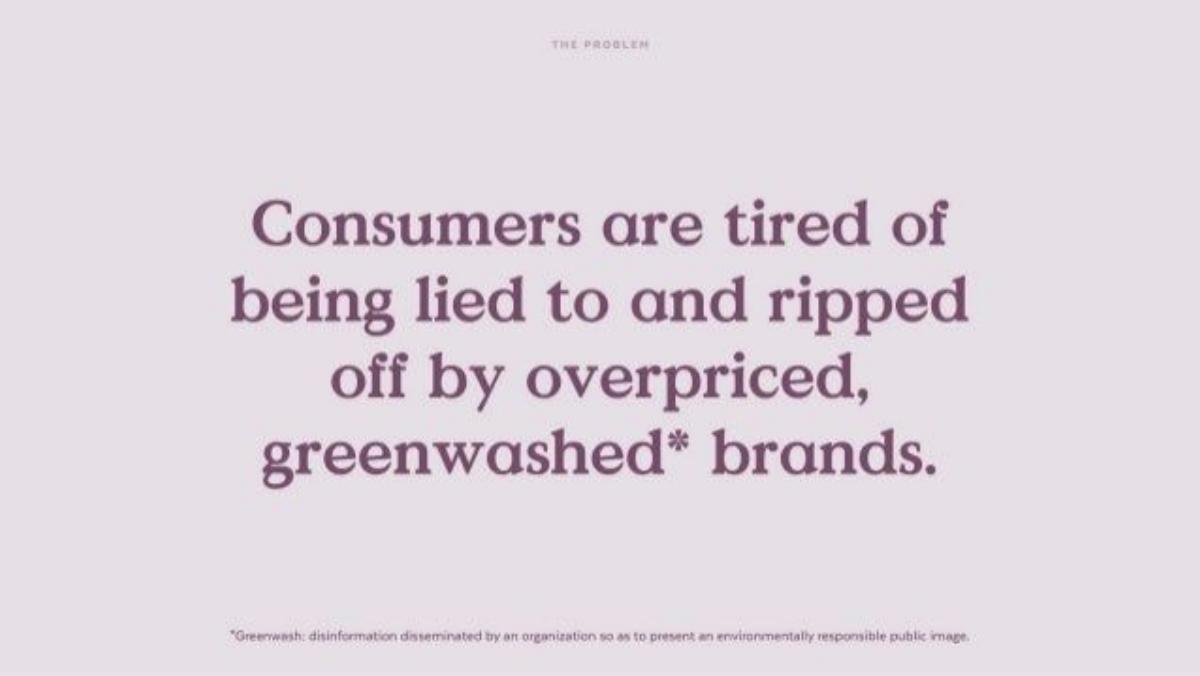
- The deck identifies a specific market pain point: 'greenwashing,' defined on Slide 2 as disinformation regarding environmental responsibility.
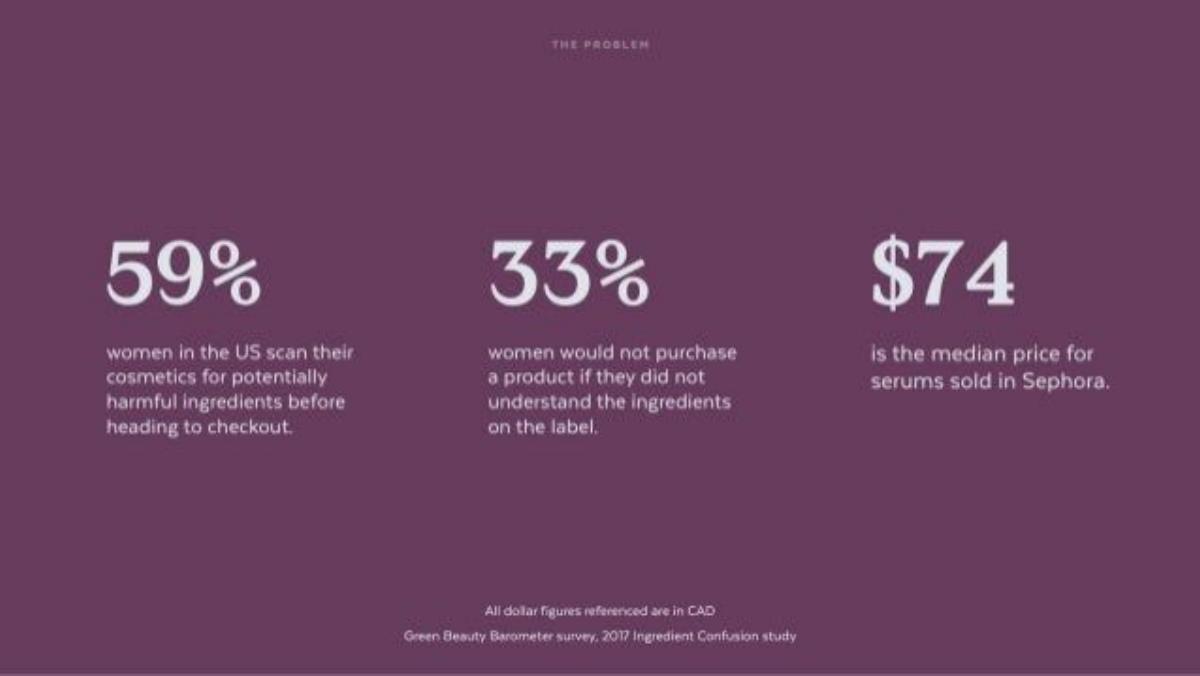
- Data-backed problem framing shows that 59% of US women scan for harmful ingredients and the median serum price at Sephora is $74 CAD (Slide 3).
- The company claims a competitive advantage through 'Formulation Transparency,' exceeding EU standards by listing every ingredient source in an online glossary (Slide 5).
- A 'Forever Affordable' promise is used as a core brand pillar, explicitly stating they will never use filler ingredients to lower costs (Slide 6).
- Social proof is established through dated customer reviews from September and October 2020, specifically targeting acne and dry skin concerns (Slide 7).
- The growth strategy is heavily weighted toward wholesale, with secured deals in Target, Whole Foods, and Hudson's Bay projected to generate over $1M in revenue (Slide 8).
- The initial ask in the deck was $550,000 (Slide 9), though catalogue data indicates they ultimately raised $1M in this 2021 seed round.
- The use of funds is highly specific, allocating 43% to customer acquisition and 29% to staffing (Slide 10).
The Narrative: Transparency as a Competitive Moat
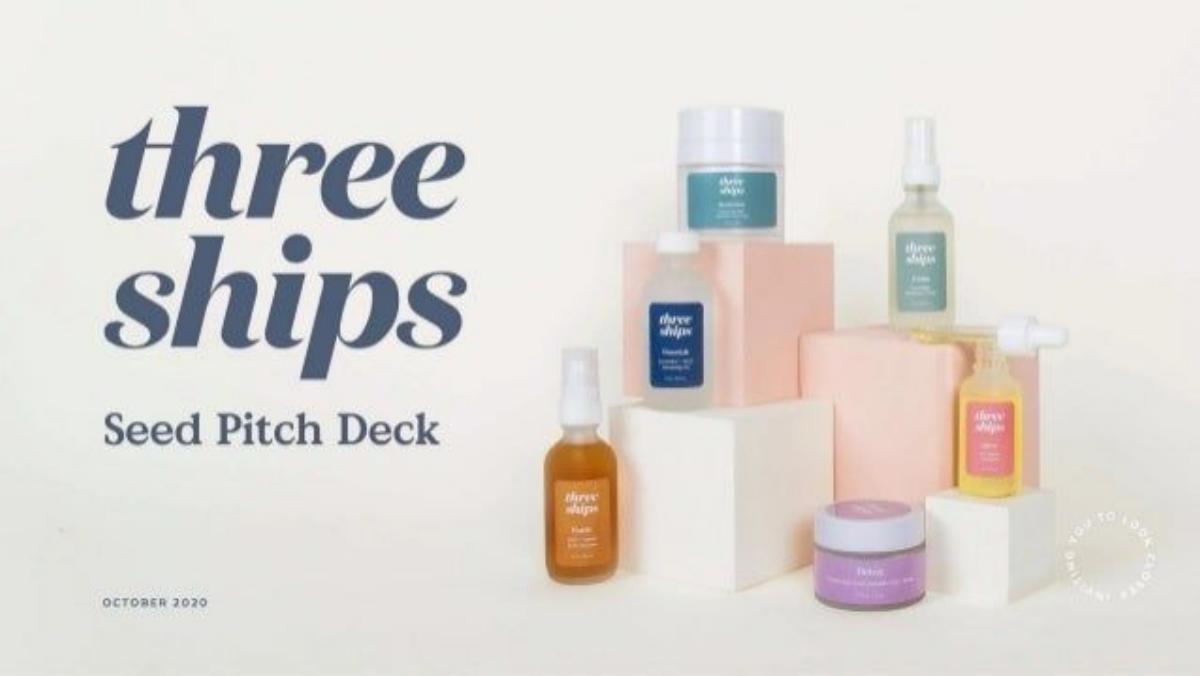
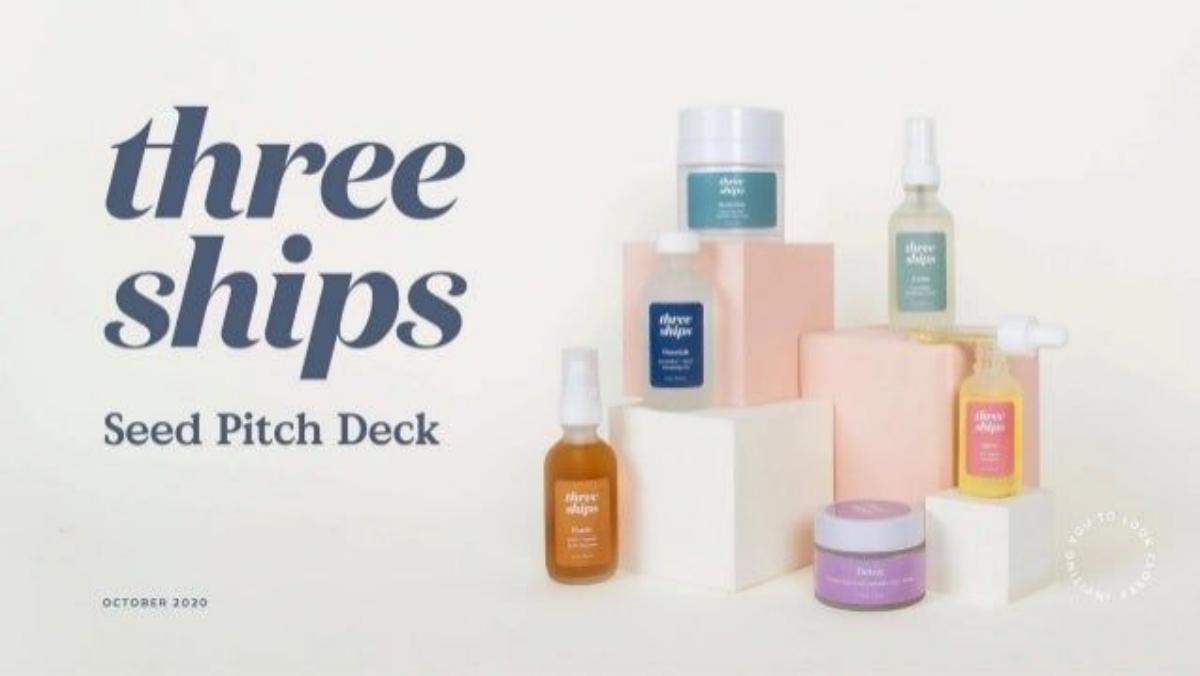
Three Ships Beauty enters the seed stage with a 12-slide deck that prioritizes brand values and retail traction over complex financial modeling. In a 2021 venture climate that was increasingly skeptical of pure-play D2C brands with rising acquisition costs, Three Ships presented a hybrid model. By focusing on 'Greenwashing' as the primary antagonist, they positioned their brand not just as a product, but as a consumer advocacy tool. The deck is visually clean, utilizing a muted palette that mirrors the product packaging shown on the title slide.
Slide 1: Title and Brand Identity
The cover slide features the Three Ships logo and the 'Seed Pitch Deck' designation, dated October 2020. The imagery is a high-quality product shot of their lineup—serums, creams, and cleansers—on geometric pedestals. This immediately establishes the brand's aesthetic: modern, minimalist, and approachable. A small circular seal in the corner reads 'Inviting you to look closer,' which introduces the theme of transparency that carries through the entire presentation.
Slides 2-3: The Problem and Market Data
Slide 2 is a bold statement slide: 'Consumers are tired of being lied to and ripped off by overpriced, greenwashed brands.' They take the time to define 'Greenwash' in a footnote as disinformation disseminated to present an environmentally responsible image. This is a strategic move; it identifies a specific enemy (dishonest incumbents) rather than just a general lack of products.
Slide 3 provides the quantitative weight to the emotional claim. It cites three key statistics: 59% of US women scan for harmful ingredients, 33% won't buy if they don't understand the label, and $74 CAD is the median price for Sephora serums. By including the $74 figure, they set a 'price to beat,' framing the natural skincare market as elitist and inaccessible. Note: All dollar figures are explicitly stated as CAD.
Slides 4-6: The Solution and Value Proposition
Slide 4 acts as a transition, claiming to be the 'most transparent natural skincare brand on the market that works.' This is a high-level claim that the following slides attempt to prove.
Slide 5 focuses on 'Formulation Transparency.' The key takeaway here is that they exceed EU standards—often cited as the gold standard in beauty regulation—by listing every ingredient's source and scientific benefit in an online glossary. This moves transparency from a marketing buzzword to a functional feature of their digital platform.
Slide 6 introduces the 'Forever Affordable' pillar. They explicitly state they will 'never use filler ingredients to lower our formulation costs.' This is a counter-intuitive and powerful point; usually, affordability implies lower quality. Three Ships argues that by removing the 'prestige' markup and fillers, they can offer high quality at a lower price point.
Slide 7: Social Proof and Validation
The 'Customer Reviews' slide features two five-star testimonials. One from 'Mari' in the US (09/06/2020) focuses on hormonal acne, and another from 'Jeanette O.' in Canada (10/06/2020) focuses on dry skin. These reviews are strategically chosen to show that the products solve specific, difficult dermatological issues (acne and cystic acne side effects) rather than just providing a 'glow.' This addresses the 'that works' part of their Slide 4 claim.
Slide 8: The Growth Engine (Wholesale)
This is arguably the most important slide in the deck for a seed investor. It shifts the focus from 'what we believe' to 'what we have achieved.' Three Ships highlights 'Wholesale Growth,' noting they have secured deals with Target, Whole Foods, Hudson's Bay, Indigo, Causebox, and Ipsy. They claim to be launching into 600 'new doors' with over $1M in projected revenue. For a seed-stage company, having a retail giant like Target on the slide is a massive de-risking factor. It proves that professional buyers at major corporations have vetted the product and believe it will sell.
Slides 9-10: The Ask and Use of Funds
Slide 9 is a simple, high-contrast slide stating: 'We’re raising $550,000.' While the catalogue data shows they eventually closed $1M, this slide represents the target at the time of the October 2020 pitch.
Slide 10 breaks down the 'Use of Funds' with a pie chart. The largest allocation is Customer Acquisition at 43%, followed by Staffing at 29%, Retail Marketing at 15%, and Working Capital at 12%. This distribution is typical for a growth-stage consumer brand, where the primary goal of a seed round is to 'pour gasoline' on existing sales channels and build the team necessary to manage 600+ retail accounts.
Slide 11: The Founders
The team slide features Laura Burget and Connie Lo. The deck emphasizes their educational backgrounds: Burget has a Bachelor of Chemical Engineering (2016) and Lo has a Bachelor of Commerce (2015). This 'Product + Sales' founder duo is a classic venture capital preference. Burget’s engineering degree provides the technical 'right to play' in formulation, while Lo’s commerce background suggests the operational rigour needed for the wholesale expansion mentioned on Slide 8.
Slide 12: Closing
The final slide repeats the 'Look closer' tagline and provides direct email addresses for both founders. It is simple and maintains the brand's visual consistency.
What Works in This Deck
1. Specificity of the Problem: By defining 'greenwashing' and citing the 33% 'confusion' stat, they make the problem feel urgent and solvable. They aren't just 'making better soap'; they are fixing a trust gap in a multi-billion dollar industry.
2. Retail Traction: Listing Target and Whole Foods is the ultimate 'social proof' for a physical product. It suggests that the brand has already passed the hardest test: getting onto a shelf.
3. Technical Credibility: Highlighting a Chemical Engineering degree for a skincare founder is a strong move. It differentiates them from 'influencer brands' that often outsource all formulation to white-label labs.
What Is Missing
1. Unit Economics: There is no mention of Gross Margins, Contribution Margin, or CAC/LTV. Investors in the beauty space need to know if the 'Forever Affordable' model leaves enough room for profitable growth, especially when selling through wholesalers who take a significant cut.
2. Competitive Landscape: While they mention 'Sephora brands' generally, they don't name specific competitors like The Ordinary or Versed, which also play in the 'affordable and transparent' space. A positioning matrix would have helped define their exact niche.
3. Financial Projections: Beyond the '$1M projected revenue' from wholesale, there are no forward-looking statements regarding total revenue targets for the next 12-24 months.
What a Founder Should Copy
1. The 'Anti-Hero' Strategy: Identify a common industry practice that consumers hate (like greenwashing or high markups) and position your brand as the explicit solution to that specific frustration.
2. The Use of Funds Pie Chart: This slide is clear and shows that the founders have a plan for every dollar. It prevents the 'what will you do with the money?' question from becoming a stumbling block.
3. Aesthetic Alignment: The deck looks like the product. For a B2C brand, the pitch deck is the first 'marketing asset' an investor sees. If it is messy or off-brand, it signals a lack of attention to detail that will likely carry over to the consumer experience.
4. Direct Problem-to-Metric Mapping: Slide 3 is a perfect example of this. They don't just say 'skincare is expensive'; they say '$74 is the median price.' Specificity builds authority.
Frequently asked questions
- What is the primary problem Three Ships Beauty aims to solve?
- According to Slide 2 and Slide 3, the company is addressing consumer fatigue with 'overpriced, greenwashed' brands. They cite that 33% of women will not purchase a product if they do not understand the ingredients, and they highlight the high barrier to entry in the natural space, where the median price for a serum at Sephora is $74 CAD.
- How does Three Ships Beauty differentiate itself from other 'clean' brands?
- They differentiate through 'Radical Transparency' and affordability. Slide 5 explains that they exceed EU formulation standards by providing an online Ingredient Glossary that lists the source and scientific benefit of every ingredient. Slide 6 reinforces this by committing to a 'Forever Affordable' model that avoids filler ingredients.
- What does the deck reveal about their sales and distribution strategy?
- The deck shows a strong pivot toward omnichannel retail. Slide 8 lists major wholesale partners including Target, Whole Foods, Hudson's Bay, Indigo, Causebox, and Ipsy. They claim to be launching into 600 'new doors' with over $1M in projected revenue from these deals alone.
- Who are the founders and what are their backgrounds?
- As shown on Slide 11, the company was co-founded by Laura Burget and Connie Lo. Burget holds a Bachelor of Chemical Engineering from the University of Toronto (2016) and leads product development. Lo holds a Bachelor of Commerce from Queen's University (2015) and leads sales and marketing.
- What are the biggest omissions in this pitch deck?
- The deck lacks a detailed financial slide showing historical month-over-month revenue growth, burn rate, or margins. There is also no mention of unit economics like Customer Acquisition Cost (CAC) or Lifetime Value (LTV), which are standard for B2C/E-commerce pitches. Additionally, a formal competitive landscape matrix is missing.