Three Ships' seed deck is a concise 13-slide presentation that successfully bridges the gap between a digital-native brand and a retail powerhouse. By the time of this October 2020 deck, the company had already secured placements in major 'doors' like Target and Whole Foods, projecting over $1M in revenue from wholesale alone. The deck avoids complex financial modeling in favor of high-impact social proof, citing a 4.8/5 average rating across more than 40,000 reviews. While it lacks a traditional competitor matrix or detailed unit economics, the strength of its existing traction and clear $55…
Key takeaways
- The deck identifies a median price of $74 for Sephora serums as a key market pain point on slide 3.
- Three Ships claims to exceed EU standards for formulation transparency by listing every ingredient in an online glossary, as stated on slide 5.
- Social proof is a central pillar, with the brand reporting over 40,000 online reviews and a 4.8 out of 5 average rating on slide 7.
- The company demonstrates a 21% repeat purchase rate, providing a glimpse into customer retention on slide 7.
- Wholesale traction is significant, with 600 new 'doors' opened and $1M in projected revenue from partners like Target and Whole Foods on slide 9.
- The founders have highly relevant backgrounds: Laura Burget in Chemical Engineering and Connie Lo in Commerce, as detailed on slide 12.
- The $550,000 raise is specifically allocated, with 43% dedicated to customer acquisition and 29% to staffing on slide 11.
- The deck lacks a formal market size (TAM/SAM/SOM) slide or a competitive landscape comparison.
The Three Ships Pitch Deck Analysis
Three Ships entered the crowded skincare market with a specific thesis: natural beauty is often overpriced and opaque. Their October 2020 seed deck, used to seek $550,000, is a lean 13-slide document that prioritizes brand identity and retail traction over technical jargon. By focusing on 'transparency that works,' the founders positioned themselves as the antidote to 'greenwashing' in the cosmetics industry.
The Hook: Problem and Market Gap
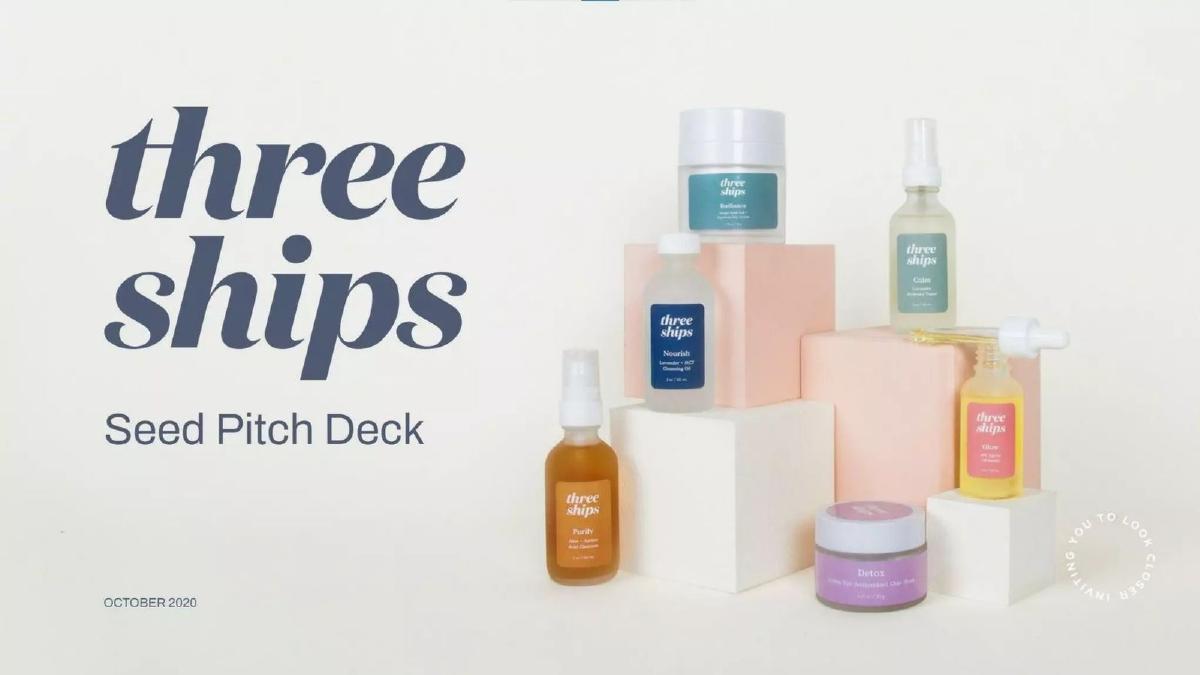
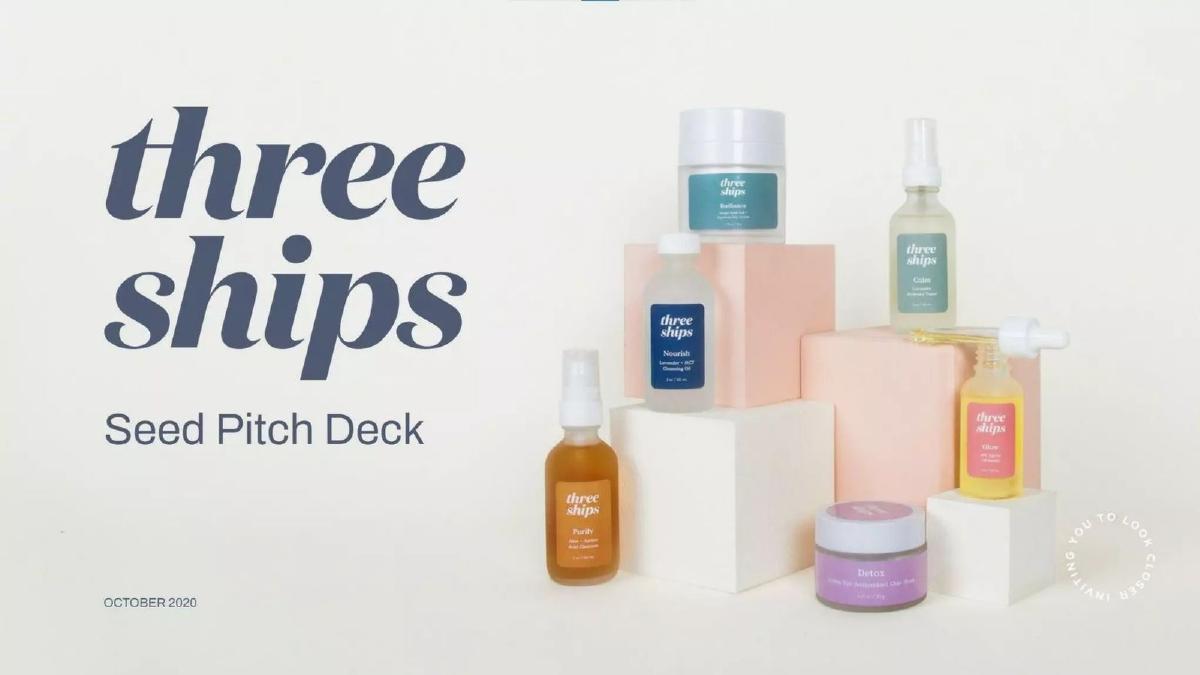
Slide 1: Title Slide The deck opens with a clean, lifestyle-oriented product shot. The branding is prominent, and the date (October 2020) establishes the context of a mid-pandemic raise where D2C brands were seeing significant tailwinds.
Slide 2: The Problem The problem is stated as a single, bold sentence: "Consumers are tired of being lied to and ripped off by overpriced, greenwashed brands." A footnote defines greenwashing as disinformation used to present an environmentally responsible public image. This sets a moral tone for the brand.
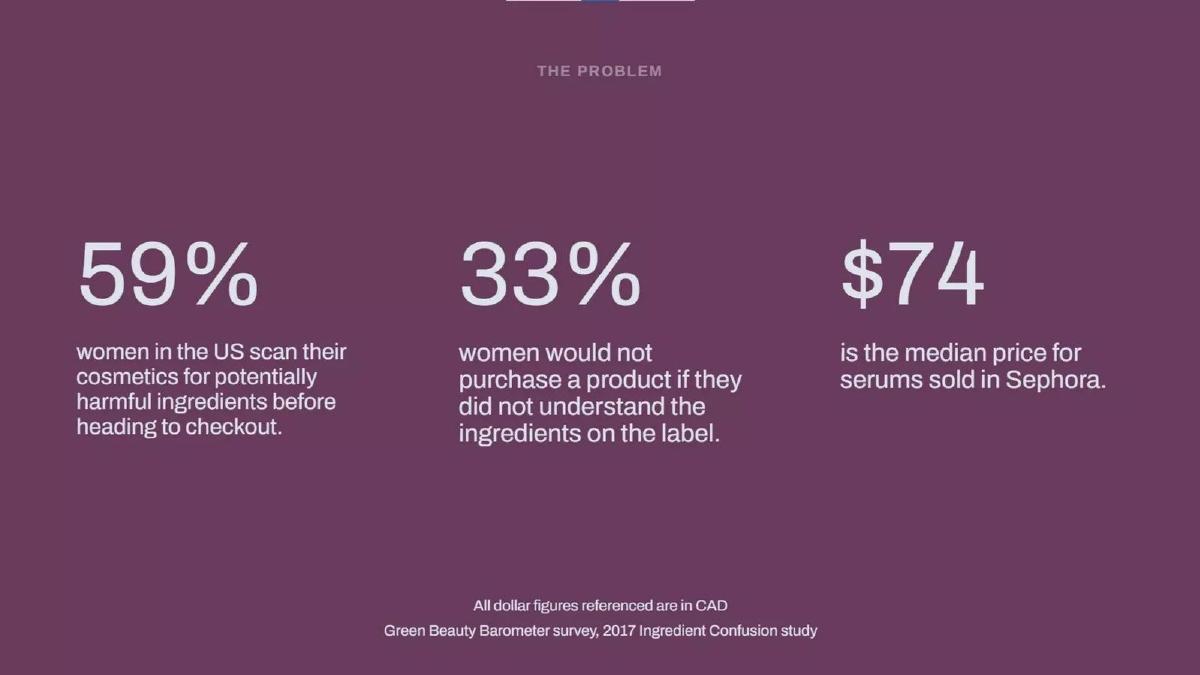
Slide 3: The Problem (Data) This slide provides the quantitative 'why' behind the brand. It cites that 59% of US women scan for harmful ingredients and 33% won't buy a product if they don't understand the label. Most importantly, it highlights a price barrier: $74 is the median price for serums at Sephora. This establishes the 'Affordable' pillar of their value proposition.
The Solution: Transparency and Efficacy
Slide 4: The Mission A simple transition slide claiming to be the "most transparent natural skincare brand on the market that works." The addition of "that works" is a subtle jab at natural products that prioritize ingredients over results.
Slide 5: Formulation Transparency Three Ships defines their transparency through action. They claim to exceed EU standards by listing every ingredient in an online glossary, including sourcing and scientific benefits. This addresses the 33% of women mentioned in slide 3 who are confused by labels.
Slide 6: Forever Affordable The brand commits to "fair pricing" and promises never to use filler ingredients to lower costs. This slide reinforces the brand's positioning as a high-quality but accessible alternative to luxury retail brands.
Slide 7: Proven Efficacy This is arguably the strongest slide in the deck. It combines a visual 'before and after' for cystic acne with massive social proof: over 40,000 online reviews and a 4.8/5 rating. It also includes a critical retention metric: a 21% repeat purchase rate. For a seed-stage D2C brand, these numbers are exceptionally high.
Slide 8: Customer Reviews Two long-form testimonials from customers in the US and Canada. These reviews specifically mention hormonal acne and dry skin, giving the brand credibility in treating specific dermatological concerns rather than just being a 'general' moisturizer.
Traction and Scale
Slide 9: Wholesale Growth Moving from D2C to omnichannel, this slide shows the brand's retail footprint. They report opening 600 new doors in the last quarter and project over $1M in revenue from these deals. The logos of Target, Whole Foods, and Hudson's Bay provide immediate institutional validation.
Slide 10: The Ask A simple, high-contrast slide stating: "We’re raising $550,000." While the catalogue data suggests they eventually raised $1.4M, this slide shows their initial target for the seed round.
Slide 11: Use of Funds A pie chart breaks down the allocation: 43% for Customer Acquisition, 29% for Staffing, 15% for Retail Marketing, and 12% for Working Capital. This is a standard allocation for a growth-stage consumer brand, prioritizing new user growth and the team needed to support it.
The Team and Closing
Slide 12: The Founders The team slide features Laura Burget (Product/Ops) and Connie Lo (Sales/Marketing). Their degrees—Chemical Engineering and Commerce—perfectly mirror the two sides of a successful beauty business: formulation and distribution. The 2015/2016 graduation dates suggest a young, hungry founding team with enough distance from school to have built the initial traction shown in earlier slides.
Slide 13: Closing The deck ends with the brand tagline "Look closer" and direct contact information for both founders. It maintains the minimalist aesthetic of the rest of the presentation.
What Works in the Three Ships Deck
1. Massive Social Proof: Citing 40,000 reviews at the seed stage is an outlier metric. It effectively ends the debate over whether the product works or if there is market demand. Investors looking at D2C are terrified of 'one-hit-wonder' products; 40,000 reviews suggest a sustained movement.
2. Omnichannel Validation: Many D2C brands struggle to move into physical retail. By showing logos like Target and Whole Foods alongside a $1M projected revenue figure, Three Ships proves they can survive outside of their own website.
3. Founder-Market Fit: The combination of a chemical engineer and a commerce major is the 'dream team' for a skincare startup. It suggests that the product is scientifically sound and the business is commercially viable.
What is Missing from the Three Ships Deck
1. Competitive Landscape: The deck mentions Sephora's median price but doesn't show where Three Ships sits relative to other 'clean' brands like The Ordinary, Versed, or Cocokind. A competitor matrix would have helped define their specific niche.
2. Unit Economics: While they mention a 21% repeat purchase rate, there is no mention of Customer Acquisition Cost (CAC), Lifetime Value (LTV), or gross margins. For a $550k raise where 43% is going to acquisition, investors would typically want to see the efficiency of that spend.
3. Market Size: There is no TAM/SAM/SOM slide. While the beauty market is known to be massive, specific figures regarding the 'clean beauty' or 'affordable natural' segments would have helped quantify the total opportunity.
What a Founder Should Copy
1. The 'Problem-Data' Slide: Slide 3 is a perfect example of how to use third-party research to validate a personal observation. Don't just say people want transparency; show that 33% of women won't buy without it.
2. Visual Traction: If you have a physical product, show it in use. The 'before and after' photo on slide 7, paired with the 4.8-star rating, is more persuasive than ten slides of financial projections.
3. Clear Allocation: The 'Use of Funds' slide is refreshingly simple. It tells the investor exactly what their money is buying: more customers and the staff to serve them. Avoid 'General Corporate Purposes' as a bucket; use specific categories like Three Ships did.
Frequently asked questions
- How much did Three Ships raise with this deck?
- Slide 10 explicitly states the company was raising $550,000. However, catalogue data from pitchdeckhunt.com indicates the total amount raised for this stage reached $1,400,000, suggesting the round may have been oversubscribed or expanded after the initial pitch.
- What is the primary use of funds for Three Ships?
- According to the pie chart on slide 11, the largest portion of the $550,000 raise (43%) was allocated to Customer Acquisition. This is followed by Staffing at 29%, Retail Marketing at 15%, and Working Capital at 12%.
- How does Three Ships differentiate itself from other 'natural' brands?
- The deck focuses on 'Formulation Transparency' (slide 5) and 'Forever Affordable' pricing (slide 6). They specifically contrast their pricing against the $74 median price for Sephora serums and claim to never use filler ingredients to lower costs.
- What retail traction had the company achieved by 2020?
- Slide 9 lists several major retail partners, including Target, Whole Foods Market, Hudson's Bay, Indigo, Causebox, and Ipsy. They reported opening 600 new doors in the quarter preceding the deck's creation.
- Who are the founders and what are their qualifications?
- Slide 12 introduces Laura Burget, who handles Product Development & Operations with a Chemical Engineering degree (2016), and Connie Lo, who manages Sales & Marketing with a Bachelor of Commerce (2015). Both are from top-tier Canadian universities (Toronto and Queen's).