The ntensify pitch deck is an exercise in extreme minimalism, containing only 8 slides and almost no body text. It targets the mobile gaming market, specifically the opportunity to turn digital intellectual property into physical merchandise revenue. By highlighting a '$2B' market opportunity on slide 2 and showcasing a '#8 Most Downloaded' game integration on slide 4, the deck attempts to prove product-market fit through association. However, the deck suffers from significant omissions: there are no financial projections, no business model details, no competitive analysis, and no specific fu…
Key takeaways
- The deck identifies a $2B market opportunity for mobile game merchandise on slide 2.
- The solution is presented as a three-step process involving code, logistics, and revenue on slide 3.
- Validation is shown through an integration with the #8 most downloaded game of 2014 on slide 4.
- Product functionality is demonstrated via in-app screenshots of 'Buddyman' apparel on slide 5.
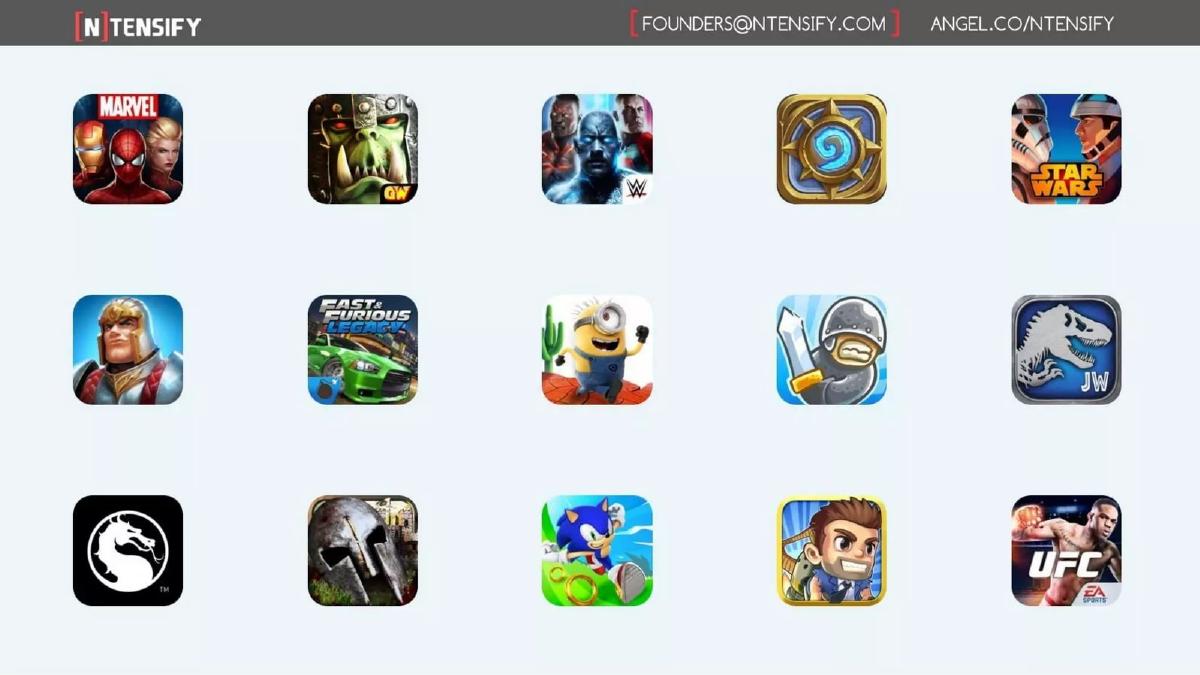
- The company leverages brand recognition by displaying 15 major mobile game icons on slide 6.
- The founding team possesses high-level corporate experience from NFL Mobile and Sony Pictures as seen on slide 7.
- The deck completely omits a formal 'Ask' slide, leaving valuation and funding requirements unknown.
- There is zero mention of unit economics, margins, or customer acquisition costs across all 8 slides.
The 8-Slide Teaser: ntensify’s Visual Pitch
The ntensify pitch deck is a relic of the 2012-2014 era of mobile gaming gold rushes. It is remarkably brief, consisting of only eight slides. In an industry where decks often bloat to 20 or 30 pages of complex metrics, ntensify takes the opposite approach: extreme minimalism. The deck is designed to be flipped through in under sixty seconds, relying on the viewer's ability to recognize major brands and understand a simple value proposition: turning pixels into t-shirts.
The Hook and the Market (Slides 1-2)
Slide 1: Title The cover slide establishes the brand and the mission statement: "A new revenue stream for mobile developers." The imagery of two young men using a tablet reinforces the target demographic. It is a standard, clean entry point that immediately identifies the customer (mobile developers) and the value (revenue).
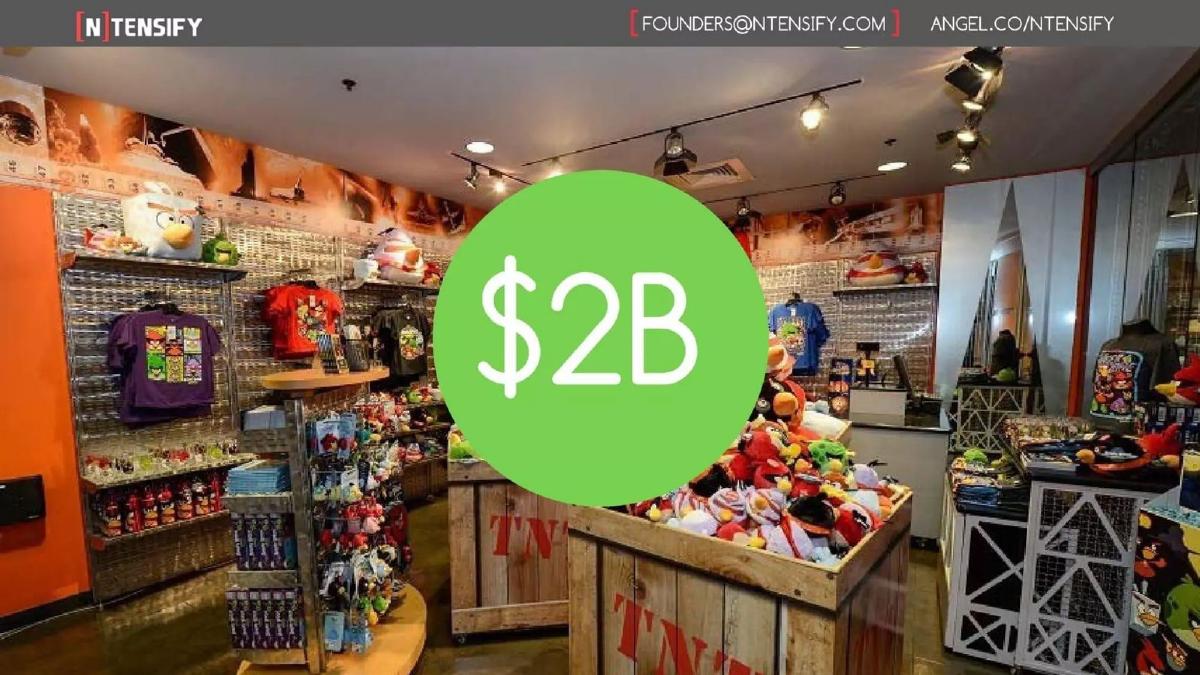
Slide 2: The $2B Opportunity This slide is a classic 'big number' play. It features a photo of a retail store filled with Angry Birds merchandise, with a massive green circle in the center containing the figure "$2B" . There is no text explaining where this number comes from or what year it represents, but the context is clear: the licensed merchandise market for mobile games is massive. By using Angry Birds as the backdrop, ntensify is signaling that they want to help every developer achieve that level of physical brand monetization.
The Solution and Validation (Slides 3-4)
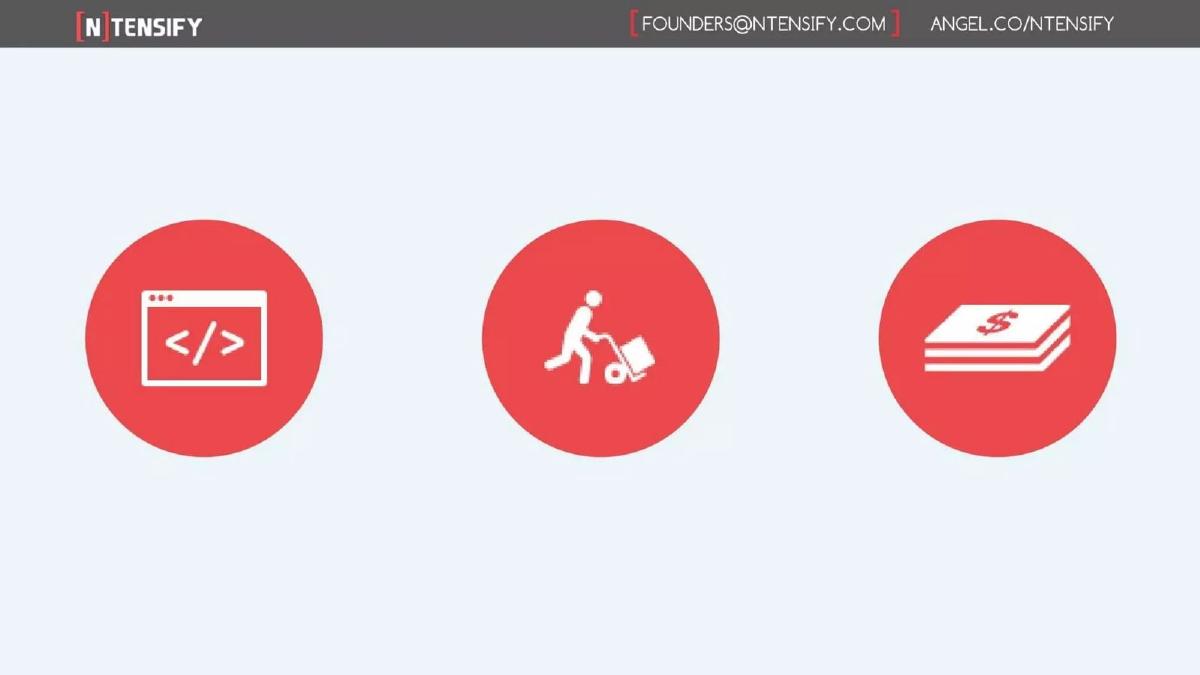
Slide 3: The Process Without using words, this slide explains the ntensify service. It features three red circles with white icons: a code snippet ( </> ), a person pushing a hand truck with a box, and a stack of cash. This is a shorthand way of saying: "You integrate our code, we handle the logistics and shipping, and you get paid." It is an effective use of iconography to explain a complex backend process (e-commerce fulfillment) simply.
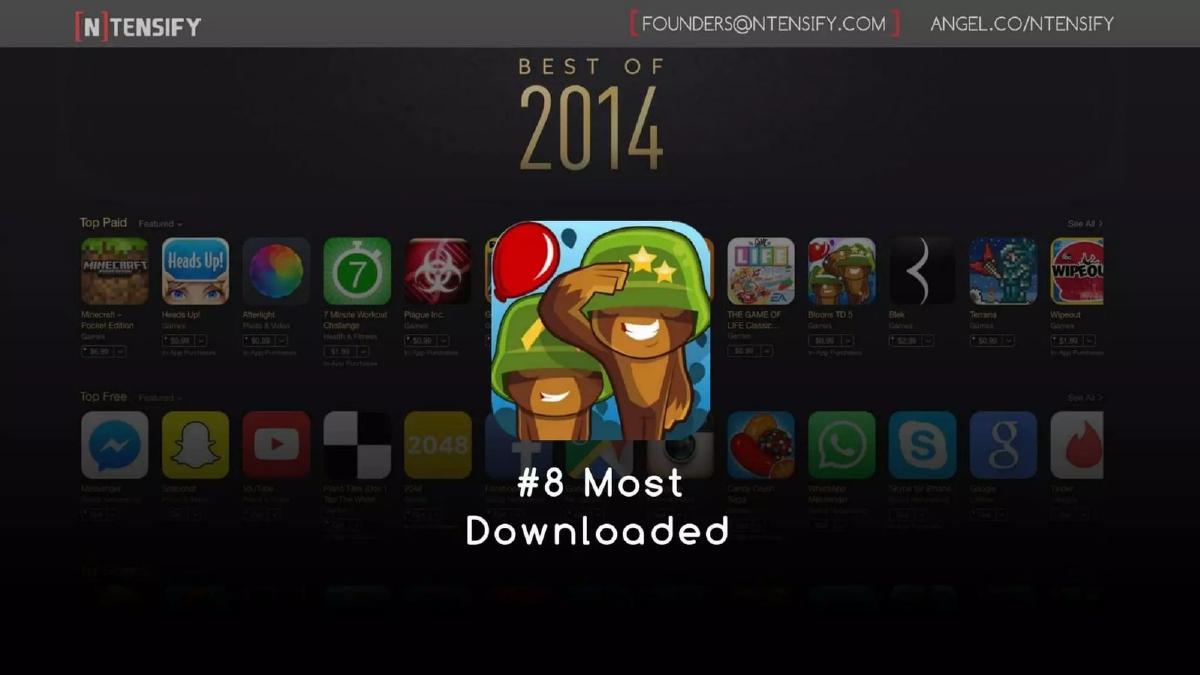
Slide 4: Traction via Association Slide 4 shows a 'Best of 2014' App Store feature. Overlaid on this is a game icon with the text "#8 Most Downloaded" . This is a crucial slide for a startup with limited public data; it suggests that their platform is already being used by top-tier apps. However, it stops short of saying how much revenue that #8 spot actually generated through ntensify.
Product and Ecosystem (Slides 5-6)
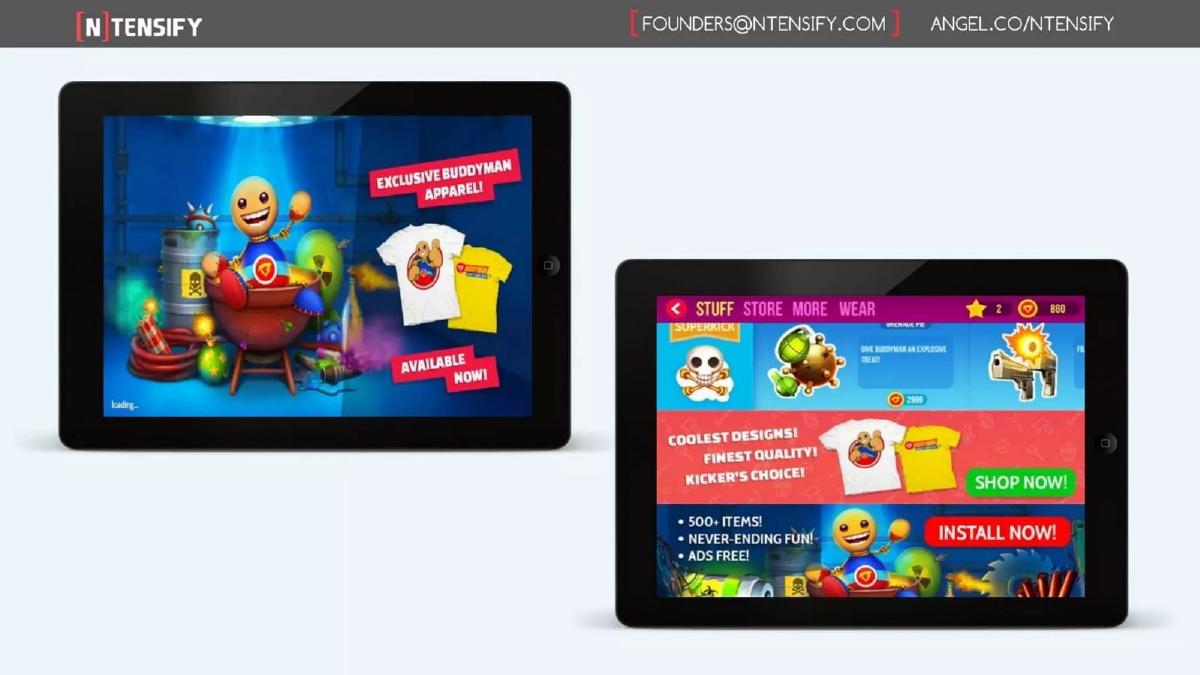
Slide 5: In-App Experience This slide provides the 'proof of life' for the product. It shows two tablet mockups. The left shows a loading screen for a game featuring "Exclusive Buddyman Apparel!" The right shows an in-game store where physical t-shirts are sold alongside digital items. This confirms that ntensify is an in-app e-commerce layer, not a separate website. It highlights features like "500+ Items!" and "Ads Free!"
Slide 6: The Target Market / Current Partners? This slide is a grid of 15 high-profile mobile game icons, including Marvel, Star Wars, WWE, Jurassic World, and Sonic the Hedgehog. This slide is ambiguous. It is unclear if these are current partners, a 'target list,' or simply examples of the types of IP that could benefit from the service. In a professional teardown, this is a 'yellow flag'—using famous logos without explicit labels of 'Partners' can be misleading to investors.
The Team and Contact (Slides 7-8)
Slide 7: The Team The pedigree on this slide is the deck's strongest point. Daven (CEO) is associated with NFL Mobile and Harvard Business School . Sangram (CMO) is linked to Sony Pictures and Northwestern University . Andrew (CTO) is credited with imagoo and Treat . The logos for NFL, Sony, and HBS do a lot of heavy lifting here, suggesting a team that understands both big-media licensing and high-level business execution.
Slide 8: The Outro The final slide is a simple contact page with an email address and an AngelList link. It features a photo of a man wearing a t-shirt with a 'Ninja Monkey' design, which presumably is a piece of merchandise powered by the ntensify platform. There is no call to action, no mention of a seed round, and no valuation.
What Works in the ntensify Deck
The visual clarity of this deck is its greatest asset. In an era where mobile developers were struggling with 'monetization fatigue' (users being tired of ads and pay-to-win mechanics), the promise of a "new revenue stream" that doesn't interrupt gameplay with ads is compelling. The use of icons on Slide 3 to explain a logistics-heavy business model is a masterclass in simplification. By focusing on the 'Buddyman' integration on Slide 5, they prove the product is functional and aesthetically integrated into the gaming experience. The team slide is also highly effective; it uses recognizable corporate logos to build instant credibility for a small team.
What is Missing from the ntensify Deck
This deck is almost entirely devoid of the 'hard' information required for an investment decision. First, there is no business model. We do not know if ntensify takes a percentage of sales, charges a monthly SaaS fee, or operates on a wholesale/retail margin. Second, there are no unit economics. Investors need to know the cost of goods sold (COGS), shipping costs, and the average order value (AOV) for a t-shirt sold inside a game. Third, there is no 'Ask.' A pitch deck without a slide stating "We are raising $X to achieve Y" is merely a brochure. Finally, there is no mention of the competitive landscape. In 2012-2014, several companies were attempting to bridge the gap between digital IP and physical goods; ntensify acts as if they are the only player in the space.
What a Founder Should Copy
Founders should emulate the visual hierarchy of this deck. Each slide has one job and one focal point. If you are pitching a highly visual product (like e-commerce or gaming), showing the product in situ (as seen on Slide 5) is far more effective than describing it with bullet points. The association strategy on Slide 2 is also smart; by placing your startup next to a $2B success story like Angry Birds, you frame the conversation around the potential upside rather than the current small-scale reality. Lastly, the minimalist team slide is a great template: a headshot, a title, and the two most impressive logos from your past. It allows the investor to vet your background at a glance.
Frequently asked questions
- What is ntensify's core business model?
- Based on the visual cues in the deck, ntensify provides an end-to-end solution for mobile developers to sell physical merchandise (like t-shirts) directly within their apps. Slide 3 uses icons for coding, logistics, and money, suggesting they handle the technical integration and fulfillment, allowing developers to generate a 'new revenue stream' as stated on the title slide.
- How much money is ntensify raising?
- The deck does not specify a fundraising goal. There is no 'Ask' slide or use of funds breakdown. The final slide only provides contact information and a link to their AngelList profile. This suggests the deck was intended as an introductory teaser to secure a meeting rather than a closing document.
- What traction does the company have?
- Traction is implied through partnerships. Slide 4 highlights their presence in a game ranked as the '#8 Most Downloaded' in 2014. Slide 5 shows a live implementation within the 'Buddyman' franchise. However, the deck provides no hard numbers regarding actual sales volume, revenue, or the number of active developer partners.
- Who are the founders and what is their background?
- The team consists of Daven (CEO), Sangram (CMO), and Andrew (CTO). According to slide 7, Daven has experience with NFL Mobile and is a Harvard Business School alumnus. Sangram comes from Sony Pictures and Northwestern University. Andrew has experience with startups like imagoo and Treat. This indicates a mix of corporate media experience and technical startup background.
- What are the biggest risks in this deck?
- The primary risk is the total lack of data. Without information on margins, shipping costs, inventory management, or revenue shares, an investor cannot evaluate the viability of the business. Additionally, the deck does not address competition from established players or the difficulty of scaling physical logistics compared to digital goods.