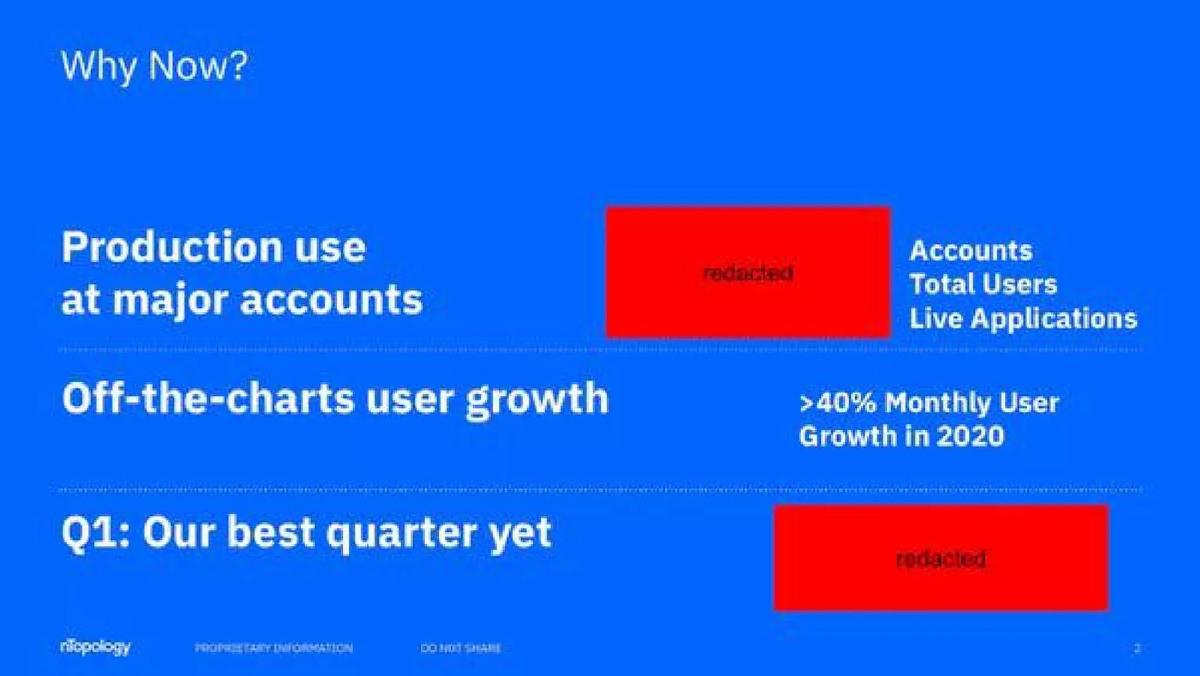
nTopology is an engineering software company that targets the limitations of traditional CAD, CAE, and CAM tools. This deck, used during a later-stage funding round, focuses heavily on technical superiority and rapid enterprise adoption. The company reports reaching over $2M in ARR with a 40% monthly user growth rate in 2020. By positioning legacy software as a 'bottleneck' for advanced manufacturing, nTopology highlights specific performance gains, such as reducing design time from 6 hours to 30 minutes for helicopter parts. The deck successfully balances high-level market opportunity—citing…
Key takeaways
- The company achieved over $2M in ARR by the time of this presentation, as stated on slide 21.
- nTopology reported a 40% monthly user growth rate throughout early 2020, according to slide 19.
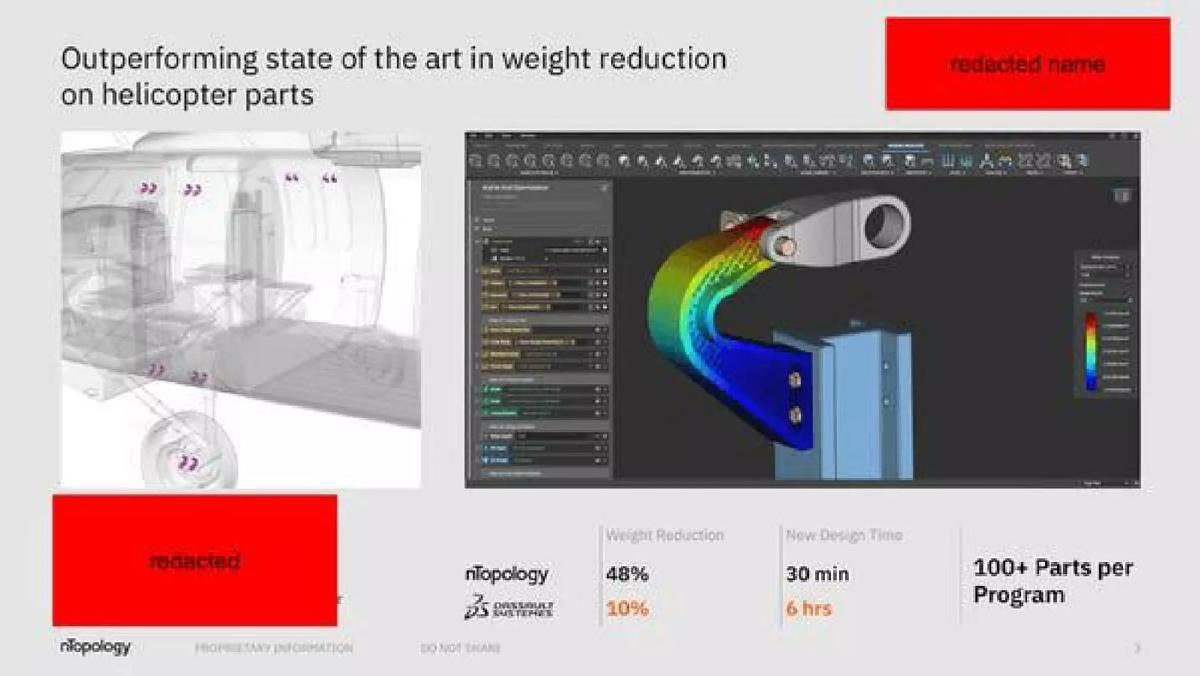
- The software claims to reduce weight by 48% and design time from 6 hours to 30 minutes for specific aerospace components on slide 3.
- Incumbent engineering software has an average age of 41 years, creating a massive opening for modern tools, per slide 11.
- The deck identifies a total yearly spend of $22B across CAD, CAE, and CAM sectors on slide 11.
- nTopology uses a 'Land and Expand' model, showing how 3 initial users can grow to 25+ users across 5 design teams, as detailed on slide 17.
- The leadership team includes the former CEO of Autodesk, Carl Bass, who serves as an independent board director and investor, shown on slide 23.
- The deck omits a specific 'Ask' slide or detailed breakdown of how the $135M in total funding would be allocated.
Introduction: The Computational Engineering Shift
nTopology represents a new breed of engineering software designed to handle the complexities of advanced manufacturing, specifically 3D printing and high-performance simulation. Founded in 2015, the company has raised over $135 million to date. This teardown examines a deck from their later stages, likely around their Series B or C, where the focus shifts from 'can we build it' to 'how fast can we scale it.' The deck is highly technical but remains accessible by focusing on the most important metric in engineering: time-to-result.
Slide 1: Title and Contact
The deck opens with a minimalist title slide. It features the nTopology logo and identifies Brad Rothenberg as the Founder and CEO. His direct email is provided, which is standard for high-stakes fundraising where the CEO is the primary point of contact for institutional investors.
Slides 3-5: The Power of Comparative Metrics
nTopology leads with results rather than theory. Slide 3 focuses on 'Outperforming state of the art in weight reduction on helicopter parts.' It compares nTopology against Dassault Systèmes. The results are stark: a 48% weight reduction compared to 10% for the incumbent, and a 30-minute design time compared to 6 hours. The slide also notes there are '100+ Parts per Program,' signaling the scale of the opportunity within a single customer.
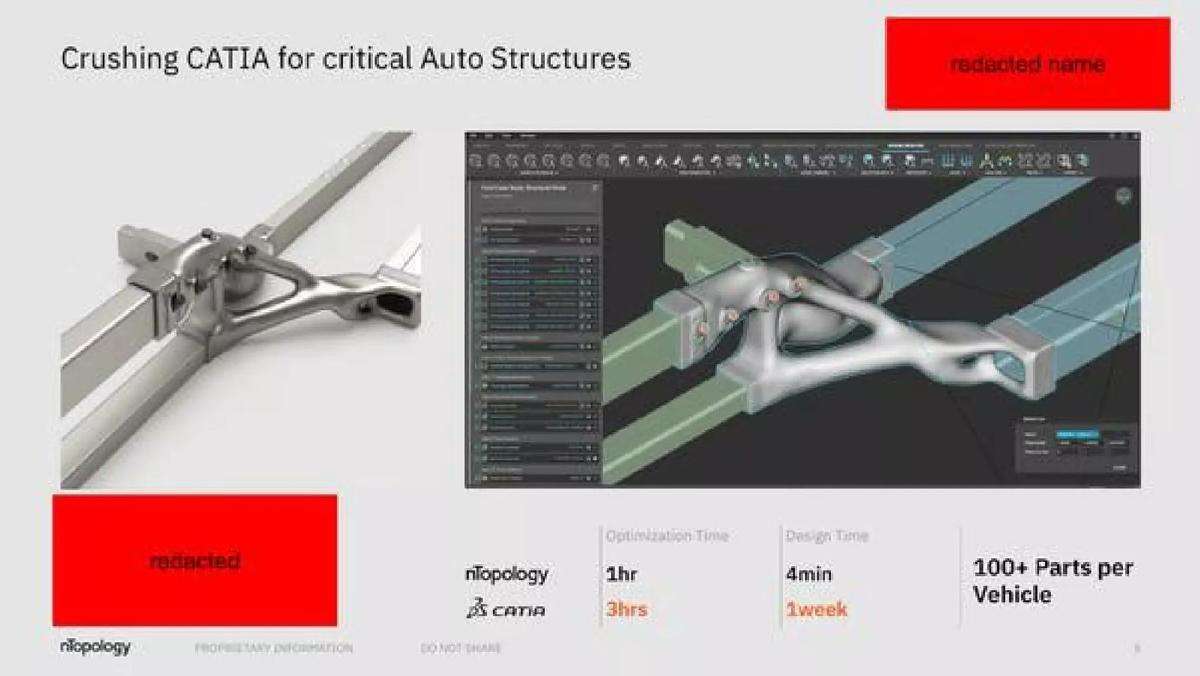
Slide 5 continues this theme, titled 'Crushing CATIA for critical Auto Structures.' Here, the design time comparison is even more dramatic: 4 minutes in nTop versus 1 week in CATIA. By using the word 'Crushing,' the founders signal an aggressive displacement strategy. These slides are effective because they quantify the 'pain' of the status quo in hours and weeks, which translates directly to cost savings for the customer.
Slide 7: Redacted Case Study
Slide 7 is titled 'Delivering for perfectionists the fastest ever.' While the content is largely redacted in this version of the deck, the layout suggests a deep dive into a specific high-profile client. Even with redactions, the headline reinforces the core value proposition: speed for high-end engineering requirements.
Slides 9-11: The Market Problem and Opportunity
Slide 9 uses a visual timeline to argue that 'Design software is the bottleneck in advanced manufacturing.' It contrasts the 1980s with 'Today,' showing that while manufacturing hardware has evolved, the software interface looks remarkably similar to its 40-year-old predecessors. This sets up the 'Dinosaur' argument on Slide 11 .
Slide 11 is a powerful market slide. It labels legacy software as 'Dinosaur software' and notes an Average Age of 41 years for the industry leaders. It breaks down the yearly spend: $9B for CAD, $8B for CAE, and $5B for CAM , totaling a $22B annual market . It also notes the combined market cap of incumbents like Autodesk, PTC, and Ansys is $100B+ . This slide justifies the venture scale of the investment; if nTopology can displace even a fraction of these 'dinosaurs,' the upside is massive.
Slides 13-15: Product and Traction
Slide 13 shows 'exponential growth patterns' across major accounts. The graph shows user counts per account growing from near zero at T=0 to over 50-75 users by the fourth quarter. This proves that once the software enters a firm, it spreads.
Slide 15 gets into the technical 'why.' It claims nTop solves problems that are 'impossible in legacy workflows.' It highlights three specific technical hurdles: High-density lattices (impossible in CAD), Field-driven design (impossible in CAD), and Shelling operations (unreliable in CAD). By positioning the product as the only solution for these specific tasks, they create a 'must-have' rather than a 'nice-to-have' utility.
Slide 17: The 'Land and Expand' Sales Motion
This is one of the most important slides for a later-stage investor. It explains the business model. The company 'Lands' with 3 users. Those users (Authors) create a workflow for a specific part, like a bracket. That workflow is then distributed to 5 different design engineering teams (Transmission, Rotors, Structure, etc.), resulting in 25 new users . This internal distribution mechanism is what drives the exponential growth shown on Slide 13.
Slides 19-21: The Financial 'Money' Slides
Slide 19 boasts that they have 'more than tripled users since the beginning of 2020' with a 40% Monthly User Growth rate. This is a classic 'hockey stick' curve that investors look for to confirm market-product fit.
Slide 21 provides the revenue proof: 'We are over $2M ARR today.' The chart shows a launch in mid-2019 followed by a steep climb. It also notes the 2019 ACV (Average Contract Value) was $35.5K , while the 2020 ACV was $25K . While the ACV appears to have dropped, the sheer volume of users and the speed of the ARR climb suggest they may have introduced a lower-tier entry point to accelerate the 'Land' portion of their strategy.
Slide 23: Leadership and Investors
The team slide is exceptionally strong. It features Brad Rothenberg (CEO), Steve Costello (CRO), Blake Courter (CTO), and George Allen (CSO). The standout inclusion is Carl Bass , the former CEO of Autodesk, serving as an Independent Board Director. Having the former CEO of the primary 'dinosaur' competitor on the board is a massive signal of credibility. The investor list includes Canaan, Data Collective, Root Ventures, Haystack, Pathbreaker, and Lockheed Martin , showing a mix of top-tier VC and strategic aerospace interest.
Slides 25-27: Appendix and Product Visuals
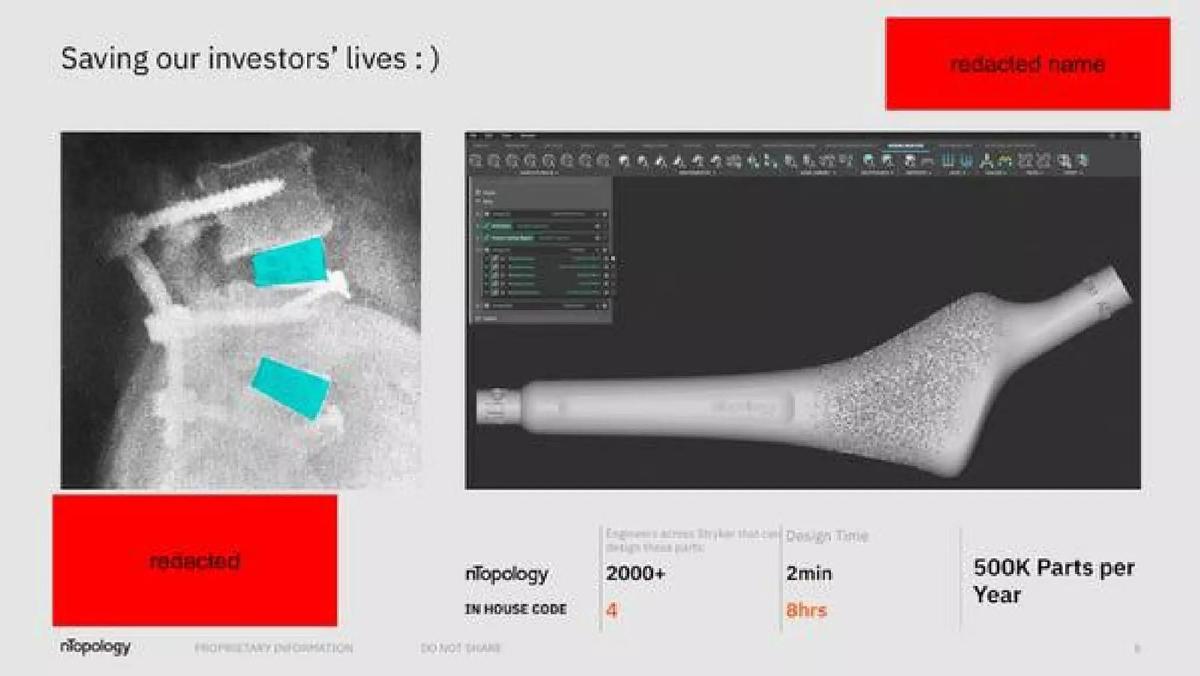
The deck concludes with an appendix. Slide 27 shows the software interface in action, designing what appears to be medical swabs or similar lattice-based structures. This reinforces that the software is real, functional, and capable of handling complex geometry at scale.
What Works in the nTopology Deck
1. Extreme Specificity: Instead of saying the software is 'fast,' they say it takes 4 minutes instead of a week (Slide 5). This level of detail is unassailable and speaks directly to the engineer's pain points.
2. The 'Dinosaur' Narrative: By framing the incumbents as 41-year-old relics, nTopology makes the case that a change isn't just possible, but inevitable. It turns the incumbents' size and history into a weakness (rigidity) rather than a strength.
3. Clear Sales Motion: Slide 17 (Land and Expand) clearly explains how the company will grow revenue without linearly increasing sales headcount. Investors love 'self-serve' or 'viral' expansion within enterprise accounts.
4. Credibility by Association: The presence of Carl Bass (former Autodesk CEO) and Lockheed Martin as an investor provides immediate validation that this isn't just another CAD plugin, but a fundamental shift in engineering capability.
What is Missing from the nTopology Deck
1. The Ask: The attached slides do not include a specific funding request. We know from the catalogue that they raised $135M, but the deck doesn't state how much they were seeking in this specific round or how they intended to spend it.
2. Unit Economics: While ARR and ACV are mentioned, there is no mention of Customer Acquisition Cost (CAC), Lifetime Value (LTV), or gross margins. For a software-as-a-service (SaaS) company at the $2M ARR mark, these metrics are usually expected.
3. Roadmap: The deck focuses heavily on what the software does now . It lacks a 'Future' slide showing where the product goes next—perhaps into automated manufacturing execution or broader AI-driven design.
What a Founder Should Copy
1. Use Head-to-Head Comparisons: If you are disrupting an incumbent, don't be afraid to name them. nTopology's comparison against CATIA is the most memorable part of the deck. Use specific time and performance benchmarks to prove your superiority.
2. Visualize the Expansion: If you have a 'Land and Expand' strategy, draw it out like Slide 17. Showing how one seat becomes twenty seats makes your revenue projections much more believable.
3. Leverage Industry Legends: If you can get a former executive from your biggest competitor to join your board or invest, put them front and center. It is the ultimate form of de-risking for a new investor.
4. Focus on the 'Impossible': Don't just say your product is better; show what it can do that others literally cannot. The 'Impossible in CAD' callouts on Slide 15 create a unique selling proposition that isn't based on price, but on capability.
Frequently asked questions
- What is the core value proposition of nTopology compared to traditional CAD?
- nTopology positions itself as a computational engineering environment that solves problems 'impossible' in legacy CAD. According to slide 15, this includes high-density lattices and field-driven design. The primary value is speed and optimization; slide 5 shows a design time reduction from one week in CATIA to just four minutes in nTop for critical auto structures.
- How does nTopology demonstrate market traction in this deck?
- Traction is shown through both user growth and revenue. Slide 19 highlights that the company tripled its user base in early 2020 with 40% monthly growth. Slide 21 confirms the company surpassed $2M in ARR, showing a clear upward trajectory from late 2018 through 2020.
- What is the 'Land and Expand' strategy mentioned in the deck?
- Slide 17 illustrates their enterprise sales motion. It starts with 'landing' 3 users (a design expert and a structures expert). These 'authors' create workflows distributed to other teams (Transmission, Rotors, etc.), resulting in 25+ new users. This internal virality increases the Total Contract Value (TCV) without requiring a new sales cycle for every seat.
- Who are the key competitors identified by nTopology?
- The deck explicitly names legacy 'dinosaur' software companies on slide 11, including Autodesk, Dassault Systèmes (CATIA), PTC, Ansys, and Siemens. It highlights that these incumbents have an average age of 41 years, suggesting they are too rigid for modern additive manufacturing and advanced simulation.
- What technical advantages does the software offer for manufacturing?
- Beyond speed, the software enables advanced geometry that traditional tools struggle with. Slide 15 points to 'shelling operations' that are unreliable in CAD and 'high-density lattices' that are impossible to design elsewhere. These capabilities allow for significant weight reduction (48% on slide 3) which is critical for aerospace and automotive industries.