ATEC's 18-slide July 2022 Series A deck asks for US$6.5m to scale IoT-connected induction cookstoves and biodigesters in Asia and Africa and sell the resulting Gold Standard carbon credits. The track record slide is genuinely strong — 6,000+ units, 4,000+ active customers, Engie and Schneider Electric on the cap table, a world-first IoT carbon registration. But the deck never states the carbon price its entire revenue model depends on, shows no historic revenue at all, merges term sheets with proposals into one $34.6m pipeline figure, and quotes three different 2030 revenue numbers on consecu…
Key takeaways
- ATEC's 18-slide Series A deck from July 2022 asked for US$6.5m to scale IoT-connected induction cookstoves and biodigesters across Asia and Africa and monetise the resulting Gold Standard carbon credits.
- The deck's strongest asset is a plain bulleted track record slide: 6,000+ units sold, 4,000+ active customers, 5x year-on-year unit growth, $3.6m raised from Engie, Schneider Electric and elea, and the first global registration of IoT carbon credits under a Gold Standard methodology.
- The entire revenue thesis converts tonnes of abated carbon into dollars, but the assumed carbon price per tonne never appears once in 18 slides.
- There is no historic revenue figure anywhere in the deck, despite six years of trading, which turns the financial slide into a forecast with nothing to anchor it.
- Slide 7 combines signed term sheets and unanswered proposals into a single $34.6m pipeline number, which invites investors to discount all of it.
- Slides 16 and 17 state three different 2030 outcomes — >$100m annual revenue, $120m total revenue and $100m+ ARR — on consecutive pages.
- The deck contains no competition slide at all, in a category with several well-funded pay-as-you-go clean-cooking and carbon-credit competitors.
- The transferable lesson: when the biggest numbers in a deck belong to the problem rather than the company, investors reframe the meeting from 'how big is this' to 'what has this proven'.
What this deck actually is
This is a real Series A fundraising deck. The file is titled "Copy of Pitch Deck ATEC Series A 2022v3.5", it runs 18 slides in 16:9, and it was built in Google Slides by ATEC Australia-International Pty Ltd — a clean-cooking company selling induction stoves and biodigesters to households in Cambodia and Bangladesh, and monetising the resulting emissions reductions as carbon credits.
Slide 2 is a confidentiality notice stating the deck may not be reproduced without written permission, which is a mild irony given the file has been publicly downloadable for years. That aside, this is the genuine article: a company with revenue, patents, named institutional investors and a specific ask of US$6.5m, asking for money in July 2022.
That matters for how you read it. Most decks circulating as "pitch deck examples" are recreations, teaching artefacts or crowdfunding collateral. This one is an operating impact business at the awkward stage where the story is genuinely good and the numbers are genuinely small, and watching how ATEC handles that gap is the whole lesson.
Slide-by-slide walkthrough
Slide 1 — Title
Three words stacked: "clean cooking / decarbonised / at scale". No company boilerplate, no date, no round name on the cover. It is a positioning statement rather than a title slide, and it works — you know the category and the ambition before you know the company name.
Slide 2 — Confidentiality notice
A full slide of legal text asserting proprietary rights over the deck. It is slide two of eighteen, which means the second thing a partner sees after the cover is a paragraph of lawyering. This is prime real estate spent on a clause that could live in six-point type in a footer.
Slide 3 — Problem divider
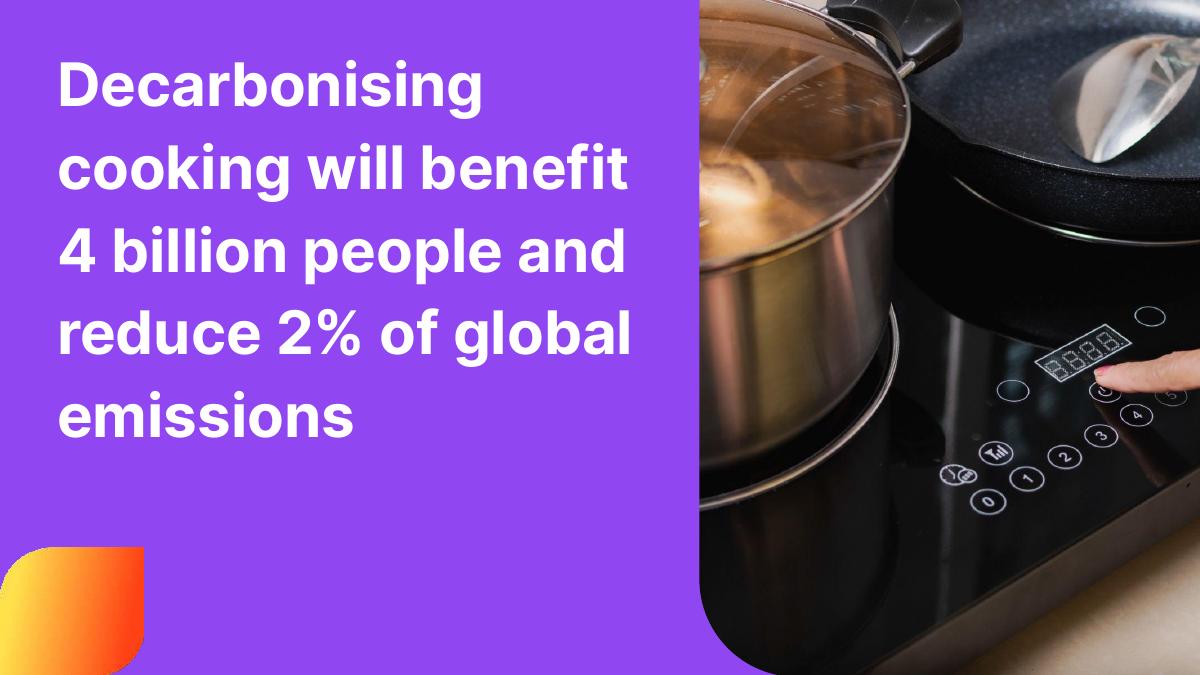
"Decarbonising cooking will benefit 4 billion people and reduce 2% of global emissions." A section break with a single claim on it. The 2% figure is the one that will get repeated in the partner meeting, and ATEC is right to isolate it.
Slide 4 — The problem, quantified
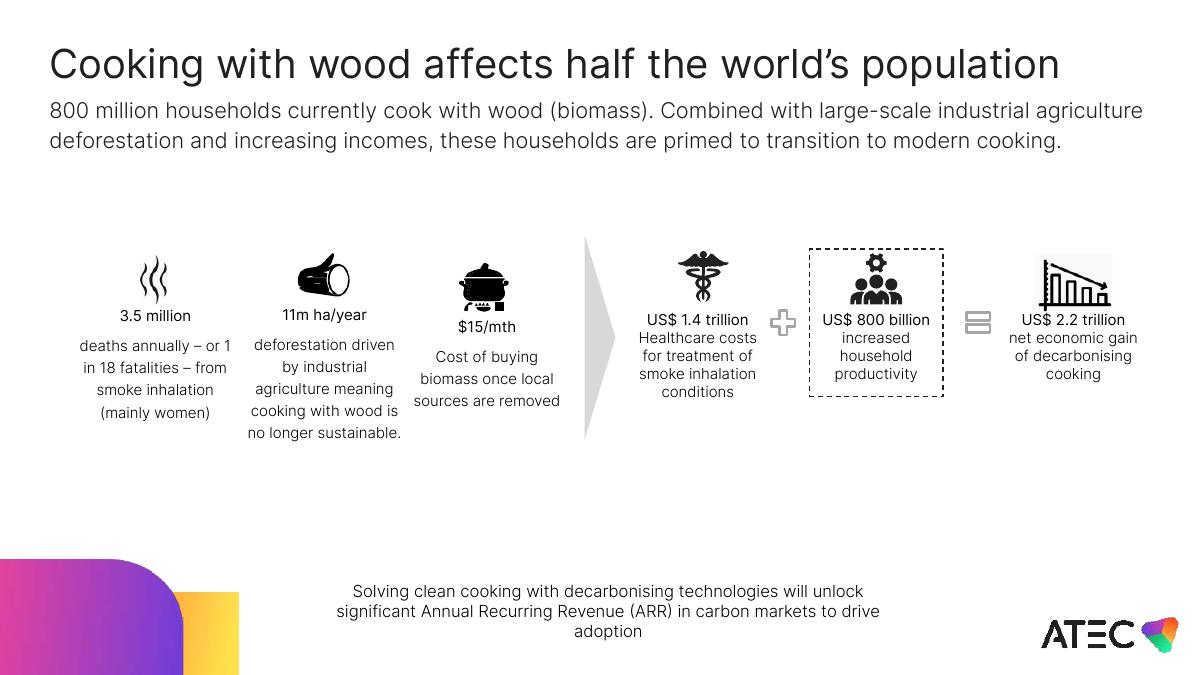
Six numbers across the slide: 800 million households cooking with biomass, 3.5 million deaths annually from smoke inhalation (one in 18 fatalities, mainly women), 11m hectares/year of deforestation driven by industrial agriculture, US$15/month cost of buying biomass once local sources are gone, US$1.4 trillion in healthcare costs, US$800 billion in lost household productivity, US$2.2 trillion net economic gain from decarbonising cooking.
None of the six numbers carries a source on the slide. The composite is powerful and the direction is uncontroversial, but a partner who wants to underwrite the $2.2 trillion number has nowhere to go.
Slide 5 — Market: "$16bn ARR carbon market"
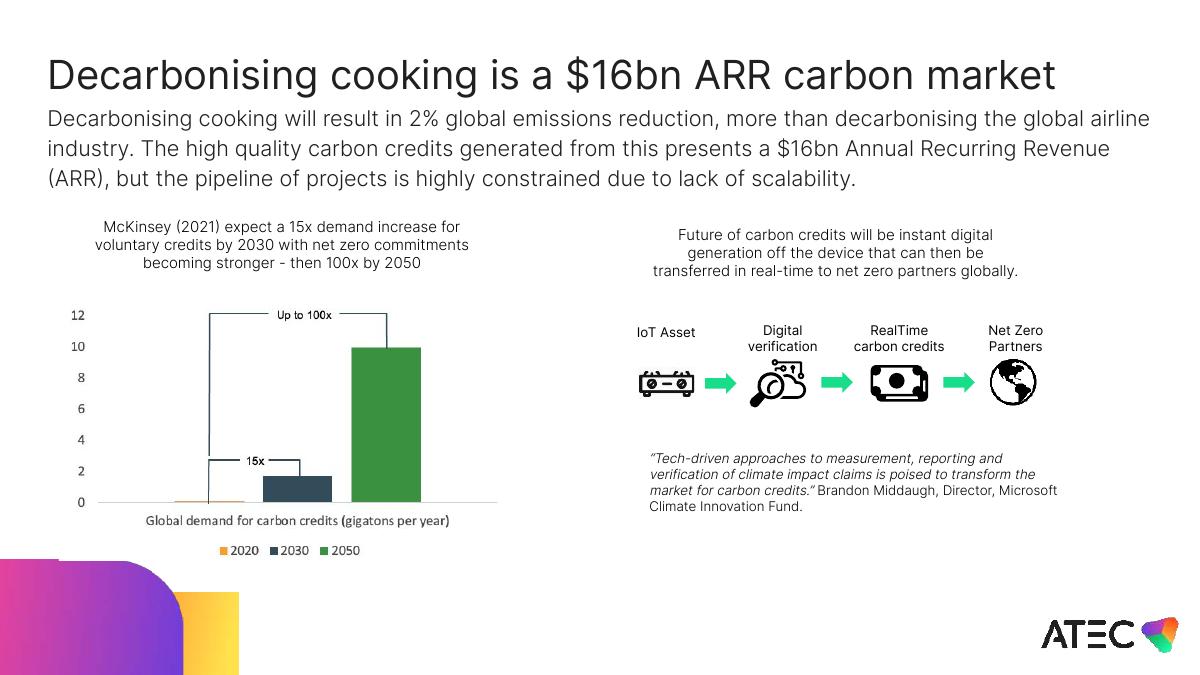
The strategic core of the raise. ATEC argues clean cooking is worth 2% of global emissions — "more than decarbonising the global airline industry" — and that the resulting high-quality credits represent a $16bn annual recurring revenue pool, constrained today because project pipelines do not scale. It cites McKinsey (2021) for 15x voluntary credit demand growth by 2030 and 100x by 2050, sketches an IoT asset → digital verification → real-time credits → net-zero partners chain, and closes with a quote from Brandon Middaugh at the Microsoft Climate Innovation Fund.
What is missing is the carbon price. Every revenue number later in the deck is a function of dollars per tonne, and that assumption never appears anywhere in 18 slides.
Slide 6 — Solution divider
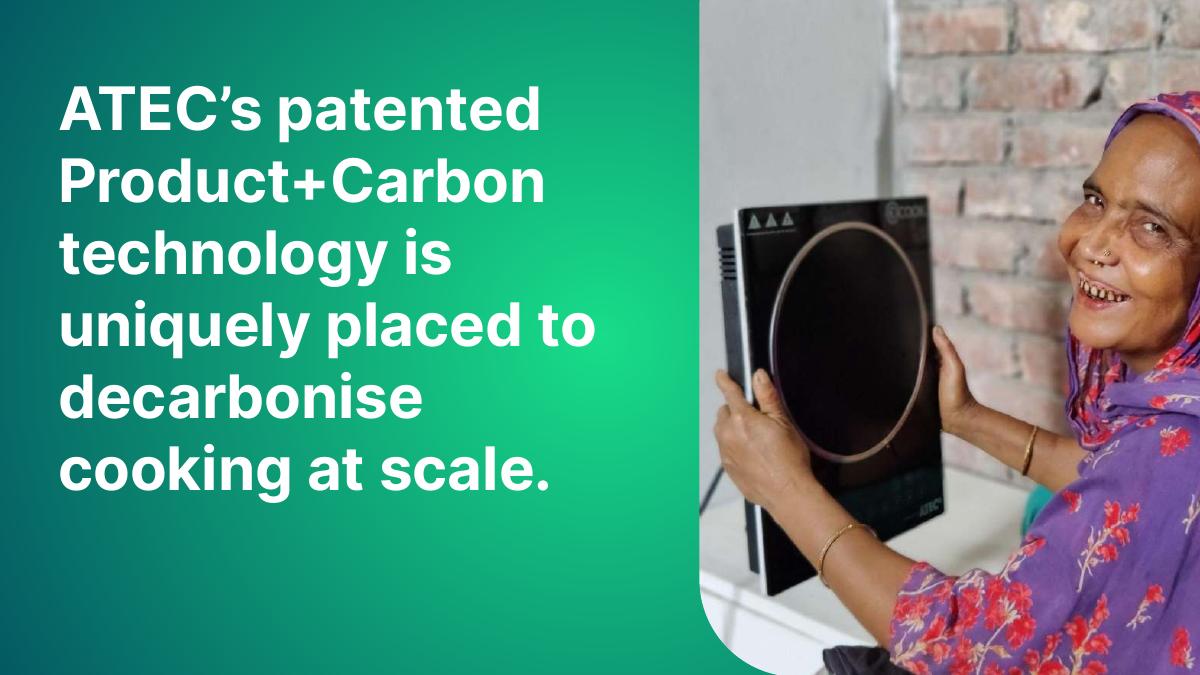
"ATEC's patented Product+Carbon technology is uniquely placed to decarbonise cooking at scale." The word "patented" is doing deliberate work here and is backed up on the next slide.
Slide 7 — Track record
The strongest slide in the deck, and it is a plain bulleted list: established 2016; over 6,000 units sold across Cambodia and Bangladesh with over 4,000 active customers; 5x year-on-year unit sales growth for Jul'21–Jun'22; global leader in pay-as-you-go cooking since 2019; $3.6m equity raised to date with Engie, Schneider Electric and Elea named as investors; first carbon credit deal signed with Engie in 2021; $34.6m in carbon deals "at term sheet or proposal phase" from Jan'22; first company globally to register IoT carbon credits under the Gold Standard methodology in 2022. A GPS scatter map of deployed units sits alongside.
Two things to flag. "6,000 units sold, 4,000 active customers" over six years is a small base — and the deck never says what those units generated in revenue. And "$34.6m at term sheet or proposal phase" collapses two very different states of a deal into one headline number; a proposal you sent is not a term sheet you received.
Slide 8 — eCook
The flagship product: a high-efficiency electromagnetic induction stove with embedded IoT. Claims are specific — patented PAYGO from as little as $5/month, zero particulate emissions, automatic carbon credit calculation to ATEC's AWS server, 50% cheaper to run than LPG or purchased wood, shipped with induction-ready pots and delivered in 48 hours through e-commerce partners. Every stove ships with a GSM SIM pre-installed, enabling remote lock-out on non-payment, tamper alerts, consumption monitoring and automated Gold Standard credit generation. ATEC forecasts electric cooking becomes the standard by 2030 on the back of $1.2tn/year of electrification investment.
The remote lock-out detail is the one that unlocks debt financing, and the deck flags it correctly — but never says what the stove costs to build or to buy.
Slide 9 — ATECBIO
The biodigester line: converts animal manure plus human, kitchen and green waste into cooking biogas and organic fertiliser. Household net income up to +US$521/year, up to 7 tonnes of carbon abated per unit per year (105 tonnes over 15 years — the highest carbon yield of any cooking device), "ikea"-style self-install, 25-year service life, flood and high-groundwater tolerant, integrated with PAYGO. Outputs cited as 20 tonnes of free fertiliser per year and up to 1,800L of biogas per day.
The slide describes biogas as "a nice product" — hedged language that reads as internal shorthand left in a v3.5 file, and it undercuts the unit with the best carbon economics in the portfolio.
Slide 10 — The Impact Flywheel
A diagram arguing the defensibility: households take PAYGO debt to buy stoves, stoves generate carbon credits, credit and stove ARR compound, that ARR finances scale, scale drops cost per unit. The closing line calls the ability to deliver product+carbon ARR at scale "ATEC's defensible position". It is a genuinely differentiated framing — but a flywheel is a hypothesis until the loop has been observed turning once, and there is no cohort data showing it has.
Slide 11 — Team and board
Seven named operators with substantive bios: Ben Jeffreys (CEO, ex-SSE, Oxfam, Westfield), Phillip Barrow (CFO, 30 years, ex-EY, Lend Lease, GPT Group), Rebecca Penglase (People and Performance, ex-Accenture), Chung Pin Teo (COO), Wilm Rompf (Lead Product Development Engineer), Shuvasish Bhowmick (Country Director, Bangladesh, ex-Unigas) and Nikolai Schwarz (Country Director, Cambodia). Below sits a board of eight, including Quentin Vaquette of Wavemaker Impact as chair, Engie's Loic de Fontaubert, elea's Stéphanie Abels and FTI Consulting's Mike McCreadie.
In-country directors on the team slide is the correct move for a business whose entire risk profile is local execution. The gap: no carbon-methodology or MRV specialist is named, even though the carbon side is where the valuation lives.
Slide 12 — Business model
A left-to-right value chain: production (bio 2,000 units/month, eCook 10,000 units/month capacity) → wholesale with stoves provisioned to ATEC IoT services → digital e-commerce with owned storefront, digital acquisition and a centralised call centre → logistics partners with 48-hour delivery → user finance at $5–$30/month via mobile money with automatic device shut-off → service and carbon data, a five touch-point 90-day programme, three-year warranty and usage data collection.
It is a clear operational map and a poor business model slide. There is no price, no gross margin, no CAC, no payback period, no default rate on the PAYGO book. For a company financing hardware to low-income households, receivables performance is the business model.
Slide 13 — Partners
A logo wall in four buckets: debt and equity investors, partners, carbon credits, product and distribution. Uncaptioned logos, so a reader cannot tell a signed offtake from a pilot conversation.
Slide 14 — The ask divider
"$6.5m Series A will expand ATEC as a global leader in cookstove and carbon markets." Fourteen slides in before the number appears, which is late but not fatal in a deck this narrative-led.
Slide 15 — Use of funds
Three buckets: 40% to product and carbon market expansion via distributor partners across Asia and Africa, with MOUs signed in Nepal, Zambia, Kenya and Rwanda; 40% to phase-2 product development automating data and payment flow between household devices and carbon/capital markets; 20% to digital carbon credit and PAYGO partnership development. A diagram shows stove → usage data → ATEC server → verified credits → buyer.
Clean allocation, but there is no runway, no milestone map and no statement of what $6.5m is supposed to prove before the next round. Four new countries on 40% of $6.5m is $2.6m across four markets — the deck never defends that.
Slide 16 — Financials
Annual operating revenue projected in a bar chart, break-even by 2025, a forecast $15m Series B in 2024, more than $100m annual revenue by 2030, and carbon credits reaching 30% of ARR by 2030. The full model is linked out rather than shown. Historic revenue does not appear.
A financial slide with no actuals is a forecast slide. An investor cannot calibrate a 2030 number without the 2021 and 2022 numbers to anchor it.
Slide 17 — Triple bottom line
Three headline outcomes by 2030: 30m tonnes of verified carbon credits, $120m total revenue, 39,000 lives saved through reduced smoke inhalation. It also references a clear fundraising roadmap and exit strategy for investors by 2032, achieved by reaching $100m+ ARR.
Slide 16 says ">$100m annual revenue by 2030". Slide 17 says "$120m total revenue by 2030" and "$100m+ ARR". Those are three different statements about the same year, on consecutive slides, and no reader can tell which one is the forecast.
Slide 18 — Close
Back to "clean cooking / decarbonised / at scale" with Ben Jeffreys' name, email and mobile number. Named human, direct contact — correct.
What this deck does better than most startup pitch decks
It has a real, defensible wedge. Product+carbon — hardware that mints its own recurring revenue via automated Gold Standard credits — is a genuinely differentiated business model, not a feature list. · Named investors do the credibility work. Engie, Schneider Electric and elea on slide 7 are worth more than any adjective the deck could have used. · A specific, checkable first. "First company globally to register IoT carbon credits under GS methodology in 2022" is falsifiable, which is exactly what makes it persuasive. · Product claims are quantified. $5/month, 50% cheaper than LPG, 7 tonnes abated per bio unit per year, 25-year service life, 48-hour delivery. Almost nothing is left as an adjective. · The team slide reflects the actual risk. Country directors in Bangladesh and Cambodia, named, with local sector history. · Debt-readiness is designed in. Remote lock-out on non-payment is the single detail that makes PAYGO receivables financeable, and the deck knows it. · Use of funds is allocated, not vague. 40/40/20 with named target markets beats "hiring and growth" every time. · It closes on a human. CEO name, email and phone number on the final slide.
Where this deck would fail in an investor meeting
No carbon price anywhere. The whole thesis converts tonnes into dollars, and the conversion rate is never stated. First question in the room; nothing in the deck answers it. · No historic revenue. Six years of operation, 6,000 units sold, and not one actual revenue figure in 18 slides. · No unit economics. No stove price, no COGS, no gross margin, no CAC, no payback, no PAYGO default rate. · "$34.6m at term sheet or proposal phase." Merging signed term sheets with unanswered proposals into one number invites a partner to discount the entire slide. · "5x YoY growth" with no base. Five times a small number is still a small number, and withholding the base makes it look smaller. · No competition slide. Not one named competitor in a category with well-funded players in exactly the same PAYGO-plus-carbon model. Silence here reads as either unawareness or avoidance. · Three different 2030 revenue figures. $100m annual revenue, $120m total revenue and $100m+ ARR on consecutive slides. · The 30m tonne claim is unbridged. At 2–7 tonnes per unit per year, 30m cumulative tonnes by 2030 implies millions of deployed units against a base of 6,000. The deck never shows the deployment ramp that gets there. · 39,000 lives saved is underived. A precise number with no visible methodology reads as modelled, not measured. · The model is a hyperlink. "Full model here" pushes the most scrutinised artefact of a Series A outside the document. · No round structure. No valuation, no instrument, no amount already committed, no lead status. · No risk slide. Carbon methodology changes, credit price volatility, currency, import duties and grid reliability in the target markets are all live risks and none are named.
Impact deck vs standard Series A deck
Traction Units sold, active customers, growth multiple Revenue, growth rate, retention, cohort curves
Market Top-down $16bn carbon ARR pool Bottom-up: units × price × attach, with the price stated
Business model Operational value chain diagram Unit economics: price, COGS, margin, CAC, payback
Financials Forecast only, model linked out Three years of actuals beside the forecast, in the deck
Pipeline Term sheets and proposals combined Signed / term sheet / proposal shown separately
Competition Absent Named players and an explicit basis of advantage
Ask $6.5m with a 40/40/20 split Amount, valuation, runway and the milestones it buys
How you would rebuild this deck
Put the carbon price on slide 5. State the assumed $/tonne, the source, and the sensitivity of 2030 revenue to a 30% price fall. This is the single highest-leverage edit in the deck. · Add one actuals slide. Revenue for FY21 and FY22, units by quarter, active customers, and the average revenue per active customer. It will be small. Small and specific beats large and unverifiable. · Split the $34.6m pipeline. Signed, term sheet, proposal — three columns, three totals. The credible number is smaller and worth more. · Replace the value-chain slide with unit economics. Stove price, COGS, contribution margin, CAC, PAYGO term, expected default rate, payback in months, carbon revenue per unit per year. · Add a competition slide. Name the other PAYGO clean-cooking and carbon players, and state plainly what the IoT-verified Gold Standard registration gives ATEC that they do not have. · Pick one 2030 number. Define it once — ARR or total revenue — and use that exact phrasing on both slide 16 and slide 17. · Bridge the 30m tonnes. A single deployment table: units per year 2023–2030, tonnes per unit, cumulative tonnes. If the ramp is not credible, change the claim rather than the font size. · Give the ask a milestone map. $6.5m buys N months to reach X active customers, Y tonnes issued and Z signed offtakes, which is what makes the $15m Series B raisable. · Cut the confidentiality slide to a footer and put the traction slide at position 2. · Add a two-line risk slide. Methodology risk, price risk, FX risk, grid risk — named, with the mitigation for each. Naming your risks is the cheapest credibility available.
The transferable lesson
ATEC's deck fails in a way that almost every mission-led company's deck fails: the story is measured in the world's numbers, not the company's. Four billion people, 3.5 million deaths, $2.2 trillion of economic gain, 2% of global emissions — and then, when the reader looks for what ATEC itself has done and earned, they get 6,000 units and no revenue line.
The macro numbers are not the problem. The problem is the ratio. When the largest number on your slides belongs to the problem rather than to your business, an investor's brain quietly reframes the meeting from "how big can this get" to "what has this actually proven". The fix is never to shrink the mission; it is to put an equally specific number next to your own performance, and to make sure that every big number in the deck can be traced back to a small one you can defend.
Read your own deck with one question: for every headline figure, can a stranger reconstruct how you got there from something else in the file? Where the answer is no, that is the slide that will end the meeting.
Frequently asked questions
- What is ATEC and what does the company do?
- ATEC Australia-International is a clean-cooking company founded in 2016 that sells IoT-connected electric induction stoves (eCook) and biodigesters (ATECBIO) to households in Cambodia and Bangladesh on pay-as-you-go finance. Each device reports usage data over an embedded GSM SIM, which ATEC uses to generate verified Gold Standard carbon credits and sell them into international voluntary carbon markets.
- Is the ATEC pitch deck a real investor deck?
- Yes. The file is titled 'Pitch Deck ATEC Series A 2022_v3.5', runs 18 slides, carries a confidentiality notice from ATEC Australia-International Pty Ltd, and asks for a specific US$6.5m Series A. It is a genuine fundraising document from an operating company with revenue, patents and named institutional investors, not a recreation or teaching sample.
- How much was ATEC raising in this deck?
- US$6.5m in a Series A, allocated 40% to product and carbon market expansion through distributor partners in Nepal, Zambia, Kenya and Rwanda, 40% to phase-2 product development automating data and payment flow between household devices and carbon markets, and 20% to digital carbon credit and PAYGO partnership development. The deck also forecasts a $15m Series B in 2024.
- What is the biggest weakness in the ATEC deck?
- The missing carbon price. Every revenue projection in the deck depends on converting tonnes of abated emissions into dollars, and the assumed price per tonne is never stated. Combined with the absence of any historic revenue figure, an investor has no way to sanity-check the 2030 forecasts against anything the company has already earned.
- Which slides from the ATEC deck should founders copy?
- Slide 7, the track record slide, is the model: eight plain bullets of falsifiable facts, named existing investors, a specific global first, and a growth multiple. Slide 15's 40/40/20 use-of-funds split with named target markets is also worth copying, as is closing on the CEO's name, email and direct phone number.
- How should an impact or climate startup structure its pitch deck differently?
- Keep the mission numbers, but never let them outweigh your own. For every macro figure — emissions percentages, deaths avoided, trillion-dollar markets — put an equally specific company figure beside it: revenue to date, active customers, unit margin, tonnes actually issued. Impact decks lose rooms when the largest numbers on screen belong to the problem rather than to the business.