AstroPrint raised $2.2 million in 2013 with a 14-slide deck that leans heavily on visual evidence rather than dense text. The presentation effectively establishes the 'problem' by showing a chaotic grid of technical settings and a failed print, then positions their software as a three-step solution accessible via mobile devices. While the deck lacks traditional slides for competition, business models, and a specific financial ask, it compensates with strong traction data, including a Kickstarter goal reached in under 24 hours and 67% month-over-month user growth. The deck serves as a mastercl…
Key takeaways
- The deck uses a grid of 15 complex settings screens on slide 7 to visually represent the barrier to entry in 3D printing.
- Traction is validated by a Kickstarter campaign that hit its goal in less than 1 day and reached 400% of the initial target (slide 11).
- User growth is reported at a 67% month-over-month rate, with a chart showing a climb toward 4,000 users (slide 12).
- The solution is simplified into a three-step process: upload, choose 3 settings, and hit print (slide 9).
- The deck highlights ecosystem potential by featuring logos of Amazon, Staples, UPS, and Shapeways (slide 10).
- A failed, 'spaghetti' print is shown on slide 8 to emphasize the consequences of current software complexity.
- The team slide (slide 14) includes three co-founders and logos from six media outlets, including TechCrunch and Make:.
- The deck completely omits a business model slide, a competitive landscape analysis, and a specific funding ask.
Introduction: The Visual Narrative of AstroPrint
AstroPrint’s 2013 seed deck is an exercise in minimalist storytelling. At a time when 3D printing was moving from industrial niches into the 'maker' and consumer consciousness, AstroPrint focused on the single biggest hurdle: usability. The deck, which helped secure $2.2 million in funding, avoids the typical text-heavy approach of early-stage startups, opting instead for high-resolution imagery that defines the problem and solution through contrast.
Slides 1-6: Establishing the Breadth of 3D Printing
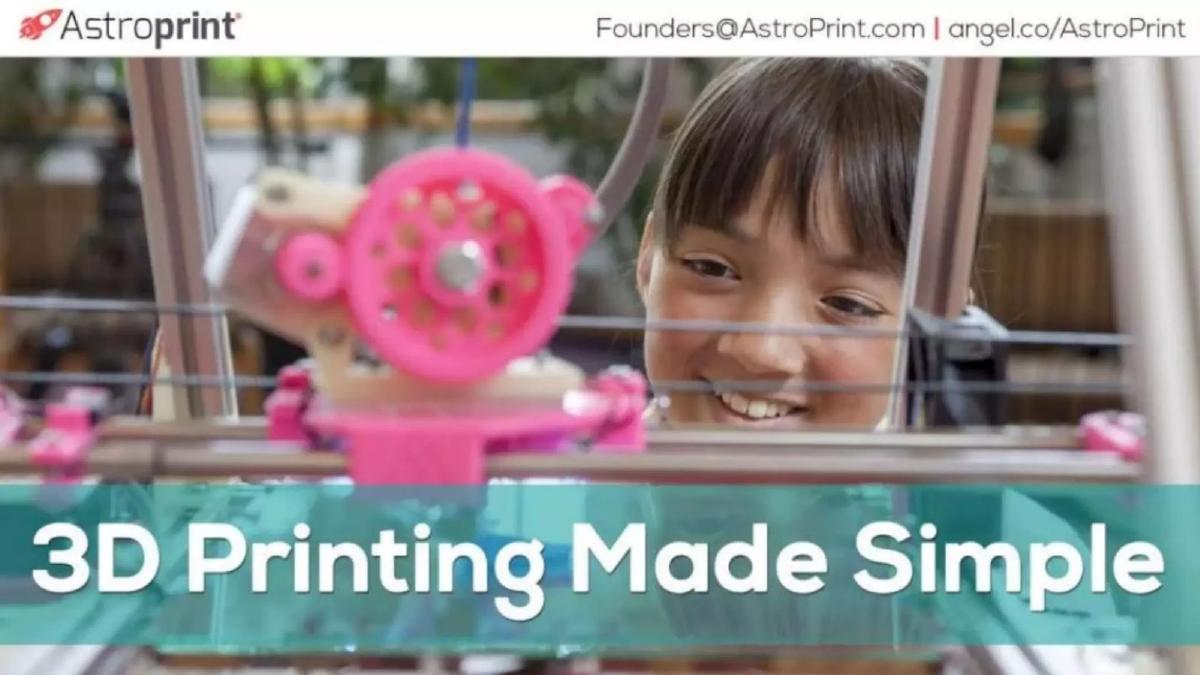
The deck opens with a standard title slide featuring the company logo and contact information. Slide 2 immediately pivots to a human-centric image of a young girl looking at a 3D printer, captioned '3D Printing Made Simple.' This sets the emotional hook, suggesting that the technology should be accessible even to children.
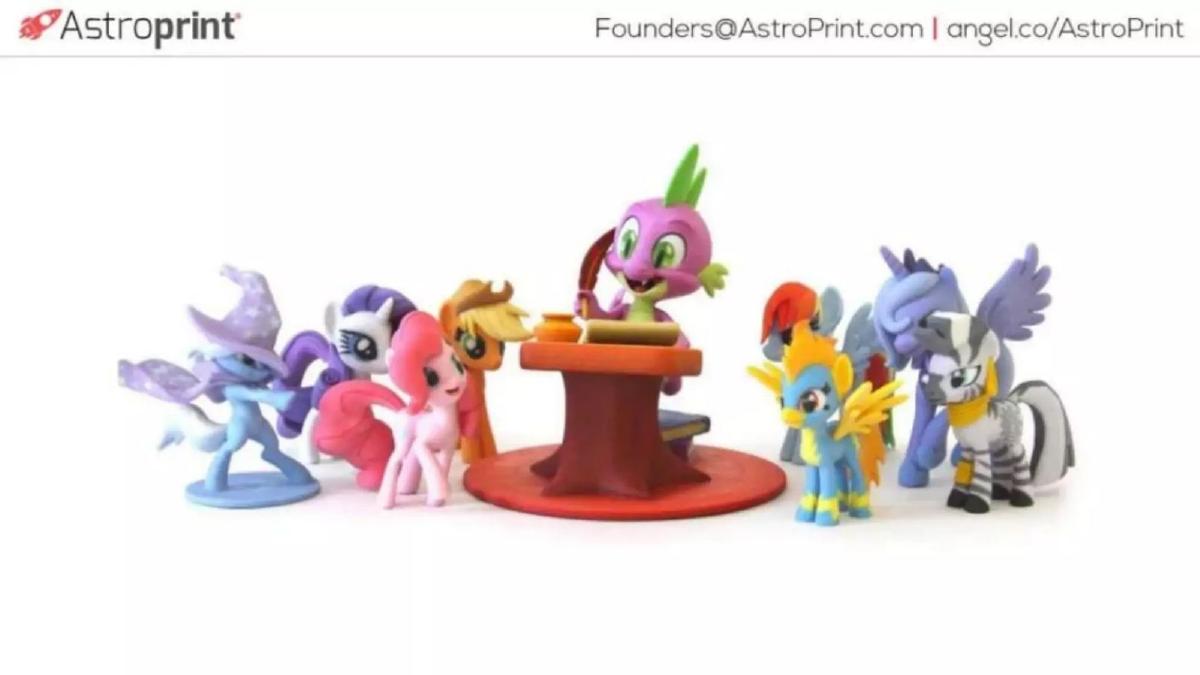
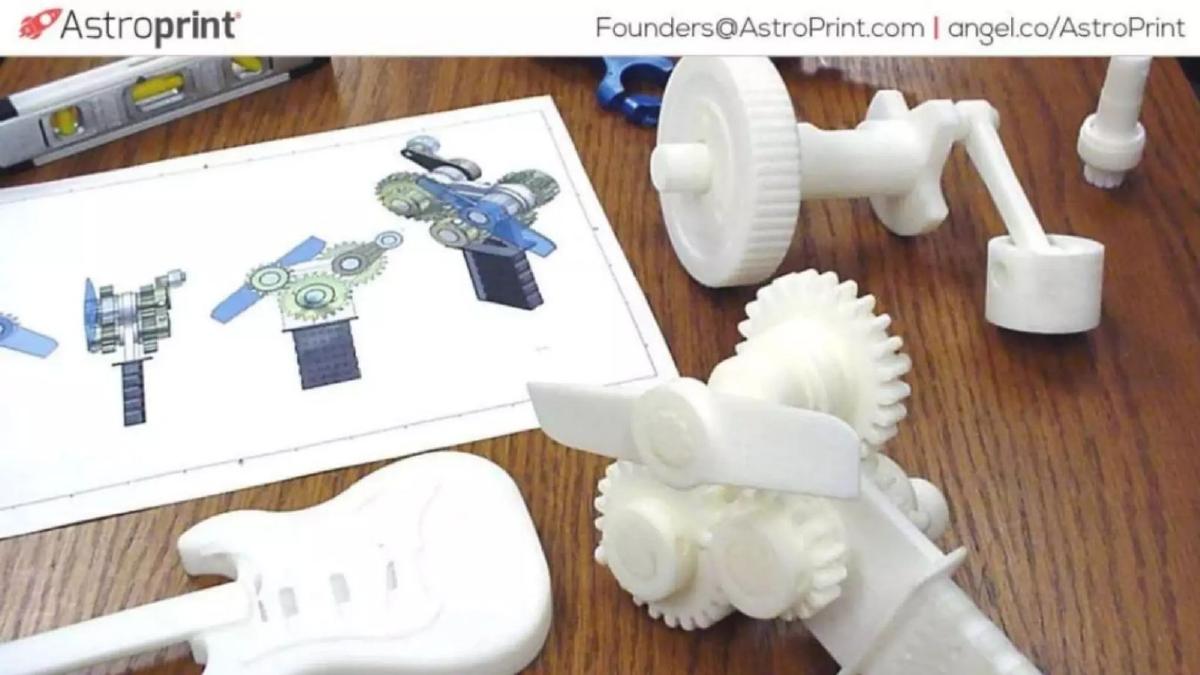
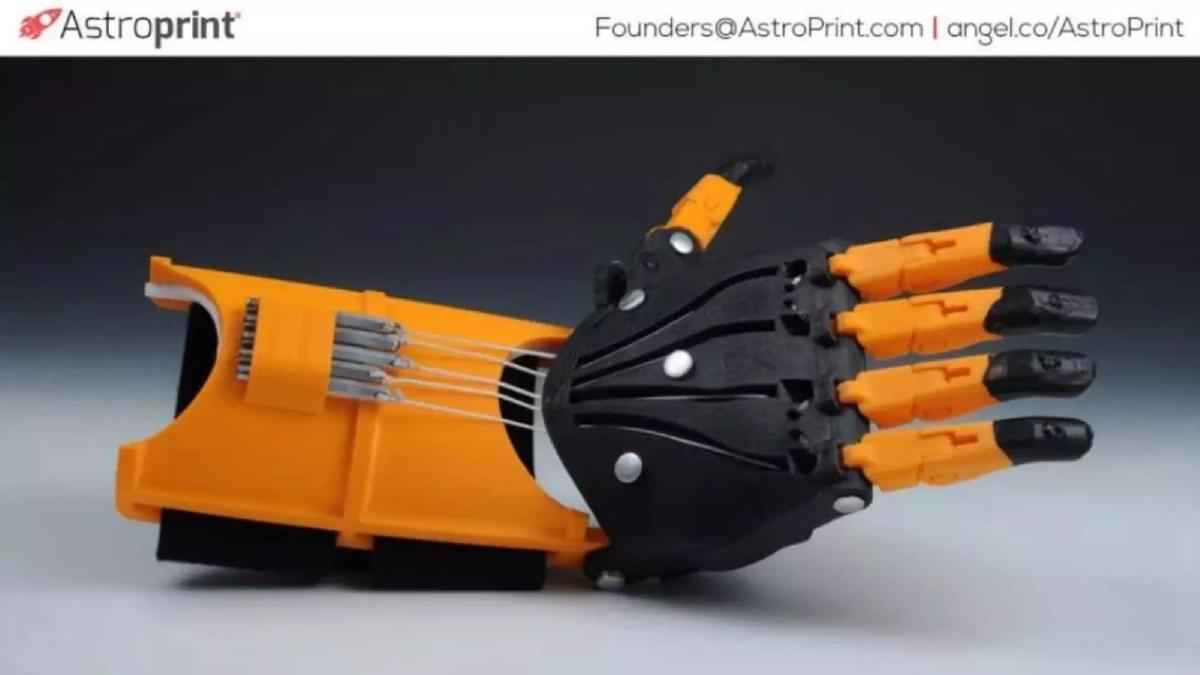
Slides 3 through 6 function as a gallery of what is possible. Slide 3 shows colorful toy figurines (My Little Pony characters), slide 4 shows complex mechanical gears and a guitar body, slide 5 features a functional prosthetic hand, and slide 6 shows Martha Stewart with a 3D printer and home goods. By moving from toys to industrial parts to medical devices to lifestyle products, AstroPrint establishes that their software isn't for a niche—it is the gateway to the entire additive manufacturing industry. There is no text on these slides, forcing the viewer to focus on the tangible outputs of the technology.
Slides 7-8: The Problem Defined by Chaos
Slide 7 is the most effective 'Problem' slide in the deck. It features a 3x5 grid of 15 different technical settings screens. Each screen is filled with checkboxes, sliders, and esoteric parameters like 'infill,' 'travel speed,' and 'skirt.' For a non-expert, this represents an insurmountable wall of complexity. It perfectly visualizes the 'before' state of the industry.
Slide 8 follows this up with the consequence of that complexity: a failed print. The image shows a blue plastic object that has collapsed into a mess of 'spaghetti' strands. This slide communicates that when software is too hard to use, the hardware fails, wasting time and material. Together, these two slides create a powerful tension that the next section promises to resolve.
Slides 9-10: The Solution and Ecosystem
Slide 9 introduces the 'After' state. It shows a tablet interface with a clean, modern design. The text is bold and instructional: 'Upload a design, choose 3 simple settings, and hit print!' This directly counters the 15 screens of complexity shown just two slides prior. It positions AstroPrint as a cloud-based abstraction layer that handles the technical heavy lifting.
Slide 10 expands the vision from a simple tool to a platform. A central hand holding a smartphone is surrounded by icons representing cloud storage, social sharing, and remote monitoring. Crucially, the slide features the logos of Amazon, Staples, Shapeways, and UPS. While the deck doesn't explicitly state the nature of these relationships, their inclusion suggests that AstroPrint aims to be the connective tissue between consumers, retailers, and logistics providers in the 3D printing ecosystem.
Slides 11-12: Traction and Growth Metrics
Having established the 'What' and 'Why,' the deck moves to 'How well is it working?' Slide 11 focuses on community validation via Kickstarter. It notes that the company hit its goal in less than 1 day and eventually reached 400% of its initial goal. For a seed-stage company, this is a vital proof of market demand.
Slide 12 provides the hard data. A user growth chart shows a steady climb from October to January, culminating in a '67% MoM Growth' figure. The chart shows the user base approaching the 4,000 mark. By including a dashed line for February projections, the founders indicate a clear upward trajectory. This slide provides the quantitative 'teeth' to the qualitative visual story told in the first half of the deck.
Slides 13-14: The Hardware and The Team
Slide 13 shows the software in action, controlling a high-end 3D printer (an Airwolf 3D model) via a tablet. This reinforces the cross-platform, remote-management capabilities of the software. It proves the product isn't just a concept but a functional tool integrated with existing hardware.
The final slide (Slide 14) introduces the founders: Drew Taylor (CEO), Daniel Arroyo (CTO), and Joshua White (CDO). Below the headshots, the slide lists six media logos: TechCrunch, Make:, Tech Cocktail, 3D Printing Industry, Brit+Co, and Small Business Trends. This 'as seen in' section serves as a final layer of social proof, suggesting that the industry's most influential voices are already paying attention to AstroPrint.
What Works in the AstroPrint Deck
Visual Contrast: The transition from the 'grid of doom' (Slide 7) to the 'three simple settings' (Slide 9) is a textbook example of how to visualize a value proposition. It makes the benefit of the software immediately obvious without requiring the reader to understand the underlying technology.
Traction Over Theory: By leading with Kickstarter success and month-over-month growth, the deck avoids the trap of spending too much time on 'market potential' and instead focuses on 'market reality.' The 67% MoM growth figure is a compelling reason for an investor to take a meeting.
Use-Case Diversity: The inclusion of everything from toys to prosthetics (Slides 3-6) demonstrates that the software is a horizontal platform. This expands the perceived Total Addressable Market (TAM) without the founders having to write a single word about market size.
What is Missing from the AstroPrint Deck
Business Model: There is no mention of how AstroPrint intends to make money. Is it a SaaS subscription for individuals? An enterprise license for printer manufacturers? A transaction fee on print jobs? The deck leaves the revenue engine entirely to the imagination.
Competitive Landscape: The 3D printing software space was becoming crowded in 2013 with both open-source tools (like Cura or Slic3r) and proprietary solutions from printer manufacturers. The deck does not explain why AstroPrint is defensible against these incumbents.
The Ask: The deck concludes without a funding slide. There is no mention of how much money is being raised, the valuation, or the milestones the team intends to hit with the new capital. While this information is often handled in a separate document or a follow-up conversation, its absence makes the deck feel more like a product presentation than a complete investment vehicle.
What a Founder Should Copy
The 'Show, Don't Tell' Philosophy: Founders should emulate the way AstroPrint uses images to define the problem. If your product simplifies a complex process, find a way to visually represent that complexity (like the settings grid on Slide 7) and contrast it with your interface.
Focus on Momentum: If you have a successful crowdfunding campaign or a high growth rate, make those the centerpiece of your traction section. AstroPrint’s use of the 'Goal Hit in Clean Design: The deck uses a consistent header with contact info and a clean, white-space-heavy layout. This professional aesthetic mirrors the 'simplicity' of the product they are selling, creating a cohesive brand experience for the investor.
Conclusion
AstroPrint's deck is a high-signal, low-noise presentation. It successfully identifies a massive pain point in a growing industry and provides evidence that they have built a solution people actually want. While it leaves significant questions unanswered regarding monetization and competition, it succeeds in its primary goal: creating enough intrigue and proof of momentum to justify a $2.2 million seed round. For founders in technical spaces, this deck is a reminder that the best way to sell a complex product is to show how simple you can make it.
Frequently asked questions
- What is the primary problem AstroPrint aims to solve?
- AstroPrint addresses the extreme technical complexity of 3D printing software. Slide 7 illustrates this by showing a confusing array of technical menus and parameters that users currently have to navigate. Slide 8 shows a failed print, implying that this complexity leads to wasted time and materials for non-expert users.
- How does AstroPrint demonstrate market validation?
- The company uses two primary metrics for validation. First, slide 11 highlights a Kickstarter campaign that reached its funding goal in less than 24 hours and eventually hit 400% of its target. Second, slide 12 shows a 67% month-over-month user growth rate, trending toward 4,000 users at the time of the pitch.
- What is missing from the AstroPrint pitch deck?
- The deck is missing several standard components: there is no slide explaining the revenue model or how they make money, no competitive analysis comparing them to other slicing or management software, and no 'Ask' slide detailing how much capital they are raising or how it will be spent.
- How does the deck position the product's ease of use?
- Slide 9 explicitly states the value proposition: 'Upload a design, choose 3 simple settings, and hit print!' This is reinforced by an image of a user interacting with the software on a tablet, suggesting a modern, touch-friendly interface that contrasts with the desktop-heavy complexity shown earlier.
- Who are the founders of AstroPrint?
- According to slide 14, the founding team consists of Drew Taylor (CEO), Daniel Arroyo (CTO), and Joshua White (CDO). The slide also lists press mentions from TechCrunch, Make:, Tech Cocktail, 3D Printing Industry, Brit+Co, and Small Business Trends to establish credibility.