ASP Isotopes (ASPI) is positioning itself as a critical infrastructure player in the global isotope market. The deck highlights a massive supply chain vulnerability: Russia currently controls 85% of historical isotope production, according to slide 5. ASPI intends to disrupt this with its 'Quantum Enrichment' technology, which claims a single-stage process compared to the 50 to 500 stages required by traditional centrifugation or gaseous diffusion (slide 25). The company targets high-value markets including medical imaging (SPECT and PET), quantum computing, and nuclear energy. With a leaders…
Key takeaways
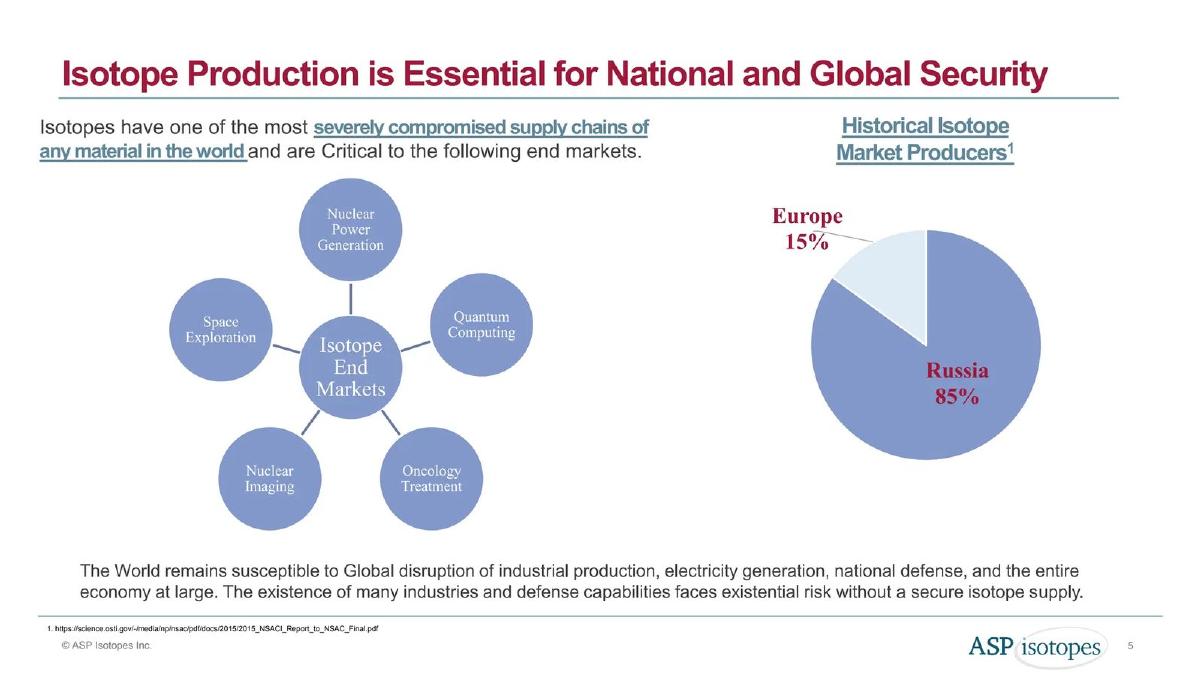
- Russia dominates 85% of the historical isotope market, creating an existential risk for global supply chains (Slide 5).
- The company's proprietary Quantum Enrichment technology requires only a single stage, whereas Gaseous Diffusion requires 500 stages (Slide 25).
- Medical imaging represents a multi-billion dollar opportunity, with the SPECT market valued at $4.61B and Technetium-99 accounting for $4.17B of that (Slide 13).
- ASP Isotopes aims to achieve annual positive operating cash flow as a primary market milestone (Slide 9).
- Commercial production at enrichment facilities in South Africa is slated for late 2023 to early 2024 (Slide 9).
- The company plans to address the environmental issue of depleted UF6 tails by processing waste into HALEU (Slide 29).
- Leadership includes a CEO with 20+ years of Wall Street experience and a CTO who co-developed the Aerodynamic Separation Process (Slide 33).
- Future growth targets include isotopes for quantum computing (Silicon-28) and molten salt reactors (Chlorine-37) (Slide 17).
Executive Summary: The Geopolitical Isotope Play
The ASP Isotopes (ASPI) Corporate Overview from October 2023 is not a typical software-as-a-service pitch. It is a deep-tech, infrastructure-heavy proposal that leverages current geopolitical tensions to justify a new approach to isotope enrichment. The deck focuses heavily on the 'why now,' citing the dangerous reliance on Russian supply chains for materials critical to healthcare and energy. By emphasizing a proprietary, single-stage enrichment process, ASPI argues it can produce these materials faster, cheaper, and more reliably than legacy state-owned incumbents.
Slide 1: Title and Corporate Identity
The deck opens with a clean, professional title slide: "ASP Isotopes Corporate Overview - October 2023." The branding is clinical and scientific, featuring a hexagonal molecular background that reinforces the company's focus on chemistry and physics. There is no tagline on this slide, letting the company name and the date set a formal tone for institutional investors.
Slide 5: The Problem of Global Supply Chain Concentration
This is the 'hook' of the deck. ASPI identifies isotope production as "Essential for National and Global Security." The slide highlights that isotopes have one of the most "severely compromised supply chains of any material in the world." The most striking data point is a pie chart showing that Russia accounts for 85% of historical isotope production, while Europe accounts for only 15%. The slide lists five critical end markets: Nuclear Power Generation, Quantum Computing, Oncology Treatment, Nuclear Imaging, and Space Exploration. The takeaway is clear: the world is at the mercy of a single geopolitical actor for materials that keep hospitals running and the lights on.
Slide 9: Anticipated Milestones
ASPI divides its roadmap into Market Milestones and Operational Milestones. On the market side, the company aims to secure at least two additional supply agreements for healthcare isotopes and enter contracts for the 2025-2028 timeframe. Crucially, they state a goal to "Generate sufficient revenues for the company to have annual positive operating cash flow," though no specific date is attached to this financial goal. Operationally, the deck promises the start of commercial production in South Africa by "Late 2023-Early 2024" and the start of construction on a second facility in a low-energy-cost location by the second half of 2024.
Slide 13: High-Value Medical Imaging Markets
This slide focuses on the immediate commercial opportunity in nuclear medicine. It breaks down two categories: SPECT and PET. The SPECT market is valued at $4.61B, with Technetium-99 (99Tc) representing $4.17B of that total. The slide notes that 80-85% of all SPECT procedures use 99Tc. The PET market is smaller at $1.15B, but the deck highlights Gallium-68 (68Ga) as a high-growth area, particularly for prostate cancer identification, where it offers 76/97% sensitivity/specificity compared to much lower rates for MRI alone. By targeting these isotopes, ASPI is moving into markets with established demand and high price points.
Slide 17: Expanding the Portfolio to Quantum and Fusion
Beyond medical imaging, ASPI looks toward frontier technologies. This slide lists four "Other Isotopes": Silicon-28 for Quantum Computing (requiring >99.99% purity), Ytterbium-176 for Oncology (specifically for producing Lutetium-177), Chlorine-37 for Molten Salt Reactors, and Lithium-6 for Nuclear Fusion. The inclusion of Silicon-28 is particularly notable, as the slide claims it is "not available at any price at commercial scale," suggesting a potential monopoly position for ASPI if they can successfully enrich it.
Slide 21: The Nuclear Energy Renaissance
ASPI ties its success to the global push for "Green Nuclear Energy." The slide argues that to reach Net Zero by 2050, global nuclear energy output must double. It highlights energy security concerns, noting that the U.S. imports 95% of its uranium, with 81% of enrichment coming from overseas. The slide also lists aggressive nuclear expansion plans by country: the UK (8 new plants), France (up to 6 new reactors), India (10 new reactors), and China (19 under construction). This provides the macro-economic justification for ASPI’s enrichment technology as a domestic alternative to foreign imports.
Slide 25: Technology Comparison - The 'Quantum' Advantage
This is the most technical and critical slide for validating the company's competitive advantage. It compares six enrichment methods: Gaseous Diffusion, Centrifugation, MLIS, AVLIS, Silex Systems, and ASPI’s "Quantum Enrichment." The table shows that Quantum Enrichment requires only a "Single stage" to reach desired enrichment levels, compared to 50 stages for Centrifugation and 500 stages for Gaseous Diffusion. It also claims the highest selectivity (α ≥ 50) and low capital costs. If these figures are accurate, ASPI possesses a generational leap in efficiency that would make legacy enrichment plants obsolete.
Slide 29: Solving the Nuclear Waste Problem
ASPI addresses the environmental downside of nuclear power: depleted UF6 tails. The slide notes that 1.69 million tons of this waste have accumulated globally, with 700,000 tons in the USA alone. ASPI claims its process can convert this waste into HALEU (High-Assay Low-Enriched Uranium), which is the fuel required for many next-generation small modular reactors (SMRs). This positions the company not just as a producer, but as a recycler that can solve a major political hurdle for the nuclear industry.
Slide 33: Leadership Team
The final slide presented covers the leadership team. Paul Mann (Chairman and CEO) brings the financial pedigree, with 20+ years on Wall Street at Soros and Morgan Stanley. Sergey Vasnetsov (Vice-Chairman) adds strategic depth from his time at LyondellBasell and Barclays. The technical weight comes from Dr. Hendrik Strydom (CTO), who co-developed the Aerodynamic Separation Process and has spent decades researching laser isotope separation. The team represents a balanced mix of capital markets expertise and specialized physics.
What Works in This Deck
The Geopolitical Narrative: The deck does an excellent job of framing a technical product as a solution to a global security crisis. By citing the 85% Russian market share early on, they create a sense of urgency that transcends simple profit motives. Investors are more likely to fund a company that feels "inevitable" due to political necessity.
Clear Market Segmentation: Rather than claiming to do "everything nuclear," the deck specifically identifies Molybdenum-100, Zinc-68, and Silicon-28. This specificity allows investors to model the TAM (Total Addressable Market) based on known medical and industrial procedures.
Technical Differentiation: The comparison table on slide 25 is the strongest piece of evidence in the deck. By showing the "Single stage" requirement versus the hundreds of stages required by competitors, they provide a clear, quantifiable reason why their business model could have superior margins.
What Is Missing or Omitted
Unit Economics: While the deck mentions "low capital costs" and "low energy costs," it does not provide a single dollar figure for the cost of production per gram or kilogram of any specific isotope. Without these figures, the claim of being a low-cost producer remains unverified.
Regulatory and Licensing Path: Enrichment is one of the most heavily regulated industries on earth. The deck mentions a facility in South Africa and a future one elsewhere, but it does not detail the status of nuclear licenses, export controls, or international safeguards (IAEA) compliance. For a company in this sector, the regulatory hurdle is often higher than the technical one.
Detailed Financials: There is no slide showing projected revenue, burn rate, or the specific amount of capital being raised in this round. While this may be a "Corporate Overview" rather than a pure "Pitch Deck," the lack of a clear 'Ask' or financial roadmap is a notable omission for a fundraising teardown.
Founder Takeaways: What to Copy
Use Macro Trends to Justify Micro Solutions: ASP Isotopes doesn't just say they have a better laser; they say the world is running out of oncology treatments because of a war. Founders should always link their specific product to a larger, undeniable global trend (e.g., energy security, supply chain reshoring).
The 'Comparison Table' Done Right: Slide 25 is a masterclass in competitive positioning. It doesn't just use checkmarks; it uses specific technical metrics (Selectivity, SWU, Stages). If you have a technical advantage, prove it with the industry-standard units of measure that experts in the field will recognize.
Address the 'Waste' or 'Downside' of Your Industry: By including a slide on depleted UF6 tails, ASPI turns a common criticism of nuclear energy into a business opportunity. Founders in controversial or high-impact industries should look for ways to turn their sector's biggest liability into their company's unique value proposition.
Frequently asked questions
- What is the primary problem ASP Isotopes is solving?
- The primary problem is a severely compromised global supply chain for isotopes. As shown on slide 5, Russia produces 85% of the world's isotopes. This concentration creates significant risks for nuclear power, oncology treatments, and national defense. ASP Isotopes intends to provide a decentralized, Western-aligned production capability to mitigate these geopolitical risks.
- How does their technology differ from traditional enrichment?
- According to slide 25, ASP Isotopes uses 'Quantum Enrichment.' Unlike Gaseous Diffusion, which requires 500 stages and 2500 kWh/SWU, or Centrifugation, which requires 50 stages, their method is a 'Single stage' process. It claims low capital costs, small physical size, and high selectivity (α ≥ 50), making it significantly more efficient than legacy methods.
- What are the key medical markets for their isotopes?
- The deck identifies two major medical imaging markets on slide 13: SPECT (Single-photon emission computed tomography) and PET (Positron emission tomography). The SPECT market is $4.61B, dominated by Technetium-99 ($4.17B). The PET market is $1.15B, with Gallium-68 being a key isotope for identifying prostate cancers with high sensitivity.
- What is the company's plan for nuclear waste?
- Slide 29 explains that traditional uranium enrichment produces 'depleted UF6 tails,' which are a growing environmental problem with nearly 1.7 million tons accumulated globally. ASP Isotopes claims their process can convert this waste into HALEU (High-Assay Low-Enriched Uranium), potentially turning a liability into a high-value fuel source for next-generation reactors.
- Who is leading the company?
- The leadership team (Slide 33) is a mix of finance and science. CEO Paul Mann has over 20 years of experience at firms like Soros Fund Management and Morgan Stanley. CTO Dr. Hendrik Strydom is a physicist who co-developed the Aerodynamic Separation Process and previously led Klydon, the predecessor company.