Worldr’s pitch deck is a textbook example of how to sell into the enterprise security space by highlighting high-stakes compliance failures. By citing specific $200 million fines and federal secrecy orders on Slide 2, the company establishes immediate urgency. The deck avoids the common pitfall of asking users to switch platforms, instead showcasing a product that integrates directly into Microsoft Teams (Slide 3). With a heavy emphasis on intellectual property (Slide 4) and a leadership team boasting experience from UBS, Credit Suisse, and Kaspersky (Slide 7), Worldr builds a narrative of te…
Key takeaways
- The problem is framed through massive regulatory fines, citing JPMorgan's $200 million penalty for WhatsApp usage on Slide 2.
- Worldr positions itself as a 'zero trust' layer for existing platforms like Microsoft Teams rather than a standalone competitor (Slide 3).
- The company highlights technical defensibility by listing three pending patent applications for encryption and data loading on Slide 4.
- Traction is demonstrated through a two-pronged approach: high-value Enterprise PoCs (Slide 5) and mid-market revenue growth (Slide 6).
- The leadership slide (Slide 7) is exceptionally strong, featuring logos from major financial institutions like Bloomberg and UBS to signal industry trust.
- Market pull is validated by direct customer quotes expressing a need for 'protection for the whole 365 stack' on Slide 8.
- The deck utilizes a 'teaser' format, omitting a specific 'Ask' or detailed financial projections, likely to drive follow-up meetings.
- The visual design uses a dark, high-contrast theme to reinforce the 'security' and 'privacy' branding throughout the 17 slides.
Introduction: The Zero-Trust Overlay Strategy
Worldr’s 17-slide deck is a strategic masterclass in positioning a cybersecurity product within the existing enterprise ecosystem. Rather than trying to unseat giants like Microsoft or Slack, Worldr positions itself as the essential security layer that makes those tools compliant for high-stakes industries like finance and law. The deck, which supported an $11M Seed round in 2023, relies heavily on fear, uncertainty, and doubt (FUD) regarding centralized data storage, backed by credible regulatory threats.
Slide 1: The Hook
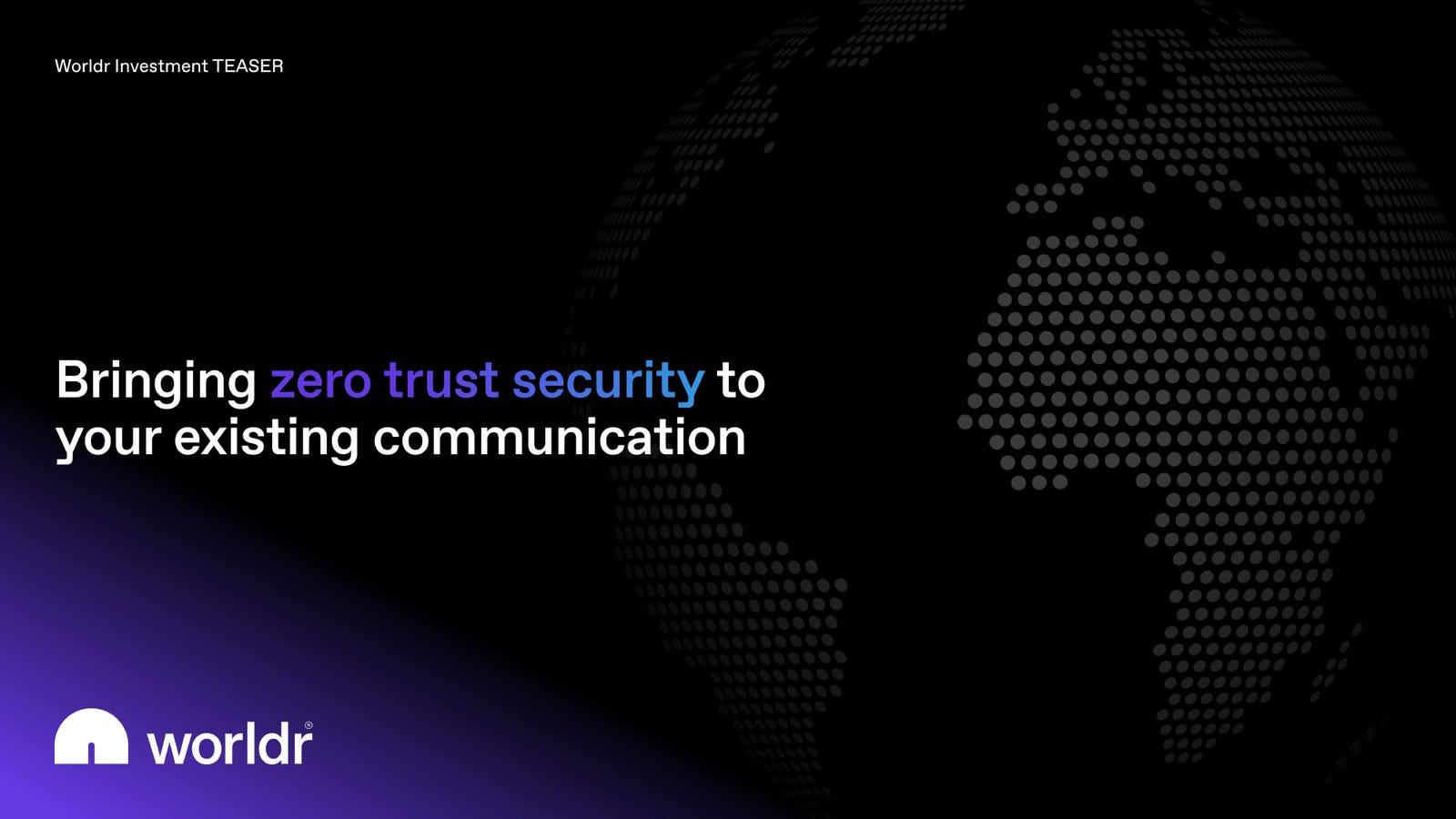
The title slide is minimalist, featuring the company logo and the tagline: "Bringing zero trust security to your existing communication." This immediately answers the 'what' and 'how' of the business. By emphasizing 'existing communication,' Worldr signals to investors that they have solved the adoption hurdle—the hardest part of enterprise software.
Slide 2: The Problem as a Financial Liability
Slide 2, titled "Breaking News," is the most aggressive slide in the deck. It targets Microsoft directly, stating that centralized services are now the "biggest targets" for hackers. It cites three specific third-party sources to validate the threat: The Register (July 2021) regarding federal secrecy orders, CNBC (December 2021) regarding "$200 million in fines" for JPMorgan, and TechCrunch (March 2022) regarding the Lapsus$ breach of Microsoft source code. This isn't just a security problem; it's a multi-million dollar compliance and legal risk.
Slide 3: Product Integration and UI
The "Product Overview" slide shows a clean screenshot of the Worldr interface living inside Microsoft Teams. The copy emphasizes that users can "secure your critical data, without leaving the platforms you love." This is a critical value proposition for IT departments who struggle with 'shadow IT' (employees using unapproved apps like WhatsApp because the corporate tools are too clunky). The slide also notes that the architecture can be deployed in "minutes for any size organization," addressing the common concern that security software is difficult to install.
Slide 4: Intellectual Property as a Moat
To justify a Seed valuation in a crowded cybersecurity market, Worldr highlights its "3 patent applications pending." While the specific details are blurred in the redacted version, the categories are visible: "Indirect Certificate Pinning," "Intelligent Loading of Data," and "Transparent Encryption of Database." This slide tells investors that the company isn't just a UI wrapper; it has proprietary technology that is difficult to replicate.
Slide 5 & 6: The Traction Proof
Slide 5 focuses on "Enterprise PoCs," showing four blurred logos with flags representing the UK, UAE, Switzerland, and the USA. This demonstrates global demand. Slide 6, titled "Mid market success," shows a grid of 12 company logos that signed on in Q2. Although the "Q2 Total Revenue" and "H1 Revenue" figures are redacted, the sheer volume of logos suggests a repeatable sales motion. The distinction between 'Enterprise PoCs' and 'Mid market success' shows a sophisticated understanding of different sales cycles.
Slide 7: The Leadership Team
The "Worldr leadership" slide is arguably the strongest in the deck. It features 11 individuals with impressive pedigrees. The logos on the left— UBS, Credit Suisse, Bloomberg, Novartis, Bumble, Kaspersky —act as a proxy for trust. If people from these institutions are building the product, the assumption is that they understand the rigorous security requirements of those same institutions. Notable mentions include Max Buchan (CEO), noted as "CoinShares Employee no 1," and Andreas Wuchner (CISO), who held CISO roles at UBS and Novartis.
Slide 8: Market Pull and Roadmap
This slide combines social proof with future planning. It includes quotes from potential or current customers, one of whom states, "Our problem with WhatsApp is right now 10x of a bigger problem than our Teams rollout." This validates the 'Breaking News' slide from earlier. The "Roadmap" at the bottom covers Q3'22 to Q1'23, though the specific milestones are blurred. This timeline suggests the deck was likely used in mid-to-late 2022, leading up to the 2023 funding announcement.
Slide 9: The Close
The final slide is a simple "Thank you!" with a 3D graphic of a lock and the CEO's email address. It maintains the dark, sleek aesthetic of the rest of the deck.
What Worldr Does Well
1. Problem-Solution Alignment: The deck starts with a massive, expensive problem (fines and breaches) and immediately presents a solution that doesn't require changing user behavior. This is the 'holy grail' of enterprise sales.
2. Credibility by Association: By listing logos like UBS and Bloomberg next to their team members, Worldr bypasses the 'startup risk' perception. They look like industry veterans solving an industry problem.
3. Technical Defensibility: Mentioning patents early (Slide 4) is a smart move for a Seed round, as it gives investors confidence that the company can maintain its lead even if a larger competitor tries to copy the 'overlay' strategy.
What is Missing from the Deck
1. The Ask: As a 'teaser' deck, this version omits the specific amount being raised and the intended use of funds. While common in initial outreach, a full pitch would need to detail how the $11M will be allocated between engineering, sales, and marketing.
2. Unit Economics: There is no mention of Customer Acquisition Cost (CAC), Lifetime Value (LTV), or churn rates. While Slide 6 shows revenue growth, it doesn't explain the cost of achieving that growth.
3. Competitive Landscape: The deck assumes the only competition is 'centralized services' like Microsoft. It does not address other encryption layers or secure messaging alternatives like Signal or Wickr, which a sophisticated VC would certainly ask about.
Founder Takeaways
Sell the 'Layer,' not the 'Replacement': If you are entering a market dominated by a giant (like Microsoft), don't try to replace them. Show how you make the giant better or safer. Worldr’s 'without leaving the platforms you love' is a powerful hook.
Use Third-Party Validation: Don't just say there is a problem; show a screenshot of a $200 million fine. External news sources carry more weight than founder claims.
Structure Your Team Slide for Trust: If your team has worked at prestigious companies, put those logos front and center. In cybersecurity and fintech, where trust is the primary currency, these logos are more important than the bullet points of what the individuals actually did there.
Frequently asked questions
- What is Worldr's core product offering?
- As shown on Slide 3, Worldr provides a zero-trust security layer that integrates into existing communication platforms like Microsoft Teams. It allows organizations to secure sensitive data and prevent external breaches without forcing employees to leave the software they already use, supporting both cloud-based and on-premise environments.
- How does Worldr justify the need for its service?
- The deck uses 'Breaking News' headlines on Slide 2 to highlight the vulnerability of centralized services. It specifically mentions that Microsoft is a target for hackers and that companies like JPMorgan have faced $200 million in fines for failing to control employee communications on non-compliant apps like WhatsApp.
- What kind of team is behind Worldr?
- Slide 7 shows a highly experienced team divided into Founding, Technical, Operational, and Commercial leads. The team includes a CISO with experience at UBS and Novartis, a Director of IT Security with a PhD in Theoretical Astrophysics, and members who previously worked at Bloomberg, Kaspersky, and Credit Suisse.
- Does the deck show any revenue or traction?
- Yes, Slide 6 focuses on 'Mid market success' and mentions that H1 revenue is 'Approaching' a specific (redacted) figure. It also lists 12 company logos as Q2 customers. Additionally, Slide 5 highlights four Enterprise Proof of Concepts (PoCs) across the UK, UAE, Switzerland, and the US.
- What technical defensibility does Worldr claim?
- On Slide 4, the company states it has three patent applications pending. These cover 'Indirect Certificate Pinning,' 'Intelligent Loading of Data,' and 'Transparent Encryption of Database,' suggesting a deep technical moat beyond simple software integration.