Writer's Series A deck is a clinical example of how to position a specialized SaaS product against a dominant incumbent like Grammarly. By framing writing as the 'last unstructured major business process' (Slide 2), the company moves beyond simple grammar checking into the realm of enterprise operations. The deck relies heavily on social proof, showcasing logos like Intuit, Twitter, and Deloitte (Slide 10) to validate its enterprise readiness. Crucially, it addresses the primary enterprise concern—data privacy—by explicitly stating 'Your data isn't the product' (Slide 9). While the deck lacks…
Key takeaways
- The deck identifies writing as the last major unstructured business process to be systemized (Slide 2).
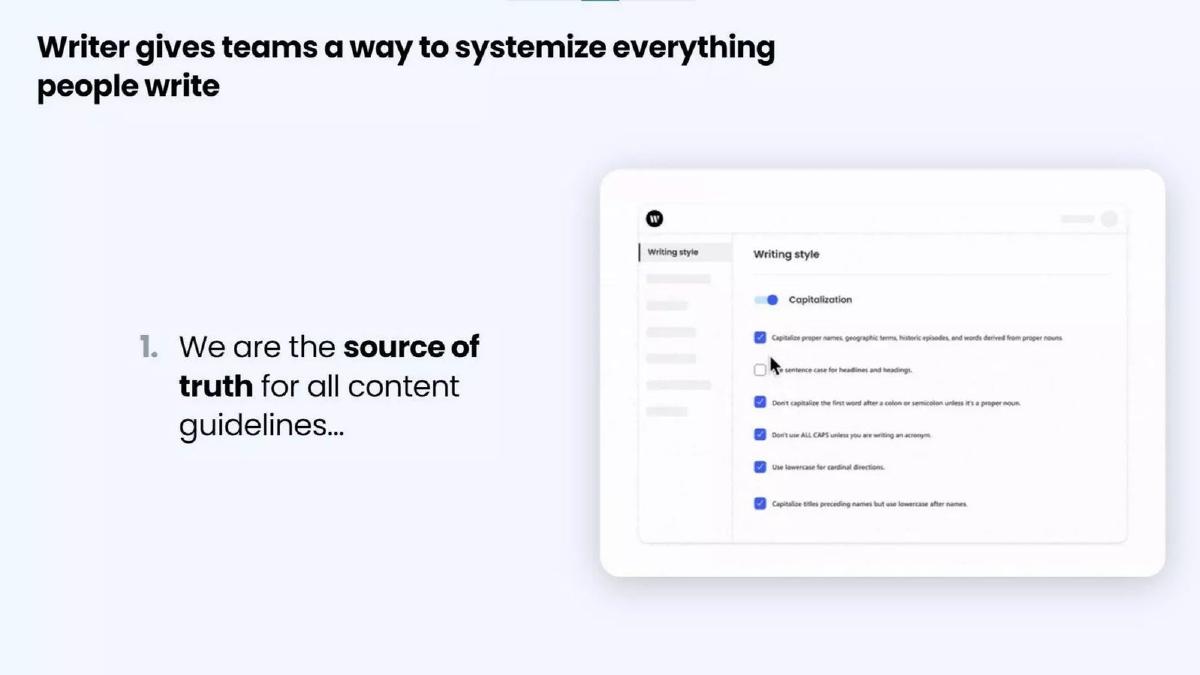
- Writer positions itself as a 'source of truth' for content guidelines rather than just a spellchecker (Slide 4).
- The product integrates directly into existing workflows across 16+ major platforms including Salesforce and GitHub (Slide 8).
- Privacy is a core value proposition, with a promise that user data is never used for machine learning models (Slide 9).
- The company demonstrates significant enterprise traction with logos like Accenture, Deloitte, and UnitedHealthcare (Slide 10).
- Pricing is tiered from a free personal tier to an $18/user 'Team' tier and a custom 'Enterprise' tier (Slide 11).
- Engagement metrics show high DAU/MAU retention, with self-service and sales-assisted cohorts both exceeding 40% (Slide 13).
- A direct feature-by-feature comparison explicitly targets Grammarly Business as the primary competitor (Slide 14).
Introduction: The Shift from Grammar to Governance
In 2020, Writer raised $26,000,000 in a Series A round to take on the giants of the writing assistant space. At the time, the market was dominated by consumer-focused tools. Writer's strategy, as evidenced by this deck, was to pivot the conversation toward enterprise governance, brand consistency, and data security. This teardown examines how they successfully positioned an AI tool as a 'business process' rather than a 'writing widget.'
Slides 1-2: The Macro Thesis
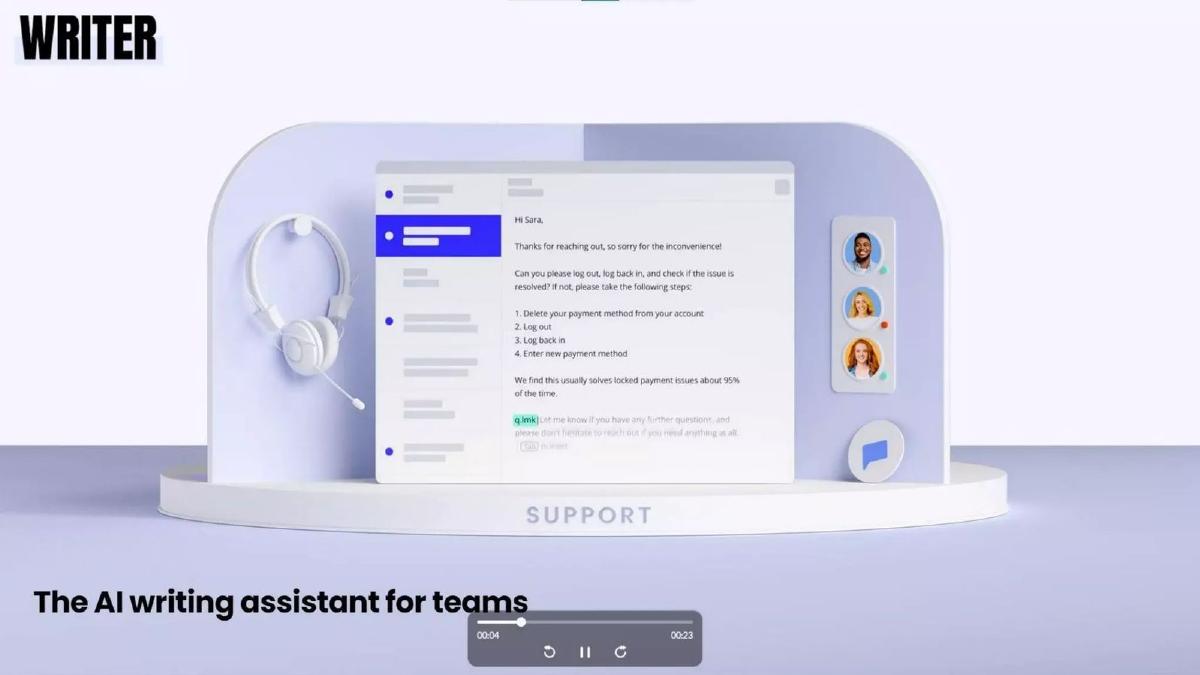
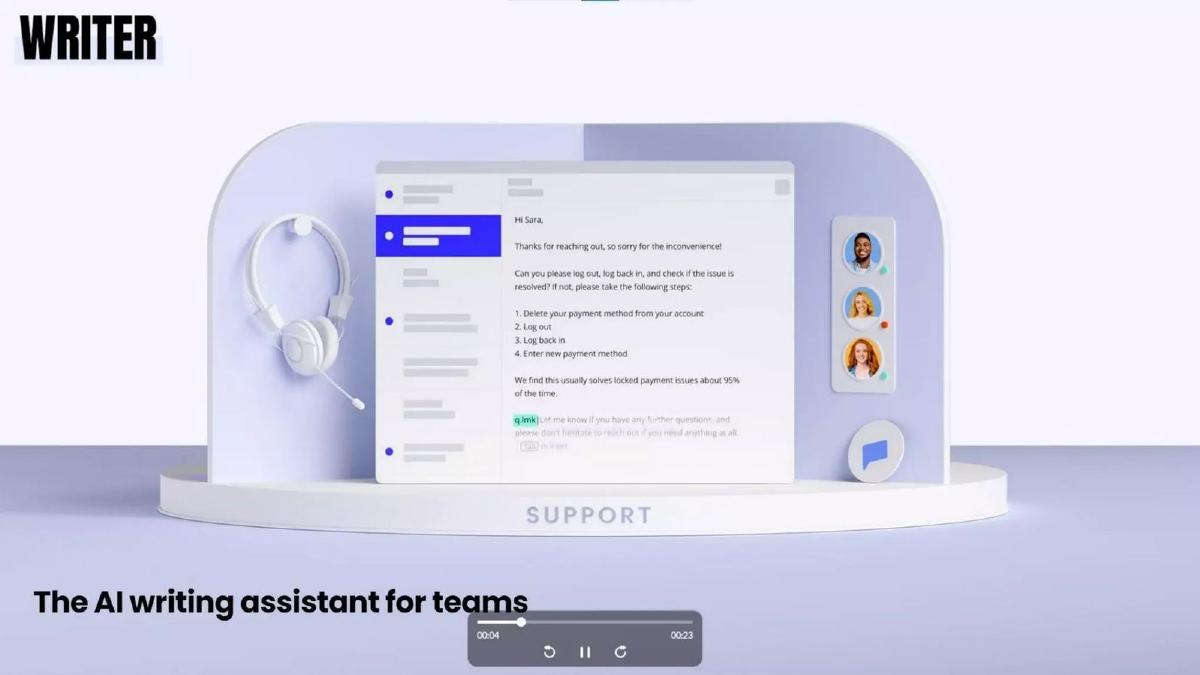
Slide 1 is a clean title slide introducing 'The AI writing assistant for teams.' It features a 3D render of a support environment, immediately signaling that this isn't just for novelists or students—it is for professional functions like customer support.
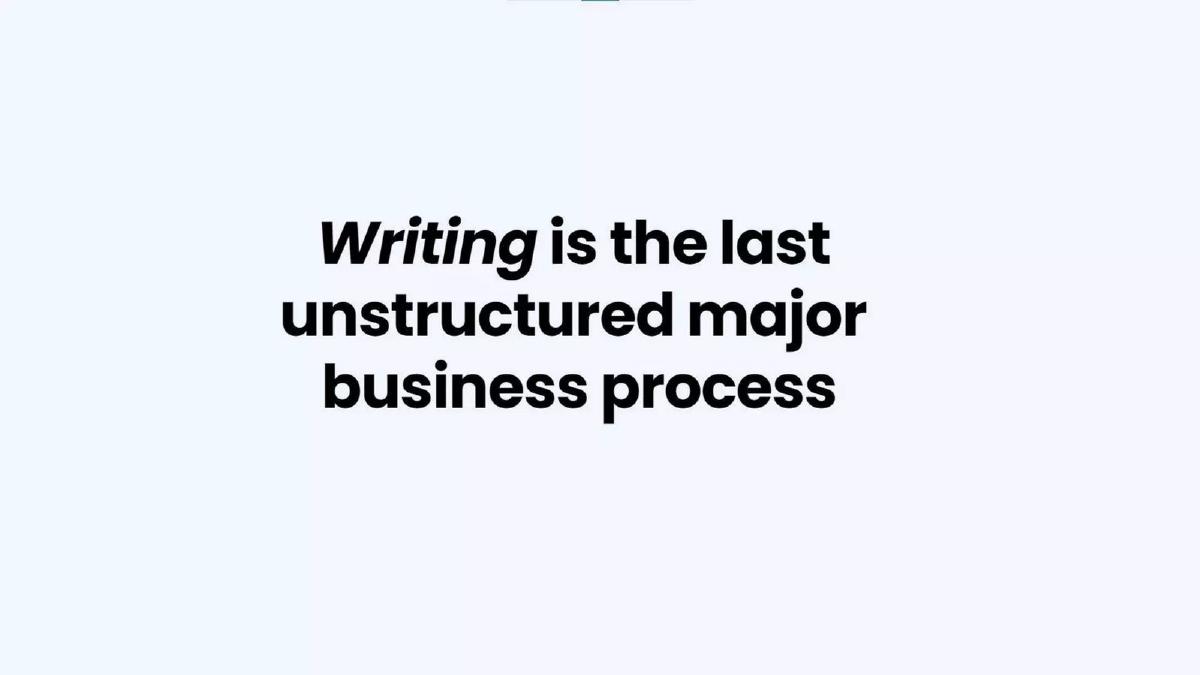
Slide 2 delivers the 'Big Relevant Change' or the core thesis: 'Writing is the last unstructured major business process.' By using the word 'process,' Writer elevates its product from a tool to a system. This is a classic enterprise sales tactic: you aren't selling a feature; you are selling the solution to a structural inefficiency.
Slides 3-5: The Problem and the Source of Truth
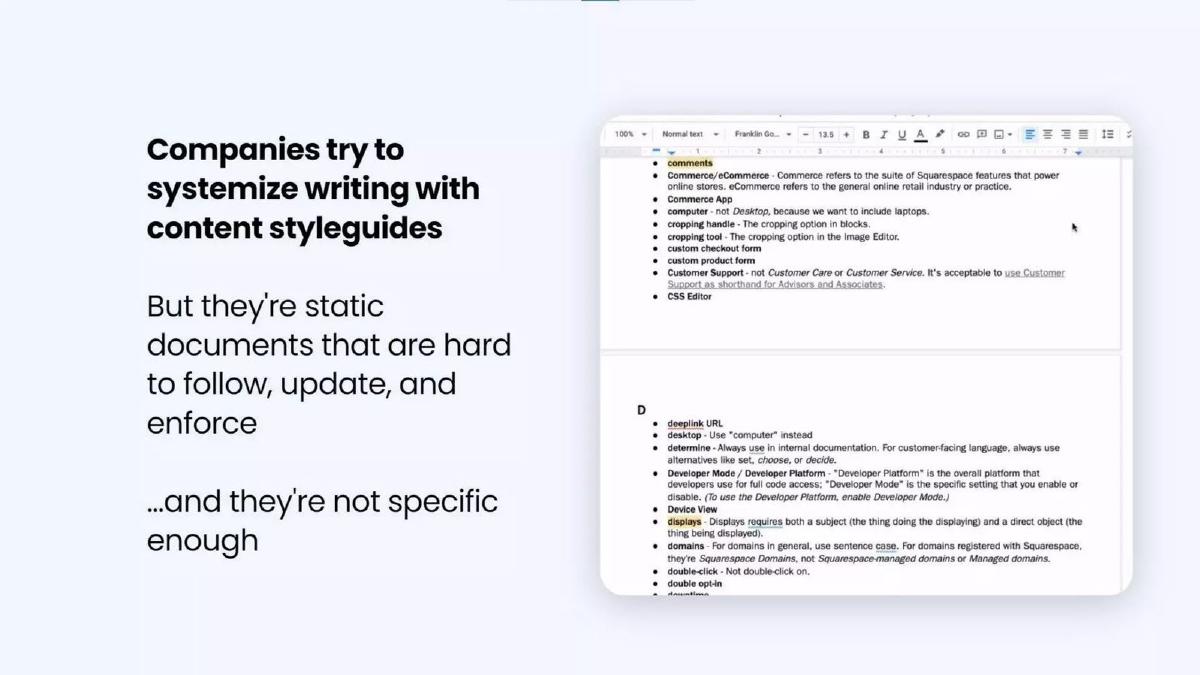
Slide 3 identifies the status quo: 'Companies try to systemize writing with content styleguides.' It shows a screenshot of a static Google Doc, noting they are 'hard to follow, update, and enforce.' This is a relatable pain point for any marketing lead or brand manager.
Slide 4 introduces the solution. Writer positions itself as the 'source of truth for all content guidelines.' The visual shows a UI where administrators can toggle rules like 'Capitalize proper names' or 'Use sentence case for headlines.' This shifts the power from the individual writer to the brand administrator.
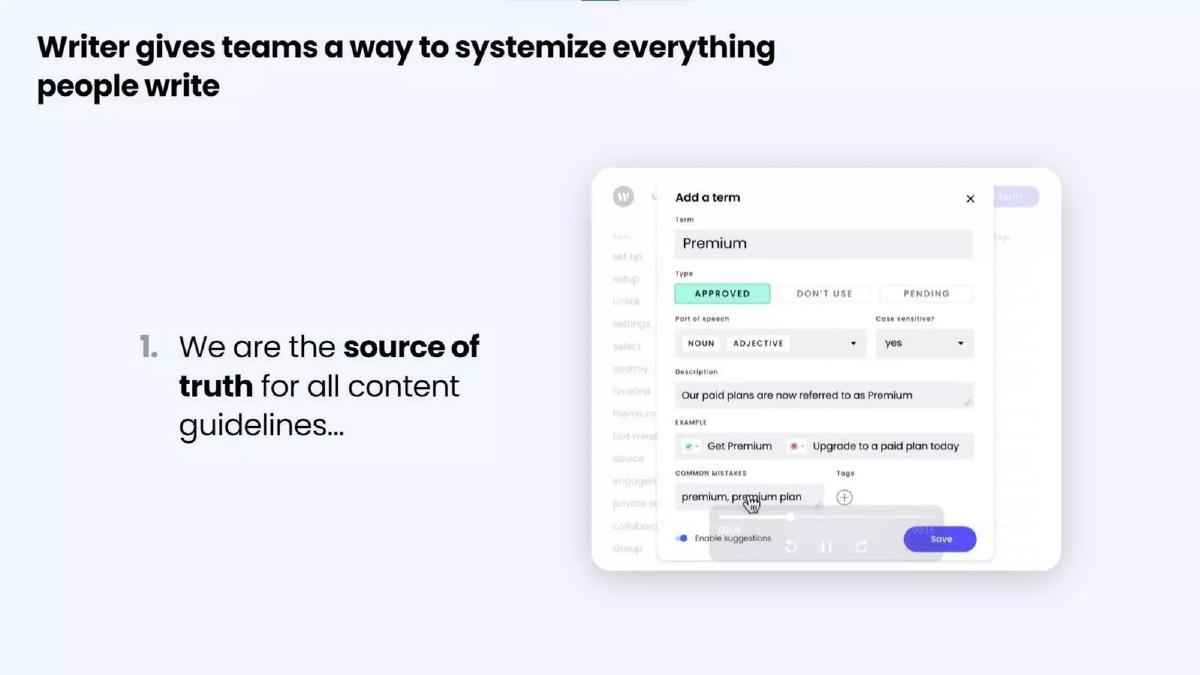
Slide 5 goes deeper into the 'source of truth' concept, showing a 'Add a term' interface. It allows teams to define approved vs. 'don't use' terminology (e.g., 'Premium' vs. 'premium'). This is a specific enterprise feature that general-purpose AI tools usually lack.
Slides 6-8: Workflow Integration
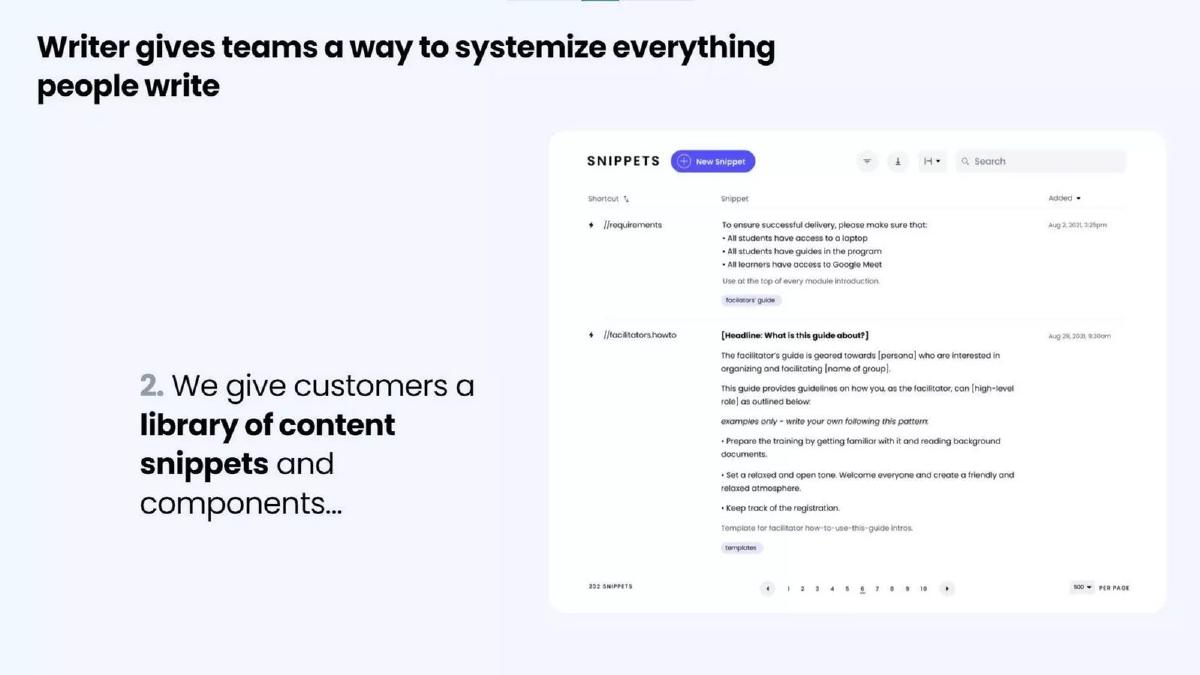
Slide 6 introduces 'Snippets,' a library of reusable content components. This addresses the 'speed to market' mentioned in the company's self-description, allowing teams to insert pre-approved blocks of text instantly.
Slide 7 demonstrates enforcement. It shows the tool in action, highlighting a term ('pre-recorded announcement') and suggesting the approved version ('Recorded Announcement'). The UI includes a 'Terms' explanation, providing the 'why' behind the correction.
Slide 8 is a critical 'Where we live' slide. It displays 16 logos of third-party integrations, including Salesforce, Zendesk, Intercom, Figma, Gmail, Google Docs, WordPress, Adobe Experience Manager, GitHub, Oracle, Microsoft Word, Slack, Contentful, and others. This proves that Writer isn't a destination site; it is a layer that sits on top of the entire enterprise tech stack.
Slides 9-10: Security and Social Proof
Slide 9 tackles the biggest hurdle for enterprise AI: data privacy. The headline 'Your data isn't the product' is a direct shot at competitors who might use customer data to train global models. It explicitly states that data is 'analyzed transiently' and 'never make[s] it into our machine learning models.' This slide alone likely saved months of legal vetting during their sales cycles.
Slide 10 is the 'Wall of Love' or logo slide. It features 16 heavy hitters: Intuit, Twitter, UiPath, Pinterest, Vistaprint, InVision, iManage, Bill.com, Accenture, McKesson, Deloitte, Webflow, Squarespace, Ellevest, Northwestern Mutual, and UnitedHealthcare. The diversity of these industries (finance, healthcare, tech, consulting) proves the horizontal nature of the problem.
Slides 11-13: Business Model and Engagement
Slide 11 outlines the pricing strategy. It shows four tiers: Personal (Free), Personal Pro ($11/user), Team ($18/user), and Enterprise (Contact Sales). The 'Team' tier is highlighted in green, suggesting it is the primary target. The feature list for Enterprise includes 'SAML-based single sign-on' and 'API,' which are standard requirements for large-scale deployments.
Slide 12 lists the 'Ways to use Writer,' mapping the product to specific departments: Content Strategy, Marketing, Editorial, Support, Documentation, Learning and Training, Operations and IT, and HR. This helps investors visualize the Total Addressable Market (TAM) within a single company.
Slide 13 provides the 'hard' data. It shows a DAU/MAU chart from January 2021. The definition of a DAU is 'user accepted a suggestion from Writer.' The graph shows engagement climbing from ~15% to over 40% for both self-service and sales-assisted users. High DAU/MAU ratios are the 'holy grail' for SaaS investors as they indicate 'stickiness.'
Slides 14-16: Competition and Team
Slide 14 is a direct comparison: 'Writer vs Grammarly Business.' It uses a checkmark matrix to show that Writer has 9 key features (like Custom rule builder and Documentation site) that Grammarly lacks. This is a bold, aggressive slide that clearly defines the 'enemy.'
Slide 15 introduces the team. Instead of individual headshots with resumes, it shows a Zoom-style grid of 30 people, emphasizing their '5 countries, 1 vision' remote culture. The vision is stated simply: 'Great writing for everyone.'
Slide 16 is the closing 'Join Us!' slide. It lists their values (Connect, Challenge, Own) and provides a contact email. Notably, there is no slide detailing the specific investment terms, valuation, or use of funds in this version of the deck.
What Works
The 'Process' Framing: By defining writing as an 'unstructured business process' on Slide 2, they move the product out of the 'nice-to-have' category and into the 'operational necessity' category. · Integration Breadth: Slide 8 is a powerful visual. It shows that the product is not a silo; it works where the employees already are. · Privacy as a Feature: Slide 9 addresses the primary enterprise objection (data leakage) before the investor even has to ask. · High-Intent Metrics: Defining a DAU as an 'accepted suggestion' (Slide 13) is much more honest and impressive than simple login data.
What is Missing
Financial Projections: There are no slides showing ARR (Annual Recurring Revenue) growth, churn rates (other than the DAU proxy), or future revenue targets. · The Ask: The deck does not state how much capital is being raised or how it will be allocated (e.g., 50% to R&D, 30% to Sales). · Market Size (TAM/SAM/SOM): While Slide 12 hints at the departments they serve, there is no quantitative analysis of the total market opportunity in dollars. · Founder Pedigree: Slide 15 shows the team but doesn't highlight the specific backgrounds or previous successes of the founders, which is unusual for a Series A deck.
What a Founder Should Copy
The Competitive Matrix: If you are entering a crowded market with a dominant incumbent, use a slide like Slide 14. Don't be afraid to name your competitor and show exactly where you beat them on enterprise-specific features. · The 'Source of Truth' Narrative: If your tool manages something that is usually scattered (like brand voice), position yourself as the central repository. It makes your product harder to rip and replace. · Clear Pricing Tiers: Slide 11 is a model of clarity. It shows exactly what you get at each price point, making the 'Enterprise' value proposition obvious by comparison. · Social Proof Grouping: Grouping logos by industry or use case (as hinted at in Slide 10 and 12) helps investors see the 'land and expand' potential across different sectors.
Frequently asked questions
- How does Writer differentiate itself from Grammarly?
- Writer uses Slide 14 to present a direct competitive matrix. It claims superiority in collaboration/multiplayer mode, business-grade terminology, multi-team management, and custom rule builders. Most importantly, it emphasizes 'Business writing and datasets,' suggesting its AI is trained on professional enterprise data rather than general consumer web data, which is a key differentiator for corporate legal and marketing teams.
- What is Writer's approach to data privacy in this deck?
- Writer addresses the 'AI privacy trap' head-on in Slide 9. They explicitly state that user data is analyzed 'transiently' and never makes it into their machine learning models. This is a critical enterprise selling point, as it prevents proprietary company information from being leaked into a general model that could potentially serve competitors, a common fear with GPT-based applications.
- What metrics does the deck use to prove product-market fit?
- The deck focuses on two primary areas: enterprise logos and user engagement. Slide 10 lists 16 high-profile enterprise customers. Slide 13 provides a DAU/MAU (Daily Active Users to Monthly Active Users) chart from January 2021, showing that both self-service and sales-assisted users maintain an engagement rate between 40% and 60%, which is exceptionally high for a B2B SaaS tool.
- Is there a clear financial 'ask' or use of funds in the deck?
- No. The 16 slides provided do not include a specific 'Ask' slide detailing how much money they are raising or how they intend to spend it. This is common in 'leaked' or shared versions of Series A decks where the final slide is often removed for confidentiality, or the 'Join Us' slide (Slide 16) serves as a soft closing for talent and investors alike.
- How does the deck define a Daily Active User (DAU)?
- Writer uses a high-intent definition for its engagement metrics. According to Slide 13, a DAU is defined as a 'user [who] accepted a suggestion from Writer.' This is a much stronger metric than simple logins or page views, as it measures the actual utility and value extraction by the end-user within their writing workflow.