WunderHaus presents a localized real estate and hospitality play centered on a specific parcel in Leavenworth, WA. The deck outlines a transition from a lease-option to a direct purchase, intending to develop the site into a 'Bavarian Tourist Village.' The project is highly specific, focusing on infrastructure upgrades like buried electrical lines and sewer impact analysis to support new revenue streams, including a beer garden and yurt site development. Financed through traditional funding, the deck projects a total investment of $112,500. While the deck provides clear site-specific details…
Key takeaways
- The project is located at 9336 Icicle Rd. in Leavenworth, WA, as identified on slide 2.
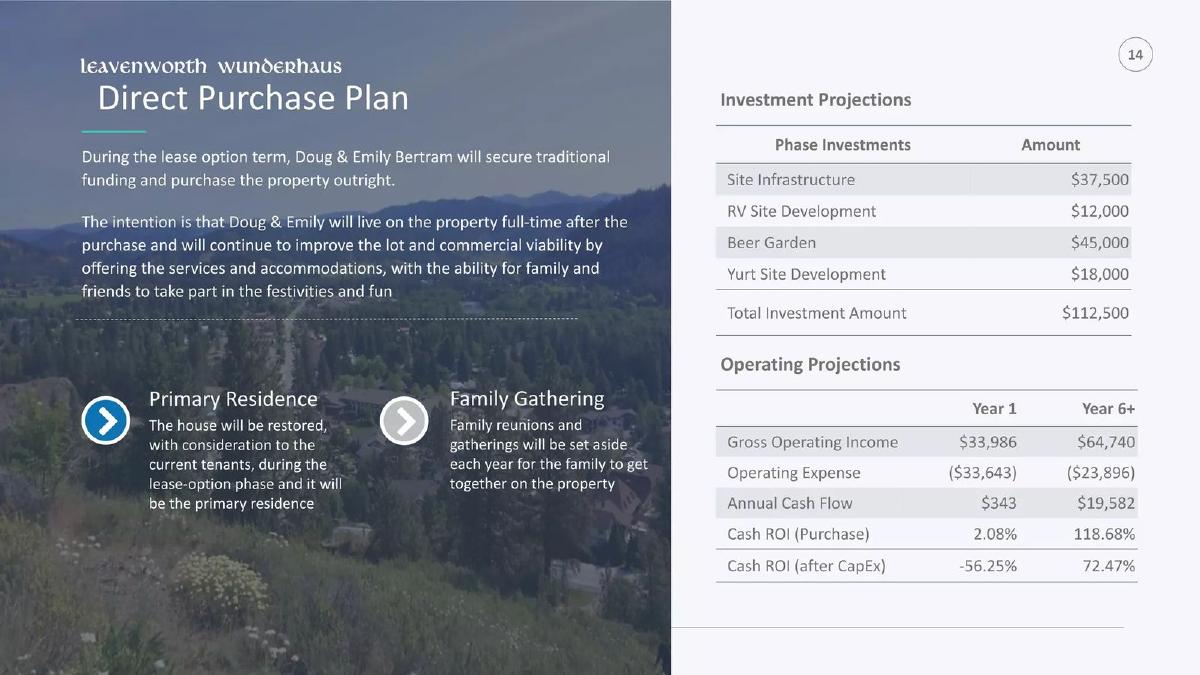
- Development plans include a beer garden ($45,000) and yurt site development ($18,000) according to slide 14.
- Infrastructure investments prioritize burying electrical services and conducting a sewer systems impact analysis (slide 7).
- The business is positioned as a family-owned and family-operated venture (slide 8).
- Total projected investment for the site development phase is $112,500 (slide 14).
- Operating projections show a significant jump in annual cash flow from $343 in Year 1 to $19,582 in Year 6+ (slide 14).
- The founders, Doug and Emily Bertram, intend to use the property as their primary residence while operating the commercial components (slide 14).
- The deck lacks a traditional competitive analysis or broader market data beyond the specific town context.
Executive Summary
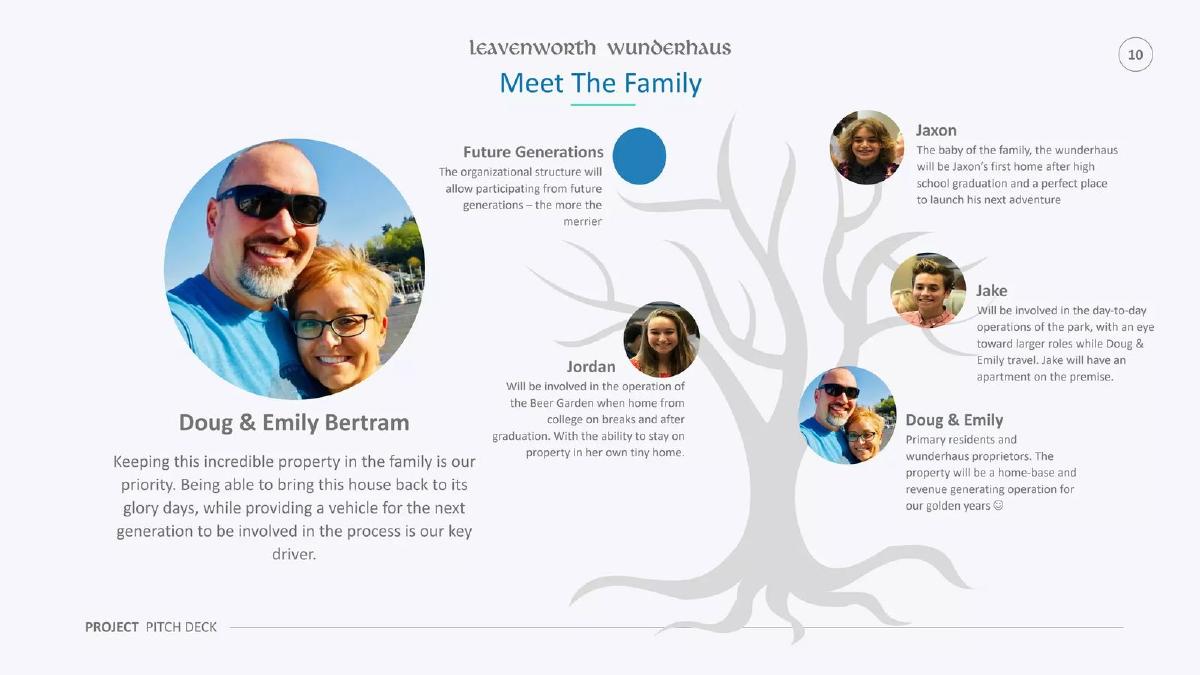
WunderHaus is a micro-hospitality project targeting the specific tourism market of Leavenworth, Washington. The deck serves as a project roadmap for transforming a residential lot into a commercial 'Bavarian Tourist Village.' Unlike high-growth tech decks, this presentation is a real estate development brief focused on site-specific utility upgrades and localized revenue streams like beer gardens and yurt rentals. The narrative is deeply personal, highlighting the founders' intent to reside on-site, which positions the venture as a lifestyle business rather than a scalable startup.
Slide 1: Title Slide
The cover slide introduces the brand 'WunderHaus Bavarian Tourist Village.' The logo features a mountain peak inside a shield, utilizing a black, white, and gold color palette. The background image shows a traditional Bavarian-style building with a steep roof and decorative woodwork, immediately establishing the aesthetic theme of the project. The branding is clear and aligns with the specific architectural requirements of the Leavenworth area.
Slide 2: Village Site Location
This slide provides the exact geographic context for the investment. It features a parcel map highlighting a specific lot at 9336 Icicle Rd., Leavenworth, WA. The map shows the property's proximity to US Highway 2 and the Leavenworth Golf Club. Providing a specific address and parcel map is a standard requirement for real estate-focused pitches, as it allows potential investors or lenders to perform immediate due diligence on land value and zoning.
Slide 7: Site Infrastructure Investments
Infrastructure is the core of this slide, which uses a three-ring Venn-style graphic to categorize necessary upgrades. 1. Electrical: The plan involves burying power poles to 'enhance the natural beauty' and installing new service to accommodate site plans. 2. Sewer: An engineering analysis is required to choose between city sewer (available on the East side of Icicle road) and on-site septic. 3. Facilities: This involves expanding the current building to include gender-separated restrooms and two additional shower rooms with eco-friendly fixtures and key code locks. A footer note mentions that site prep and landscaping will occur concurrently with these upgrades.
Slide 8: Family Owned and Operated
This slide shifts from technical details to the human element. It features a photo of seven children standing in front of a 'Leavenworth National Fish Hatchery' sign. The text 'FAMILY OWNED FAMILY OPERATED' is displayed prominently. In a fundraising context, this slide signals that the management team is a family unit, which often implies lower overhead but can also signal risks regarding professional management scaling and succession planning.
Slide 11: Deal Specifics - Purchase and Investment
This is a transition slide featuring a photo of a modest brown house with a metal roof and a wooden deck in a snowy or wet environment. A dog is visible on the deck. The slide serves as a section header for the financial and contractual details of the acquisition, though it contains no specific data points itself.
Slide 14: Direct Purchase Plan and Projections
This is the most data-dense slide in the deck. It outlines the transition from a lease-option to a direct purchase by Doug and Emily Bertram using 'traditional funding.' The text clarifies that the house will be the primary residence and will be restored while respecting current tenants. Investment Projections: The total investment is listed at $112,500, with the largest portion allocated to a Beer Garden ($45,000) and Site Infrastructure ($37,500). Operating Projections: Year 1 shows a Gross Operating Income of $33,986 against $33,643 in expenses, leaving a negligible $343 in cash flow. By Year 6+, the income is projected to rise to $64,740 with reduced expenses of $23,896, leading to a cash flow of $19,582. The slide also notes a 'Cash ROI (after CapEx)' of -56.25% in Year 1, turning to 72.47% by Year 6.
Slide 17: Contact Information
The final slide provides contact details for Doug Bertram. It includes a physical address in Gig Harbor, WA, a personal email address, a mobile phone number, and the website URL 'www.WunderHa.us.' Social media icons for Facebook, Twitter, and Instagram are present but not linked to specific handles on the slide.
What WunderHaus Does Well
The deck is exceptionally transparent about the physical requirements of the project. By detailing specific infrastructure needs like buried power lines and sewer impact studies, the founders demonstrate a realistic understanding of the hurdles involved in converting a residential lot for commercial use. The financial projections are grounded; they do not promise overnight millions, instead showing a very tight Year 1 margin that reflects the reality of high initial capital expenditures in real estate development. The use of a specific address and parcel map adds a level of concrete detail that is often missing from more abstract hospitality pitches.
What is Missing from the Deck
The most significant omission is a detailed breakdown of the revenue drivers. While 'Beer Garden' and 'Yurt Site' are mentioned as investment categories, there is no data on projected nightly rates for the yurts, expected foot traffic for the beer garden, or seasonal occupancy rates for the RV sites. Furthermore, the deck lacks a formal 'Team' slide that outlines the professional backgrounds of Doug and Emily Bertram. While the 'Family Owned' slide adds sentiment, it does not communicate the founders' experience in property management, construction, or hospitality operations. There is also no mention of the specific zoning permits required for a 'Tourist Village' in Leavenworth, which is a notoriously regulated area for short-term rentals and commercial development.
What Other Founders Can Copy
Founders in the real estate or physical hospitality space should emulate the way WunderHaus breaks down 'Phase Investments.' Instead of asking for a lump sum, they categorize the spend into logical buckets (Infrastructure, RV, Beer Garden, Yurt). This allows a lender or investor to see exactly where the capital is being deployed. Additionally, the 'Direct Purchase Plan' clearly explains the founders' personal skin in the game—living on-site and restoring the property—which can be a compelling narrative for local banks or private lenders who value owner-occupied business models.
Final Analyst Thoughts
The WunderHaus deck is less of a 'pitch' for a high-growth company and more of a 'business plan summary' for a localized real estate project. The projected annual cash flow of ~$20k after six years suggests this is a debt-financing play rather than an equity-financing play. For an equity investor, the returns are likely too low and the timeline too long. However, for a local bank or a private lender interested in secured real estate, the deck provides a clear, honest, and aesthetically consistent roadmap of how a specific piece of land will be improved and monetized.
Frequently asked questions
- What is the primary business model for WunderHaus?
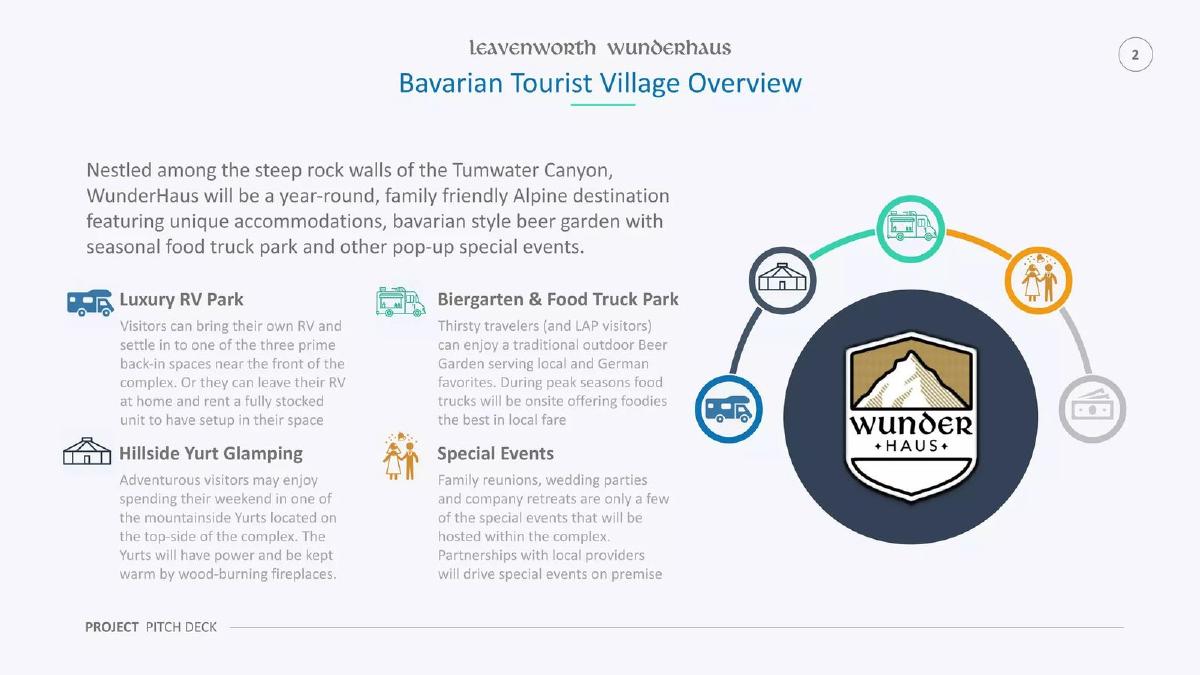
- WunderHaus operates as a hybrid residential and commercial hospitality site. The founders intend to live on the property while generating revenue through tourist-focused amenities. Specifically, slide 14 highlights a beer garden, RV sites, and yurt rentals as the core commercial drivers intended to improve the lot's commercial viability.
- How much capital does the project require for development?
- According to the 'Investment Projections' table on slide 14, the total investment amount for the development phase is $112,500. This is broken down into site infrastructure ($37,500), beer garden ($45,000), yurt site development ($18,000), and RV site development ($12,000).
- What are the infrastructure challenges identified in the deck?
- Slide 7 details three main infrastructure focus areas: upgrading electrical service by burying power lines, conducting a sewer systems impact analysis to determine if the site needs city sewer or if on-site septic is sufficient, and expanding bathroom/shower facilities to accommodate increased capacity with eco-friendly fixtures.
- Who are the principals behind the project?
- The project is led by Doug and Emily Bertram. Slide 8 emphasizes the 'Family Owned, Family Operated' nature of the business, and slide 17 provides Doug Bertram's contact information, including a Gig Harbor, WA address and a personal email.
- What are the long-term financial expectations for the village?
- Slide 14 projects that by Year 6 and beyond, the project will generate $64,740 in gross operating income with $23,896 in operating expenses. This results in an annual cash flow of $19,582, representing a 72.47% Cash ROI after capital expenditures.