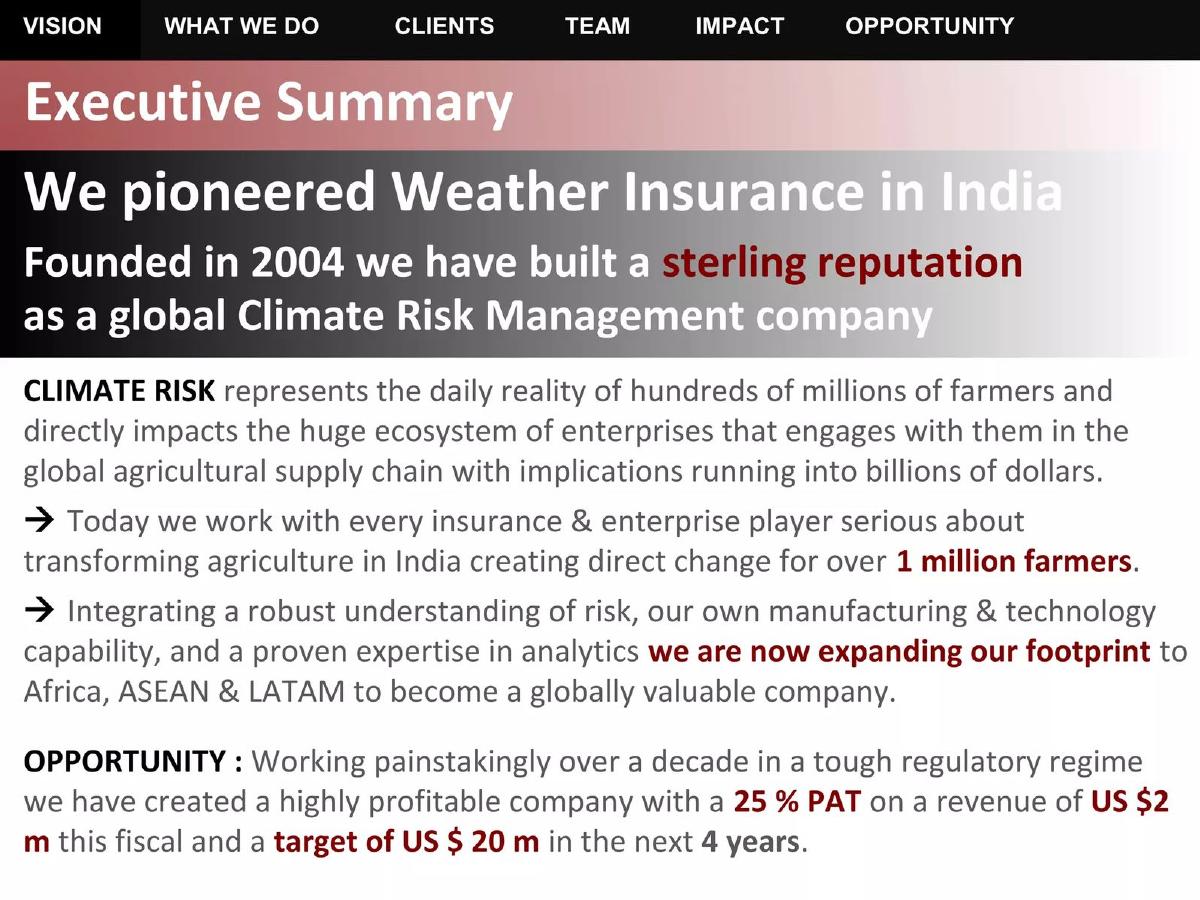
WRL's 2014 investor deck highlights a mature company transitioning from a service-oriented risk manager to a technology-driven platform. With a history dating back to 2004, the company showcases significant traction, including a $1,000 Cr. regulatory subsidy win and partnerships with major insurers like ICICI Lombard. The deck outlines three distinct business pillars: Weather Insurance, Big Data Analytics (via their 'Weatherzilla' cluster), and Smart Devices. While the company reports a healthy 15-20% Profit After Tax (PAT) and $1.2 million in revenue for 2013-2014, the deck lacks a specific…
Key takeaways
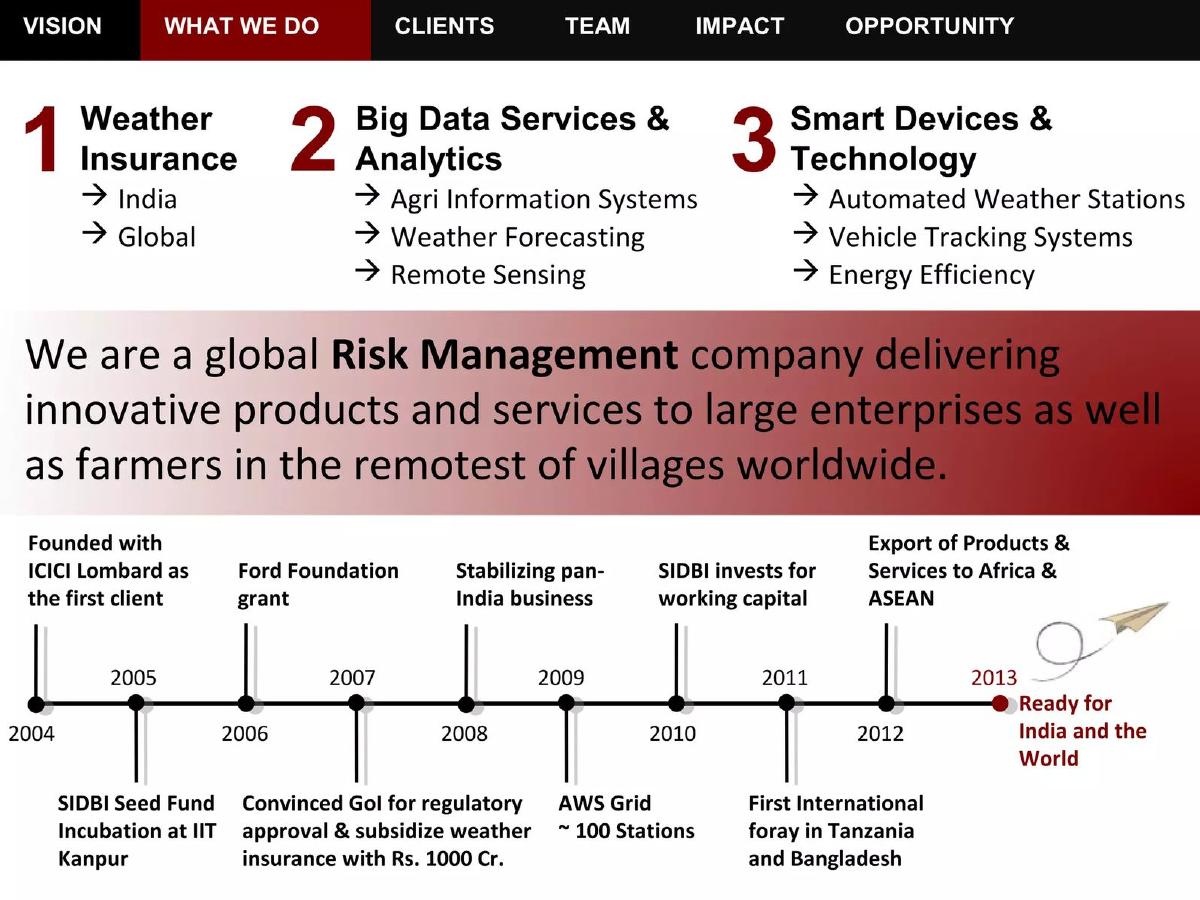
- The company has a long operational history, starting with incubation at IIT Kanpur in 2004 and securing ICICI Lombard as its first client in 2005 (Slide 2).
- WRL claims a significant regulatory victory, having convinced the Government of India to subsidize weather insurance with Rs. 1000 Cr. (Slide 2).
- The 'Weatherzilla Hadoop Cluster' serves as the technical backbone, processing social, satellite, and ground sensor data to provide crop analytics and power load estimation (Slide 3).
- The team is highly academic and specialized, featuring multiple PhDs and alumni from IIT Kanpur and IIM Calcutta (Slide 4).
- A case study with ICICI Lombard shows WRL covered 4,000 farmers across 10,000 acres in two districts of West Bengal by 2009 (Slide 5).
- The market opportunity in India for weather insurance is projected to reach 10,000 Cr. within four years, with WRL currently holding a 500 Cr. market share (Slide 6).
- Hardware traction includes 6,000 vehicle tracking devices installed and a network of Automated Weather Stations (AWS) across India (Slide 7).
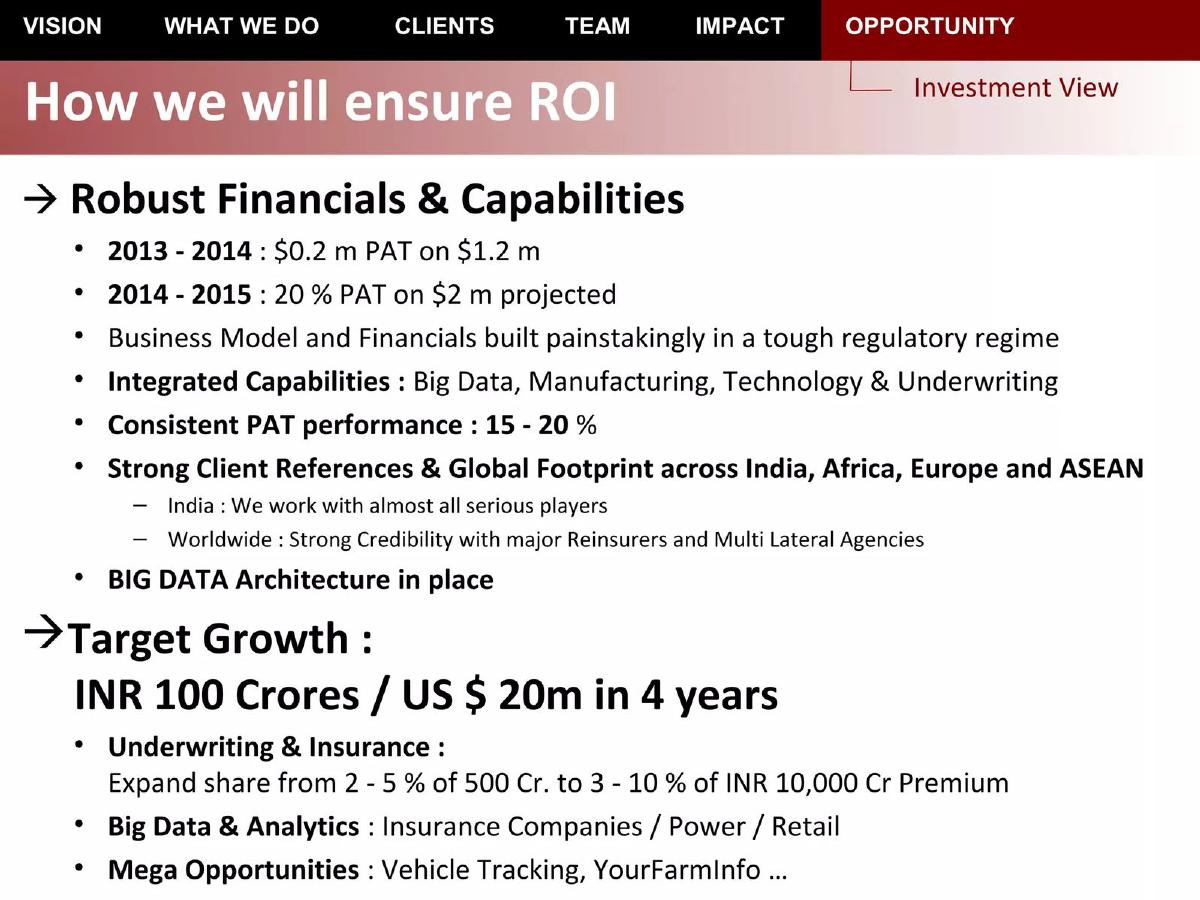
- Financials show $0.2m PAT on $1.2m revenue for 2013-2014, with a projection of $2m revenue for 2014-2015 (Slide 8).
Slide-by-Slide Teardown
Slide 1: Title Slide
The cover slide features the company name 'Weather Risk' and introduces Sonu Agrawal, Managing Director. The date is noted as August 2014. The imagery—a silhouette of a person with a red umbrella under a stormy sky—clearly communicates the sector: risk mitigation against adverse weather conditions.
Slide 2: What We Do & Timeline
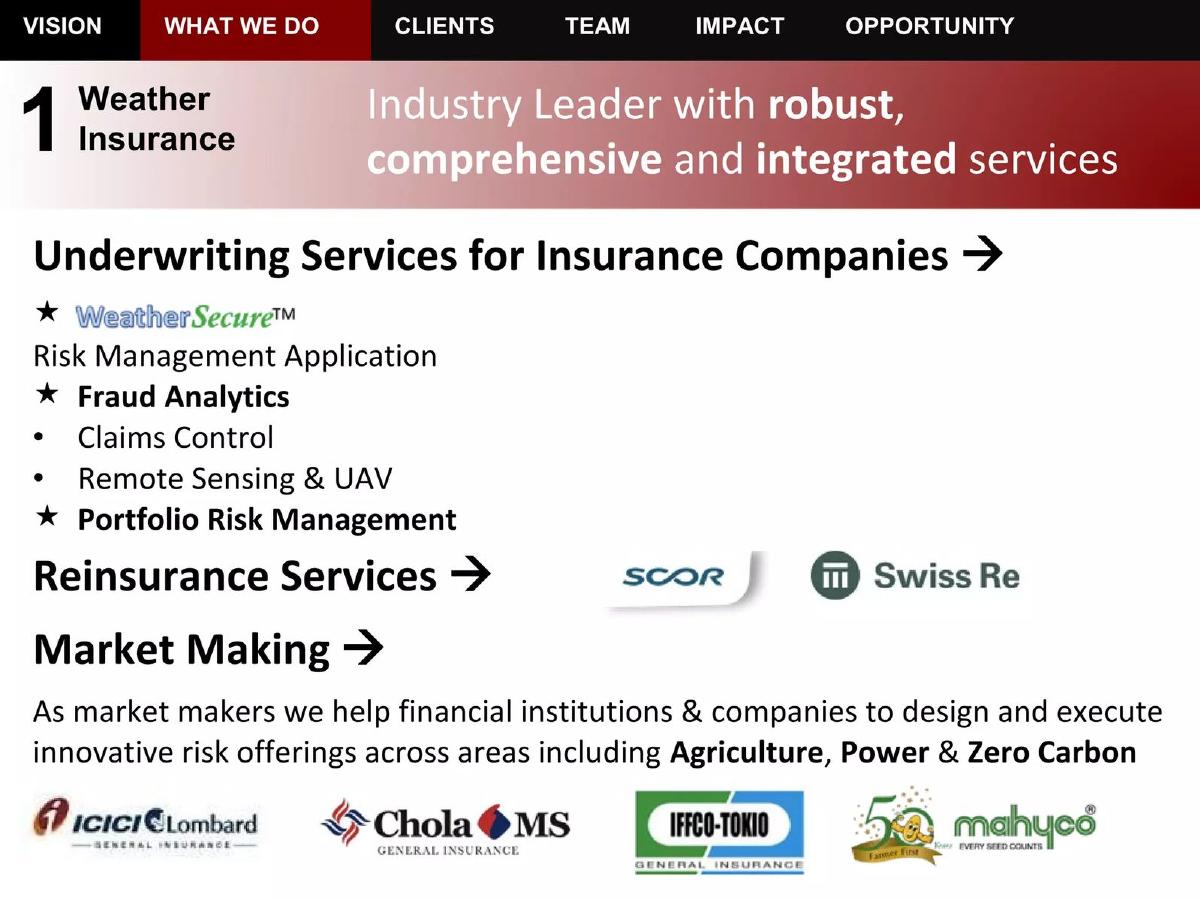
This slide serves as both a product overview and a historical roadmap. WRL divides its operations into three segments: Weather Insurance, Big Data Services & Analytics, and Smart Devices & Technology. The timeline is impressive for a startup deck, showing a 10-year history. Key milestones include incubation at IIT Kanpur (2004), a Ford Foundation grant (2006), and a major regulatory achievement in 2007 where they convinced the Government of India to subsidize weather insurance with Rs. 1000 Cr. The slide ends with the claim that they were 'Ready for India and the World' by 2013.
Slide 3: Data Services & Analytics
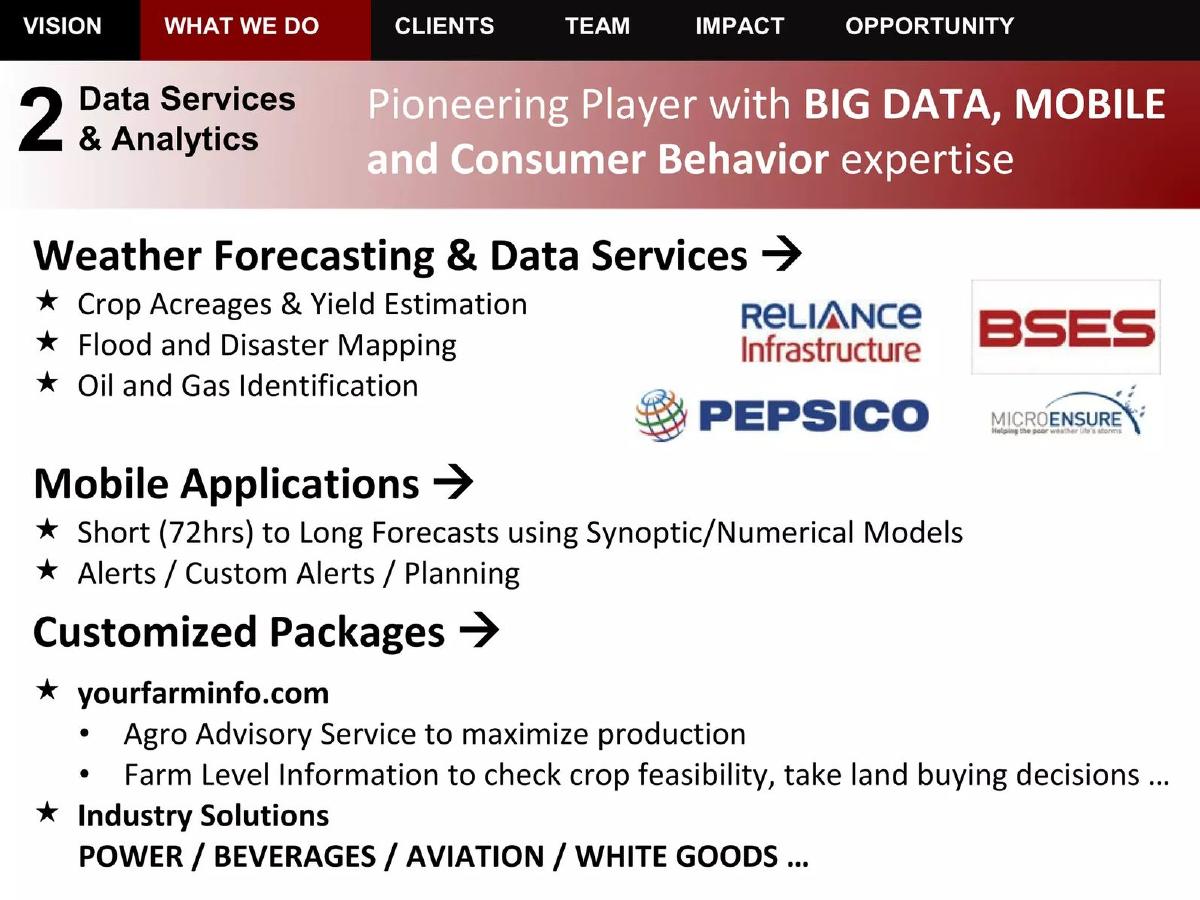
WRL details its technical infrastructure here, showcasing the 'Weatherzilla Hadoop Cluster.' The diagram illustrates a complex data pipeline involving 2TB of social data, 10TB of geo-surveillance data, and 10TB of satellite data. The output of this system includes a 'Weather Consumer Index,' 'Crop Analytics,' and 'Power Load Estimators.' This slide aims to prove that WRL is not just a brokerage or consultancy, but a deep-tech data company.
Slide 4: Executive Team & Advisory Board
The team slide emphasizes academic credentials and industry experience. The three core executives—Sonu Agrawal, Anuj Khumbat, and Ashish Agarwal—are all alumni of prestigious Indian institutions like IIT Kanpur and IIM Calcutta. The deck notes a total staff of 101 people. The advisory board is equally robust, featuring former directors from the National Centre for Medium Range Weather Forecasting and the Indian Meteorological Department, which adds significant regulatory and scientific credibility.
Slide 5: Impact - Representative Case Study
Focusing on their relationship with ICICI Lombard, this slide outlines a 'market making' exercise. WRL developed low-cost weather stations and UAVs to facilitate claim settlements. The impact section notes that by the 2009-10 Rabi season, they covered 4,000 farmers across 10,000 acres. This slide is critical for proving that their theoretical data models have practical, large-scale applications in the field.
Slide 6: Opportunity - Weather Insurance INDIA
This slide quantifies the Indian market. WRL identifies a current insurance market size of 5,000 Cr., expected to double to 10,000 Cr. in four years. They claim a current market share of 500 Cr. (10% of the current market). The slide also lists 'Hot Opportunities' with logos from Chola MS, Reliance, and Future Generali, and 'Emerging Opportunities' with HDFC ERGO and IFFCO-TOKIO, suggesting a strong sales pipeline.
Slide 7: Opportunity - Smart Devices & Technology
WRL pivots to hardware, focusing on Automated Weather Stations (AWS) and Vehicle Tracking Systems. They cite a WMO recommendation for one weather station every 25 km². For vehicle tracking, they claim to have installed 6,000 devices and are in discussions for an additional 200,000 units with two major insurers. This highlights a hardware-enabled data strategy where WRL owns the primary data source.
Slide 8: Investment View - How we will ensure ROI
The penultimate slide provides hard financials. WRL reported $1.2 million in revenue for 2013-2014 with a $0.2 million profit. They projected $2 million in revenue for 2014-2015. The 'Target Growth' is set at $20 million (INR 100 Crores) within four years. The slide reiterates their integrated capabilities across big data, manufacturing, and underwriting.
Slide 9: Closing Slide
The deck concludes with the tagline 'The sky is not the limit' and a call to action: 'Ask us for a detailed business plan.' It repeats the contact information for Sonu Agrawal but notably lacks a specific 'Ask' slide detailing how much capital they are raising or at what valuation.
What WRL Does Well
WRL excels at demonstrating longevity and credibility . In a startup ecosystem often dominated by pre-revenue ideas, WRL’s 10-year timeline and 101-person staff suggest a stable, de-risked operation. The inclusion of a major regulatory win (the Rs. 1000 Cr. subsidy) is a powerful signal that the founders understand how to navigate the complex Indian bureaucratic landscape.
The multi-vertical integration is also a strength. By owning the hardware (weather stations), the data processing (Hadoop cluster), and the end-product (insurance underwriting support), WRL creates a 'moat' that is difficult for pure software or pure brokerage competitors to replicate. Their case study with ICICI Lombard provides the necessary 'proof of work' to back up these claims.
What is Missing from the Deck
The most glaring omission is a specific investment ask . While the deck mentions a $20 million growth target, it does not specify how much they are raising in the current round, the equity offered, or the specific use of proceeds (e.g., R&D, sales expansion, or hardware manufacturing). This makes the deck feel more like a corporate credentials presentation than a focused fundraising tool.
Furthermore, the deck lacks unit economics . While they provide top-line revenue and PAT, they do not break down the margins for their three very different business lines. Hardware manufacturing (weather stations), SaaS/Data analytics, and insurance commissions have vastly different cost structures and scalability profiles. Investors would need to see how these segments contribute individually to the 20% PAT.
What Other Founders Should Copy
Founders in complex, regulated industries should emulate WRL’s Advisory Board composition . By including former directors of national meteorological departments and professors from top technical universities, WRL effectively pre-empts concerns about their scientific accuracy and regulatory compliance. This is a 'trust transfer' mechanism that works exceptionally well for deep-tech startups.
Additionally, the 'Market Making' case study (Slide 5) is a masterclass in showing value. Instead of just saying they have a client, they explain the 'Business Case,' 'What we did,' and the 'Impact.' This structure helps investors understand the exact mechanics of the company's value proposition in a real-world scenario.
Frequently asked questions
- What is WRL's core business model?
- WRL operates a tripartite model: Weather Insurance (market making and underwriting support), Big Data Services (analytics for agriculture and energy), and Smart Devices (manufacturing Automated Weather Stations and vehicle tracking systems). They position themselves as a risk management company that integrates hardware data with software analytics to serve large enterprises and smallholder farmers.
- How does WRL utilize big data?
- According to slide 3, the company uses a Hadoop cluster named 'Weatherzilla.' It ingests 2TB of social data, 10TB of geo-surveillance data, and 10TB of satellite data. This information is processed through a correlation engine to produce weather consumer indexes, crop analytics, and insurance analysis for their portfolio clients.
- What is the company's historical financial performance?
- Slide 8 reports that for the 2013-2014 fiscal year, WRL achieved a Profit After Tax (PAT) of $0.2 million on $1.2 million in revenue. They projected $2 million in revenue for the following year with a 20% PAT. The company emphasizes a consistent PAT performance of 15-20% over their operating history.
- Who are WRL's primary customers?
- The deck lists several major Indian insurance providers as clients or partners, including ICICI Lombard, Chola MS, Reliance General Insurance, and HDFC ERGO. They also mention international expansion into Africa and ASEAN regions, specifically citing work in Tanzania and Bangladesh on slide 2.
- What is the specific funding request in this deck?
- The deck does not state a specific funding amount, valuation, or use of proceeds. Slide 9 simply asks investors to request a 'detailed business plan.' However, slide 8 mentions a 'Target Growth' of $20 million (INR 100 Crores) over the next four years, implying the scale of capital they may be seeking to deploy.