Worona’s 11-slide deck (6 slides provided) positions the company as a technical bridge for the WordPress ecosystem, converting websites into high-performance mobile apps. The deck relies on the macro-trend of web development evolving to match native app experiences, citing technologies like React and Node.js. Their business model is a classic 'freemium' open-source play: a free core product supported by a marketplace for premium extensions and themes, plus a paid publishing service. While the deck identifies clear exit opportunities with giants like Automattic ($1.16B valuation), it suffers f…
Key takeaways
- The deck identifies a shift in web development over the 'last year' to match native app user experiences (Slide 3).
- Worona claims its technology provides 10x pageviews and 3x shares for mobile sites (Slide 5).
- The product suite includes both a native iOS/Android app with offline capabilities and a high-performance mobile site (Slide 5).
- The business model is built on an 'Extensions & Themes marketplace' and a 'Publish' service for app stores (Slide 7).
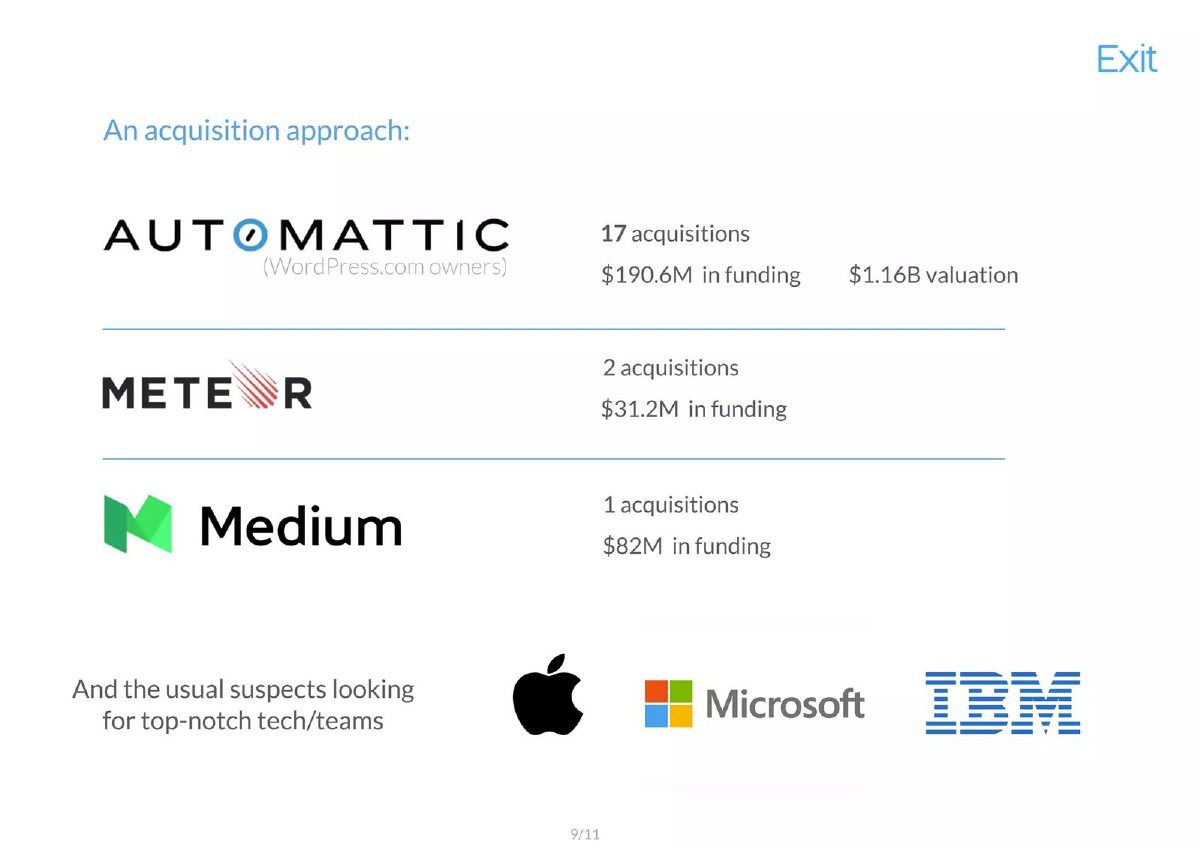
- Worona identifies Automattic as a primary acquisition target, noting their $1.16B valuation and 17 acquisitions (Slide 9).
- The deck lists secondary exit targets including Meteor ($31.2M funding) and Medium ($82M funding) (Slide 9).
- The company has participated in or received support from programs like Telefonica Open Future and Startup Next (Slide 11).
- The deck lacks a dedicated team slide, missing crucial information on founder expertise and technical background.
Introduction: The WordPress Mobile Gap
Worona’s pitch deck, dated 2016, enters a market where WordPress powered over 25% of the internet but struggled to provide a seamless, high-performance mobile experience. The deck is structured as a lean, 11-slide presentation (with 6 slides available for analysis) that focuses on the technical evolution of the web and how Worona capitalizes on it. It positions itself not just as a plugin, but as an 'evolution' of the platform for the mobile-first era.
Slide 1: Title and Branding
The cover slide is minimalist, featuring the Worona logo and the tagline "WordPress mobile evolution." It includes a contact email for investors, setting the stage for a professional fundraising outreach. The branding is clean, using a blue-and-white color palette that evokes a sense of technology and reliability. By labeling the company as an 'evolution,' the founders suggest that their solution is a necessary next step for the existing WordPress ecosystem rather than a peripheral add-on.
Slide 3: The Environment and Technical Shift
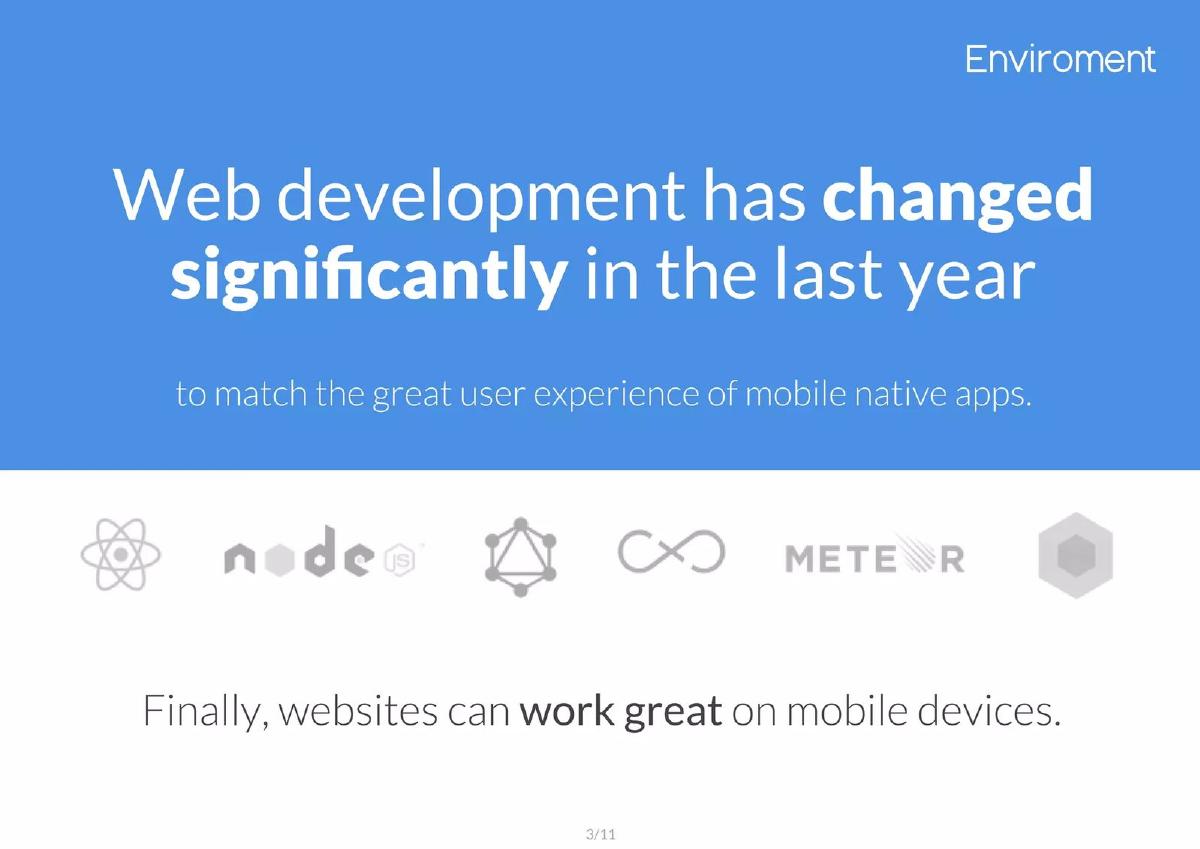
Slide 3, titled "Enviroment" (note the misspelling in the original slide), establishes the 'Why Now?' of the pitch. It states that "Web development has changed significantly in the last year to match the great user experience of mobile native apps." This is a crucial framing device. It suggests that until recently, the technology didn't exist to make web-based mobile experiences competitive with native apps.
The slide displays logos for several key technologies: React, Node.js, GraphQL, Meteor, and Webpack. By aligning with these modern frameworks, Worona signals to investors that their technical stack is current and capable of delivering high-performance results. The concluding statement, "Finally, websites can work great on mobile devices," positions Worona as the beneficiary of this technological tipping point.
Slide 5: The Solution and Performance Metrics
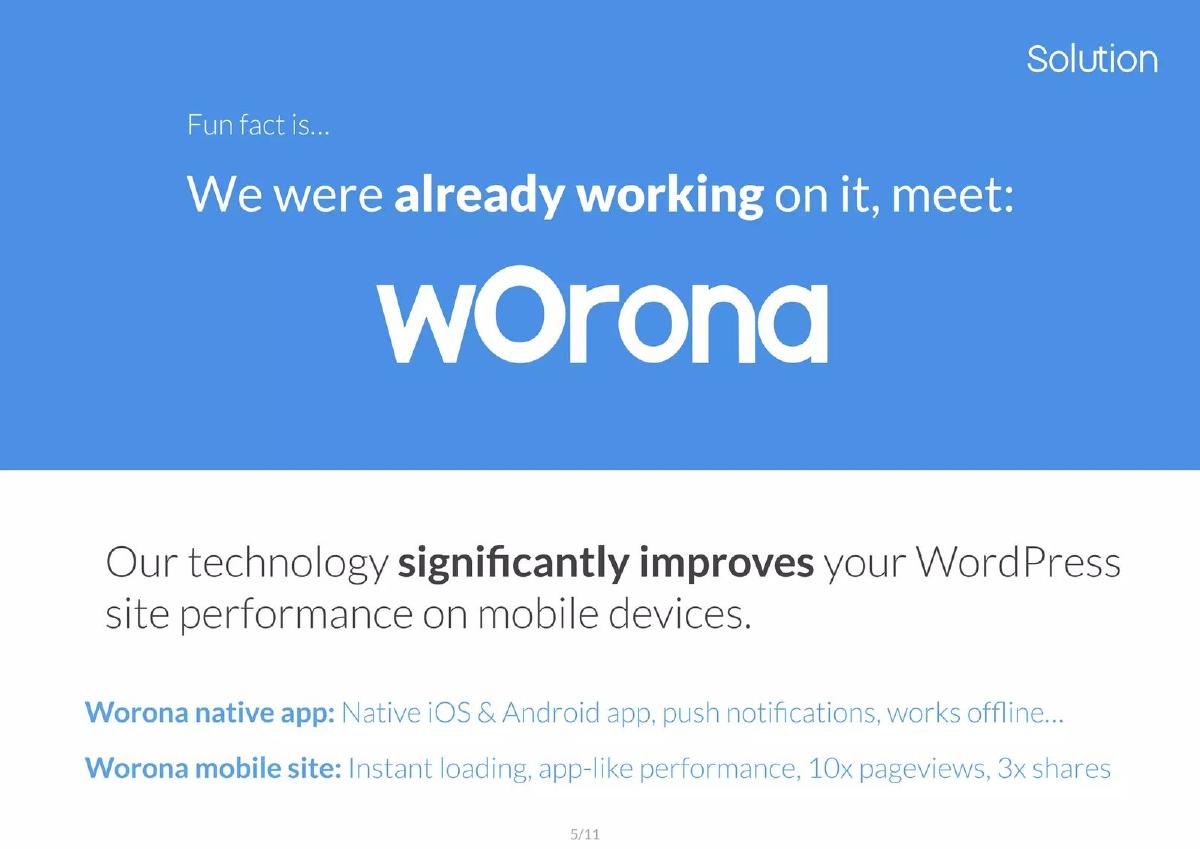
On Slide 5, the company introduces its specific offering. The headline claims, "Our technology significantly improves your WordPress site performance on mobile devices." The slide breaks the solution into two distinct categories:
Worona native app: Described as a "Native iOS & Android app" featuring "push notifications" and the ability to "work offline." · Worona mobile site: Promised to deliver "Instant loading" and "app-like performance."
Most importantly, this slide provides the deck's primary performance claims: "10x pageviews" and "3x shares." While these figures are impressive, the slide does not specify if these are averages across a user base, results from a single beta tester, or projected benefits. In a teardown context, this lack of attribution makes the figures feel more like marketing copy than verified traction data.
Slide 7: The Open-Source Business Model
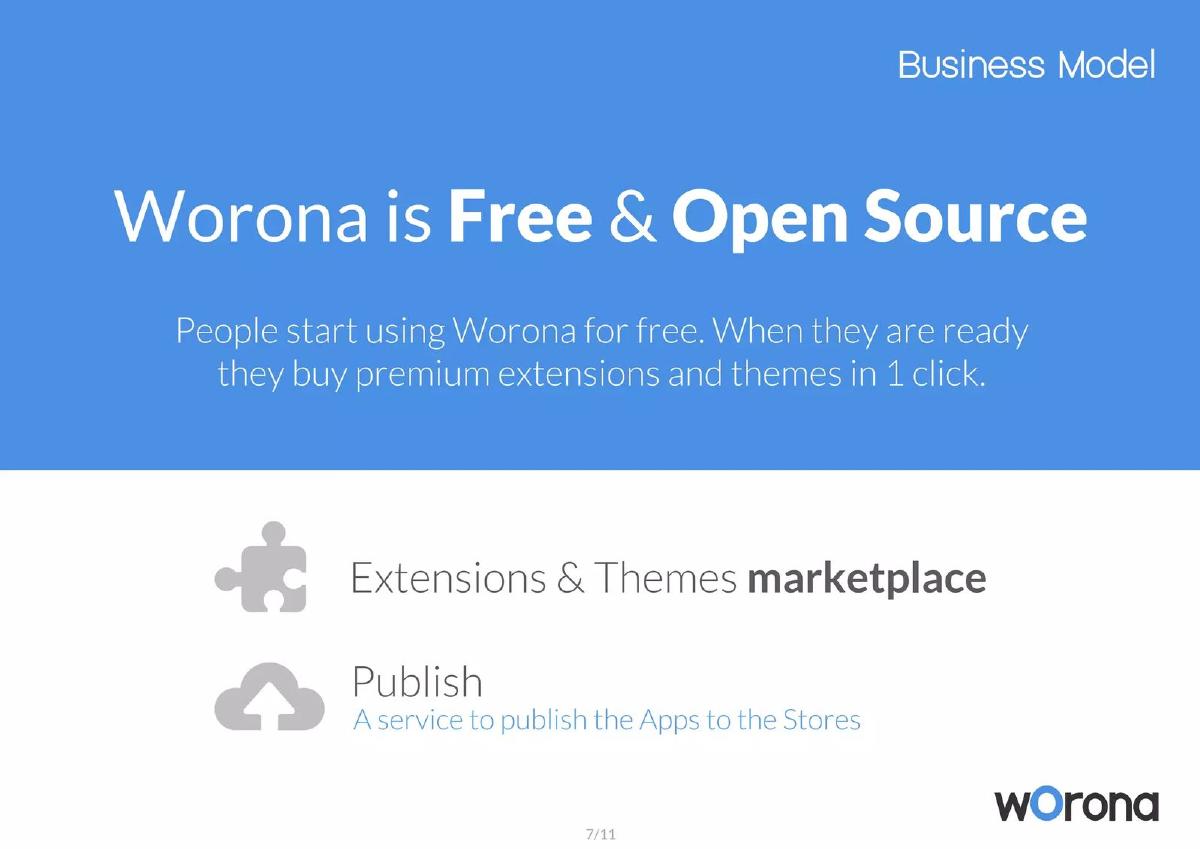
Slide 7 outlines a classic "Free & Open Source" business model. The strategy is to lower the barrier to entry: "People start using Worona for free. When they are ready they buy premium extensions and themes in 1 click."
Extensions & Themes marketplace: A modular approach where users pay for specific added functionality. · Publish: Described as "A service to publish the Apps to the Stores."
This model is highly scalable because it mirrors the successful business models of WordPress itself and other major platforms like Shopify. It suggests that Worona isn't just selling a tool, but building a marketplace ecosystem where they can capture recurring or transactional value from a large user base.
Slide 9: The Exit Strategy
Slide 9 is dedicated to the "Exit" and uses an "acquisition approach" to justify the investment. It highlights three primary targets with their respective stats:
Automattic (WordPress.com owners): 17 acquisitions, $190.6M in funding, and a "$1.16B valuation." · Meteor: 2 acquisitions and $31.2M in funding. · Medium: 1 acquisition and $82M in funding.
The slide also lists Apple, Microsoft, and IBM as "the usual suspects looking for top-notch tech/teams." By including Automattic's valuation and acquisition history, Worona makes a strong case that there is a clear, high-value buyer for technology that improves the WordPress ecosystem. However, listing Apple and IBM feels speculative and less grounded than the specific WordPress-related targets.
Slide 11: Partners and Social Proof
The final slide (11/11) serves as a closing and a display of social proof. It repeats the investor contact email and showcases four logos of organizations that have supported the startup: Telefonica Open Future, Startup Next (Powered by Google for Entrepreneurs), Civeta Investment, and Enisa. These logos provide necessary credibility, suggesting that the company has already passed through some level of professional vetting or early-stage acceleration. This is particularly important given the lack of a team slide in the provided materials.
What Works in This Deck
1. Clear Market Positioning: Worona does an excellent job of positioning itself within a massive, pre-existing market (WordPress). By focusing on the 'mobile evolution,' they identify a specific pain point—mobile performance—that every WordPress site owner faces.
2. Modern Tech Stack: Citing React and Node.js was a strong move in 2016. It signaled to technical investors that the product wasn't just another PHP-heavy plugin, but a modern application capable of native-like speed.
3. Simple Monetization: The business model slide is easy to understand. The 'freemium' approach to open source is a proven winner in the developer tool space, and the 'Publish' service offers a clear path to revenue from non-technical users.
What is Missing
1. The Team: There is no team slide in the provided sequence. For an early-stage startup, the founders' pedigree is often more important than the product itself. Investors need to know who is building this and why they are the right people to execute.
2. Hard Traction Data: While the deck mentions '10x pageviews,' it lacks a slide showing user growth, active installs, or revenue to date. Without these, it is impossible to tell if Worona is a concept or a functioning business with market fit.
3. The Ask: A pitch deck should clearly state how much money is being raised and what the milestones will be once that capital is deployed. This deck omits the 'Ask' entirely.
4. Competition: The deck ignores other 'WordPress to App' converters. Acknowledging competitors and explaining a unique technical advantage (like the use of React) would have made the pitch more robust.
Founder's Takeaway
The Worona deck is a masterclass in conceptual simplicity. It identifies a macro trend (web tech catching up to native apps), applies it to a massive market (WordPress), and offers a simple way to make money (Marketplace + Service). However, it leans too heavily on the 'WordPress is big' argument and not enough on 'Worona is winning.' Founders should copy the clear business model visualization but must ensure they include a strong team slide and specific, dated traction metrics to move beyond a high-level concept pitch.
Frequently asked questions
- What specific problem does Worona solve?
- Worona addresses the performance gap between standard WordPress websites and native mobile applications. According to Slide 5, their technology 'significantly improves' site performance, offering features like offline functionality, push notifications, and 'app-like performance' for mobile sites to drive higher engagement metrics like pageviews and shares.
- How does Worona plan to generate revenue?
- The company utilizes an open-source freemium model. As detailed on Slide 7, the core software is free to start. Revenue is generated through a one-click marketplace for premium extensions and themes, as well as a paid service to handle the technical process of publishing apps to the Apple App Store and Google Play Store.
- Which technologies underpin the Worona platform?
- Slide 3 highlights a stack of modern (as of 2016) web development tools including React, Node.js, GraphQL, and Meteor. The deck argues that these technologies allow websites to finally 'work great on mobile devices' by mimicking the speed and UX of native code.
- Who are the potential acquirers for a business like Worona?
- Slide 9 explicitly lists Automattic (the owners of WordPress.com) as the primary 'acquisition approach.' It also lists Meteor and Medium as companies with significant funding that make acquisitions, alongside 'usual suspects' like Apple, Microsoft, and IBM who look for 'top-notch tech/teams.'
- What is the biggest weakness in the Worona pitch deck?
- The most glaring omission is the lack of a team slide and specific traction data. While Slide 5 mentions '10x pageviews,' it doesn't clarify if this is a theoretical benefit or a result from a specific case study. Without founder backgrounds or hard user growth numbers, the deck relies entirely on the strength of the WordPress market opportunity.