WorkMotion’s pitch deck for its Series B round is a masterclass in market positioning. Rather than competing head-to-head with generalist global payroll providers, WorkMotion explicitly targets the 'underserved middle-market' in Europe. The deck highlights exceptional growth metrics, including a 335% Net Revenue Retention (NRR) and a client base of over 500 companies. By focusing on the 'painful mess' of global employment—specifically legal entities, IP protection, and social security—WorkMotion positions its platform as a specialized 'Global Talent Operating System.' The presentation balance…
Key takeaways
- WorkMotion positions itself as a 'Global Talent Operating System' rather than just a payroll tool (Slide 1).
- The company identifies the 'painful mess' of global employment through an iceberg analogy, citing 10 specific legal and operational challenges (Slide 3).
- A clear competitive map places WorkMotion in the 'midsize companies' segment (201-2,000 employees), differentiating from players like Deel and Remote (Slide 6).
- The deck reports a highly efficient growth engine with a 335% Net Revenue Retention (NRR) as of April 2022 (Slide 8).
- WorkMotion has secured over 500 clients with a Net Promoter Score (NPS) of 67 (Slide 8).
- Product differentiation is centered on proprietary, in-house data for total cost of employment calculations (Slide 16).
- The 'WorkDirect' product is highlighted as the first direct employment solution specifically productized for the EU market (Slide 18).
- Integration strategy focuses on major HCM suites like Personio and BambooHR to reduce friction in the HR experience (Slide 20).
WorkMotion Series B Teardown: The Mid-Market Specialist
WorkMotion’s Series B deck is a study in narrow positioning within a broad category. While the Employer of Record (EOR) and global payroll space became incredibly crowded between 2020 and 2024, WorkMotion secured $50M by arguing that the 'middle market' was being ignored by the first wave of global hiring platforms. The deck uses a clean, professional aesthetic to transition from the 'pain' of global compliance to a multi-phase product roadmap.
Slide 1-2: The Vision and Identity
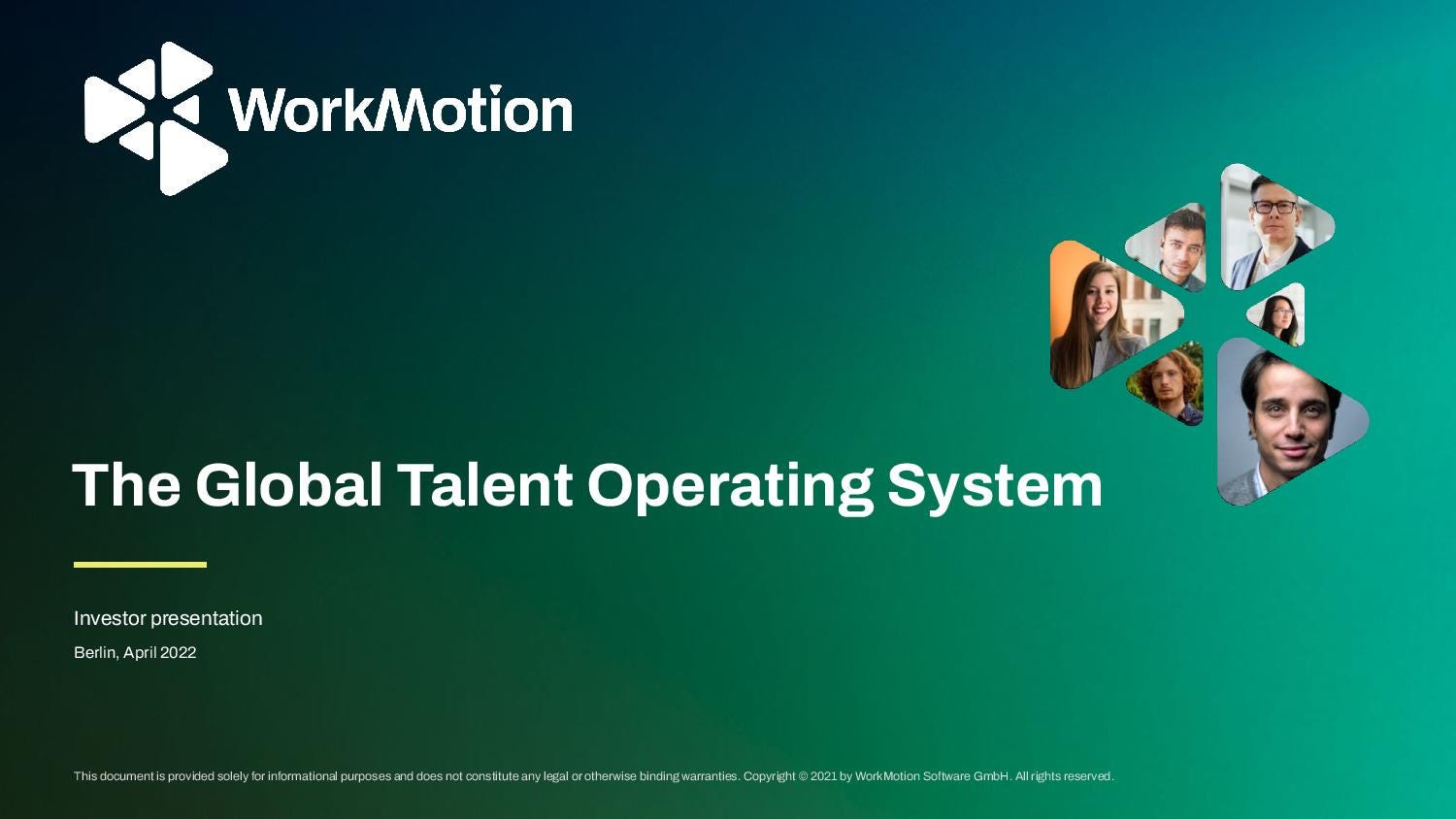
The deck opens with a bold claim: WorkMotion is 'The Global Talent Operating System.' This phrasing is intentional. By calling itself an 'Operating System' (OS) rather than a 'platform' or 'tool,' the company signals that it intends to be the foundational layer for all HR activities, not just a utility for sending payments. The imagery features diverse professional headshots, reinforcing the human element of global hiring.
Slide 3: The Iceberg of Global Employment
Slide 3 uses the classic iceberg analogy to define the problem. The 'dream' is simply operating talent globally, but the 'painful mess' lies beneath the surface. WorkMotion lists ten specific hurdles: legal entity setup, labor law compliance, social security, IP protection, PE (Permanent Establishment) risk, payroll, F/X, mobility, benefits, and work permits. This slide serves to overwhelm the investor with the complexity of the task, making the 'solution' seem more valuable.
Slide 6: Competitive Landscape and Segmentation
This is arguably the most important slide in the deck. WorkMotion segments the market by headcount: Micro (<50), Small (51-200), Midsize (201-2,000), and Enterprise (>2,000). They place themselves squarely in the 'Midsize' and 'Enterprise' categories. Crucially, they name competitors like Deel, Oyster, and Remote, but categorize them as 'silo solution providers' or focused on different niches (e.g., Deel as FinTech/payments). By positioning themselves as the 'Full solution provider' for the mid-market, they carve out a defensible territory that investors can easily visualize.
Slide 8: The Traction Proof-Points
WorkMotion presents three massive numbers to validate their market fit. First, 500+ clients, which shows scale. Second, an NPS of 67, which indicates high customer satisfaction in a category usually known for bureaucratic friction. Third, and most impressively, a 335% Net Revenue Retention (NRR). An NRR of 335% is extraordinary for SaaS, suggesting that once a company starts hiring one person through WorkMotion, they rapidly expand their global footprint using the platform.
Slide 13-16: Product Phase 1 - Transparency
The deck shifts into product specifics, starting with 'Phase 1.' The focus here is a 'Total cost of employment calculator.' WorkMotion emphasizes that their data is 'proprietary & sourced in-house.' In a world of API-driven wrappers, claiming proprietary data for salary and benefit calculations across different jurisdictions is a significant moat. The slide shows a UI mockup of a 'Salary & Benefits' input screen resulting in a 'Total Monthly Payment' calculation, promising full transparency to the employer before they commit to a hire.
Slide 18: Product Phase 2.1 - WorkDirect
WorkMotion introduces 'WorkDirect,' which they claim is the 'first direct employment solution in the market.' This is a specific legal play for the EU. Instead of the standard EOR model where the startup employs the person on behalf of the client, WorkDirect helps the client register as a foreign employer. This is often a preferred route for mid-market companies that want a more direct relationship with their staff but lack the expertise to handle the local registration. Productizing this complex legal process is a clear value add.
Slide 20: Integrations and Ecosystem
The final slide in this selection focuses on the 'HR experience' through integrations. WorkMotion shows logos for Workday, Personio, BambooHR, and others. They highlight that they have already completed integrations with Personio and BambooHR. This addresses a common mid-market pain point: the 'data silo.' By ensuring data flows smoothly between the global hiring tool and the central HCM (Human Capital Management) suite, WorkMotion reduces the administrative burden on HR teams.
What WorkMotion Does Well
The deck is exceptionally disciplined regarding its target audience. By explicitly stating they are built for the 'underserved middle-market' (Slide 6), they avoid the trap of trying to be everything to everyone. Their use of the 335% NRR figure is a powerful 'mic drop' moment that proves their existing customers are finding immense value and scaling quickly. Furthermore, the distinction between EOR and 'WorkDirect' (direct employment) shows a sophisticated understanding of European labor nuances that generic global competitors might overlook.
What is Missing from the Deck
Based on the 16 slides provided, there are several standard venture capital requirements missing. There is no Team Slide , which is critical for a Series B to show the depth of leadership. There is no Financial Projections slide or a detailed Use of Funds breakdown, though the publisher reports a $50M raise. Additionally, while the competitive landscape is addressed, a detailed Unit Economics slide (CAC, LTV, Payback Period) is absent, which investors typically scrutinize at this stage to ensure the 335% NRR is being achieved profitably.
Founder Takeaways
Segment your competition: Don't just list competitors; categorize them by the customer size they serve. This makes your 'unique positioning' a logical conclusion rather than a marketing claim. · Lead with 'Retention' over 'Acquisition': While 500 clients is good, 335% NRR is world-class. If you have a metric that is an outlier, make it the centerpiece of your traction slide. · Productize the 'Boring' stuff: WorkMotion didn't just build a dashboard; they productized 'foreign employer registration' and 'proprietary cost calculators.' Solving specific legal headaches is more defensible than building a better UI. · Address the 'Silo' fear: Mid-market and Enterprise clients fear adding more tools that don't talk to their existing stack. Showing a clear integration roadmap (Slide 20) is essential for closing larger deals.
Frequently asked questions
- What is WorkMotion's primary market focus?
- WorkMotion explicitly targets the European mid-market, defined in their deck as companies with 201 to 2,000 employees. They position themselves as a deeper, enterprise-grade solution that maintains the flexibility required by mid-sized firms, contrasting their approach with 'silo solution providers' or those focused primarily on micro-businesses.
- How does WorkMotion differentiate its product from competitors like Deel or Remote?
- According to Slide 6, WorkMotion views Deel as a FinTech focused on payments and Remote as an EOR solution for tech companies. WorkMotion differentiates by offering 'WorkDirect,' a solution specifically for the EU that allows companies to hire abroad via registration as a foreign employer, rather than just using a third-party entity.
- What are the key growth metrics shared in the Series B deck?
- The deck highlights three primary metrics on Slide 8: a client base of 500+, a Net Promoter Score (NPS) of 67, and a remarkably high Net Revenue Retention (NRR) of 335%. These figures suggest that existing clients are significantly expanding their use of the platform over time.
- What specific problems does the platform solve for HR departments?
- Slide 3 lists several 'under the surface' challenges including intellectual property protection, PE risk & corporate taxes, social security compliance, and F/X transfers. The platform aims to solve these by providing transparency on the total cost of employment and streamlining the registration process for foreign talent.
- What is the 'WorkDirect' feature mentioned in the deck?
- WorkDirect is described on Slide 18 as a productized direct employment solution. It allows clients to hire talent in foreign countries by registering as a foreign employer rather than using an intermediary. The deck claims this is a solution specific to the EU market that manages the entire talent lifecycle.