Worklete, which rebranded to WorkPatterns for this specific fundraising narrative, presents a 10-slide Seed deck that successfully bridges the gap between high-level cultural shifts and granular product utility. By framing the 'Problem Space' around the inefficiency of one-on-one meetings and the 'disruption culture' of Slack, the deck positions its software as an 'operating system' for modern teams. The deck is notably light on financial projections and market sizing, choosing instead to focus on the 'Old Way' vs. 'WorkPatterns Way' comparison to demonstrate value. With a team boasting backg…
Key takeaways
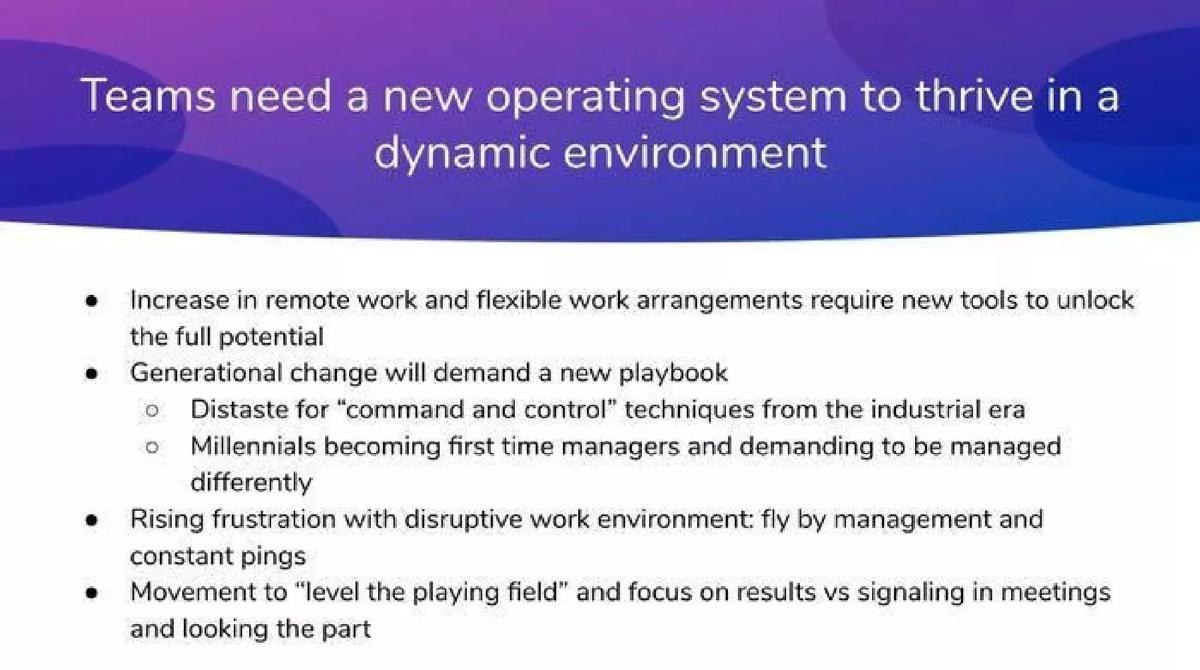
- The deck positions the product as a 'new operating system' for teams to thrive in dynamic environments (Slide 3).
- It identifies 'one-on-ones' as the primary operational building block that currently lacks standardization (Slide 4).
- The presentation uses a direct 'Old Way' vs. 'WorkPatterns Way' comparison across four categories: One-on-ones, Performance Reviews, Recognition, and Communication (Slides 6-7).
- The Go-To-Market strategy is a three-step 'Bottoms Up' approach starting with free trials for managers (Slide 8).
- Traction is demonstrated through 'Weekly Active Uniques' and 'Daily Active Uniques' charts showing growth from September to November (Slide 9).
- The deck highlights early pilot success with major enterprise logos including Adobe, Dialpad, GitHub, and MIXT (Slide 9).
- The team slide emphasizes previous experience at high-growth companies like AdRoll, Optimizely, and Etsy (Slide 10).
- There is a total absence of a financial 'Ask' slide, valuation, or detailed use of funds within these 10 slides.
The Narrative-First Seed Deck
The Worklete (WorkPatterns) deck is a study in brevity. At only 10 slides, it avoids the common pitfall of over-explaining technical architecture or providing bloated financial models that are often speculative at the Seed stage. Instead, it focuses on a cultural shift: the transition from 'command and control' industrial-era management to a results-oriented, asynchronous remote work environment. This teardown follows the deck's progression from high-level vision to the specific team capable of executing it.
Slides 1-2: Vision and Mission
Slide 1 is a minimalist title slide featuring the 'workpatterns' logo against a blue and purple gradient background. There is no tagline or date, keeping the focus entirely on the brand identity.
Slide 2 delivers the mission statement: "Empowering teams to work more effectively, transparently, and enjoyably by making management best practices automatic." This slide sets the stage for a product that isn't just a tool, but a facilitator of 'best practices,' suggesting an embedded consultancy or coaching element within the software.
Slides 3-4: The Macro Shift and The Problem Space
Slide 3 , titled "Teams need a new operating system to thrive in a dynamic environment," outlines the 'Why Now' of the investment. It cites four key drivers: the increase in remote work, generational change (Millennials becoming first-time managers), frustration with 'fly by management' and constant pings, and a movement toward 'leveling the playing field' based on results rather than meeting presence. This slide successfully connects the product to broader labor trends.
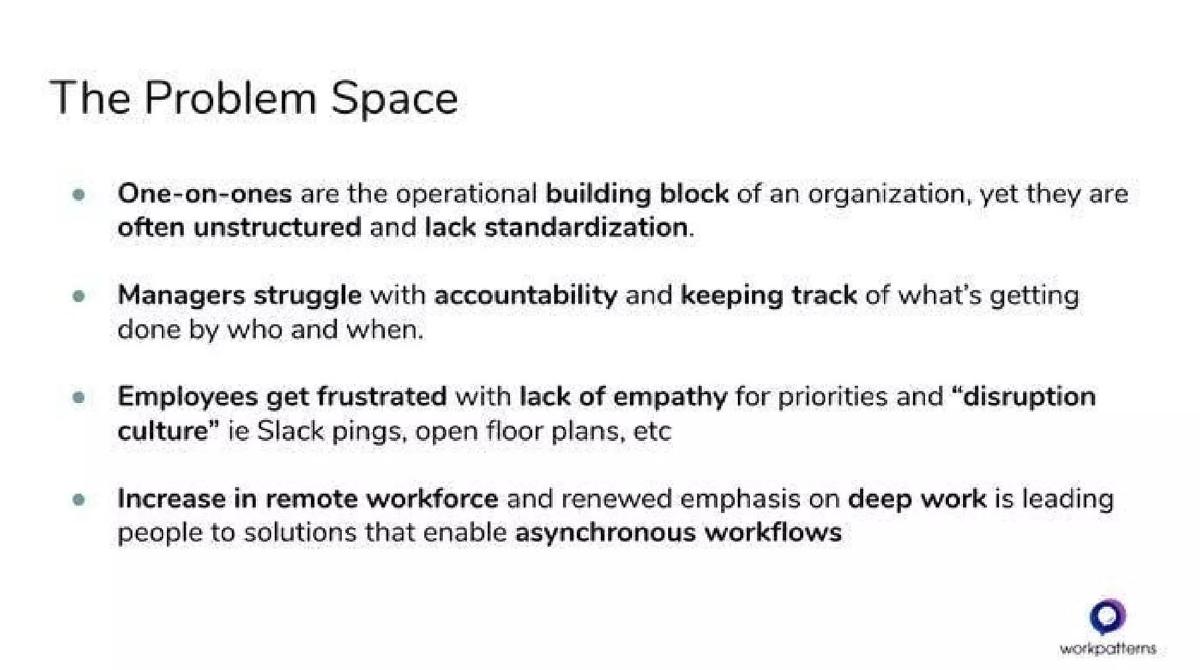
Slide 4 narrows the focus to "The Problem Space." It identifies one-on-ones as the "operational building block of an organization" but notes they are currently unstructured. It highlights a lack of accountability for managers and a 'disruption culture' (specifically naming Slack pings and open floor plans) that frustrates employees. This slide is critical because it identifies the specific pain point—the one-on-one meeting—that the product intends to own.
Slide 5: The Product Demo
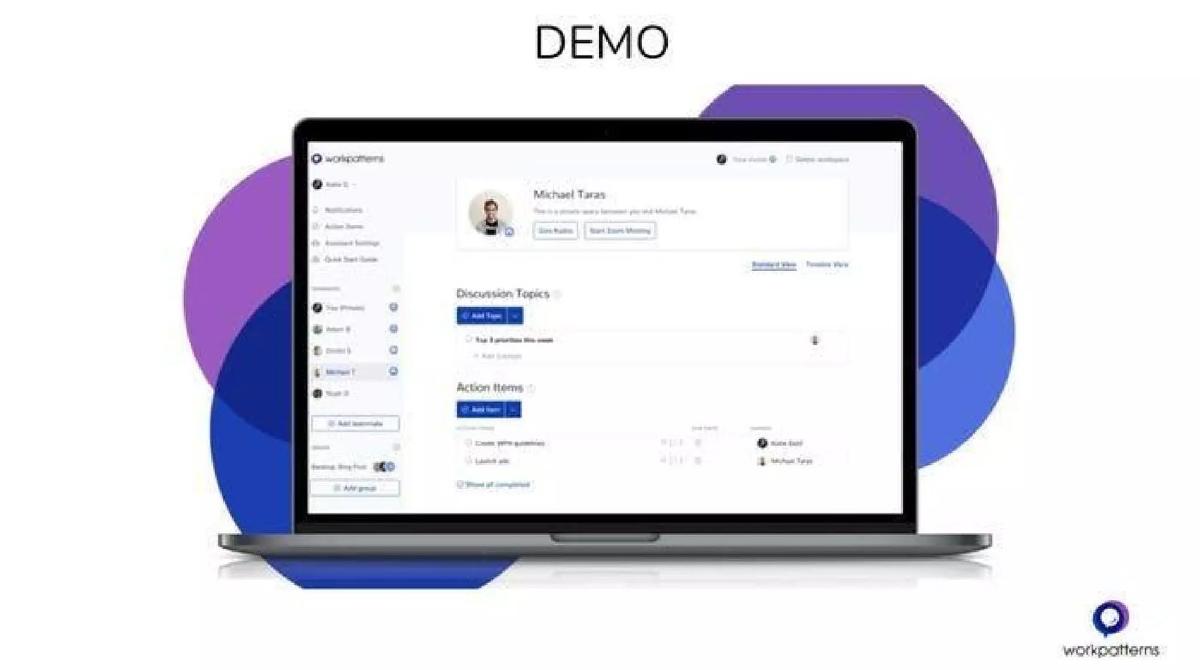
Slide 5 is a simple "DEMO" slide featuring a laptop mockup of the WorkPatterns interface. The UI shown includes sections for "Discussion Topics" and "Action Items," with a sidebar for team members. It visualizes the solution mentioned in the previous slide, showing a clean, structured environment for those previously 'unstructured' one-on-ones.
Slides 6-7: The 'Old Way' vs. The 'WorkPatterns Way'
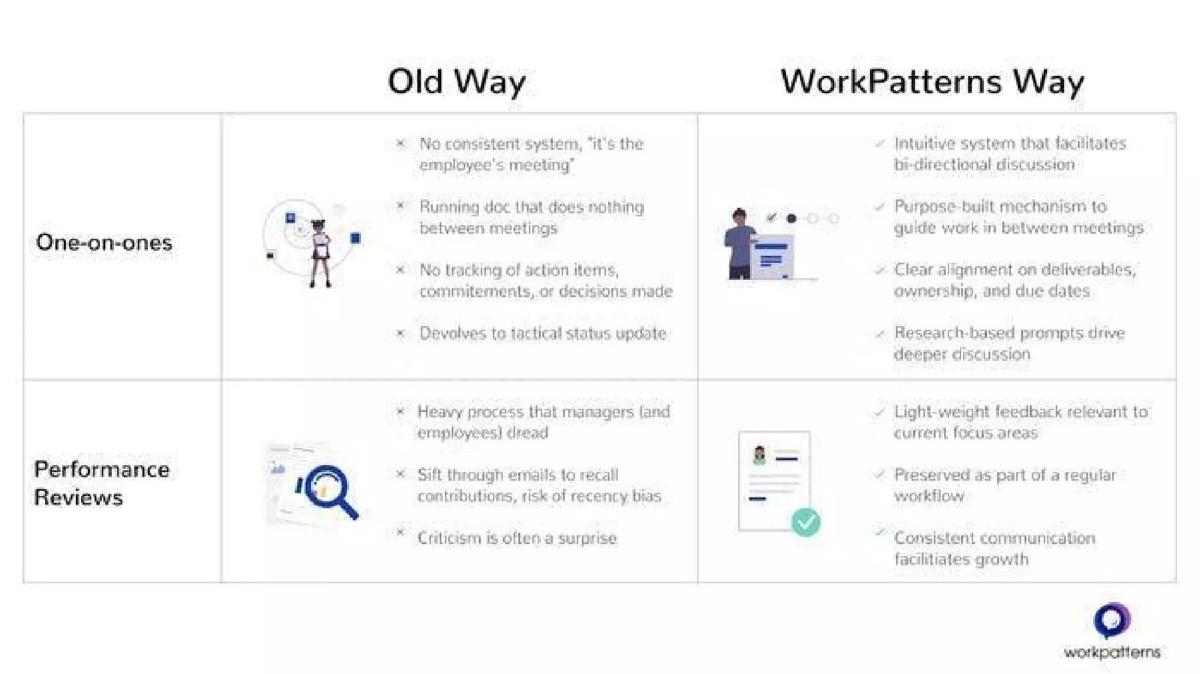
These two slides function as the competitive and value proposition analysis. Slide 6 compares One-on-ones and Performance Reviews. It characterizes the 'Old Way' of one-on-ones as a "running doc that does nothing between meetings" and performance reviews as a "heavy process that managers (and employees) dread." The 'WorkPatterns Way' promises a "purpose-built mechanism" and "light-weight feedback relevant to current focus areas."
Slide 7 continues this comparison for Recognition and Communication. It argues that recognition is currently "ad hoc and favors assertive personalities," whereas WorkPatterns offers a "level playing field focused on results." For communication, it pits "real-time noise" against "asynchronous, enabling of deep work and focus." By framing the product as the antidote to 'noise' and 'bias,' the deck appeals to modern HR sensibilities.
Slide 8: Go-To-Market Strategy
Slide 8 details a "Bottoms Up Go To Market" strategy. It is a simple three-step circular flow: 1) Manager pilots with 2-3 reports; 2) Manager rolls out to the full team; 3) Manager and ICs share horizontally for cross-functional meetings. This indicates a product-led growth (PLG) model where the software spreads organically through an organization rather than requiring a top-down enterprise sales cycle from day one.
Slide 9: Traction and Validation
Slide 9 provides the data to back up the narrative. Titled "Initial Traction: Successful pilots with newer cohorts more engaged," it displays two charts: Weekly Active Uniques and Daily Active Uniques. The weekly chart shows a steady climb from late September through early November. Below the charts, the deck displays logos for Adobe, Dialpad, GitHub, and MIXT, signaling that the product is already being tested within high-profile, tech-forward organizations.
Slide 10: The Team
Slide 10 , "Experienced Founding Team with Diverse Skill Sets," closes the deck. It lists five key members: Adam Berke (CEO), Dmitri Skjorshammer (Co-founder), Noah Duncan (Co-founder), Michael Taras (Full Stack Engineer), and Katie Rinkevich (Head of Design). The slide uses logos from NextRoll, AdRoll, RollWorks, Alto, Optimizely, and Daily Kos to establish credibility. The emphasis here is on a team that has already built and scaled successful tech products.
What Works in This Deck
Clear Problem Identification: By focusing on the 'one-on-one' as the core unit of work, the deck makes a vague concept (management software) very tangible. · The 'Old Way' vs. 'New Way' Framework: This is a highly effective way to communicate value without needing a complex feature list. It focuses on the emotional and operational outcomes for the user. · Logo Authority: For a Seed round, having pilots with Adobe and GitHub (Slide 9) provides massive de-risking for investors. · Pedigree: The team slide (Slide 10) uses recognizable logos to prove they have the experience to build an enterprise-grade platform.
What Is Missing
The Ask: There is no slide stating how much money is being raised, the terms, or the specific milestones the team intends to hit with the capital. · Market Sizing: The deck assumes the investor agrees the market for 'management software' is large, but it provides no TAM (Total Addressable Market) figures. · Business Model: While it mentions a 'free trial' on Slide 8, there is no mention of pricing tiers, seat costs, or expected ACV (Annual Contract Value). · Competition: The deck ignores existing players in the space (like 15Five or Lattice), choosing instead to compete against 'the old way' (docs and emails) rather than direct software competitors.
What a Founder Should Copy
The 10-Slide Limit: This deck proves you can tell a compelling story and raise millions without a 30-page presentation. · Visualizing the Shift: Use a comparison table (like Slides 6 and 7) to show how your product changes the status quo. It is often more effective than a standard 'Features' slide. · Focus on the 'Why Now': Slide 3 does an excellent job of explaining why the world has changed in a way that makes this product necessary today, rather than five years ago. · Clean Design: The consistent use of the blue/purple palette and minimalist layouts keeps the focus on the text and the data.
Frequently asked questions
- How much did Worklete raise with this deck?
- According to catalogue facts, Worklete raised $7,900,000 in 2015 during its Seed stage. The company listing also mentions securing $8M from investors including Trinity Ventures, Launch Capital, RiverPark Ventures, and Kapor Capital.
- What is the core problem the deck aims to solve?
- The deck targets the lack of structure in management, specifically citing that one-on-one meetings are often unstructured and lack standardization. It also addresses 'disruption culture' caused by constant pings and the shift toward remote work requiring asynchronous workflows as detailed on Slide 4.
- Does the deck include financial projections?
- No. The 10-slide deck contains no revenue figures, burn rates, or future financial projections. It focuses entirely on product-market fit, the management narrative, and early engagement metrics from pilots.
- What is the 'Bottoms Up' Go-To-Market strategy mentioned?
- Slide 8 outlines a three-step process: 1) A manager pilots the tool with 2-3 reports via a free trial; 2) The manager rolls it out to the full team; 3) The manager and individual contributors share the tool horizontally for cross-functional meetings.
- Who are the key team members listed?
- The founding team includes Adam Berke (CEO, formerly of AdRoll), Dmitri Skjorshammer (Co-founder, formerly of Clovi), Noah Duncan (Co-founder, PhD from UCLA), Michael Taras (Full Stack Engineer), and Katie Rinkevich (Head of Design, formerly of Etsy).