WorkPatterns raised $9.6M in 2018 with a deck that prioritizes narrative over dense data. The presentation identifies a specific cultural shift—the rise of remote work and the millennial manager—to justify a new 'operating system' for teams. Rather than selling a broad HR tool, they anchor their value proposition on the 'One-on-One' meeting, framing it as the essential unit of work. The deck excels at 'Old Way vs. New Way' comparisons, making a clear case for how their software replaces unstructured documents and disruptive pings with bi-directional accountability. While it lacks a formal 'As…
Key takeaways
- The deck identifies the 'One-on-One' as the primary operational building block of an organization on Slide 4.
- It leverages a macro-trend shift, citing a move away from 'command and control' industrial-era management on Slide 3.
- The product is positioned as an 'operating system' that makes management best practices automatic, as stated on Slide 2.
- A two-slide 'Old Way vs. WorkPatterns Way' comparison (Slides 6 and 7) clearly articulates the transition from ad-hoc recognition to results-focused visibility.
- The Go-To-Market strategy is strictly 'Bottoms Up,' starting with a 2-3 person pilot before horizontal expansion, detailed on Slide 8.
- Initial traction is demonstrated through weekly and daily active unique user charts on Slide 9, featuring logos like Adobe, GitHub, and Dialpad.
- The team slide (Slide 10) highlights significant pedigree, including a CEO who was previously President/CMO and Co-Founder of AdRoll.
- The deck completely omits a financial 'Ask' slide, valuation, or use of funds breakdown.
Executive Summary: The Narrative of the Modern Manager
WorkPatterns entered the market in 2018 with a clear thesis: the way we manage people is an outdated relic of the industrial era. Their 10-slide deck is a focused argument for a new 'operating system' for teams. By raising $9.6M, the company proved that investors were hungry for tools that solve the 'soft' problems of management—accountability, feedback, and recognition—through 'hard' software workflows. The deck is notable for its brevity and its reliance on the team's significant past successes to carry the weight of the investment thesis.
Slides 1-2: The Vision and Mission
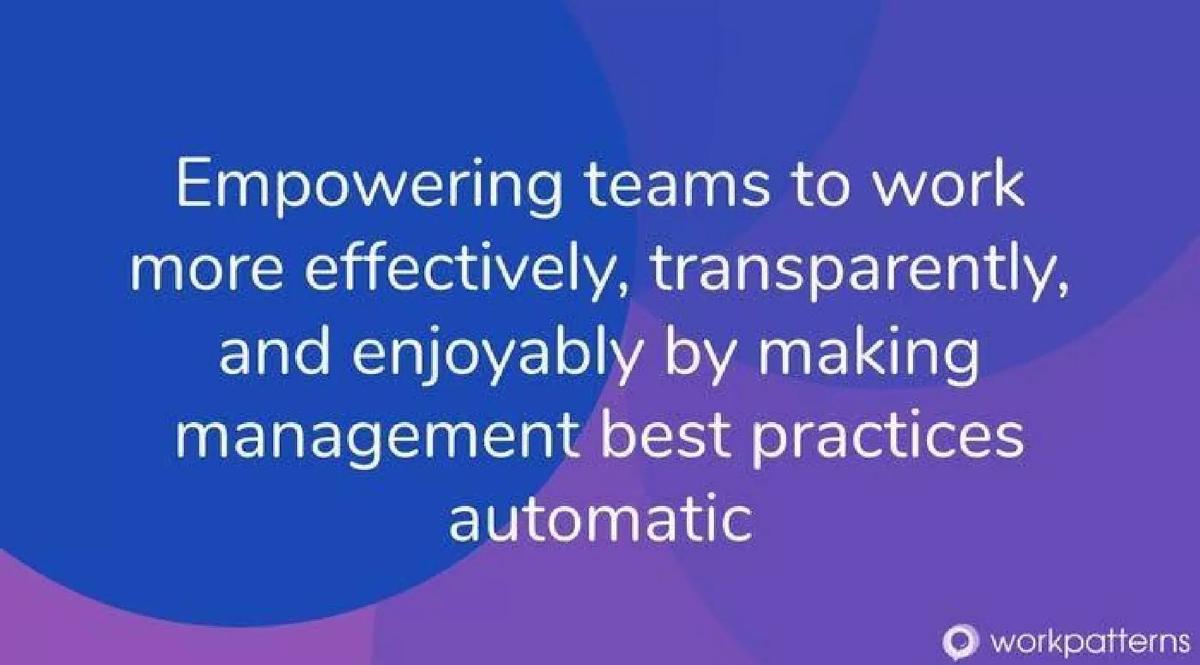
The deck opens with a minimalist title slide featuring the WorkPatterns logo. Slide 2 immediately follows with a high-level mission statement: "Empowering teams to work more effectively, transparently, and enjoyably by making management best practices automatic." This slide sets the tone for the entire presentation. It doesn't lead with features; it leads with a promise of automation for a traditionally manual and inconsistent human process.
Slide 3: The Macro Shift
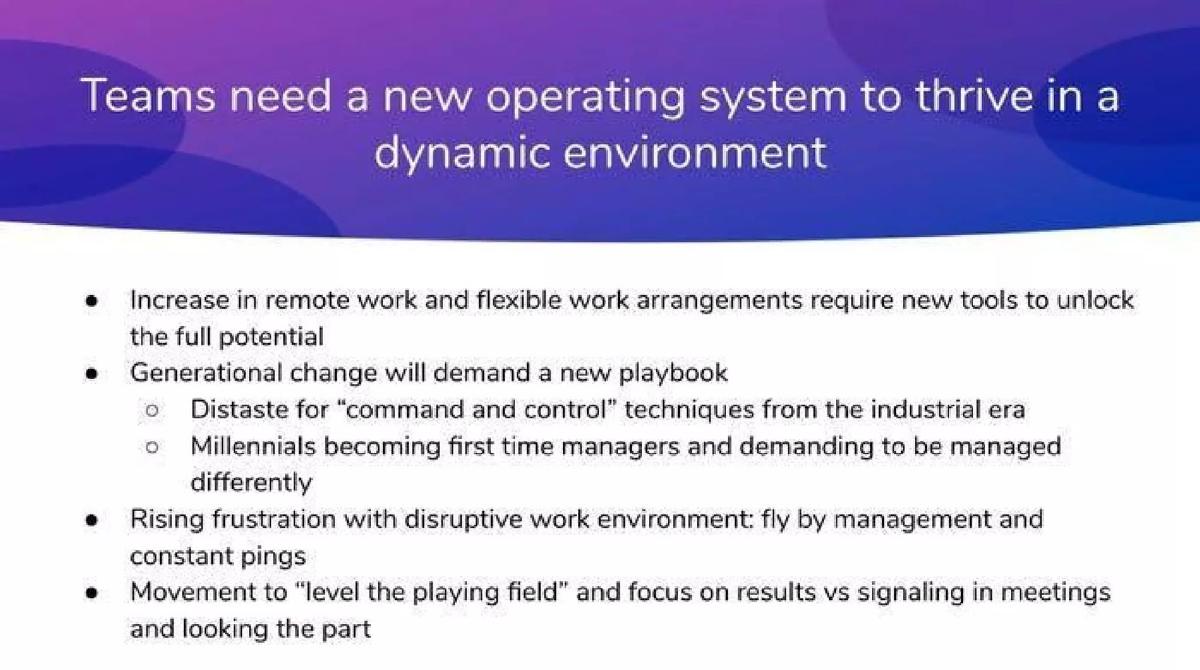
Slide 3, titled "Teams need a new operating system to thrive in a dynamic environment," establishes the 'Why Now.' The company identifies four key drivers:
Increase in remote work and flexible arrangements. · Generational change (Millennials becoming first-time managers). · Frustration with 'disruption culture' and constant pings. · A shift from 'signaling' in meetings to a focus on results.
This slide is critical because it frames WorkPatterns not just as a tool, but as a necessary response to a global shift in work culture.
Slide 4: Defining the Problem Space
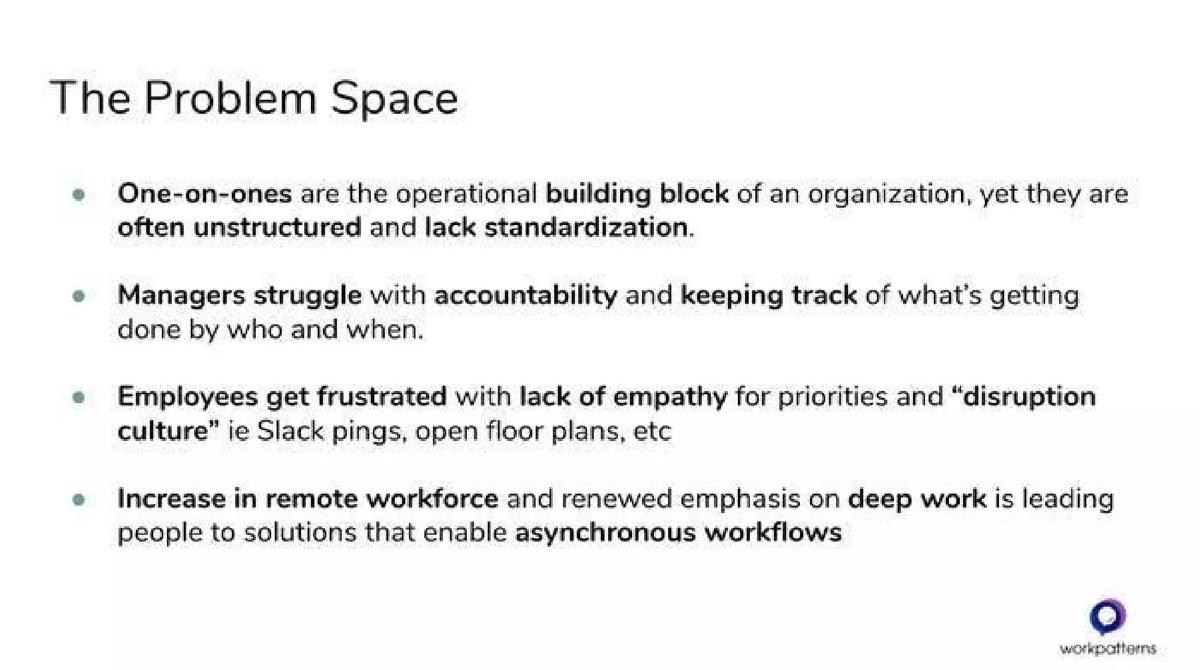
Slide 4 narrows the focus to specific pain points. It identifies "One-on-ones" as the "operational building block of an organization," yet notes they are often unstructured. It highlights the manager's struggle with accountability and the employee's frustration with a lack of empathy for priorities. By calling out 'Slack pings' and 'open floor plans' as sources of disruption, the deck positions WorkPatterns as the antidote to the noise of modern office life.
Slide 5: The Product Demo
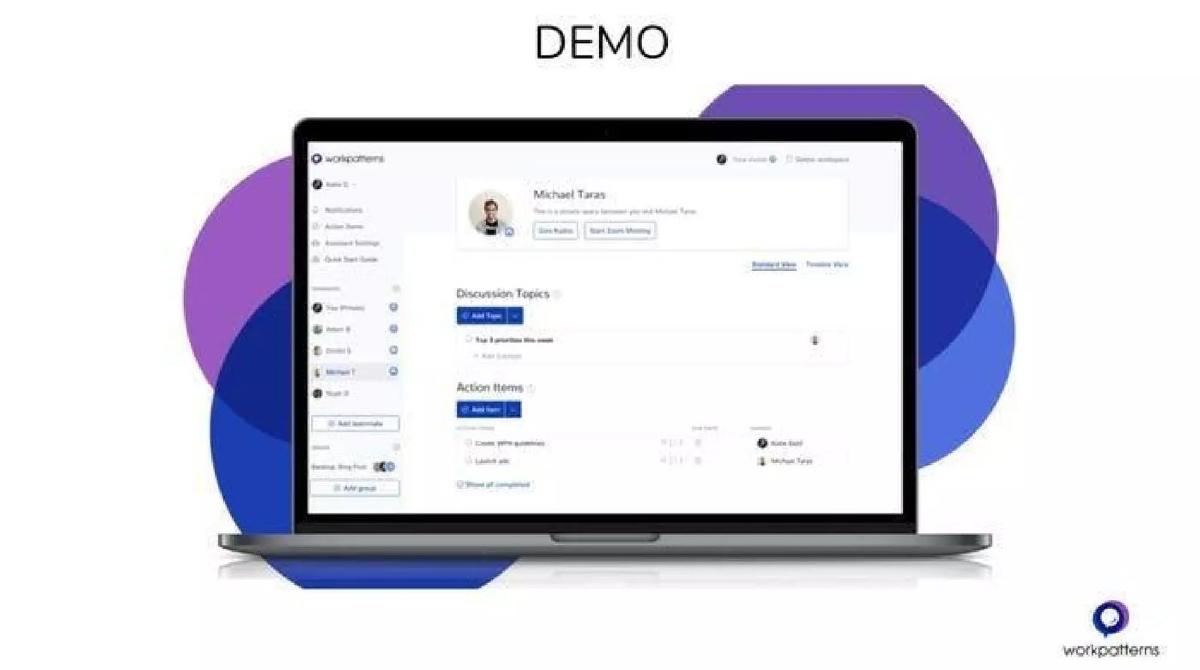
Slide 5 is a simple "DEMO" slide featuring a mockup of the platform on a laptop. The interface shown is clean, focusing on 'Discussion Topics' and 'Action Items.' It visualizes the private space between a manager (Michael Taras) and a report, showing how the software facilitates the 'One-on-One' structure mentioned in the previous slide. This is the only visual representation of the product in the deck.
Slides 6-7: The 'Old Way' vs. The 'WorkPatterns Way'
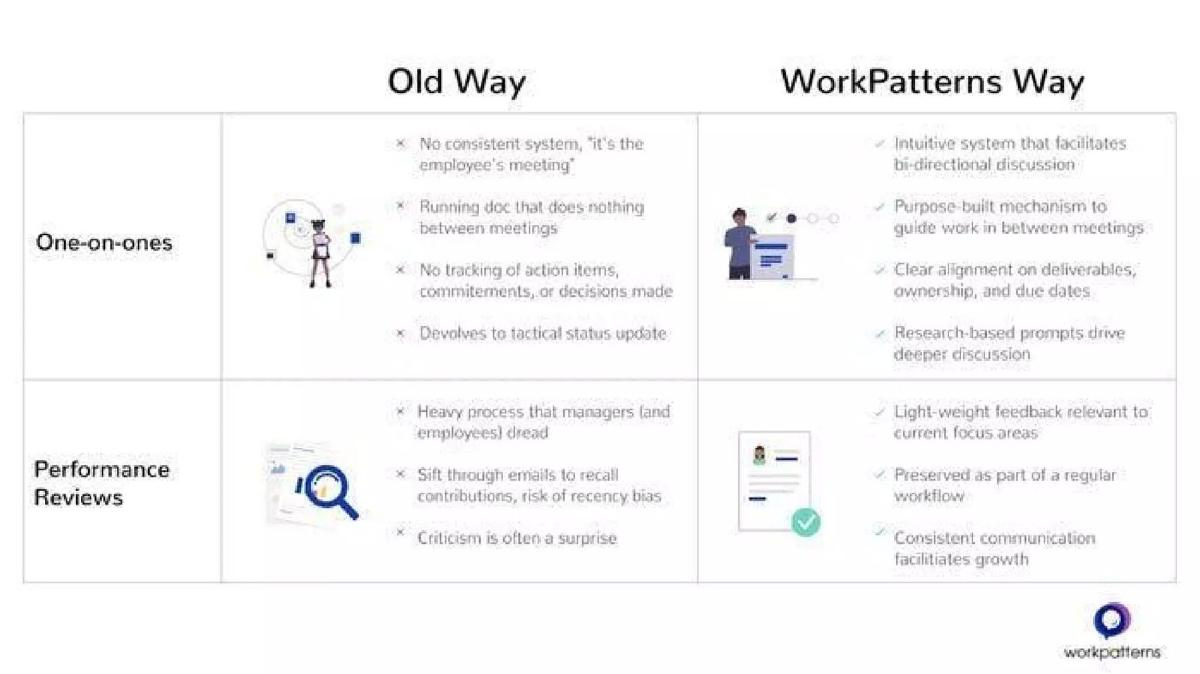
These two slides are the core of the value proposition. Slide 6 compares One-on-ones and Performance Reviews. It claims the 'Old Way' for One-on-ones is a "running doc that does nothing between meetings," while the 'WorkPatterns Way' is a "purpose-built mechanism to guide work in between meetings." For Performance Reviews, it contrasts a "heavy process that managers and employees dread" with "light-weight feedback relevant to current focus areas."
Slide 7 continues this comparison for Recognition and Communication. It argues that recognition is currently "ad hoc and favors assertive personalities," whereas WorkPatterns creates a "level playing field focused on results, not just the loudest voice." For communication, it pits "disruptive pings" against "asynchronous [workflows], enabling deep work and focus." These slides effectively turn abstract management concepts into concrete software benefits.
Slide 8: The Go-To-Market Strategy
Slide 8 outlines a "Bottoms Up Go To Market" strategy in three steps:
1. Manager pilots with 2-3 reports as part of a free trial. · 2. Manager rolls out to full team (with feature gates TBD). · 3. Manager and ICs share horizontally for cross-functional meetings.
This strategy emphasizes low-friction entry and viral expansion within an organization, a classic SaaS growth playbook.
Slide 9: Initial Traction
Slide 9 provides the data to back up the narrative. It shows two charts: "Weekly Active Uniques (Logged In Only)" and "Daily Active Uniques (Logged In Only)." Both charts show a significant upward trend starting in late October. At the bottom of the slide, the company displays logos for Adobe, Dialpad, GitHub, and Mixt , providing high-tier social proof that their 'bottoms-up' strategy is working at scale.
Slide 10: The Team
The final slide, "Experienced Founding Team with Diverse Skill Sets," is perhaps the most important for a $9.6M round. It features:
Adam Berke (CEO): Previously President/CMO and Co-Founder of AdRoll. · Dmitri Skjorshammer (Co-founder): Previously Founder of Clovi. · Noah Duncan (Co-founder): PhD in Computer Science from UCLA. · Michael Taras (Full Stack Engineer): Previously at Nitid and Daily Kos. · Katie Rinkevich (Head of Design): Previously at Alto and Etsy.
The inclusion of logos like NextRoll, AdRoll, RollWorks, Alto, Optimizely, and Daily Kos at the bottom reinforces the team's pedigree as 'accomplished operators' mentioned in the catalogue listing.
What Works in This Deck
The 'Unit of Work' Focus: By identifying the One-on-One as the 'building block' of an organization, WorkPatterns avoids the trap of being a 'generic HR tool.' They own a specific, recurring event in every employee's life.
The Contrast Tables: Slides 6 and 7 are masterclasses in positioning. They don't just list features; they attack the status quo (running docs, Slack pings, hallway thumbs-up) and offer a structured alternative.
The Pedigree: For a 10-slide deck, the team slide does a massive amount of heavy lifting. Having a co-founder of a successful company like AdRoll immediately de-risks the investment for VCs.
What Is Missing from This Deck
The Ask: There is no slide detailing how much money is being raised, the valuation, or how the funds will be spent. While this information is often handled in conversation, its absence in the deck leaves the reader without a sense of the round's scale.
Business Model/Pricing: The deck mentions 'feature gates TBD' on Slide 8, but it never explains how the company actually makes money. Is it per-seat, per-manager, or an enterprise license?
Market Size: There is no TAM/SAM/SOM analysis. The deck assumes the investor already understands that 'management software' is a massive category.
Competition: The deck operates in a vacuum. It does not mention competitors like Lattice, 15Five, or even general-purpose tools like Notion or Google Docs, which are the 'Old Way' they are trying to replace.
What a Founder Should Copy
The 'Why Now' Slide: Slide 3 is an excellent example of how to link a product to broad cultural shifts (remote work, millennial managers). It makes the product feel inevitable rather than just 'nice to have.'
The Bottoms-Up Visual: Slide 8 clearly explains how the product spreads. If you have a product-led growth (PLG) story, use a simple 1-2-3 step graphic to show how you land and expand.
Minimalist Design: The deck uses a consistent color palette and avoids clutter. It allows the text—and the logos of the companies using the product—to stand out.
Social Proof Placement: Placing the logos of Adobe and GitHub on the traction slide (Slide 9) is much more effective than having a separate 'Our Customers' slide. It ties the logos directly to the growth data.
Frequently asked questions
- What is the primary problem WorkPatterns aims to solve?
- According to Slide 4, the company targets the lack of structure in one-on-one meetings, which they call the 'operational building block' of organizations. They address the frustration managers feel regarding accountability and the 'disruption culture' employees face from constant pings and open floor plans. The deck argues that current tools fail to support deep work and asynchronous workflows.
- How does WorkPatterns differentiate itself from traditional management methods?
- Slides 6 and 7 use a direct comparison table. The 'Old Way' is characterized by running docs that do nothing between meetings, tactical status updates, and feedback that is often a surprise. The 'WorkPatterns Way' offers a purpose-built mechanism to guide work between meetings, research-based prompts for deeper discussion, and lightweight feedback that is preserved as part of a regular workflow.
- What is the company's growth strategy?
- WorkPatterns employs a 'Bottoms Up Go To Market' strategy, as shown on Slide 8. The process involves three steps: first, a manager pilots the tool with 2-3 reports during a free trial; second, the manager rolls it out to the full team; and third, the manager and individual contributors share the tool horizontally for cross-functional meetings.
- Is there evidence of product-market fit in the deck?
- Slide 9 presents 'Initial Traction' through two line charts showing growth in Weekly Active Uniques and Daily Active Uniques since September 16th. The slide also displays logos for Adobe, Dialpad, GitHub, and Mixt, suggesting that the platform had already gained a foothold in high-profile technology companies at the time of the pitch.
- Who are the key members of the founding team?
- Slide 10 lists a highly experienced team: CEO Adam Berke (formerly Co-Founder of AdRoll), Dmitri Skjorshammer (formerly Founder of Clovi), Noah Duncan (PhD in Computer Science from UCLA), Michael Taras (Full Stack Engineer), and Katie Rinkevich (Head of Design, formerly of Etsy). This level of experience likely compensated for the deck's lack of financial detail.