Workep’s pitch deck centers on a 'platform-native' strategy, aiming to become the default project management layer for the millions of users already within the Google Apps for Work ecosystem. By integrating directly with tools like Drive, Gmail, and Calendar, Workep attempts to solve the friction of manual task coordination. The deck highlights a low-price strategy ($0.99 to $1.99 per user) and a distribution model heavily reliant on Google’s own channels, including the Apps Marketplace and Authorized Resellers. While the product vision is clear and the market size is framed through the lens…
Key takeaways
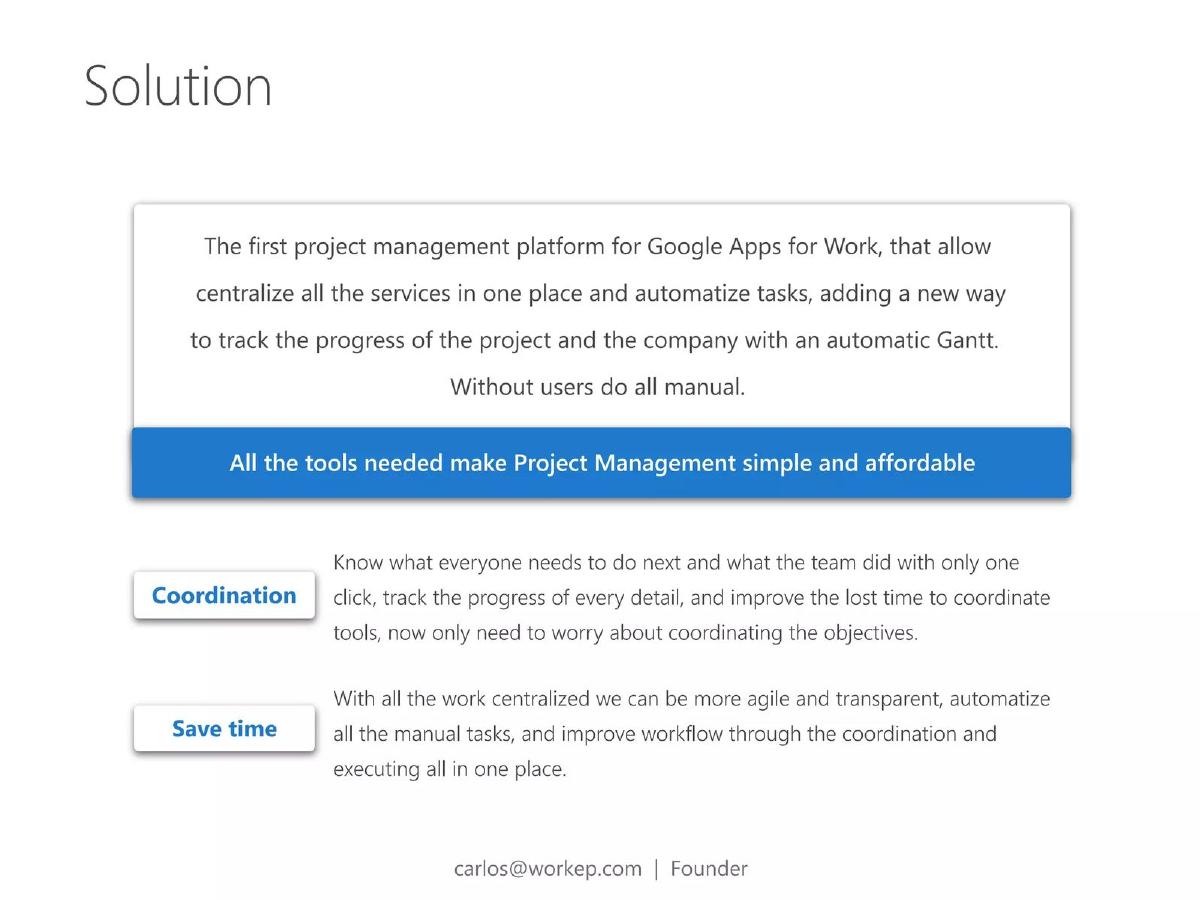
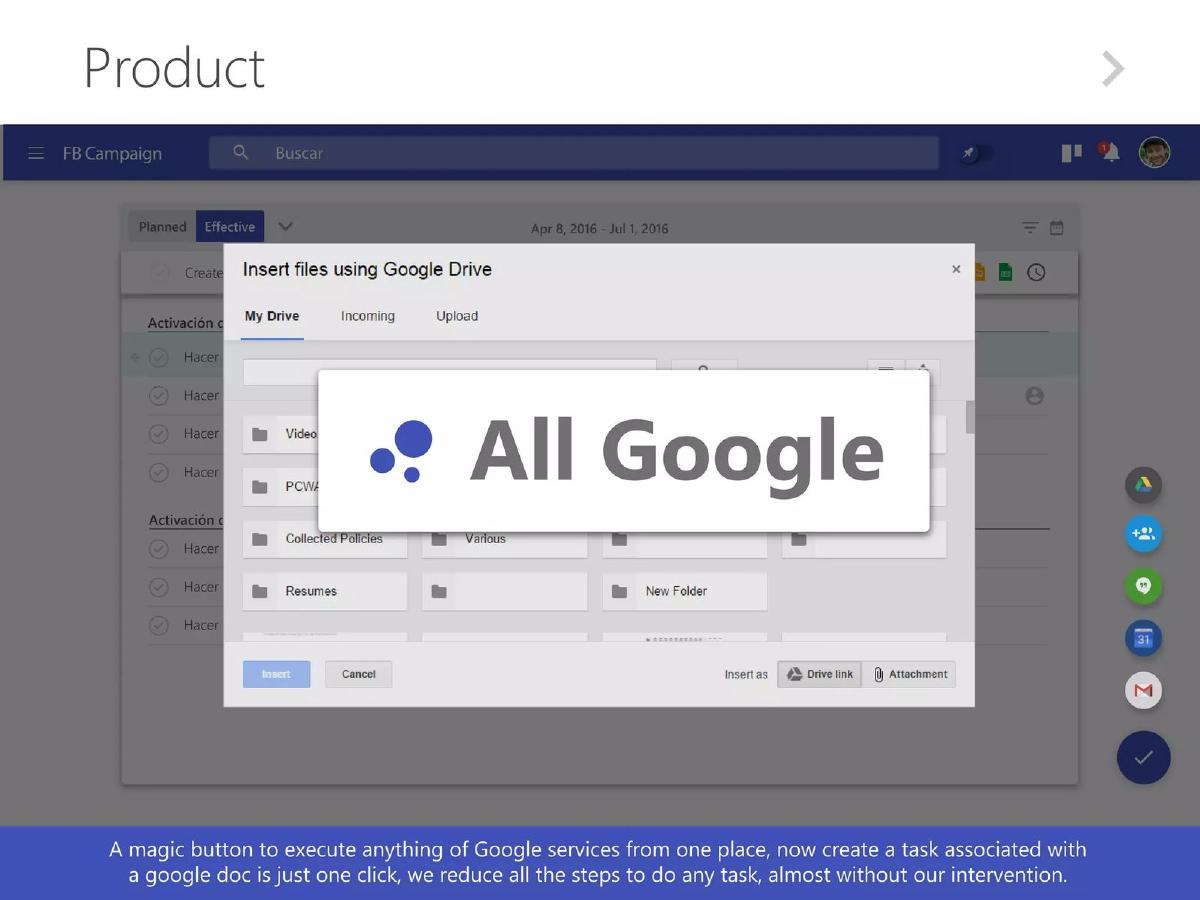
- Workep defines itself as the first project management platform designed to centralize Google Apps for Work services in one place (Slide 2).
- The product features an 'automatic Gantt' chart designed to track progress across all projects with a visual interface (Slide 3).
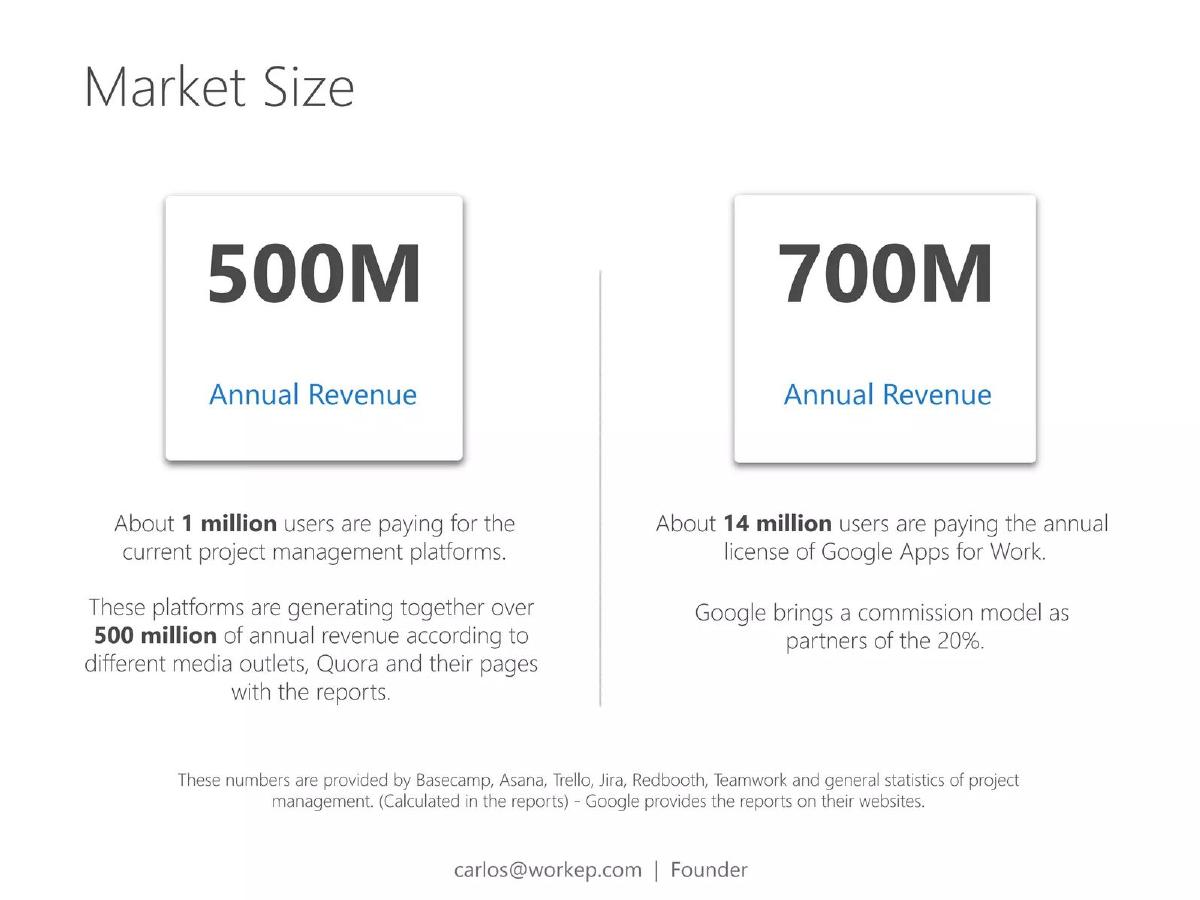
- Market size is estimated by comparing 1 million current project management users to 14 million Google Apps for Work licensed users (Slide 4).
- The distribution strategy relies on three pillars: Events (Google Launchpad), Partnerships (Google Resellers), and Marketplaces (Slide 5).
- Pricing is set aggressively low at $0.99 and $1.99 per user to maintain a competitive advantage (Slide 6).
- The roadmap outlines a 10-month plan, moving from initial development to distribution with Google Resellers in the USA, UK, and LATAM (Slide 7).
- The deck omits a dedicated team slide, current user traction metrics, and a specific funding request.
- Design-wise, the platform utilizes Google's 'Material Design' standards to ensure a seamless user experience for existing Google users (Slide 6).
Executive Summary
Workep is a project management solution built to live inside the Google Apps for Work (now Google Workspace) ecosystem. The pitch deck focuses on the inefficiency of using disparate tools and proposes a centralized hub that automates task tracking through a visual Gantt interface. While the deck is visually clean and follows a logical flow, it is heavily focused on the 'what' and 'how' of the product, leaving significant gaps regarding the 'who' (team) and the 'how much' (funding ask).
Slide 1: Title Slide
The cover slide establishes the brand identity immediately. The Workep logo is flanked by icons for Google Drive, Docs, Gmail, and Calendar, visually reinforcing the tagline: "The Google Apps project management." The contact information identifies 'carlos@workep.com' as the Founder. It is a functional, minimalist start that clearly defines the niche.
Slide 2: The Solution
Workep defines its solution as the "first project management platform for Google Apps for Work." The core value drivers identified are Coordination and Save time . The slide claims to centralize all services in one place and "automatize tasks" using an automatic Gantt chart. The language is slightly unpolished ("Without users do all manual"), but the message that it simplifies and makes project management affordable is clear.
Slide 3: Product Showcase
This slide provides a high-level UI mockup of the platform. It highlights the "Revolutionary automatic and visual Gantt" chart. The interface appears to borrow heavily from Google’s Material Design language, featuring a red header bar and clean white cards. The mockup shows project progress bars for various tasks (e.g., "Bankity iOS App") and team member avatars, suggesting a collaborative environment. The emphasis here is on ease of control and visibility.
Slide 4: Market Size
Workep uses a comparative method to illustrate market potential. On the left, they cite 500M in annual revenue generated by 1 million users across current platforms like Basecamp, Asana, and Trello. On the right, they point to 14 million users paying for Google Apps for Work licenses, representing 700M in annual revenue (likely referring to the potential commission or partner revenue). They cite Quora and general reports as sources, which is somewhat informal for a professional deck, but it effectively argues that the 'Google-only' market is larger than the current 'Project Management-only' market.
Slide 5: Market Adoption
The go-to-market strategy is divided into three channels: Events , Partnerships , and Marketplace . They list heavy-hitting logos like Google Launchpad, Google I/O, and TechCrunch Disrupt under events. For partnerships, they specifically target the Google Apps Authorized Reseller Program . For marketplace presence, they aim for the Google Apps Marketplace and review sites like G2 Crowd and TrustRadius. This slide shows a sophisticated understanding of how to scale within a specific ecosystem.
Slide 6: Competitive Advantages
1st to Market: Claiming to be the first focused solely on Google Apps integration. · Price: Stating a price point of USD $0.99 and 1.99 for a user . · Progress: The automatic Gantt chart. · Ease of Use: Utilizing Google’s Material Design to reduce the learning curve. · Focus: Solving problems specifically for Google users. · Future: Plans to integrate other Google services like Analytics and AdWords.
The pricing strategy is the most notable takeaway here, suggesting a play for the low-end of the market that larger competitors might ignore.
Slide 7: Times and Strategies
The final slide in the set is a roadmap. It outlines a 10-month trajectory:
1M - 3M: Development stages and testing (20-day bug fix periods). · 3M: Product Ready. · 6M: Distributing with Google Resellers USA. · 8M: Distributing with Google Resellers UK. · 10M: Distributing with Google Resellers LATAM.
This timeline is aggressive, moving from 'Product Ready' to international distribution in just seven months. It lacks specific milestones regarding user count or revenue targets, focusing instead on distribution logistics.
What Works
Ecosystem Alignment: The deck does an excellent job of tethering the company's success to Google. By using Google’s design language and targeting Google’s resellers, they present a clear, low-friction path to market. Investors who believe in the growth of the Google Workspace ecosystem would find this compelling. Visual Clarity: The slides are not cluttered. The use of white space and consistent branding makes the deck easy to digest quickly, which is essential for early-stage pitches.
What is Missing
The Team: There is no slide introducing the founders or advisors. In early-stage investing, the team is often more important than the product. Without knowing who is building this, it is impossible to assess execution risk. Traction: The deck is forward-looking. There are no mentions of current beta users, waitlist numbers, or pilot programs. The Ask: A fundraising deck must eventually ask for money. This deck omits how much capital is needed and what that capital will achieve (e.g., hiring developers, marketing spend). Unit Economics: While they mention a $0.99 price point, they don't explain the Cost of Customer Acquisition (CAC) or the Lifetime Value (LTV), which is critical for a low-price SaaS model.
Founder's Takeaway
Founders should look at this deck as a model for niche positioning . Workep doesn't try to beat Asana at everything; it tries to beat Asana specifically for people who love Google. However, founders must avoid the 'missing slides' seen here. Always include a team slide that highlights relevant expertise and a clear financial ask. If you are building on top of a giant (like Google or Salesforce), ensure you also address the platform risk—what happens if Google builds this themselves? Workep’s deck is a strong start for a partnership discussion but needs more 'business meat' to be a successful fundraising tool.
Frequently asked questions
- What is Workep's primary value proposition?
- Workep aims to eliminate the manual effort required to coordinate between various Google tools. By centralizing Gmail, Drive, and Calendar into a single project management interface with automated Gantt charts, it promises to save time and improve team coordination. It positions itself as a 'native' feeling extension of the Google workspace rather than a standalone third-party tool.
- How does Workep plan to acquire customers?
- The strategy is almost entirely dependent on the Google ecosystem. They plan to leverage the Google Apps Marketplace for organic discovery, participate in Google-led events like Launchpad and I/O, and most notably, partner with Google Authorized Resellers to distribute the software in major regions like the USA, UK, and Latin America.
- What is the pricing model described in the deck?
- Workep lists a very low price point of $0.99 and $1.99 per user. This suggests a high-volume, low-margin strategy intended to undercut established competitors like Asana or Jira, which typically charge significantly more. The goal appears to be rapid adoption among small to medium businesses already paying for Google Apps.
- What are the biggest risks visible in this deck?
- The primary risk is 'platform dependency.' Because Workep is built specifically for Google Apps for Work, any changes to Google’s API, terms of service, or the introduction of a first-party Google project management tool could be catastrophic. Additionally, the deck lacks proof of current traction, making it unclear if the market actually wants this specific integration.
- Is there a clear investment 'Ask' in the presentation?
- No. The provided slides do not include a financial ask, valuation, or use of proceeds. The timeline on Slide 7 focuses on product development and distribution milestones rather than capital requirements. This suggests the deck might be intended for potential partners or early-stage incubator applications rather than a formal Series A round.